Mercedes F1’s 2023 Season: Toto Wolff Reflects on Highs, Lows, and the Strategic Value of P2
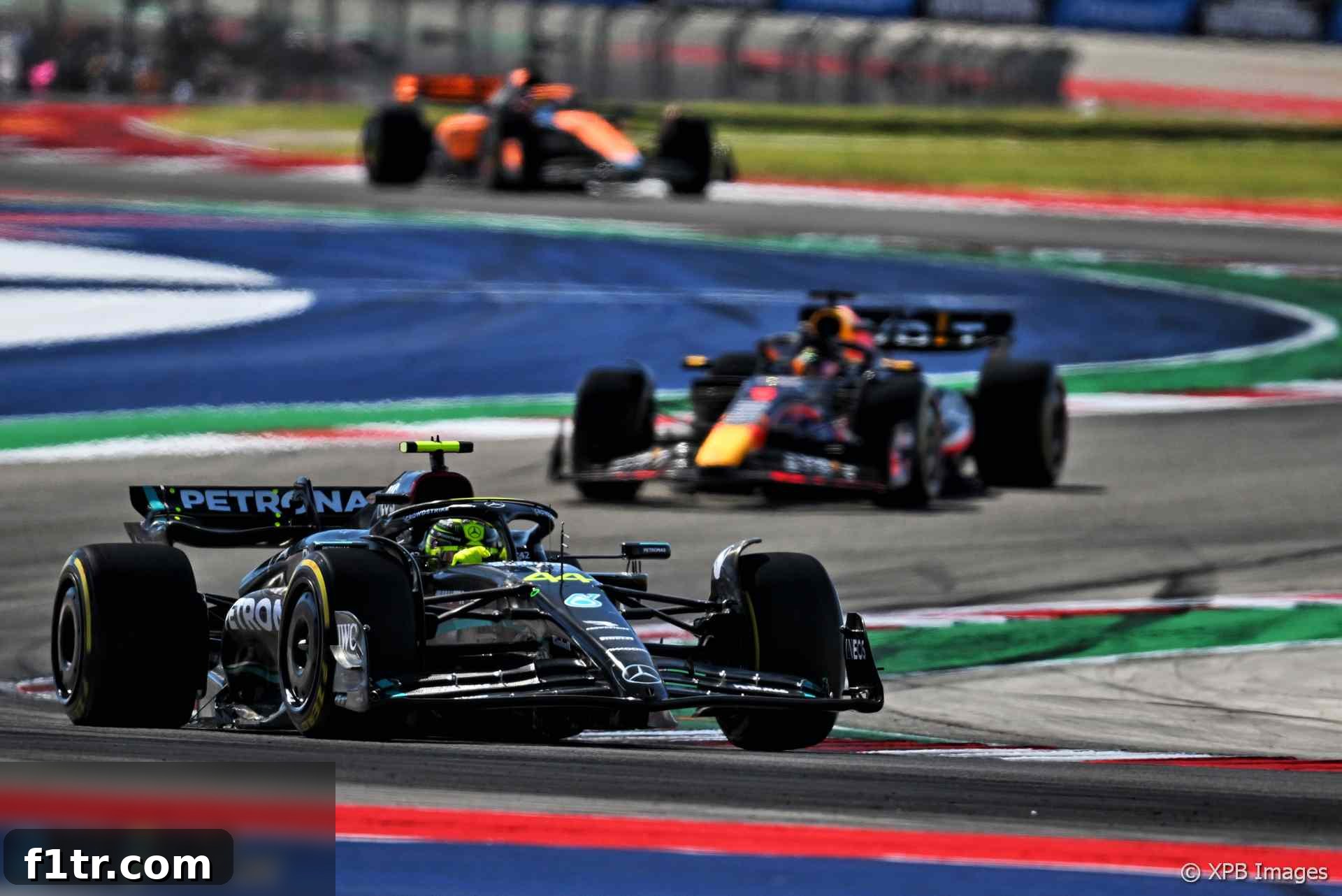
In a candid reflection on the challenging 2023 Formula 1 season, Mercedes-AMG Petronas F1 Team Principal and CEO Toto Wolff controversially identified the United States Grand Prix as their strongest performance, despite the race culminating in Lewis Hamilton’s disqualification. This seemingly paradoxical statement underscores the team’s unwavering focus on raw performance gains, even when overshadowed by regulatory setbacks.
Advert | Become a Supporter & go ad-free
Hamilton’s hard-fought second place at the Circuit of the Americas was tragically stripped due to excessive wear on his car’s underbody plank. This technical infringement, while costly in terms of championship points, could not diminish the palpable improvement in the W14’s performance. His teammate, George Russell, ultimately secured a fifth-place finish, making him the team’s sole classified participant from the event. The disqualification, stemming from a minor but critical breach of the FIA’s technical regulations concerning the car’s minimum ride height and plank wear, highlighted the razor-thin margins within which F1 teams operate, especially when pushing the limits of car setup for optimal speed and handling characteristics.
A Breakthrough in Austin: The New Floor’s Transformative Impact
Wolff openly admitted that his choice of the United States Grand Prix as the season’s pinnacle “might sound strange, because we got disqualified.” However, he emphasized that the team derived immense and genuine encouragement from the car’s competitive showing, which he largely attributed to a significant new floor upgrade introduced that weekend. This aerodynamic revision was a crucial step in understanding and rectifying the W14’s inherent limitations, particularly its sensitivity to ride height and the persistent porpoising issues that had plagued the team since the introduction of the new ground effect regulations in 2022. The new floor package demonstrably unlocked a greater performance window, allowing the car to operate more effectively in different phases of a lap.
“We brought an upgrade package that worked, the car was performing well, and we were hunting down the leader,” Wolff explained in a team-published video. This statement perfectly encapsulates Mercedes’ fundamental philosophy: prioritizing the development of raw pace over flawless, but potentially slower, execution, especially during a rebuilding phase. He further elaborated, “You could say, ‘well, you were disqualified for a car that was too low,’ but the genuine performance was there, and that was an enjoyable weekend.” For a team historically accustomed to dominating the sport, discovering genuine, unadulterated pace, even if momentarily, proved to be a more significant morale booster and a more valuable data point than a compliant yet uninspiring finish.
A critical aspect of the Austin weekend’s success was the long-awaited alignment between the wind tunnel data and the on-track performance – a persistent challenge for Mercedes in the recent past. Wolff underscored this by stating, “I’ve always said that I’d rather have a fast car that we haven’t tuned in the right way. Obviously, you need to finish, but that was the best weekend overall, seeing that the correlation between the wind tunnel and the track was good.” This crucial validation of their advanced simulation tools and development methodologies provided a vital foundation for future improvements. It offered a strong glimmer of hope that the team was finally converging on the correct car concept and understanding, a sentiment that resonated deeply within the engineering and design departments, fueling renewed optimism for the forthcoming seasons.
Hamilton’s Sprint Success and the Elusive Pursuit of Victory
While the main race tragically concluded in disappointment for Lewis Hamilton, he did secure a commendable second place in the sprint race held earlier that weekend – a result that, crucially, remained valid. This strong performance in the shorter format further underscored the raw potential of the upgraded W14. Throughout the challenging 2023 season, Mercedes achieved three other second-place finishes in various Grands Prix, consistently demonstrating the car’s ability to be a front-runner on its day. However, a significant benchmark was missed: they failed to secure a single race victory for the first time since the 2011 season. This unprecedented drought highlighted the immense challenge of competing against a dominant Red Bull Racing team, which often seemed to operate in a league of its own, setting new standards for performance and consistency.
Despite these sporadic strong performances and flashes of potential, the season was also frequently marked by moments of dashed expectations and unexpected struggles. “It’s difficult because there have been so many moments where we had high expectations and it didn’t pan out as we’d expected,” Wolff admitted, reflecting on a year filled with intensive analytical deep dives, relentless development efforts, and a constant search for answers. The journey to truly understand and tame the W14 was a complex and arduous one, involving continuous adjustments, a willingness to experiment with radical setups, and an unwavering determination to innovate, often under the intense glare of public and media scrutiny.
Advert | Become a RaceFans supporter andgo ad-free
The Disappointment of Interlagos: A Stark Reversal of Fortune
In stark contrast to the encouragement and strategic insights gleaned from Austin, Wolff pinpointed the return to Interlagos as one of Mercedes’ most profound disappointments of the season. The Brazilian Grand Prix holds a special significance for the team, having been the scene of their sole victory of the previous season in 2022. The 2022 Brazilian Grand Prix had been a truly triumphant weekend for Mercedes, with George Russell securing his maiden F1 victory and Lewis Hamilton completing a memorable 1-2 finish. The team had convincingly dominated both the sprint race and the main Grand Prix, showcasing a car that, for one glorious weekend, seemed perfectly suited to the challenging and undulating Brazilian circuit, exhibiting exceptional pace and tire management.
“Brazil was difficult because that was such a good race for us in 2022,” Wolff recalled, emphasizing the emotional weight of the contrast. “We dominated the whole weekend last year, the sprint race and the main race, and then in 2023 the opposite was the case. So that was a bad moment.” The 2023 Brazilian Grand Prix saw Mercedes struggle significantly across the board, with both drivers grappling severely with tire degradation, a critical lack of grip, and an overall deficit in pace that left them far behind the front-runners. This dramatic reversal of fortune underscored the frustratingly inconsistent nature of the W14 and the team’s ongoing struggle to find a stable and consistent performance window across diverse track layouts, weather conditions, and tire compounds, making the development path unpredictable.
The Unexpected Morale Boost of Securing Second Place
Despite the persistent lack of a race victory throughout the season, Mercedes managed a crucial achievement: they improved their position in the Constructors’ Championship, moving up one place from third in 2022 to second in 2023. This accomplishment, while not the ultimate goal of championship victory, provided a remarkably significant morale boost, particularly as the season drew to a close in Abu Dhabi, the traditional finale of the F1 calendar.
“A good moment was Sunday night in Abu Dhabi,” Wolff recounted, describing the feeling. “I never paid lots of attention to P2 and P3; we of course want to come P1. But then finishing P2 was emotionally and morally important for the team. That was a good moment.” This sentiment highlights a crucial shift in perspective within the team. For an organization accustomed to championship glory and multiple titles, second place might typically be perceived as a form of defeat. However, after a challenging and arduous season of rebuilding, self-discovery, and relentless development, securing the runner-up spot against fierce competition from formidable rivals like Ferrari and Aston Martin was a powerful testament to the team’s resilience, adaptability, and sustained development efforts throughout the entire year.
Wolff candidly acknowledged the common strategic consideration within Formula 1: finishing third in the Constructors’ Championship would have granted Mercedes a beneficial advantage in terms of aerodynamic development time under F1’s unique handicapping rules, known as Aerodynamic Testing Restrictions (ATR). Under these regulations, teams finishing lower in the championship are allocated a greater proportion of wind tunnel and CFD (Computational Fluid Dynamics) usage hours, a system specifically designed to help them close the performance gap to the front-runners. This sophisticated system aims to promote closer competition by incentivizing teams outside the top spots to improve, potentially suggesting a strategic sacrifice of a higher position for long-term development benefits.
“From a mindset perspective, if you would have asked me at the beginning of the season, I would have said it’s not very relevant whether we finish P2 or P3,” Wolff admitted, initially viewing the ATR benefits as a compelling and logical argument. “The sporting advantage is that you have more wind tunnel time for next year.” This increased allowance for testing and simulation could theoretically translate into faster and more effective car development, potentially leading to a stronger starting position and a more competitive package for the subsequent season.
However, Wolff emphasized that the decision to prioritize P2 was multifaceted, extending significantly beyond mere sporting regulations and technical advantages. “But then there is a financial component for all our staff in terms of bonus. I need to look after everyone together with my senior management. Therefore, it is a very important component, even though maybe from the sporting side, it is not so relevant.” The financial incentives directly tied to championship positions play a crucial role in team motivation and overall employee welfare, demonstrating a holistic approach to team management where human factors, morale, and financial security are meticulously weighed alongside purely technical and sporting advantages. This commitment to the entire workforce is a hallmark of the Mercedes ethos.
“Having finished second in the world championship that evening, it felt great. I wasn’t expecting to have that feeling,” Wolff confessed, highlighting the profound emotional impact of the achievement on himself and the team. “You could see a boost of morale and emotion that was going through the team, and that was important.” This collective uplift in spirits, a renewed sense of purpose, belief, and collective accomplishment, was arguably more valuable in the immediate term than a few additional wind tunnel hours. It provided a powerful and positive closing note to an incredibly challenging season and laid a critical psychological groundwork for the intense development efforts and strategic shifts required for the 2024 campaign, fostering a renewed sense of unity and determination.
Advert | Become a RaceFans supporter andgo ad-free
Looking Ahead: Foundations for a Stronger 2024 Campaign
Mercedes’ 2023 Formula 1 season was ultimately a year of profound learning, strategic recalibration, and significant internal growth. From the paradoxical triumph of the US Grand Prix – a performance demonstrating raw pace despite disqualification – to the deep disappointment experienced in Brazil, and the unexpected emotional lift of securing P2 in the Constructors’ Championship, the team’s journey was undeniably complex and layered. The consistent focus on understanding the W14’s true potential, even at the cost of immediate championship points, and the clear recognition of team morale as an absolutely vital asset, collectively underscore Mercedes’ unwavering commitment to returning to championship-winning form. As they meticulously look towards the 2024 season, the invaluable lessons learned, the data gathered, and the strong foundations laid in 2023 will be absolutely crucial in shaping their next challenger, aiming to once again compete fiercely at the very pinnacle of Formula 1 and reclaim their place among the elite.
Related: 2023 United States Grand Prix Insights
- US GP was Mercedes’ best race of 2023 despite disqualification – Wolff
- Singapore and Austin Retirements Cost Me Top 10 Championship Place – Ocon
- United States Grand Prix Result Unchanged as FIA Rejects Haas’ Call for Review
- Sargeant Admits He’s ‘Struggled to Use All the Downforce at Times’ in F1
- Mercedes’ Brazilian GP Set-up Was “Conservative” After US GP Disqualification
Browse all 2023 United States Grand Prix articles