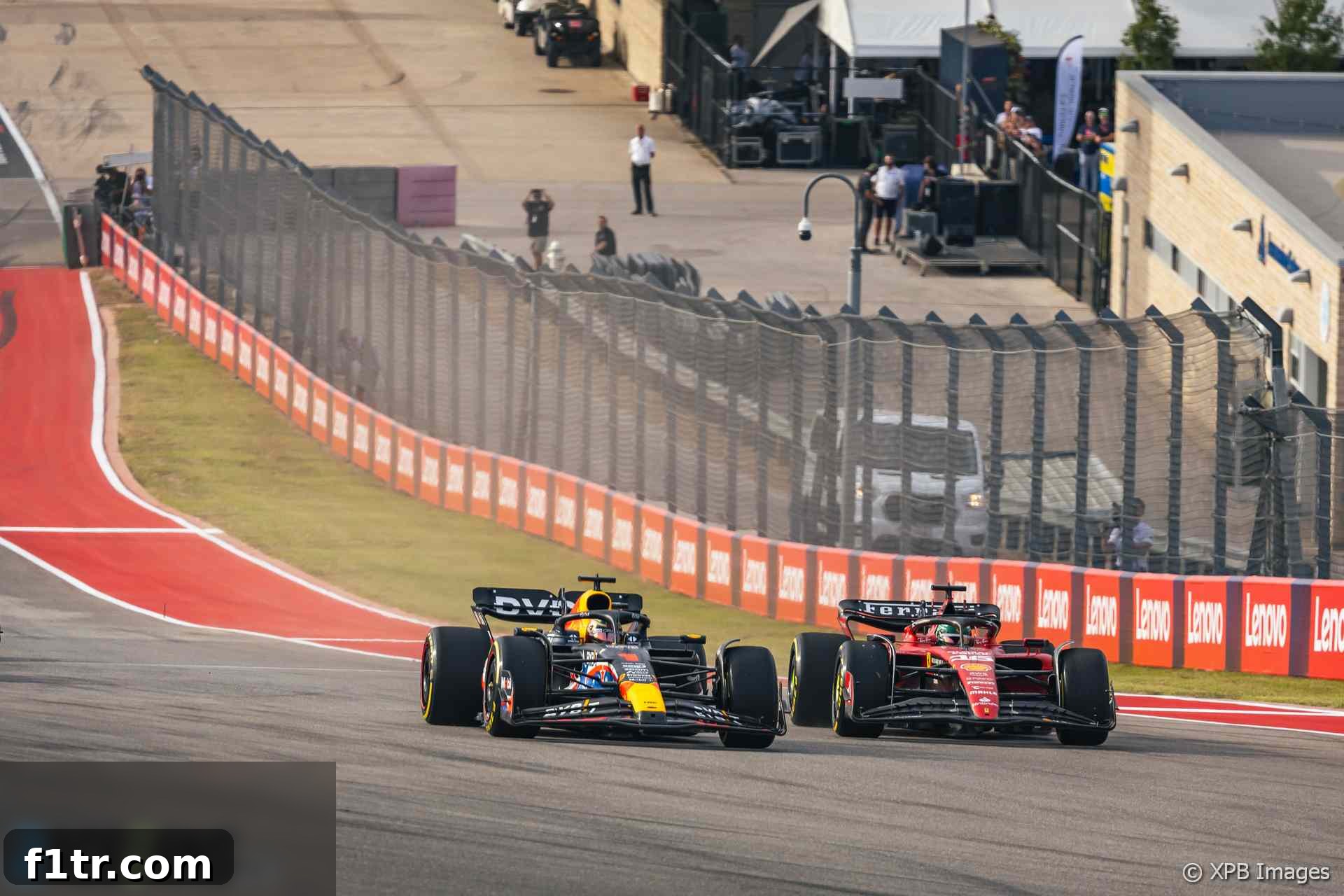
While America proudly hosts three Formula 1 events annually, only one carries the historic weight and prestige of the **United States Grand Prix**. This particular race, held at the iconic Circuit of the Americas (COTA) in Austin, Texas, is more than just another stop on the calendar; it’s a testament to Formula 1’s enduring and recently resurgent appeal in a nation traditionally dominated by other motorsports.
Advert | Become a Supporter & go ad-free
For many decades, Formula 1’s journey to captivate the American public was a challenging one. Commercial rights holders, administrators, and teams invested significant effort to introduce the world’s most prestigious motorsport series to a skeptical audience. Through various venues, from Watkins Glen to Phoenix and Indianapolis, F1 struggled to establish a lasting footprint. However, a pivotal shift occurred with American ownership of the sport and the meteoric rise of Netflix’s “Drive to Survive” series. This docu-series masterfully unveiled the intricate human drama, high-stakes competition, and captivating personalities behind the helmets, drawing in millions of new fans, particularly a younger demographic, who had previously been oblivious to the sport’s allure. The glitz, glamour, and compelling narratives successfully broke through into the American cultural consciousness, turning F1 into a mainstream phenomenon.
Yet, this newfound popularity faces a unique challenge. While “Drive to Survive” brought scores of fresh eyes to Formula 1, the on-track action in recent seasons has often lacked the nail-biting suspense that would truly keep new fans glued to their seats. Max Verstappen, with his Red Bull Racing powerhouse, has been virtually unstoppable. His relentless domination of the sport this year mirrors the most commanding periods seen in F1 history, reminiscent of Michael Schumacher’s Ferrari era or Lewis Hamilton’s Mercedes reign. While undeniably a display of peak performance, such supremacy can inadvertently reduce the unpredictability and direct wheel-to-wheel battles at the very front, which are often the most thrilling aspects for emerging fans.
Nevertheless, the anticipation for the 44th United States Grand Prix at the Circuit of the Americas remains palpable. Hundreds of thousands of fans are expected to descend upon Austin, knowing that for once, Verstappen’s path to victory might not be as straightforward as usual. The unique circumstances of this sprint weekend have injected a much-needed dose of intrigue into the main event, promising a more competitive and strategic Sunday race.
A mere few centimetres proved to be Max Verstappen’s undoing during Friday’s crucial qualifying session. A track limits infringement at Turn 19, a notoriously tricky corner for staying within the white lines, cost him pole position for Sunday’s grand prix. This seemingly small infraction relegated the reigning world champion from the top spot to sixth on the grid. While it marked the fifth time this season Verstappen has started outside the front row, it was only the second occasion where his own error directly led to the compromised grid slot. Track limits, enforced rigorously, demand absolute precision from drivers, and COTA’s sweeping turns, combined with the low-grip surface, make it a constant challenge to navigate without exceeding the boundaries.
Despite this sub-optimal starting position, Verstappen and Red Bull have every reason to approach Sunday’s race with confidence. A key advantage for Verstappen is his car’s setup, which was locked in from the moment he left the pit lane for Q1 on Friday due to the sprint weekend format. This means any adjustments made during the sprint race cannot be carried over to the main event. His dominant victory from pole in Saturday’s sprint race provided unequivocal proof that the RB19, in its current configuration, possesses unmatched race pace. Verstappen has consistently demonstrated his ability to scythe through the field, having won numerous races from lower grid positions throughout the last two seasons, often overcoming greater deficits than the one he faces at COTA.
To reclaim the lead, Verstappen will need to navigate a gauntlet of formidable rivals lining up ahead of him: George Russell, Carlos Sainz Jnr, Lewis Hamilton, Lando Norris, and Charles Leclerc. While each of these drivers is a world-class competitor, they all face the undeniable disadvantage of not wielding the potent RB19, which, as Hamilton himself observed, appears to be in a league of its own. Lewis Hamilton, despite his competitive spirit, echoed the general sentiment after the sprint race, acknowledging the uphill battle his rivals face.
“He’s got at least half a second on all the cars ahead of him per lap, pretty much,” Hamilton conceded. “So that should be enough to get by. There is degradation and those sorts of things and strategy [but] I assume he will be climbing relatively fast. So we will have a job on our hands up ahead to try and hold him back. But it’s a track that you can overtake, so it is likely that he will be finishing high up tomorrow.” Hamilton’s assessment highlights the strategic complexities beyond raw pace, emphasizing tire degradation and clever strategy as potential variables. COTA’s wide track, with its significant elevation changes and long straights, offers multiple overtaking opportunities, particularly into Turn 1 and at the end of the back straight. This characteristic of the circuit could play directly into Verstappen’s hands, allowing him to exploit his car’s superior performance.
Advert | Become a RaceFans supporter andgo ad-free
While Max Verstappen is undoubtedly the favorite, Charles Leclerc and Ferrari have maximized their chances by securing pole position for the main race. Their strategy, centered around a notably lower downforce setup compared to their key rivals, places critical importance on track position. This aerodynamic compromise means sacrificing some grip in corners for higher straight-line speed, a trade-off that can be highly effective at certain circuits like COTA with its long straights.
The effectiveness of Ferrari’s low-downforce approach was clearly visible during the sprint race. Both Leclerc and Carlos Sainz Jnr showcased exceptional straight-line speed along Austin’s multiple straights. They consistently recorded higher speeds down the lengthy back straight compared to drivers from Red Bull, McLaren, and Mercedes. This blistering pace makes them incredibly difficult to overtake on these sections, even for cars with DRS activated. Conversely, their cornering speeds suffered, particularly through the high-speed sweepers of the opening sector and the intricate triple-right-hand sequence of Turns 16, 17, and 18 in sector three. This strategic compromise means Ferrari’s drivers gain on the straights but tend to lose time through the more technical, high-speed corners where downforce is paramount.
This dynamic was perfectly encapsulated in the sprint race when George Russell, despite having the advantage of DRS and fresher tires, found himself unable to make a move on Sainz. Russell’s frustration was compounded by his own car’s setup, which, in hindsight, he admitted might have been running with slightly too much downforce. When questioned about this post-race, Russell acknowledged, “in my situation, you would say yes.” He elaborated on the trade-offs: “In clean air, I think more wing is better. So it depends what race you find yourself in. If it’s close between one and a two-stop, having more wing will help give us that flexibility.” This illustrates the delicate balance teams must strike between maximizing performance in clean air versus optimizing for battles in traffic, a decision made even harder by the limited practice time in a sprint weekend format.
Advert | Become a Supporter & go ad-free
With Leclerc starting from pole position and exhibiting one of the highest top speeds among the front-runners even without DRS, Ferrari’s setup seems perfectly tailored for leading from the front and defending against threats from behind. Their ability to pull away on the straights could prove crucial in neutralizing overtakes. Beyond this aerodynamic advantage, Ferrari holds another potentially vital strategic card up its sleeve.
Sprint race weekends introduce a unique set of challenges for teams, particularly concerning tire strategy. The compressed schedule means significantly reduced practice time, leaving teams with less intimate knowledge of how the three available tire compounds will perform over a full grand prix distance. Typically, there’s only enough opportunity for a single high-fuel run on a “green track” – one that hasn’t had much rubber laid down, making it less representative – before the sprint race offers the only truly relevant data, and even then, usually for just one compound.
However, Carlos Sainz’s decision to run on soft tires during the sprint race provided Ferrari with a unique and invaluable dataset. While his lap times faded later in the sprint, clearly indicating that the softs might not be the optimal choice for an extended stint in the longer race, Ferrari is now the only team with tangible data on two different tire compounds heading into Sunday’s grand prix. Sainz, despite the degradation, believes this information offers a tactical edge. “It’s an option for 10, 12 laps,” Sainz explained, suggesting a short, aggressive stint. “Where you want to do them is a matter of choosing when,” he added, hinting at potential undercut or overcut strategies, or even a late-race charge.
Advert | Become a RaceFans supporter andgo ad-free
Pirelli, the official tire supplier, has unsurprisingly projected a two-stop strategy, predominantly utilizing the medium and hard compounds, as the optimal approach for the 56-lap race. For Charles Leclerc, the run to Turn 1 will be absolutely critical in his quest for victory. Given this, he is almost certain to opt for medium tires for the opening stint, providing the necessary traction and grip to defend his position and potentially pull away from Lando Norris, who starts alongside him, on the steep uphill climb to the first corner. Pirelli anticipates most teams will then transition to hard tires for the middle stint. The second stop would then see a switch to either hards or mediums, depending on various factors: the exact lap number of the pit stop, the remaining laps until the checkered flag, and the available tire sets following earlier running. The flexible nature of this strategy allows teams to react to race developments, safety car periods, or unexpected tire degradation.
However, despite his pole position and strategic advantages, Leclerc is acutely aware of the challenges ahead. With Norris alongside him on the grid, Lewis Hamilton directly behind, and his own lap times showing more degradation than most in the latter stages of the sprint, Leclerc knows he has more to contend with than just the inevitable charge from Max Verstappen. His post-sprint comments reflected a pragmatic outlook. “It’s going to be tight,” Leclerc admitted. “I expect Max to get ahead and to not be too much of a fight but then otherwise it’s going to be tight.” His primary concern remains consistency: “I think we have to look into our data and try to understand what we can do better for tomorrow’s degradation because the pace is there, it’s always been there, sometimes we seem to be a bit inconsistent with our race pace. Today was the case, we struggled more than others and we’ll try to understand what’s wrong and see if we can do anything different for tomorrow to help that.” This internal struggle for consistent race pace, particularly with tire management, could be Ferrari’s biggest hurdle.
For Max Verstappen, the objective is clear and singular: victory. With four rounds still remaining in the season, he is on the cusp of equaling his own record of 15 Grand Prix wins in a single season. Anything less than a top step finish will be a disappointment. His confidence, despite the grid penalty, remains unshaken. “It’s five cars to pass – which is never straightforward – but with the pace I think we had today, hopefully with more fuel in the car tomorrow, it will be even better,” he asserted. “For sure this was a very positive day for us and hopefully we can show something similar out there tomorrow.” Verstappen’s calculated optimism, rooted in his car’s demonstrated performance and his own exceptional skill, sets the stage for what promises to be a thrilling pursuit through the field.
Advert | Become a RaceFans supporter andgo ad-free
Qualifying times in full
| P. | Driver | Team | Q1 | Q2 (v Q1) | Q3 (v Q2) |
|---|---|---|---|---|---|
| 1 | Charles Leclerc | Ferrari | 1’36.061 | 1’35.004 (-1.057s) | 1’34.723 (-0.281s) |
| 2 | Lando Norris | McLaren | 1’35.110 | 1’35.441 (+0.331s) | 1’34.853 (-0.588s) |
| 3 | Lewis Hamilton | Mercedes | 1’35.091 | 1’35.240 (+0.149s) | 1’34.862 (-0.378s) |
| 4 | Carlos Sainz Jnr | Ferrari | 1’35.824 | 1’35.302 (-0.522s) | 1’34.945 (-0.357s) |
| 5 | George Russell | Mercedes | 1’36.165 | 1’35.606 (-0.559s) | 1’35.079 (-0.527s) |
| 6 | Max Verstappen | Red Bull | 1’35.346 | 1’35.008 (-0.338s) | 1’35.081 (+0.073s) |
| 7 | Pierre Gasly | Alpine | 1’36.158 | 1’35.496 (-0.662s) | 1’35.089 (-0.407s) |
| 8 | Esteban Ocon | Alpine | 1’36.131 | 1’35.413 (-0.718s) | 1’35.154 (-0.259s) |
| 9 | Sergio Perez | Red Bull | 1’35.989 | 1’35.679 (-0.310s) | 1’35.173 (-0.506s) |
| 10 | Oscar Piastri | McLaren | 1’36.064 | 1’35.576 (-0.488s) | 1’35.467 (-0.109s) |
| 11 | Yuki Tsunoda | AlphaTauri | 1’35.913 | 1’35.697 (-0.216s) | Missed by 0.018s |
| 12 | Zhou Guanyu | Alfa Romeo | 1’36.052 | 1’35.698 (-0.354s) | Missed by 0.019s |
| 13 | Valtteri Bottas | Alfa Romeo | 1’36.082 | 1’35.858 (-0.224s) | Missed by 0.179s |
| 14 | Kevin Magnussen | Haas | 1’36.009 | 1’35.880 (-0.129s) | Missed by 0.201s |
| 15 | Daniel Ricciardo | AlphaTauri | 1’36.213 | 1’35.974 (-0.239s) | Missed by 0.295s |
| 16 | Nico Hulkenberg | Haas | 1’36.235 | Missed by 0.022s | |
| 17 | Fernando Alonso | Aston Martin | 1’36.268 | Missed by 0.055s | |
| 18 | Alexander Albon | Williams | 1’36.315 | Missed by 0.102s | |
| 19 | Lance Stroll | Aston Martin | 1’36.589 | Missed by 0.376s | |
| 20 | Logan Sargeant | Williams | 1’36.827 | Missed by 0.614s |
The qualifying results highlight Ferrari’s strong single-lap pace, with Charles Leclerc demonstrating a significant improvement through the sessions to secure pole. Max Verstappen’s Q3 time, marked in red, indicates his track limits infringement, costing him the top spot despite his strong performance in Q2.
Sector times
| P. | # | Driver | S1 | S2 | S3 | Ultimate lap (deficit) |
|---|---|---|---|---|---|---|
| 1 | 1 | Max Verstappen | 25.332 (1) | 38.095 (2) | 31.146 (1) | 1’34.573 (+0.435) |
| 2 | 16 | Charles Leclerc | 25.338 (2) | 38.153 (5) | 31.147 (2) | 1’34.638 (+0.085) |
| 3 | 44 | Lewis Hamilton | 25.416 (6) | 38.055 (1) | 31.269 (4) | 1’34.740 (+0.122) |
| 4 | 4 | Lando Norris | 25.485 (7) | 38.111 (3) | 31.257 (3) | 1’34.853 |
| 5 | 55 | Carlos Sainz Jnr | 25.387 (4) | 38.178 (6) | 31.297 (5) | 1’34.862 (+0.083) |
| 6 | 10 | Pierre Gasly | 25.374 (3) | 38.288 (8) | 31.358 (8) | 1’35.020 (+0.069) |
| 7 | 63 | George Russell | 25.585 (10) | 38.128 (4) | 31.313 (7) | 1’35.026 (+0.053) |
| 8 | 31 | Esteban Ocon | 25.402 (5) | 38.365 (11) | 31.387 (9) | 1’35.154 |
| 9 | 11 | Sergio Perez | 25.515 (8) | 38.354 (9) | 31.304 (6) | 1’35.173 |
| 10 | 81 | Oscar Piastri | 25.564 (9) | 38.262 (7) | 31.422 (10) | 1’35.248 (+0.219) |
| 11 | 24 | Zhou Guanyu | 25.617 (11) | 38.505 (13) | 31.485 (13) | 1’35.607 (+0.091) |
| 12 | 22 | Yuki Tsunoda | 25.65 (12) | 38.554 (15) | 31.437 (11) | 1’35.641 (+0.056) |
| 13 | 77 | Valtteri Bottas | 25.676 (14) | 38.434 (12) | 31.666 (16) | 1’35.776 (+0.082) |
| 14 | 20 | Kevin Magnussen | 25.725 (15) | 38.513 (14) | 31.571 (14) | 1’35.809 (+0.071) |
| 15 | 3 | Daniel Ricciardo | 25.817 (17) | 38.616 (16) | 31.471 (12) | 1’35.904 (+0.070) |
| 16 | 27 | Nico Hulkenberg | 25.901 (18) | 38.357 (10) | 31.664 (15) | 1’35.922 (+0.313) |
| 17 | 14 | Fernando Alonso | 25.814 (16) | 38.631 (17) | 31.823 (17) | 1’36.268 |
| 18 | 23 | Alexander Albon | 25.671 (13) | 38.765 (20) | 31.879 (19) | 1’36.315 |
| 19 | 18 | Lance Stroll | 25.938 (19) | 38.68 (18) | 31.83 (18) | 1’36.448 (+0.141) |
| 20 | 2 | Logan Sargeant | 26 (20) | 38.755 (19) | 32.072 (20) | 1’36.827 |
The sector times reveal Max Verstappen’s raw speed, particularly in Sector 1 and 3 where he set the fastest times. Lewis Hamilton excelled in Sector 2, demonstrating Mercedes’ strength in the middle, more flowing section of the track. Ferrari’s strong performance in the speed traps, as shown below, suggests their setup prioritizes straight-line velocity, impacting their times in the more technical sectors.
Speed trap
| P. | # | Driver | Car | Engine | Model | Max kph (mph) |
|---|---|---|---|---|---|---|
| 1 | 20 | Kevin Magnussen | Haas | Ferrari | VF-23 | 330.3 (205.2) |
| 2 | 27 | Nico Hulkenberg | Haas | Ferrari | VF-23 | 327.6 (203.6) |
| 3 | 16 | Charles Leclerc | Ferrari | Ferrari | SF-23 | 327.3 (203.4) |
| 4 | 55 | Carlos Sainz Jnr | Ferrari | Ferrari | SF-23 | 325.9 (202.5) |
| 5 | 77 | Valtteri Bottas | Alfa Romeo | Ferrari | C43 | 325.7 (202.4) |
| 6 | 11 | Sergio Perez | Red Bull | Honda RBPT | RB19 | 324.9 (201.9) |
| 7 | 4 | Lando Norris | McLaren | Mercedes | MCL60 | 324.8 (201.8) |
| 8 | 10 | Pierre Gasly | Alpine | Renault | A523 | 324.8 (201.8) |
| 9 | 2 | Logan Sargeant | Williams | Mercedes | FW45 | 324.8 (201.8) |
| 10 | 81 | Oscar Piastri | McLaren | Mercedes | MCL60 | 324.6 (201.7) |
| 11 | 14 | Fernando Alonso | Aston Martin | Mercedes | AMR23 | 324.4 (201.6) |
| 12 | 1 | Max Verstappen | Red Bull | Honda RBPT | RB19 | 324.4 (201.6) |
| 13 | 31 | Esteban Ocon | Alpine | Renault | A523 | 324.3 (201.5) |
| 14 | 23 | Alexander Albon | Williams | Mercedes | FW45 | 324.0 (201.3) |
| 15 | 24 | Zhou Guanyu | Alfa Romeo | Ferrari | C43 | 323.5 (201.0) |
| 16 | 18 | Lance Stroll | Aston Martin | Mercedes | AMR23 | 322.0 (200.1) |
| 17 | 44 | Lewis Hamilton | Mercedes | Mercedes | W14 | 320.0 (198.8) |
| 18 | 3 | Daniel Ricciardo”>Daniel Ricciardo | AlphaTauri | Honda RBPT | AT04 | 320.0 (198.8) |
| 19 | 22 | Yuki Tsunoda | AlphaTauri | Honda RBPT | AT04 | 319.7 (198.7) |
| 20 | 63 | George Russell | Mercedes | Mercedes | W14 | 318.8 (198.1) |
The speed trap data strongly supports the observation of Ferrari’s low-downforce setup, with Charles Leclerc and Carlos Sainz consistently ranking among the fastest on the straights. Haas, also powered by Ferrari engines, topped the charts. Notably, the Mercedes cars of Hamilton and Russell appear lower, confirming their higher-downforce configurations which sacrifice top speed for cornering grip.
Advert | Become a RaceFans supporter andgo ad-free
Over to you
The stage is set for a truly captivating United States Grand Prix. Will this be another demonstration of Max Verstappen’s unparalleled dominance as he carves his way through the field, setting yet another record? Or can Charles Leclerc, armed with pole position, a strategically optimized Ferrari, and crucial tire data, hold off the challenge and convert his advantage into a much-needed victory? Furthermore, can the likes of Lando Norris, Lewis Hamilton, and Carlos Sainz capitalize on Verstappen’s compromised starting position and Ferrari’s potential weaknesses in race consistency to fight for the podium? Share your views on the United States Grand Prix in the comments section below.
2023 United States Grand Prix
- US GP was Mercedes’ best race of 2023 despite disqualification – Wolff
- Singapore and Austin retirements cost me top 10 championship place – Ocon
- United States Grand Prix result unchanged as FIA rejects Haas’ call for review
- Sargeant admits he’s ‘struggled to use all the downforce at times’ in F1
- Mercedes’ Brazilian GP set-up was “conservative” after US GP disqualification
Browse all 2023 United States Grand Prix articles