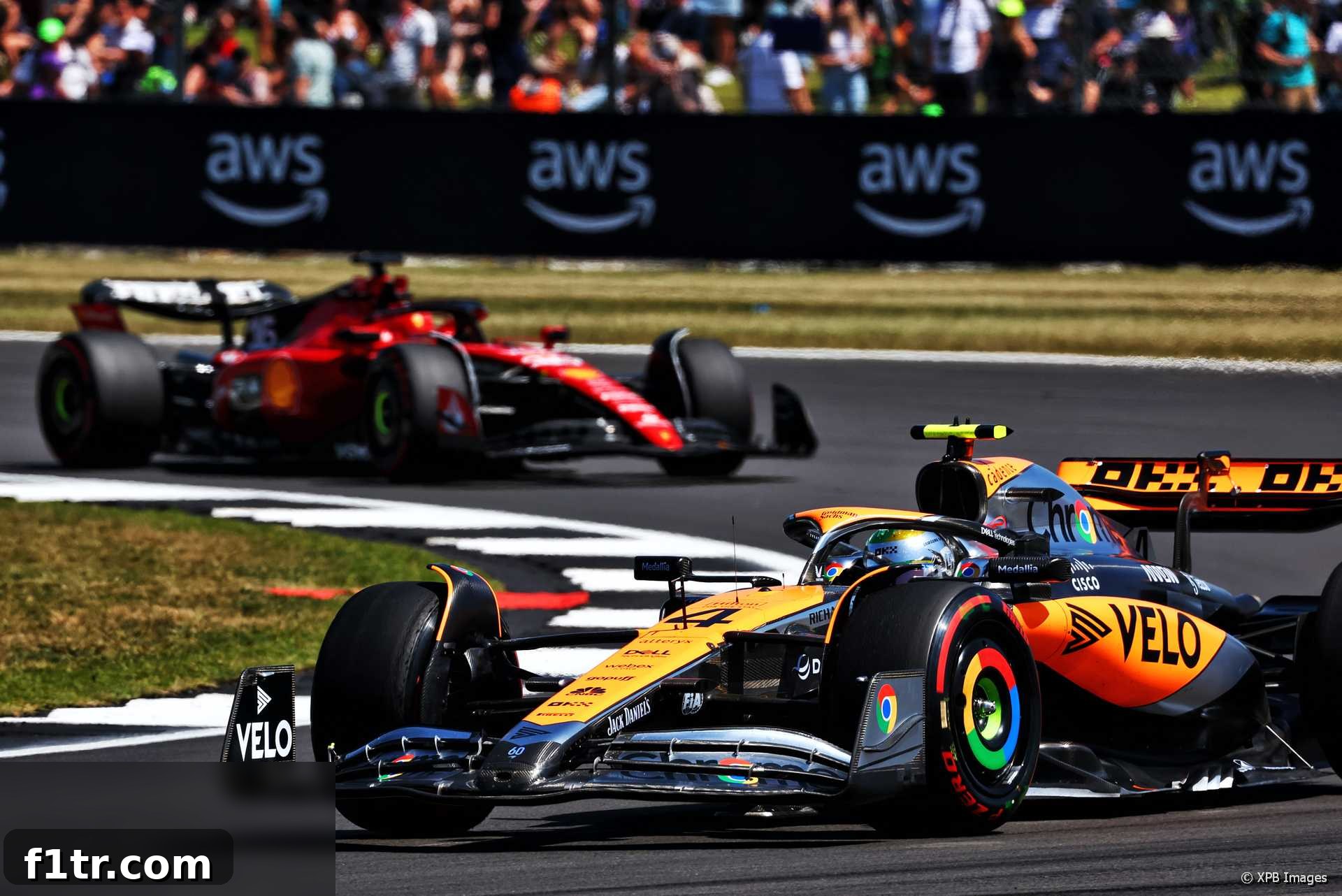
McLaren’s significant performance leap in qualifying for the British Grand Prix can be directly attributed to the impactful upgrades introduced to their MCL60, according to team statements. While the team celebrated a stellar Saturday, securing second and third positions on the grid, they remain cautious about translating this pace into a similarly dominant race performance. This measured optimism stems from past experiences this season, most notably in Spain, where strong qualifying results were overshadowed by struggles with tyre degradation during the Grand Prix itself.
Advert | Become a Supporter & go ad-free
Lando Norris, securing P2, and Oscar Piastri, starting P3, delivered a qualifying masterclass at Silverstone, marking the best collective starting positions for McLaren in recent memory. This achievement injects a much-needed boost of confidence into the Woking-based outfit, especially after a challenging start to the 2023 Formula 1 season. The team’s ability to extract such raw pace over a single lap suggests a clear step forward in understanding and optimizing their car package. However, the shadow of tyre management and consistent long-run performance looms large, a hurdle McLaren is acutely aware of and actively working to overcome.
McLaren Team Principal Andrea Stella offered nuanced insights into the team’s qualifying success, acknowledging a familiar pattern of favorable conditions while emphatically highlighting the tangible impact of the car’s recent upgrades. “There’s definitely a pattern,” Stella stated to media, including RaceFans, detailing the specific environmental factors that often align with the MCL60’s inherent strengths. “High speed corners, cold conditions, soft tyres. By the way, the same compound, C3. So, we like these conditions, our car likes it. The rear end kind of finds naturally some good grip, which we may be missing in continuous laps or when it’s hotter. So conditions come to our favour.”
However, Stella was quick to clarify that it wasn’t solely down to luck or track characteristics. He stressed the measurable improvements brought by the team’s persistent development efforts. “But at the same time I think there’s in this result some contribution coming from the improvements we have made to the car. We measure these improvements in terms of downforce, and we see that in some of the low-speed we are decently competitive now.” This assessment underscores the intricate interplay between a car’s inherent design, the specific track conditions, and the continuous enhancement through strategic upgrades. McLaren’s engineering team has clearly made strides in improving the MCL60’s aerodynamic efficiency and downforce generation, allowing it to better exploit these advantageous conditions.
Despite the significant progress, Stella also provided a grounded perspective on the competitive landscape. “Still, we have GPS overlays, we can see that some cars are quicker than us. This just confirmed what is our objective in terms of development. So I think a combination of conditions, but also improvements of the car that we brought to Austria and then we made available to Oscar here in Silverstone.” This candid acknowledgement indicates that while McLaren is on an upward trajectory, they remain realistic about the performance gaps to the very front runners. The data gathered from GPS overlays, a crucial tool for performance analysis in modern F1, continues to guide their development objectives, pushing them to find further gains in all areas of the car.
With the two McLarens positioned strategically on the grid, they find themselves directly ahead of the formidable Ferrari duo and the Mercedes pair, setting the stage for a thrilling race. Stella emphasized that McLaren’s immediate challenge lies in transforming their single-lap prowess into a robust race pace capable of fending off these championship contenders. The fight for track position and points will be intense, demanding not only outright speed but also astute strategy and impeccable tyre management.
Advert | Become a RaceFans supporter andgo ad-free
“While we have improved the car in terms of aerodynamic efficiency, we haven’t made yet large enough improvements in terms of elements that can improve the race pace,” Stella explained, highlighting a critical area of ongoing development. “So I would still expect that there’s cars around us that will be quicker in terms of race pace: Ferrari and possibly Mercedes as well. We will see also Aston Martin, how they do.” This realistic outlook on race pace is a testament to the team’s honest self-assessment, recognizing that pure qualifying speed doesn’t always translate into Sunday dominance, especially in the tight midfield battle. The challenge of maintaining tyre performance over a full race stint, particularly preventing excessive degradation, remains a cornerstone of Formula 1 success, and it’s an area McLaren is diligently addressing.
The conditions for the race will also play a crucial role, according to Stella. “It will depend also to some extent on the conditions. Cold conditions should favour us for the same reasons I said before, even in the race.” This suggests that if Silverstone maintains cooler temperatures, McLaren might find a more stable platform for their MCL60, potentially mitigating some of their race pace concerns. Tyre operating windows and optimal car balance are heavily influenced by ambient and track temperatures, and McLaren appears to have found a sweet spot in colder environments.
Lando Norris’s impressive fourth-place finish in Austria provided a glimpse of McLaren’s potential, representing the team’s best result of the season thus far. Stella believes this success was a confluence of factors: the tangible improvements brought by the upgrades and the specific characteristics of the Red Bull Ring. “Definitely the race pace in Austria was better than Barcelona,” he confirmed, attributing much of this improvement to the team’s development. “We think that the upgrades were absolutely fundamental in terms of this improvement.” The effectiveness of the upgrades, therefore, is not just a qualifying phenomenon but has shown glimpses of aiding race performance on suitable circuits.
Delving deeper into track characteristics, Stella elaborated, “At the same time, Austria is a front-end limited circuit. Our car is generous when it comes to providing front grip, so we know that track might suit the characteristics of our car. Here it could be more rear-end limited, it will depend on the temperature like for instance Barcelona was.” This technical insight highlights the nuanced performance profile of the MCL60. A front-end limited circuit, where the front tyres dictate grip and balance, plays into McLaren’s strengths. However, Silverstone, especially with varying temperatures, could shift towards being more rear-end limited, demanding greater stability from the rear axle – an area where the MCL60 has historically faced challenges. This delicate balance underscores the ongoing quest for a versatile F1 car.
“So we have to be cautious because we are still quite subject to the conditions in a way, if we want to get less dependent on the conditions we just have to keep improving the car,” Stella concluded. This statement encapsulates McLaren’s long-term vision: to develop a car that performs consistently and optimally across a broader spectrum of track types and environmental conditions, thereby reducing its dependency on specific favourable scenarios. The journey to become a front-running team requires not just outright pace, but also robust adaptability.
Advert | Become a RaceFans supporter andgo ad-free
Stella also articulated that such fluctuations in car performance from track to track are not unique to McLaren, even extending to the dominant teams on the grid. “We see with Red Bull, they have such a margin that I’m sure they have similar kind of issues, but they mask it because it falls within the margin that they have. At the moment, we don’t have this margin and if the conditions don’t help us then we will be struggling in terms of race pace.” This perspective offers a valuable insight into the competitive nature of Formula 1; every car has its strengths and weaknesses, but only those with a significant performance advantage can afford to mask these inherent characteristics.
The midfield, however, offers no such luxury. “It’s also true that the group of cars is so compact that you see sometimes it’s Alpine, sometimes it’s Aston Martin, sometimes it’s someone else, so as soon as you are not competitive you lose many positions.” This intense competition means that even minor performance variations can lead to significant swings in grid position and race results, making consistent development and adaptation paramount for teams like McLaren.
The stellar qualifying performance also marked significant milestones for both McLaren drivers. Lando Norris achieved his third front-row start in Formula 1, cementing his reputation as a formidable qualifier. For rookie Oscar Piastri, starting P3 represents the best grid position of his burgeoning career, a remarkable feat in only his ninth Grand Prix. This dual success not only highlights the improved potential of the MCL60 but also the raw talent within McLaren’s driver lineup.
With both cars starting so high up the grid, the potential for a substantial points haul, perhaps even a podium, is very real. However, the first lap of any Grand Prix is notoriously perilous, especially when teammates are starting side-by-side. Stella expressed full confidence in his drivers’ ability to navigate the opening stages cleanly and avoid any unfortunate incidents. “They’ve already been next to each other on the grid and we have regular conversations before every single event, before the race,” he explained. “Lando and Oscar know exactly what to do. In fairness, it would be the same with any other driver.”
The team principal stressed the overarching objective for the race: to bring both cars home and maximize their potential. “What’s important is to see the chequered flag, we have had already some impact of racing incidents this year if you think Barcelona, pretty much it was decided for Lando at corner one. We had a situation in Austria during the sprint, so we just want to aim at having a clean race, exploit the potential that is available and I’m sure the drivers want exactly the same.” Avoiding collisions, especially with each other, is paramount to securing the team’s largest points return of the season and validating the progress made with the MCL60 upgrades. The British Grand Prix offers a golden opportunity for McLaren to reaffirm its competitive resurgence and demonstrate its long-term potential in Formula 1.
Advert | Become a RaceFans supporter andgo ad-free
2023 British Grand Prix Insights
- Norris is “growing” closer to the champion who inspired him to race
- Second supplier part failure ‘a frustrating issue we must solve’ – Alpine
- Albon ‘surprised’ to be quicker than Alonso at end of British GP
- Bottas admits Alfa Romeo ‘were expecting to be better than this’ in 2023
- McLaren now “finding performance quicker” after emulating Red Bull’s design
Browse all 2023 British Grand Prix articles