Lewis Hamilton’s Bahrain Comeback: From Qualifying Despair to Race Day Optimism
Lewis Hamilton faced a stark contrast between his performance in qualifying for the 2025 Bahrain Grand Prix and his race day execution. While deep disappointment clouded his spirits after a challenging qualifying session, a palpable sense of cautious optimism emerged following the grand prix itself. His ability to navigate the race, particularly a transformative middle stint, offered glimmers of hope for his integration into the Ferrari team and his understanding of the SF-25 chassis.
Race Analysis & Strategy
The Safety Car Impact
In-Depth Statistics
Fastest Laps
Pit Stop Times
Hamilton’s Race Day Redemption: Finding Synergy with the Ferrari SF-25
Starting from a disappointing ninth position on the grid, Hamilton managed to climb four places to finish fifth, just one spot behind his esteemed teammate Charles Leclerc. This progression was not merely a result of attrition or luck; it was a testament to his persistent efforts to adapt to his new machinery and a crucial breakthrough in understanding the car’s nuanced behavior. His post-race comments highlighted a significant learning curve during the event.
“I learned a lot today,” Hamilton revealed to the official F1 channel. “As you saw in that middle stint, I really was in line with the car. In that moment, I had the pace and I was moving forwards. I needed that at the beginning and at the end and I needed it in qualifying. So I know what to search for now.” This declaration suggests a pivotal moment in his championship campaign with Ferrari, indicating he has identified the critical elements required to unlock the car’s full potential and align it with his driving preferences. The quest for this synergy, often the greatest challenge for drivers transitioning to a new team, seems to have taken a significant step forward in Bahrain.
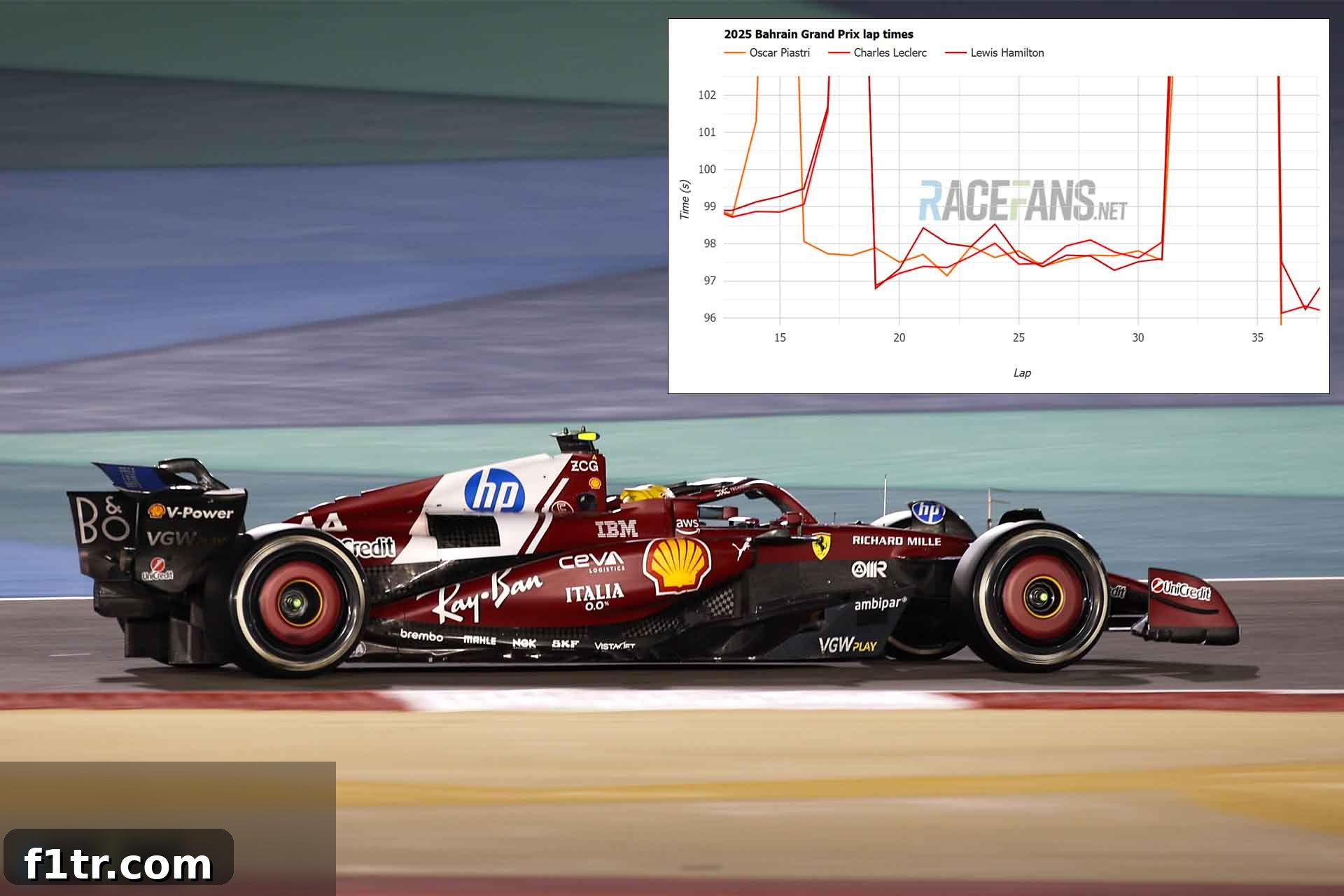
Ferrari’s strategic decision to start both its drivers, Hamilton and Leclerc, on medium compound tires deviated from the popular choice of most rivals, who opted for the softer compound. This bold move was designed to offer greater flexibility later in the race, banking on the mediums’ durability. Initially, Hamilton found himself battling with Carlos Sainz Jnr, but once he cleared the Spaniard, his lap times showed marked improvement, drawing closer to Leclerc’s pace. This early battle underscored the competitive density of the field and the importance of clear air for performance optimization.
The team executed a synchronized double pit stop for their drivers, a common tactic for preserving track position and minimizing time loss. Emerging into clear air during the second stint, Hamilton truly began to shine, consistently closing the gap to the cars ahead. His car, which he described as feeling “night-and-day different” compared to its qualifying iteration, allowed him to push harder and with greater confidence. This dramatic shift points to successful in-race adjustments or a deeper understanding of setup parameters.
Reflecting on the arduous nature of the race, Hamilton elaborated, “Of course, it was a hard afternoon. To progress is not easy out there, everyone’s so close. The car is sometimes quite hard to drive and I’m really working hard to adapt my driving style. That’s what I’ve really got to do and also get the set-up where I need it. We’ve got a much better set-up, I moved to where Charles was and he didn’t move away from that all weekend. I’m just getting confidence in that and then adjusting the driving style to it.” This honest assessment highlights the continuous process of adaptation required in Formula 1, not just for newcomers but for seasoned champions like Hamilton. His reference to aligning his setup with Leclerc’s, who had seemingly found a stable balance throughout the weekend, indicates a team-oriented approach to problem-solving and a willingness to learn from his teammate.
Strategic Plays and the Unforeseen Impact of the Safety Car
As the race progressed into its middle phase, with drivers contemplating their second pit stops, Hamilton, Leclerc, and Oscar Piastri emerged as the fastest drivers on track. Their strong pace positioned them favorably to make further gains. However, the dynamics of the race were dramatically altered on lap 32 with the deployment of a Safety Car. This intervention proved particularly unwelcome for the Ferrari duo, as it prematurely ended their strong second stint, which had been characterized by impressive lap times and effective tire management. The Safety Car typically compresses the field, negating any time advantages built up, and crucially, it often favors those drivers who started on softer compounds and were planning to make a shorter final stint on fresher tires.
Several teams shrewdly capitalized on the Safety Car period to switch to soft tires, most notably Mercedes for George Russell, a move that would ultimately pay dividends. Ferrari, however, opted for a more conservative approach, fitting their cars with hard compound tires. This decision reflected a long-term strategy for tire longevity and potentially a belief in the hard compound’s performance over a sustained period, despite the temporary advantage soft tires offered on restart.
While Hamilton had showcased fierce competitiveness against Lando Norris at the beginning of the second stint, his pace on the hard tires post-Safety Car was not sufficient to keep pace with those ahead, particularly those on the softer, faster compounds. By the time the chequered flag waved, he found himself eight seconds adrift of his teammate, Leclerc. This gap highlighted the compromise Ferrari made with their tire choice under the Safety Car conditions, costing Hamilton further potential gains.
The Bahrain Grand Prix marked a potentially pivotal moment for Lewis Hamilton within the Ferrari camp. His undeniable relief after the race, despite not achieving a podium finish, suggested a psychological turning point. The successful identification of the car’s optimal balance during his middle stint, coupled with a clearer understanding of the necessary driving style adjustments, could lay the foundation for a stronger, more consistent performance throughout the remainder of the 2025 season. This newfound understanding, even if partially disrupted by external factors like the Safety Car, is invaluable for a driver embarking on a new chapter with a storied team.
The Safety Car’s disruptive influence extended beyond the Ferrari garage. Drivers who had pitted shortly before its deployment found themselves at a significant disadvantage, having lost the benefit of fresh tires under green flag conditions. Among them was Max Verstappen, though for the Red Bull ace, this was merely one of several issues plaguing his afternoon. Pierre Gasly and Esteban Ocon also faced challenges but managed to bring their cars home in the points. Andrea Kimi Antonelli, whose afternoon was already complex, saw his fortunes further hampered after switching to softs with 30 laps remaining. Similarly, Jack Doohan, who had been running an impressive ninth with 13 laps to go, ultimately fell out of the points due to the reshuffled strategies and pace after the Safety Car restart.
In-Depth Statistics from the 2025 Bahrain Grand Prix
Analyzing the race’s intricate details through various data points offers a deeper understanding of driver performances, strategic outcomes, and the overall competitiveness of the 2025 Bahrain Grand Prix. While interactive charts provide real-time insights during a live broadcast, a static review of these critical metrics reveals the underlying story of the race weekend.
2025 Bahrain Grand Prix Lap Chart Overview
The lap chart visually tracks the position of each driver on every lap of the Grand Prix. For Lewis Hamilton, this chart would illustrate his steady ascent from ninth on the grid, showcasing his ability to overtake and maintain positions, particularly during his strong middle stint. It would also highlight key battles and overtakes throughout the field, providing a clear trajectory of each competitor’s race. The compression of the field during the Safety Car period would also be evident, as positions briefly stabilize before drivers battle for supremacy on the restart.
2025 Bahrain Grand Prix Gaps Chart Analysis
The gaps chart plots the time differences between each driver relative to the race leader’s average lap time. This visual representation helps to identify periods of strong pace, struggles, and strategic plays. For Ferrari, this chart would demonstrate how Hamilton and Leclerc managed their gaps, particularly how Hamilton closed in on the leading pack during his purple patches and how the Safety Car disrupted these trends, bringing everyone back together. Very large gaps are typically omitted for clarity, focusing on the competitive clusters.
2025 Bahrain Grand Prix Lap Times Breakdown
Examining individual lap times (excluding very slow laps, such as those under Safety Car or during pit entries/exits) reveals the raw pace of each driver and car combination. These times are crucial for assessing performance consistency and peak potential. A detailed review would pinpoint Hamilton’s faster laps during his successful middle stint, contrasting them with his earlier or later segments of the race, or with his qualifying pace, further underlining his claim of finding synergy with the car.
2025 Bahrain Grand Prix Fastest Laps
The battle for the fastest lap often reflects a driver’s maximum raw speed and the ultimate performance of their car. In Bahrain, the top honors went to Oscar Piastri of McLaren-Mercedes, demonstrating the potent combination of the McLaren chassis and the Mercedes power unit. George Russell closely followed, reaffirming Mercedes’ strong single-lap pace. These fastest laps were often set towards the end of stints on fresher tires, or during periods of aggressive pushing, showcasing the fine margins separating the elite drivers and their machines.
| Rank | # | Driver | Car | Lap time | Gap | Avg. speed (kph) | Lap no. |
|---|---|---|---|---|---|---|---|
| 1 | 81 | Oscar Piastri | McLaren-Mercedes | 1’35.140 | 204.78 | 36 | |
| 2 | 63 | George Russell | Mercedes | 1’35.518 | 0.378 | 203.97 | 36 |
| 3 | 4 | Lando Norris | McLaren-Mercedes | 1’35.728 | 0.588 | 203.53 | 38 |
| 4 | 16 | Charles Leclerc | Ferrari | 1’36.132 | 0.992 | 202.67 | 36 |
| 5 | 1 | Max Verstappen | Red Bull-Honda RBPT | 1’36.167 | 1.027 | 202.6 | 29 |
| 6 | 44 | Lewis Hamilton | Ferrari | 1’36.235 | 1.095 | 202.45 | 37 |
| 7 | 10 | Pierre Gasly | Alpine-Renault | 1’36.531 | 1.391 | 201.83 | 39 |
| 8 | 7 | Jack Doohan | Alpine-Renault | 1’36.682 | 1.542 | 201.52 | 31 |
| 9 | 12 | Andrea Kimi Antonelli | Mercedes | 1’36.690 | 1.550 | 201.5 | Multiple laps |
| 10 | 6 | Isack Hadjar | Racing Bulls-Honda RBPT | 1’36.952 | 1.812 | 200.96 | 30 |
| 11 | 55 | Carlos Sainz Jnr | Williams-Mercedes | 1’36.954 | 1.814 | 200.95 | 16 |
| 12 | 31 | Esteban Ocon | Haas-Ferrari | 1’37.098 | 1.958 | 200.66 | 30 |
| 13 | 23 | Alexander Albon | Williams-Mercedes | 1’37.141 | 2.001 | 200.57 | 47 |
| 14 | 22 | Yuki Tsunoda | Red Bull-Honda RBPT | 1’37.225 | 2.085 | 200.39 | 45 |
| 15 | 87 | Oliver Bearman | Haas-Ferrari | 1’37.303 | 2.163 | 200.23 | 40 |
| 16 | 27 | Nico Hulkenberg | Sauber-Ferrari | 1’37.338 | 2.198 | 200.16 | 30 |
| 17 | 30 | Liam Lawson | Racing Bulls-Honda RBPT | 1’37.380 | 2.240 | 200.07 | 44 |
| 18 | 14 | Fernando Alonso | Aston Martin-Mercedes | 1’37.906 | 2.766 | 199 | 38 |
| 19 | 5 | Gabriel Bortoleto | Sauber-Ferrari | 1’38.006 | 2.866 | 198.8 | 38 |
| 20 | 18 | Lance Stroll | Aston Martin-Mercedes | 1’38.064 | 2.924 | 198.68 | 38 |
2025 Bahrain Grand Prix Tyre Strategies
Tyre strategy is a cornerstone of modern Formula 1, and the 2025 Bahrain Grand Prix offered a fascinating display of diverse approaches. Teams weigh the pros and cons of softer, faster but less durable compounds versus harder, slower but more resilient ones, often dictating the number and timing of pit stops. Ferrari’s choice to start on mediums was a clear strategic gamble that paid off during Hamilton’s strong middle stint, demonstrating the longevity they could extract. Other teams opted for aggressive soft-tire starts, hoping to gain initial track position and managing tire degradation carefully. The Safety Car’s timing then forced many teams to re-evaluate their plans on the fly, leading to varied tire choices for the final stint, which significantly influenced the closing stages of the race.
2025 Bahrain Grand Prix Pit Stop Times
Efficient pit stops are crucial for gaining or maintaining track position, with even fractions of a second making a significant difference over a race distance. The pit stop times from the Bahrain Grand Prix highlight the operational excellence of the teams. McLaren once again demonstrated their prowess, with Lando Norris executing the fastest complete stop of 24.035 seconds during his second pit. Mercedes also showed strong performance in the pits for George Russell. Ferrari’s pit stops for both Hamilton and Leclerc were consistently competitive, contributing to their race progression. Conversely, a few teams experienced slightly longer stops, which can be detrimental, especially in a tightly contested race. These times underscore the high-pressure environment of a Formula 1 pit lane and the continuous pursuit of perfection by every team member.
| Rank | # | Driver | Team | Complete stop time (s) | Gap to best (s) | Stop no. | Lap no. |
|---|---|---|---|---|---|---|---|
| 1 | 4 | Lando Norris | McLaren | 24.035 | 2 | 32 | |
| 2 | 63 | George Russell | Mercedes | 24.044 | 0.009 | 1 | 13 |
| 3 | 63 | George Russell | Mercedes | 24.1 | 0.065 | 2 | 32 |
| 4 | 5 | Gabriel Bortoleto | Sauber | 24.143 | 0.108 | 1 | 13 |
| 5 | 30 | Liam Lawson | Racing Bulls | 24.191 | 0.156 | 2 | 32 |
| 6 | 27 | Nico Hulkenberg | Sauber | 24.229 | 0.194 | 1 | 5 |
| 7 | 16 | Charles Leclerc | Ferrari | 24.241 | 0.206 | 2 | 32 |
| 8 | 27 | Nico Hulkenberg | Sauber | 24.291 | 0.256 | 2 | 27 |
| 9 | 55 | Carlos Sainz Jnr | Williams | 24.315 | 0.28 | 2 | 32 |
| 10 | 44 | Lewis Hamilton | Ferrari | 24.34 | 0.305 | 1 | 17 |
| 11 | 44 | Lewis Hamilton | Ferrari | 24.35 | 0.315 | 2 | 32 |
| 12 | 81 | Oscar Piastri | McLaren | 24.498 | 0.463 | 1 | 14 |
| 13 | 12 | Andrea Kimi Antonelli | Mercedes | 24.506 | 0.471 | 2 | 27 |
| 14 | 87 | Oliver Bearman | Haas | 24.562 | 0.527 | 1 | 14 |
| 15 | 18 | Lance Stroll | Aston Martin | 24.592 | 0.557 | 2 | 32 |
| 16 | 55 | Carlos Sainz Jnr | Williams | 24.6 | 0.565 | 1 | 14 |
| 17 | 18 | Lance Stroll | Aston Martin | 24.611 | 0.576 | 1 | 12 |
| 18 | 6 | Isack Hadjar | Racing Bulls | 24.64 | 0.605 | 2 | 28 |
| 19 | 12 | Andrea Kimi Antonelli | Mercedes | 24.693 | 0.658 | 3 | 32 |
| 20 | 22 | Yuki Tsunoda | Red Bull | 24.771 | 0.736 | 2 | 32 |
| 21 | 7 | Jack Doohan | Alpine | 24.791 | 0.756 | 1 | 9 |
| 22 | 16 | Charles Leclerc | Ferrari | 24.802 | 0.767 | 1 | 17 |
| 23 | 12 | Andrea Kimi Antonelli | Mercedes | 24.807 | 0.772 | 1 | 12 |
| 24 | 14 | Fernando Alonso | Aston Martin | 24.826 | 0.791 | 1 | 16 |
| 25 | 31 | Esteban Ocon | Haas | 24.832 | 0.797 | 2 | 27 |
| 26 | 14 | Fernando Alonso | Aston Martin | 24.846 | 0.811 | 2 | 32 |
| 27 | 31 | Esteban Ocon | Haas | 24.876 | 0.841 | 1 | 8 |
| 28 | 87 | Oliver Bearman | Haas | 24.895 | 0.86 | 2 | 32 |
| 29 | 81 | Oscar Piastri | McLaren | 24.9 | 0.865 | 2 | 32 |
| 30 | 10 | Pierre Gasly | Alpine | 24.958 | 0.923 | 2 | 28 |
| 31 | 10 | Pierre Gasly | Alpine | 25.033 | 0.998 | 1 | 10 |
| 32 | 7 | Jack Doohan | Alpine | 25.093 | 1.058 | 2 | 28 |
| 33 | 30 | Liam Lawson | Racing Bulls | 25.242 | 1.207 | 1 | 14 |
| 34 | 6 | Isack Hadjar | Racing Bulls | 25.265 | 1.23 | 1 | 6 |
| 35 | 23 | Alexander Albon | Williams | 25.394 | 1.359 | 1 | 16 |
| 36 | 5 | Gabriel Bortoleto | Sauber | 25.396 | 1.361 | 2 | 32 |
| 37 | 23 | Alexander Albon | Williams | 25.99 | 1.955 | 2 | 32 |
| 38 | 22 | Yuki Tsunoda | Red Bull | 26.493 | 2.458 | 1 | 11 |
| 39 | 1 | Max Verstappen | Red Bull | 26.518 | 2.483 | 1 | 10 |
| 40 | 1 | Max Verstappen | Red Bull | 28.067 | 4.032 | 2 | 26 |
| 41 | 4 | Lando Norris | McLaren | 29.822 | 5.787 | 1 | 10 |
| 42 | 55 | Carlos Sainz Jnr | Williams | 37.116 | 13.081 | 3 | 44 |
The 2025 Bahrain Grand Prix provided a compelling opening to the Formula 1 season, marked by strategic gambles, intense battles, and the ever-present drama of unexpected race events. For Lewis Hamilton and Ferrari, it was a race that began with trepidation but ended with a crucial step forward, signaling a promising journey ahead for the new partnership.
2025 Bahrain Grand Prix
- Hamilton making “drastic shift” in driving style to master Ferrari’s car
- Leclerc revealed Ferrari strategy details to Gasly before Bahrain Grand Prix
- Lawson made “very significant step forward” in Bahrain – Mekies
- Russell’s transponder was ‘frazzled and charred’ after Bahrain Grand Prix DRS drama
- “Don’t give me too much now”: Hamilton’s search for speed at Ferrari continues
Browse all 2025 Bahrain Grand Prix articles