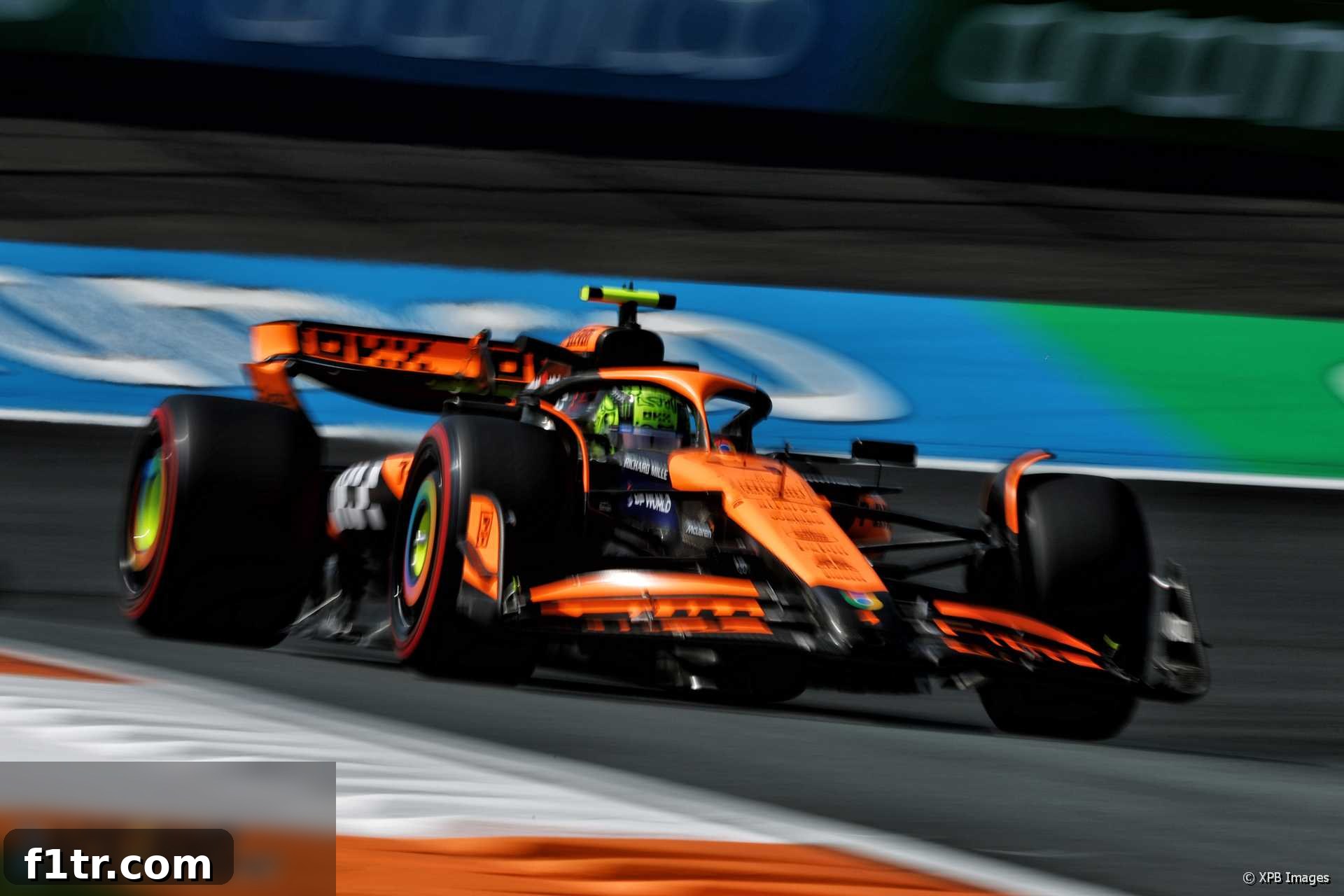
McLaren Team Principal Andrea Stella has affirmed the team’s unwavering commitment to “integrity and fairness” as they navigate the evolving dynamics of the 2024 Formula 1 season. With Lando Norris now positioned as the closest challenger to reigning champion Max Verstappen in the drivers’ championship, the question of potential driver prioritization has become a central topic within the Woking-based squad. As the season enters its critical final ten rounds, McLaren’s approach to managing its drivers, Lando Norris and Oscar Piastri, could prove pivotal in their ambitious pursuit of a world title.
The 2024 season has witnessed a remarkable resurgence for McLaren. Over the preceding five rounds, the team has accumulated more points than any other constructor, a testament to their significant mid-season development push. This impressive run culminated in a spectacular one-two finish at the Hungarian Grand Prix, underscoring the formidable pace and strategic prowess of the team. Building on this momentum, McLaren arrived at the Dutch Grand Prix at Zandvoort armed with their most substantial upgrade package since the Miami Grand Prix earlier in the year, signaling a clear intent to intensify their championship challenge.
McLaren’s Unyielding Stance on Team Orders: Integrity and Fairness First
Before the traditional summer break, McLaren Racing CEO Zak Brown indicated that the team would engage in discussions regarding the potential prioritization of their leading driver in the championship standings. However, Andrea Stella has offered a nuanced perspective, emphasizing that the team will continue to treat both Norris and Oscar Piastri with absolute equality for the foreseeable future. Stella firmly rejects the notion of prematurely designating a “number one” driver, viewing it as an antithetical approach to the spirit of competitive racing and team cohesion.
“When it comes to this conversation about being the number one, I don’t think that’s a good way of approaching racing,” Stella articulated, clarifying the team’s core philosophy. “For us, we’d rather approach racing from fairness, integrity and then see what comes from this kind of approach.” This statement underscores McLaren’s commitment to fostering a competitive yet equitable environment, allowing on-track performance to naturally dictate future strategic considerations rather than imposing hierarchical structures from the outset. This principle is not just about ethics; it’s about optimizing overall team performance and morale, ensuring both drivers feel valued and motivated to extract the maximum from their machinery.
The Path to Championship Contention: Earning Merit on Track
Stella elaborated on the conditions under which driver prioritization might eventually be considered, stressing that such decisions would be earned through consistent on-track performance, not simply granted. “It’s 10 races to go,” he noted, acknowledging the significant portion of the season that remains, demanding relentless focus and execution. “I think Lando, to realistically be in condition to chase the world championship, needs to keep performing at a very high level, he needs to keep being fast, and then you gain your ranks on track.” This implies a performance-based meritocracy, where Norris’s continued excellence and ability to convert potential into points will be the primary driver behind any eventual shift in team strategy. The emphasis is on consistent, high-calibre racing, building a compelling case through undeniable results.
Should Norris consistently demonstrate the speed and competitiveness required to genuinely contend for the world championship, Stella confirmed that the team would then evaluate their options. “If you gain your ranks, if you gain your merits on track by being fast, by being competitive, then we will evaluate – always led by integrity and fairness – whether in some occasions we need the team to take a certain direction in a 50-50 decision,” Stella explained. This pragmatic yet principled approach suggests that any potential team orders would not be a unilateral imposition but rather a carefully considered decision, possibly even involving transparent discussions with Piastri himself to secure his cooperation in supporting Norris’s championship aspirations. The underlying message is clear: performance dictates priority, always within a framework of team cohesion, mutual respect, and a shared pursuit of the ultimate prize.
Learning from Hungary: Pre-Race Clarity on Team Strategy
The sensitive nature of team orders was starkly highlighted at the Hungarian Grand Prix, where an unintentional mix-up during the final pit stops led to McLaren swapping the running order of their drivers. Norris was instructed to allow Piastri to pass him, a decision that stemmed from an unforeseen consequence of the pit strategy rather than a deliberate team order. Reflecting on this incident, Stella emphasized the critical importance of proactive communication and agreement when it comes to imposing any running order or strategic directive that might impact driver positions.
“It always has to be a conversation before the race,” Stella stated unequivocally. “Nobody should be surprised. We all should be in agreement, because ultimately we chase and we are in the quest for a drivers’ world championship as a team. There’s nobody that goes his own way and then the others will have to follow.” This reinforces McLaren’s collaborative ethos, where collective agreement precedes individual action, particularly in scenarios that could impact championship outcomes. The team principal articulated that their strategy is far more nuanced than simply anointing a “number one” driver and operating accordingly. “I don’t think it can be necessarily and simply summarised in ‘we elect a number one and then we work accordingly’,” he elaborated. “I would like to keep this more articulated as a team and then be more on a case-by-case situation,” indicating a flexible, adaptive approach tailored to specific race circumstances rather than a rigid, predefined hierarchy. This dynamic strategy allows McLaren to react to the unpredictable nature of Formula 1 while upholding their core values.
Lando Norris: A Champion in the Making
Despite Lando Norris’s own humility, where he expressed before the summer break that he felt he hadn’t yet earned “number one” status, particularly after failing to convert pole positions in Spain and Hungary into victories, Andrea Stella holds a profoundly high regard for his lead driver’s capabilities. Stella unequivocally believes Norris possesses the innate talent and burgeoning skill set to compete for Formula 1 World Championships, placing him among the elite drivers on the grid.
“Lando is definitely world championship material,” Stella declared with conviction, highlighting the prodigious talent Norris exhibits. “He performs already at levels that I’ve seen in the past in some of the great champions who I’ve had the luck to work with.” This comparison to legendary figures whom Stella has collaborated with in his extensive career – a career spanning multiple championship-winning teams – is a powerful endorsement of Norris’s potential. It speaks volumes about the young Briton’s natural aptitude and his capacity for sustained excellence. However, Stella also acknowledges that both Norris and the team are still on a developmental journey, recognizing that even in pursuit of perfection, there are always areas for improvement and refinement that can unlock even greater performance.
Shared Responsibility: Driver and Team Synergy
Stella pointed to specific areas where opportunities for improvement exist, some of which are attributable to the driver, and others to the team, emphasizing a holistic approach to performance enhancement. “Some of those opportunities come on the first lap, for instance, and trying to find the balance between being aggressive or simply staying away from situational accidents,” Stella explained, detailing the fine margins that define success in Formula 1. He specifically highlighted the team’s responsibility in optimizing starts, noting, “We definitely have something to clean up on the start itself, which is not only a driver’s responsibility, it is also the team’s responsibility.” This candid assessment showcases a balanced perspective, diffusing sole blame and fostering a collective approach to problem-solving, where both human and mechanical elements are continuously analyzed and improved.
Furthermore, Stella took ownership for several strategic missteps that cost Norris valuable points earlier in the season, demonstrating exemplary leadership and transparency. “And then I think he had a couple of situations in the races in which he might have taken some of the responsibility, but I think it was the team’s responsibility,” he admitted. Citing examples like the Canadian Grand Prix, where McLaren failed to pit Norris for a late Safety Car before the pit entry, or strategic choices in the final stint at Silverstone, Stella was unequivocal: “If the team had operated at a higher standard, then Lando would have more points in the championship.” This frank admission not only alleviates pressure on Norris but also highlights McLaren’s internal drive for continuous improvement across all operational facets, from pit wall decisions to race day execution.
The McLaren team principal openly appreciates Norris’s self-critical nature and willingness to take accountability, recognizing it as a valuable trait in a top-tier athlete. “As a team, we kind of appreciate that he puts some of the pressure on himself, or he raises his hand and says ‘it was on me’,” Stella remarked. However, he swiftly follows this with reassuring guidance for his driver. “But I think I have enough experience to say ‘mate, don’t worry. That’s on the team. Keep doing a good job, keep working to improve on your own opportunities.’” This supportive leadership style aims to empower Norris to focus on his strengths and development, trusting the team to address its own areas for enhancement. “But definitely we as a team have quite a lot of work to do as well,” Stella concluded, reinforcing the shared commitment to excellence and acknowledging that the championship pursuit is a collective endeavor.
The Impact of Zandvoort Upgrades on McLaren’s Championship Hopes
The arrival of a significant upgrade package for the Dutch Grand Prix at Zandvoort signifies McLaren’s aggressive strategy to close the gap to Red Bull and consolidate Lando Norris’s championship prospects. Following the impressive performance in Hungary, where the team secured a dominant one-two finish, the upgrades are expected to further enhance the MCL38’s performance characteristics, particularly in key aerodynamic areas. These continuous developments are crucial for maintaining momentum in a highly competitive Formula 1 season, especially when challenging a formidable opponent like Max Verstappen, who has shown few vulnerabilities.
The Zandvoort circuit, with its unique banking, undulating layout, and demanding high-speed corners, offers an excellent proving ground for new aerodynamic components and chassis refinements. The success of these upgrades will not only directly influence Norris’s immediate race results and the team’s ability to consistently challenge for podiums and victories but also provide invaluable data for future car development, potentially shaping the trajectory of the remainder of the 2024 season. McLaren’s proactive and aggressive approach to in-season development highlights their serious intent to sustain their challenge and provide both Norris and Piastri with the most competitive machinery possible, maximizing their chances in every race.
Looking Ahead: A Strategic Balancing Act for McLaren
As the Formula 1 season progresses through its demanding final phase, McLaren faces a delicate but exciting balancing act. Their philosophy of “integrity and fairness” is a strong foundation, embodying a modern approach to team management, but the intensifying championship battle will undoubtedly test these principles to their limits. The team’s ability to maximize points with both drivers while transparently and effectively supporting one’s championship bid, should the situation warrant it, will be absolutely critical. Andrea Stella’s emphasis on pre-race conversations, mutual agreement, and case-by-case decisions suggests a pragmatic, flexible strategy designed to adapt to the unpredictable nature of Grand Prix racing while upholding the core values that define McLaren.
The synergy between Lando Norris’s undeniable talent and the team’s unwavering commitment to continuous improvement paints a highly promising picture for McLaren’s future. With a highly competitive car, a clear developmental trajectory, and a principled leadership approach, McLaren is not just participating in the championship fight – they are actively shaping it with every race. The focus remains on collective excellence, with the understanding that a World Championship title is the ultimate reward for their integrated efforts, driven by both driver brilliance and unwavering team support, all working in unison towards a common, ambitious goal.