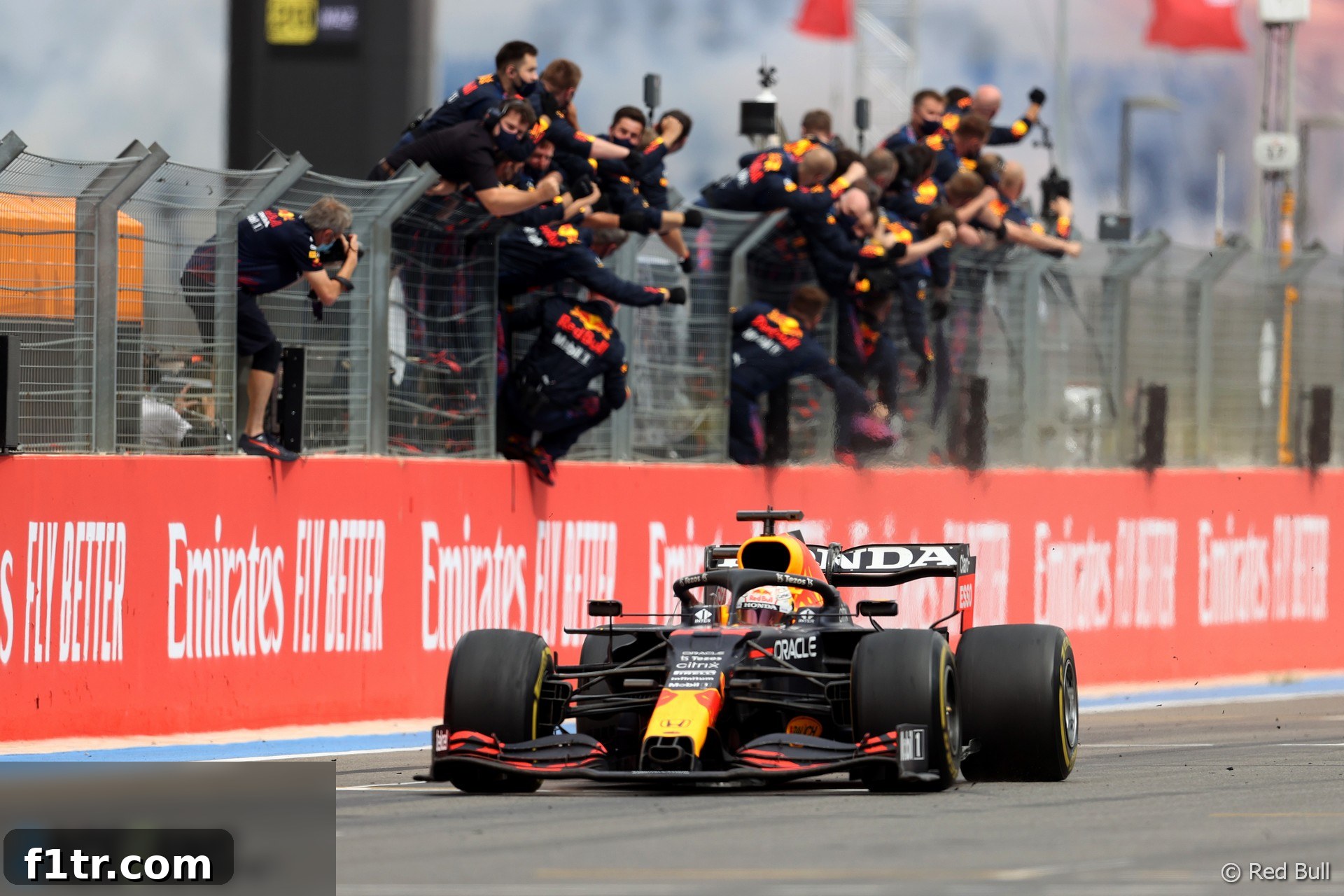
The 2021 Formula 1 season delivered an exhilarating, high-stakes battle between reigning champion Lewis Hamilton and his formidable challenger Max Verstappen. While Hamilton had previously capitalized on strategic missteps and on-track errors from Verstappen in Bahrain and Spain, the French Grand Prix at Circuit Paul Ricard marked a pivotal shift in momentum. This race would not only see Red Bull Racing and Verstappen rectify past strategic shortcomings but also demonstrate their burgeoning prowess, turning what initially seemed like a race-losing mistake into a triumphant strategic masterclass. It was a race that encapsulated the intensity of their championship duel, showcasing both on-track brilliance and razor-sharp tactical acumen.
Verstappen’s Early Setback and Hamilton’s Initial Advantage
As the Formula 1 drivers emerged from the Paul Ricard pits for their first laps since Saturday’s qualifying session, they were greeted by vastly different track conditions. Heavy rain had drenched the circuit earlier that morning, leaving it awash during the supporting F3 race. While the track surface had largely dried by the time of the Grand Prix, a significant drop in temperature – by more than 15 degrees Celsius – had a profound effect. This cooler environment dramatically altered the cars’ handling characteristics and tyre performance, setting the stage for one of the most unpredictable races at Paul Ricard since F1’s return three years prior.
The opening moments of the race delivered the first major surprise. As the pack navigated the challenging Turns One and Two, Max Verstappen, starting from pole position, misjudged his entry. He cut across the inside of the right-handed Turn Two, an error that cost him precious momentum and the lead. Lewis Hamilton, swift to react and capitalize, seized the advantage, slotting his Mercedes into first place.
While Verstappen initially remained within striking distance of Hamilton, trailing by little more than two seconds, his Red Bull teammate Sergio Perez struggled to match their immediate pace. This allowed the leading duo to pull away from the rest of the field, with Perez finding himself a further four seconds adrift. Behind them, Carlos Sainz Jnr, starting in fifth place for Ferrari, was already losing ground, foreshadowing what would prove to be a truly challenging afternoon for the Scuderia. For the first 14 laps, Verstappen maintained his pursuit, keeping the pressure on Hamilton, but the strategic chess match was about to unfold.
On lap 15, a significant moment occurred when Verstappen suddenly lost a full second, widening the gap to Hamilton. This appeared to be a golden opportunity for Mercedes to make their first pit stop, solidify Hamilton’s lead, and potentially secure a comfortable run to victory. However, to the surprise of many, Mercedes chose to pit Valtteri Bottas instead. The team later clarified that this wasn’t an attempt to strategically jump Bottas ahead of Verstappen for a one-two finish, but rather a necessary response to a vibration issue detected on Bottas’s car. Despite this explanation, Bottas had been running just over two-and-a-half seconds behind Verstappen, making Red Bull’s response almost inevitable. True to form, Red Bull swiftly called their leading driver, Verstappen, into the pits. Yet, inexplicably, Mercedes decided to keep Hamilton out on track, a decision that would prove costly.
The Unexpected Undercut: A Strategic Masterstroke
Red Bull wasted no time in making Mercedes pay for their strategic oversight. Despite Max Verstappen having been 3.1 seconds behind Lewis Hamilton before his pit stop, a blistering out-lap on fresh tyres allowed him to rapidly close the gap. Even when Hamilton eventually pitted on the following lap, giving away minimal time during his stop, Verstappen’s aggressive and perfectly executed out-lap was enough to propel him into the lead. Mercedes had been handed a golden opportunity for victory, and they had, regrettably, squandered it.
Even Verstappen himself expressed surprise at the effectiveness of the undercut. “My out-lap was good but I didn’t expect the undercut to be so big,” he commented after the race. “But when I went out I suddenly had so much more grip on the tyres everywhere. I don’t know how fast Lewis’s stop was or whatever, so I need to look at it again, but I think nobody – including us – we never expected to undercut Lewis.” This candid admission underscored the unexpected nature of Red Bull’s strategic success, highlighting how perfectly executed timing and a driver’s commitment can yield extraordinary results.
However, the initial benefit of Verstappen’s new tyres began to diminish quickly. “With new tyres you have one lap where of course everything feels a lot better,” he explained. “[But] as soon as I was ahead the next two laps, they didn’t feel so great anymore.” This meant that Hamilton, now trailing, had a window of opportunity to try and reclaim his lead on track. For several laps that followed, Hamilton pressed Verstappen hard, pushing his Mercedes to its limits in an attempt to launch an attack. But Red Bull had come to Paul Ricard with a secret weapon: a fresh Honda engine and a slimmer, lower-drag rear wing. This setup made their cars remarkably quick on the straights, a clear advantage over Mercedes, which found itself at the bottom of the speed trap rankings.
Mercedes team principal Toto Wolff had observed this potential threat the day before: “The new Honda engine will have some more horsepower, I guess. It’s pretty normal if you put the new engine into the pool. On the other side they run a much less draggy rear wing than us, which in absolute lap time is good for them.” Wolff further elaborated that such a low-downforce setup wasn’t a viable option for Mercedes. “For us it wouldn’t have functioned because even with their lesser downforce, rear wing, they were still able to do the sector times in sector three through the corners that we had.” Red Bull’s superior straight-line speed proved to be a decisive factor, even when Hamilton managed to get within half a second of Verstappen crossing the start-finish line, he simply couldn’t mount a serious overtaking challenge.
The Two-Stop Switch: Red Bull’s Decisive Gamble
After eight intense laps of Hamilton relentlessly pressing Verstappen, the Red Bull driver began to incrementally extend his lead. But a new concern was emerging for the strategists on both sides of the pit wall: despite having switched to the harder compound tyres, the lap times were starting to climb once again. Whether this was a direct consequence of the cooler track temperatures, the reduced rubber on the track surface, the higher tyre pressures mandated for this race, or a complex combination of all these factors, it was becoming clear that what was initially projected as a straightforward one-stop race was now tipping firmly into two-stop territory.
Red Bull had been outmaneuvered by Mercedes in strategic battles before, and they were resolute in not letting it happen again. As lap 31 concluded, both Mercedes drivers were visibly losing pace, signaling obvious reasons for their team to consider a second pit stop. The inherent problem with this was that a second stop for either Hamilton or Bottas would drop them behind Sergio Perez, who had pitted later than the leading trio and was clearly poised to play a crucial supporting role for his teammate.
Thus, on lap 32, after just 14 laps on the hard compound tyres, Red Bull made a bold and decisive move. They surrendered the lead, calling Verstappen in for a second pit stop and fitting a fresh set of medium compound tyres, aiming to cover the remaining 21 laps with maximum attack. Sergio Perez, understanding his role perfectly, swiftly moved aside when Verstappen appeared in his mirrors on lap 34, losing 1.4 seconds to ensure his teammate’s unimpeded progress. This act of team solidarity underscored Red Bull’s united front and strategic precision.
The true value of Perez’s sacrifice and Red Bull’s audacious two-stop strategy became abundantly clear by the race’s dramatic conclusion. Max Verstappen, on his significantly fresher medium tyres, embarked on a relentless charge through the field. He effortlessly cruised past Valtteri Bottas for second place on lap 43, the Mercedes driver inadvertently aiding Verstappen’s progress by out-braking himself at the chicane. With Bottas dispatched, Verstappen rapidly closed the gap to Hamilton, arriving on his rival’s tail on the penultimate lap of the race.
Hamilton might have mounted a more robust defense had it been the final lap, even given the enormous speed differential between the two cars on fresher tyres. However, the seasoned champion recognized the futility of attempting to delay a driver with such a significant tyre advantage in a DRS (Drag Reduction System) zone. “He had the DRS open and if he didn’t pass me there, he would have passed me the straight afterwards,” Hamilton conceded, acknowledging the inevitable. Verstappen swept past, reclaiming the lead and heading for a well-deserved victory.
Three laps earlier, Sergio Perez had successfully relieved Bottas of the final podium spot. During his overtaking maneuver, Perez briefly ran off the track, prompting Mercedes to gamble on leaving Bottas out in the hope that Perez might incur a time penalty. This would have netted Mercedes an additional three points instead of the single point they passed up by not pitting Bottas for a fresh set of tyres to chase the fastest lap. However, Perez was cleared of any wrongdoing by the stewards, and Verstappen ultimately added the bonus point for the fastest lap, completing a maximum haul of 26 points for Red Bull.
McLaren Capitalizes on Ferrari’s Woes
While the Red Bull-Mercedes battle raged at the front, the mid-field was witness to its own drama, with Ferrari experiencing a truly dreadful afternoon. Carlos Sainz, who held a promising fifth place at the end of lap one, unfortunately fell out of the points-paying positions just five laps from the finish. His teammate, Charles Leclerc, who started lap two in seventh, plummeted to a lowly 16th after being forced into an extra pit stop. It was an abject performance for Ferrari, who appeared to struggle more than any of their rivals to cope with the profound overnight change in track conditions and cooler temperatures. Their cars simply could not find the necessary tyre performance or balance, leading to a rapid degradation of their hopes.
Ferrari’s unexpected struggles created a wide-open opportunity for McLaren, and the Woking-based team seized it with both hands. Lando Norris and Daniel Ricciardo delivered strong performances, securing fifth and sixth places respectively, immediately behind the top two teams. This valuable 18-point haul significantly swung the fiercely contested battle for third place in the constructors’ championship back in McLaren’s favour, providing a crucial boost in their season-long campaign.
Lando Norris, in particular, extended his impressive points-scoring streak, overcoming an unpromising start to secure fifth place. A minor gear shift glitch at the start cost him two positions, and there was some audible grumbling on the radio about the manner in which Daniel Ricciardo initially got ahead of him. However, it soon became evident that the McLaren MCL35M was far more comfortable on its tyres than the struggling Ferrari SF21. “I think we were good in the first stint,” Norris later commented. “Everyone was so slow – I think the Ferraris were very slow and they were holding up the AlphaTauri and the Alpines. Then everyone just really destroyed their tyres.”
While Ricciardo ahead opted for an early pit stop to challenge the Ferraris – successfully jumping Sainz and soon passing Leclerc – Norris executed a longer first stint on his initial set of tyres. “Although it felt really terrible at the end of the first stint, I still didn’t come out that far behind all of those cars on some fresh tyres,” he noted, highlighting the effectiveness of his strategy. Norris could also afford to manage his tyres more delicately during the initial warm-up phase, allowing him to preserve them for longer. “I could bring them in nicely and so on. I created a big delta on the tyres to quite easily come back through. So it was a good, fun race for me.”
Norris meticulously worked his way past both Ferraris and Pierre Gasly – the latter providing a particularly robust challenge during their battle – before ultimately passing his teammate Daniel Ricciardo to secure an impressive fifth place. Behind Ricciardo and Gasly, Fernando Alonso and the two Aston Martin drivers, Lance Stroll and Sebastian Vettel, executed extended opening stints to help secure the final points-paying positions. George Russell, driving for Williams, finished a lap down and expressed a degree of bemusement at how he had managed to beat an Alpine, an AlphaTauri, and a Ferrari, yet still failed to score any points. It was a testament to the unpredictable nature of the race and the varying fortunes of the teams.
Red Bull Sets Course for a Happy Homecoming
Following Max Verstappen’s commanding pole position performance on Saturday, Red Bull team principal Christian Horner made a bold statement that resonated throughout the paddock: if they could beat Mercedes at a track like Paul Ricard, then they truly could beat them anywhere. This declaration, initially seen as confident bravado, was spectacularly validated by their triumphant performance on race day.
The victory in France marked Red Bull’s third consecutive win in the 2021 season, a testament to their growing dominance. Had it not been for Verstappen’s unfortunate left-rear tyre blow-out in Baku, this would have been his third successive individual victory as well. As it stands, he successfully extended his lead in the drivers’ championship to a crucial 12 points, further intensifying the already fierce rivalry with Lewis Hamilton.
However, more significant than the points tally itself was the profound implication of winning at a circuit like Paul Ricard. As Horner astutely indicated, victory on this challenging road circuit, which shares characteristics with many tracks in the upcoming rounds – including an effective trio of home races for Red Bull – served as the strongest indication yet that Max Verstappen and Red Bull Racing were not merely contenders but were truly ready to end Lewis Hamilton’s long-standing reign as Formula 1 World Champion. The French Grand Prix was not just another race; it was a powerful statement of intent, a strategic masterclass, and a clear signal that the championship battle had taken a decisive turn.
2021 French Grand Prix
- The potentially crucial differences in how Bottas and Perez help their team mates
- How much-maligned Paul Ricard produced “one of the most exciting races for five years”
- Todt would “prefer less controversy” in Formula 1
- Wolff encouraged by ‘real progress’ from Bottas in French GP
- Red Bull’s French GP win disproves accusations over tyres and wings – Horner
Browse all 2021 French Grand Prix articles
F1 race reviews
- Antonelli lucks in for second win and becomes youngest F1 championship leader
- Emotional Antonelli grabs first Formula 1 victory in Chinese Grand Prix
- Russell sees off Ferrari threat to lead Mercedes one-two in Melbourne
- Norris clinches F1 title by two points as Verstappen wins finale at Yas Marina
- McLaren strategy blunder in Losail hands Verstappen crucial win and shot at title
Read all F1 race reviews