The highly anticipated successor to the most dominant Formula 1 car of all time, the Red Bull RB20, officially hit the track for pre-season testing today at the Bahrain International Circuit. All eyes are on the reigning world champions, Red Bull Racing, as they unveil a radically evolved machine designed to continue their unparalleled success in the pinnacle of motorsport.
With an astounding 21 victories out of 22 races in the previous season, the RB19 set a new benchmark for dominance. Its formidable successor now faces intense scrutiny as it embarks on three crucial days of testing, providing the first real glimpse into the competitive landscape of the 2024 Formula 1 season. The debut of the RB20 marks a pivotal moment, not just for Red Bull, but for the entire F1 grid, eager to gauge the strides made by the Milton Keynes outfit and identify any potential vulnerabilities in their pursuit of excellence.
Max Verstappen, the undisputed maestro behind Red Bull’s recent triumphs and a driver fiercely seeking to clinch an unprecedented fourth consecutive world championship title this year, was the first to pilot the RB20. As the initial sessions of the three-day testing period commenced, Verstappen’s inaugural laps were keenly observed by rival teams and fans alike, offering crucial preliminary insights into the car’s handling and aerodynamic characteristics. The global Formula 1 community waits with bated breath to see if Red Bull can maintain their formidable pace and innovative edge, or if competitors have managed to close the performance gap.
Prior to its grand unveiling in Bahrain, Red Bull had conducted a brief shakedown of their new challenger at a wet Silverstone circuit last Tuesday, just two days before its official launch at their headquarters. This initial run was primarily a systems check, designed to ensure all components were functioning as intended, rather than a performance evaluation. Consequently, it offered little in the way of meaningful data or a true indication of the RB20’s raw speed. Verstappen himself emphasized the limitations of that initial outing, describing the conditions as far from ideal for understanding the car’s true potential.
“It was slippery, wet and cold,” Verstappen candidly told media, including RaceFans, at the car’s launch event. “Everything was fine, of course, from a basic operational standpoint. The car started up well, and the primary objective was simply to ensure that once the team had meticulously assembled the car, all systems were functioning correctly after the build.” This essential preliminary check is vital for any new F1 car before the vehicle is meticulously packed and dispatched to a more suitable testing venue like Bahrain, where the real, intensive performance evaluation program truly begins under representative conditions.
Verstappen highlighted the stark difference between a controlled shakedown and full-scale pre-season testing. “It’s about just making sure that once they’ve put the car together, that everything is running because basically from there the car gets sent to Bahrain,” he explained. “And that’s where it really starts, you really start to learn more about the car. You put a proper programme together and you do a lot of different kinds of running, evaluating various setups, tire compounds, fuel loads, and aerodynamic configurations to gather comprehensive data.” The anticipation was palpable as Verstappen looked forward to extracting genuine performance data from the RB20 on the sun-drenched Bahraini tarmac, a stark contrast to the dreary Silverstone.
Before his proper track debut in Bahrain, Verstappen had spent considerable time in the team’s advanced simulator, experimenting with a selection of different developmental changes and understanding new component behaviors. However, he stressed that these simulator sessions involved testing isolated “development bits” or specific aerodynamic concepts rather than the complete, integrated car package. “I haven’t really done a lot of the total car, like everything together, because constantly you work on development bits, so I still need to do that a bit more,” he elaborated, indicating the ongoing, iterative nature of F1 car development.
Verstappen’s preference underscores the irreplaceable value of real-world track time for a driver, even in an era of sophisticated digital tools. “But I prefer to always drive the car in real life first a little bit more to then have more accurate feedback for the sim,” he explained. This iterative process, where immediate real-world sensations and feedback refine simulator data and models, is crucial for optimizing car performance and ensuring driver comfort and confidence. Despite this preference for tangible experience, he expressed satisfaction with the simulator’s effectiveness thus far in preparing him for the new machine: “But so far I’ve been happy with the sim driving as well.”
While the Red Bull team officially described the RB20 as an evolution of its incredibly successful predecessor, the RB19 — a car that achieved an astonishing 95% win rate in 2023 — the new challenger presents several immediately eye-catching and even radical differences. Team Principal Christian Horner articulated the underlying philosophy behind the RB20’s design, stating that the world champions relentlessly pursued “marginal gains in all areas” with their latest iteration. This commitment to continuous, painstaking improvement, even from a position of overwhelming dominance, is a hallmark of Red Bull Racing’s engineering philosophy, often attributed to the visionary technical direction of Adrian Newey.
Horner further elaborated on the meticulous attention to detail embedded within the RB20’s intricate structure. “You’re constantly looking to try and evolve, to make every component perform better,” he asserted, reflecting the team’s relentless pursuit of perfection. “If you look at the attention to detail on the car, there’s some really exquisite detail throughout its entire structure, from the front wing to the rear diffuser. At the team, there’s been absolutely no complacency following our record-breaking season. They’ve continued to evolve, to push the boundaries of what’s possible within the stringent regulations, ensuring every component, no matter how small, contributes to enhanced performance.” This unwavering dedication to innovation and refinement is what Red Bull believes will keep them ahead of their formidable rivals.
Perhaps the most striking and debated elements of the RB20 are its highly distinctive sidepod inlets and the notably tall, elongated engine cover. These bold design choices have inevitably drawn comparisons with Mercedes’ W14, a car that controversially featured a unique “zeropod” concept which the Silver Arrows ultimately abandoned after its introduction due to inherent performance limitations and a lack of developmental potential. The fact that Red Bull, a team renowned for its aerodynamic genius and often the originator of design trends, appears to be incorporating elements reminiscent of a competitor’s previous problematic design has sparked considerable discussion and speculation within the F1 paddock, raising questions about its effectiveness.
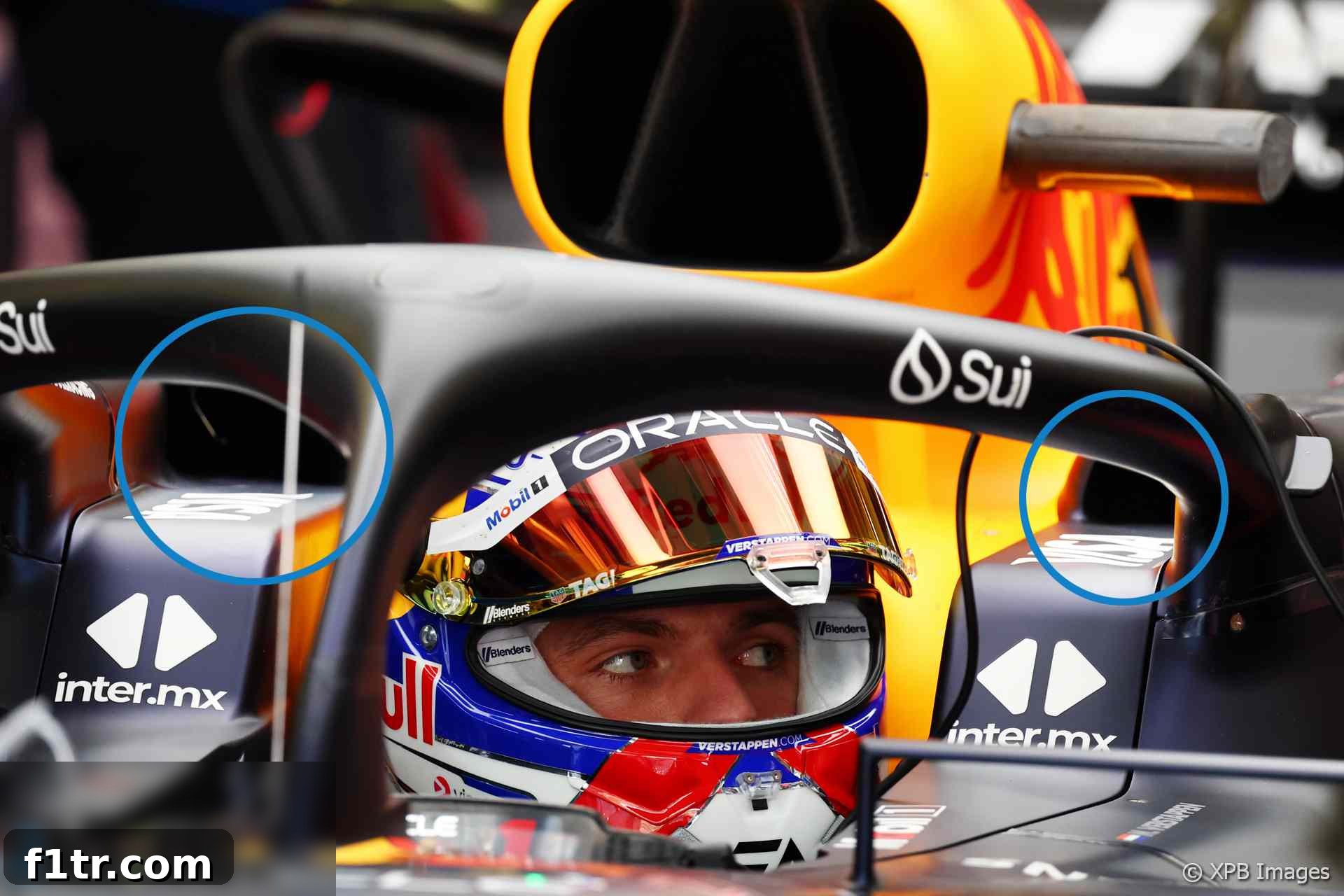
Upon closer inspection, and as the RB20 began its rigorous running in Bahrain, it became clear that the initially observed narrow horizontal and vertical cooling inlets on its sidepods are ingeniously augmented by a further, novel cooling arrangement. This intricate system is discreetly located behind the cockpit, incorporating two additional inlets positioned on either side of the roll hoop, directly behind the driver’s head. This innovative solution provides crucial room for enhanced cooling for the power unit and ancillaries, a vital aspect for both engine performance optimization and reliability in modern, high-intensity Formula 1 racing. This dual-layered approach to thermal management suggests a deeper understanding and application of complex airflow dynamics and energy dissipation.
Christian Horner eagerly embraced the scrutiny, stating, “There’s some great innovation on the car as well that will no doubt get scrutinised over the coming weeks and months by our competitors and the media alike. It’s fantastic to see the engagement and discussion it generates.” He passionately underscored the inherent creativity and fearless approach within his team’s engineering department. “Creativity has been strong in the team. You can see that in some of the audacious solutions that they’ve come up with. It’s not a conservative evolution, there’s some truly great innovation on the car, showcasing our unwavering desire to push aerodynamic boundaries and explore unconventional paths to performance.”
Addressing the conspicuous similarities to Mercedes’ previous design, Horner unequivocally asserted that these were “not tactical choices; rather, they are based purely on performance metrics derived through our advanced simulation tools and exhaustive data analysis.” This statement highlights Red Bull’s profound confidence in their sophisticated simulation and computational fluid dynamics (CFD) capabilities, suggesting that while visual cues might evoke historical comparisons, the underlying engineering rationale for the RB20’s design is distinct, thoroughly validated, and entirely performance-driven based on their own internal findings.
“Obviously the car looks quite visibly different in certain areas to last year’s RB19,” Horner acknowledged, emphasizing the bold design choices and the significant departure from what was an incredibly successful concept. “Only the stopwatch will ultimately tell the true story of its performance on track, but in the virtual world, through countless hours of simulation and computational fluid dynamics, we would not have committed it to design and production if we didn’t feel it was demonstrably better and offered a clear advantage.” This assertion firmly places the onus on track performance to validate their audacious design philosophy, setting the stage for an exciting and potentially groundbreaking season ahead.
Pictures: 2024 Red Bull RB20 on Track During Bahrain Pre-Season Test
As the 2024 Formula 1 season draws ever closer, the performance of the Red Bull RB20 in these crucial pre-season tests will set the tone for the entire championship battle. With Max Verstappen at the wheel, renowned for his exceptional skill, and an audacious, innovative design under the hood, Red Bull Racing aims not just to compete, but to extend its unprecedented era of dominance. The coming days in Bahrain will be instrumental in validating their bold engineering choices and meticulously preparing for what promises to be another thrilling season of high-stakes F1 racing, where every millisecond counts.
More from Formula 1
- Verstappen loathes F1’s new generation of cars – but what do his rivals reckon?
- The ‘throwback weekend’ is back in fashion. But it’s a flawed concept – especially for F1
- Is Formula 1’s double race cancellation a blessing in disguise?
- Todt admits Schumacher crashed on purpose – but did it really cost him two titles?
- 25 of the most memorable radio exchanges from the ‘Max and GP show’
Browse all Formula 1 articles