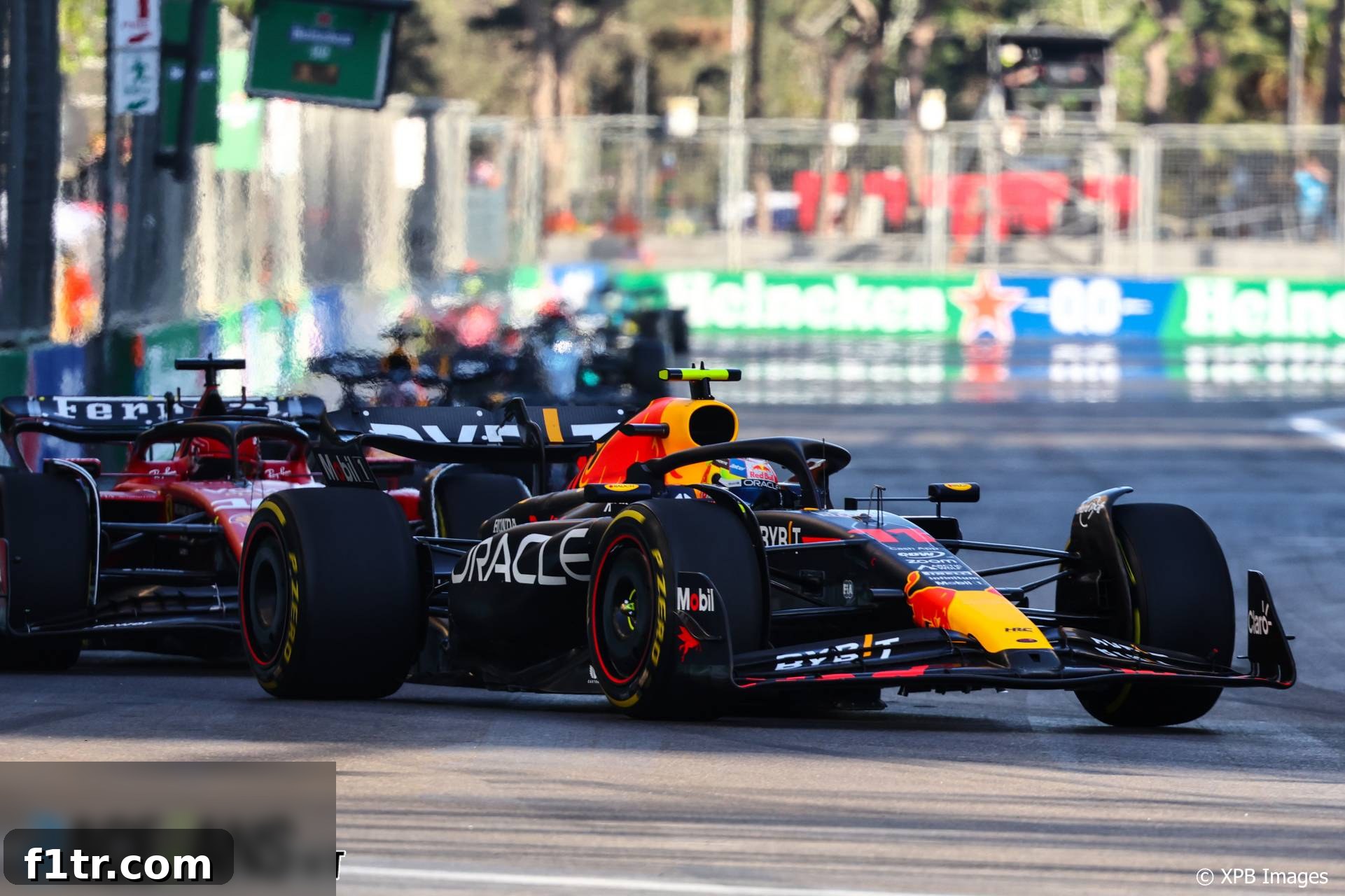
In a thrilling spectacle that ignited the Azerbaijan Grand Prix weekend, Sergio Perez showcased his mastery of the Baku City Circuit, clinching a dominant victory in the highly anticipated sprint race. The Red Bull ace executed a strategic overtake on pole-sitter Charles Leclerc midway through the race, subsequently extending his lead to cross the finish line with a comfortable margin, reaffirming his reputation as the “King of the Streets.” This crucial win not only delivered maximum points for the sprint but also underscored Perez’s formidable form on street circuits, setting a compelling tone for the main Grand Prix event. The unique format of the sprint race, designed to add an extra layer of excitement and unpredictability, certainly delivered as drivers battled fiercely for every position and valuable championship points on the challenging Azerbaijani street circuit.
The exhilarating 17-lap sprint race witnessed a high-stakes battle from the very start. Perez, demonstrating exceptional race craft and optimal use of his Red Bull’s speed, utilized the Drag Reduction System (DRS) to powerfully surge past Leclerc along the incredibly long pit straight. From that pivotal moment, the Mexican driver meticulously built a gap, ultimately securing a four-second lead over the chasing Ferrari. Meanwhile, behind the leading duo, Charles Leclerc, despite losing the lead, displayed remarkable resilience and defensive driving to hold off the persistent challenge from Max Verstappen. Verstappen, who had suffered early race damage, fought valiantly to maintain his position, setting the stage for a tense battle for second place right down to the chequered flag. The incident that affected Verstappen’s race involved an opening lap collision with Mercedes’ George Russell, a moment that significantly shaped the dynamics of the sprint.
Advert | Become a Supporter & go ad-free
High-Octane Start and Early Drama
The inaugural sprint race of the season kicked off with immense anticipation, and Charles Leclerc, starting from pole position, launched his Ferrari perfectly, rocketing into the lead as the lights went out. Perez, starting alongside him, quickly settled into second place, keeping the Monegasque driver within striking distance. However, the drama unfolded just behind them. Max Verstappen, known for his aggressive starts, found himself under immediate pressure from George Russell. The Mercedes driver, showing impressive pace and determination, managed to pull ahead of the Red Bull on the exhilarating run towards Turn 3, a critical early maneuver that would soon lead to controversy. During this intense jostling, Russell made contact with Verstappen’s car, resulting in significant damage to the Red Bull’s sidepod. This incident was a defining moment for Verstappen, limiting his performance throughout the remainder of the race and forcing him to manage a compromised car.
Further back in the pack, the unforgiving Baku circuit claimed its first major victim in the sprint. Yuki Tsunoda, driving the AlphaTauri, clipped the barrier at the notoriously tricky kink of Turn 13. The impact was severe enough to rip the tyre clean off his wheel, sending debris across the track. Tsunoda, with his car visibly damaged, limped back towards the pits. As his AlphaTauri struggled, the Virtual Safety Car (VSC) was promptly deployed to allow marshals to clear the scattered remains of Tsunoda’s tyre from the circuit, particularly on the approach to Turn 16. Despite the damage, Tsunoda pitted and rejoined the race, though his car was clearly compromised. This unsafe release, with the AlphaTauri’s rear wing visibly flapping, caught the attention of the stewards, who announced an investigation into the team’s actions after the race, highlighting safety protocols in extreme situations.
Safety Car Intervention and Race Restart
The initial Virtual Safety Car period proved insufficient as drivers began to report a substantial amount of debris still scattered across the track, posing a clear hazard. Consequently, race control made the decision to upgrade the VSC to a full Safety Car, allowing marshals ample time to thoroughly clear the circuit and ensure driver safety. This brought the entire field together, effectively neutralizing any gaps that had been built and setting the stage for a dramatic restart. The race resumed at the end of lap five, with Leclerc leading the procession. Perez was hot on his heels in second, followed by Russell in third, and a recovering but damaged Verstappen in fourth. The restart itself was a moment of high tension and strategic maneuvering. Verstappen, ever the opportunist, capitalized on the bunched-up field. Displaying his characteristic bravery and precision, he dove to the inside into the first corner, cleanly re-passing George Russell and reclaiming third position, a vital move given the early damage he was carrying.
As the field settled after the Safety Car restart, the race truly came alive. At the end of the first green flag lap, DRS (Drag Reduction System) was officially enabled, immediately changing the dynamic of the leading battle. Sergio Perez, known for his prowess in managing tyre degradation and utilizing DRS effectively, wasted no time in putting immense pressure on Charles Leclerc. The Red Bull’s superior straight-line speed on the pit straight became a critical factor. Perez meticulously stalked Leclerc, waiting for the perfect moment. That moment arrived at the start of lap eight, where, with DRS wide open, Perez effortlessly slipped past the Ferrari into the lead. Once ahead, Perez unleashed a blistering pace, rapidly pulling clear of Leclerc and establishing a gap beyond the DRS activation range, effectively breaking the tow and securing his position at the front.
Perez Extends Lead, Leclerc Defends From Verstappen
Following his decisive overtake, Sergio Perez continued to demonstrate exceptional control and pace at the front of the pack. He managed to keep his lead over Charles Leclerc consistently around the one-second mark for several laps, hinting at the finely balanced performance between the Red Bull and Ferrari. However, with approximately five laps remaining in the sprint, Perez found an extra gear. He began to incrementally increase his pace, steadily building his advantage to over three seconds. This strategic push in the latter stages allowed him to solidify his grip on the lead and effectively remove himself from any potential late-race threats. Behind him, the battle for second place intensified significantly. Max Verstappen, despite the lingering effects of his early contact with Russell and the resultant aerodynamic damage, relentlessly pursued Leclerc. He remained within a second of the Ferrari for much of the latter half of the race, constantly applying pressure and looking for any opportunity to pass. However, the combination of Leclerc’s masterful defensive driving and the inherent difficulty of overtaking on Baku’s long straights without a clear pace advantage meant Verstappen never quite got close enough to attempt a decisive move, settling for an intense, yet ultimately unfulfilled, chase.
As the final laps ticked away, Sergio Perez continued to eke out his advantage, expertly managing his tyres and maintaining a blistering pace. He crossed the chequered flag just over four seconds clear of his nearest competitor, securing a well-deserved victory and maximum points from the sprint race. Charles Leclerc, having started on pole and led for several laps, brought his Ferrari home in a commendable second place, fending off the damaged but determined Red Bull of Max Verstappen by a mere six-tenths of a second. This strong finish for Leclerc was a testament to his defensive skills and the Ferrari’s inherent speed on the street circuit. George Russell, who was involved in the early incident with Verstappen, finished a further three seconds behind, securing a solid fourth place for Mercedes. His early pace was impressive, but the strength of the Red Bull and Ferrari ultimately proved too much to overcome for a podium position.
Points Finishers and Weekend Implications
Beyond the podium, the sprint race saw a tight battle for the remaining points-scoring positions, each offering crucial championship momentum. Carlos Sainz Jnr, in the second Ferrari, drove a controlled race to finish in fifth place, adding valuable points to his tally. Fernando Alonso, the veteran Spaniard, continued his impressive form, bringing his Aston Martin home in sixth. Seven-time world champion Lewis Hamilton secured seventh place for Mercedes, showcasing consistent performance. The final point in eighth place was claimed by Lance Stroll in the other Aston Martin, ensuring both cars scored. Just outside the points, Alexander Albon narrowly missed out, finishing ninth for Williams after a strong showing. Oscar Piastri completed the top ten for McLaren, continuing to gain experience and demonstrate potential in his rookie season. The results of this sprint race provided significant insights into the pecking order and potential strategies for the main Azerbaijan Grand Prix, with Perez clearly establishing himself as a formidable contender for Sunday’s feature race. The points gained were vital for the championship standings, adding an extra layer of intensity to what promises to be an unforgettable weekend of Formula 1 action on the streets of Baku.
Advert | Become a RaceFans supporter andgo ad-free
2023 Azerbaijan Grand Prix Related Content
- Aston Martin radio messages reveal how “older brother” Alonso helps Stroll
- How slashing practice to a single hour in Baku tripped up F1 teams
- Bottas: “Rapid improvement needed” at Alfa Romeo
- Red Bull could become first team to score 1,000 points in a season
- Aston Martin hoping DRS fix works in Miami after Stroll manages fault in race
Browse all 2023 Azerbaijan Grand Prix articles