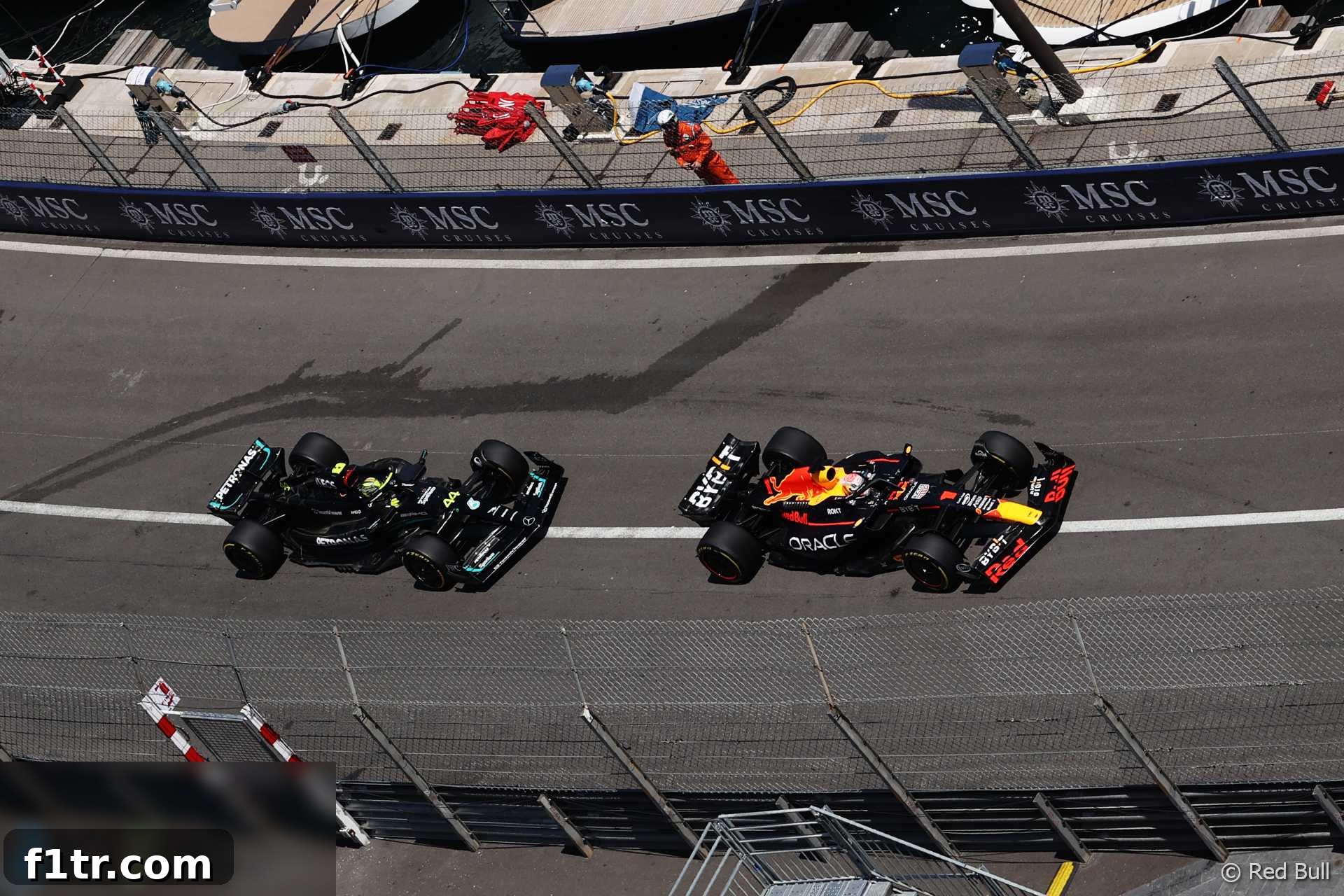
Lewis Hamilton on Mercedes’ New Design: A Long Journey to Close the Red Bull Gap
Lewis Hamilton has offered a candid assessment of Mercedes’ strategic pivot, confirming that the team’s decision to align their car design more closely with Red Bull’s dominant philosophy is beginning to yield positive results. However, the seven-time world champion emphasized that bridging the performance chasm separating them from the reigning constructors’ champions will be a protracted and arduous process. This significant shift marks a new chapter for Mercedes, moving away from the distinctive ‘zero sidepod’ concept that has characterized their W13 and W14 challengers since the introduction of the current aerodynamic regulations in 2022.
The highly anticipated comprehensive update to the Mercedes W14 chassis made its debut at the iconic Monaco Grand Prix. This upgrade package, which prominently features revised bodywork and, crucially, a new sidepod design, represents a decisive departure from their unique aerodynamic approach. For over a year, the motorsport community watched as Red Bull’s design proved overwhelmingly effective, begging the question of why it took Mercedes so long to follow suit. When directly asked about this delay, Hamilton’s response was simply, “Sure.” He elaborated, “I don’t know what else to say. It definitely is difficult when you see it and you see the proof of the concept, and it’s working.” This frank admission underscores the frustration within the Mercedes camp, witnessing a rival’s design philosophy consistently outperform their own meticulously developed, yet ultimately flawed, concept.
Beyond Imitation: The Nuances of Aerodynamic Integration
Hamilton was quick to temper expectations, highlighting that simply adopting a similar visual design will not instantly unlock Red Bull-level performance. He stressed that extracting the full potential from this new aerodynamic philosophy requires intricate understanding and substantial development, a process that takes considerable time and effort. Drawing a parallel, he recalled Aston Martin’s experience in early 2022. While Aston Martin also transitioned to a Red Bull-inspired sidepod design, Hamilton noted, “You saw that last year the Aston just changed the sidepods and they didn’t go faster. It took a whole heap of work over the winter.” This observation serves as a crucial reminder that Formula 1 car design is not merely about replicating visible components but about understanding the complex interplay of every aerodynamic surface and how they contribute to the car’s overall efficiency and downforce generation.
The challenge for Mercedes extends far beyond superficial changes. As Hamilton articulated, “The fact is we are more in that direction. But still, the airflow that they have, how they control their wake and everything is still a little bit different to ours.” This statement cuts to the core of modern F1 aerodynamics. Red Bull’s success is not solely attributed to their sidepod design, but to a holistic aerodynamic package that meticulously manages airflow from the front wing to the diffuser, minimizing drag while maximizing downforce. Their ability to “control their wake” – the turbulent air disturbed by the car – is paramount, allowing for a cleaner flow over subsequent aerodynamic elements and ensuring consistent performance in varying conditions. This intricate dance of air management is where Red Bull has held a significant advantage, particularly on the straights.
Unpacking Red Bull’s Aerodynamic Dominance
Red Bull’s formidable strength on the straights is a testament to their superior aerodynamic efficiency. They consistently achieve impressive top speeds without resorting to oversized wings, which typically generate high levels of drag and compromise straight-line performance. Their ingenious design allows them to generate substantial downforce, essential for high cornering speeds, with minimal aerodynamic resistance. This balance is incredibly difficult to achieve and is a key differentiator between Red Bull and the rest of the grid. Mercedes, on the other hand, has struggled to find this equilibrium, often requiring larger wing elements to achieve sufficient downforce, which in turn incurs a penalty in terms of drag and top speed.
Hamilton’s analysis of this disparity is telling: “I think there’s work we need to do in order to be able to use a smaller wing [like] they have. We’re still not as efficient, they still have less drag, they still have more downforce pretty much everywhere. And so we’ve got a lot of work to catch up.” This highlights the multi-faceted nature of Mercedes’ challenge. It’s not just about one area; it’s about optimizing the entire package to achieve the same level of efficiency across various parameters. The quest for less drag and more downforce concurrently is the holy grail of Formula 1 aerodynamics, and Red Bull has evidently mastered this balance with their current machinery.
Evaluating the Upgrades: The Monaco Paradox and Future Projections
The introduction of such a pivotal upgrade package at the Monaco Grand Prix presented a unique challenge for Mercedes. The team had originally planned to unveil these significant changes at the Emilia-Romagna Grand Prix, but its unfortunate cancellation due to severe flooding necessitated a change of plans. Consequently, Monaco, widely recognized as the slowest and most idiosyncratic circuit on the Formula 1 calendar, became the chosen venue for the W14’s updated guise. Monaco’s tight, twisting streets, its relentless series of low-speed corners, and its limited opportunities for high-speed running make it an outlier where the true impact of aerodynamic changes, particularly those aimed at improving overall efficiency and high-speed stability, is notoriously difficult to assess accurately. The specific demands of Monaco often mask broader performance trends, meaning that while initial data points are collected, a definitive judgment on the upgrade’s success remains elusive.
Team principal Toto Wolff echoed Hamilton’s sentiments regarding the long-term perspective and the challenge of immediate evaluation. Wolff acknowledged the limitations of Monaco for data gathering but expressed optimism about the path ahead. “I think Barcelona is not enough. I think we need to collect data, that’s why we put it also here in Monaco, collect further analysis, which we will do in Barcelona. Montreal is a little bit of an outlier again.” This strategic approach underscores Mercedes’ commitment to a systematic and data-driven development process. Wolff’s comments suggest that a comprehensive understanding of the W14’s new capabilities will only emerge after a few races, allowing the team to gather sufficient data from diverse track types and conditions. Barcelona, with its mix of high-speed corners and a long main straight, typically serves as an excellent benchmark for overall car performance, while Montreal, with its heavy braking zones and chicanes, offers different insights. This measured approach is crucial for optimizing the car and understanding how to extract maximum performance from the updated package.
Wolff concluded with a cautious but hopeful outlook: “Over the next races, hopefully we can really increase the performance of the car. But it’s not going to suddenly be right there. That’s why I’m actually pleased with the time gap that we have today. That was always a mediocre race track for us, so that’s okay.” This reflects a realistic understanding within Mercedes that a sudden leap to the front of the grid is unlikely. Instead, the focus is on incremental gains and a sustained development trajectory. The initial performance in Monaco, a circuit historically not favoring Mercedes’ previous car characteristics, provided some encouragement, suggesting that the fundamental direction of the upgrade is sound. The journey to reclaim their position at the pinnacle of Formula 1 is clearly a marathon, not a sprint, demanding patience, perseverance, and meticulous engineering.
Mercedes’ Path to Recovery: A Test of Patience and Engineering Prowess
The decision to fundamentally alter the W14’s aerodynamic concept represents a significant gamble for Mercedes, one taken out of necessity rather than choice. Since the sweeping regulatory changes of 2022, the Silver Arrows have struggled to adapt, finding themselves behind the pace of Red Bull and, at times, even Aston Martin. This shift towards a design philosophy proven by their rivals is a pragmatic acknowledgement of what works best under the current rules. It signals a readiness to learn, adapt, and relentlessly pursue every avenue for performance improvement. The path to recovery is paved with countless hours of simulation, wind tunnel testing, and real-world track data analysis. It requires not just engineering brilliance but also strategic foresight and the ability to rapidly iterate on design concepts.
For Lewis Hamilton, this period of development is particularly critical. His dedication to pushing the team forward, offering invaluable feedback, and maintaining motivation despite the challenges is a testament to his championship mentality. He understands that closing the gap to Red Bull involves not only a better car but also continuous optimization of every aspect, from tire management to race strategy. The coming races in Spain and Canada will be crucial litmus tests for the W14’s new direction, providing a clearer picture of its potential and the scale of the task ahead. Mercedes’ ambition remains unwavering: to return to championship contention. This bold aerodynamic overhaul is a definitive statement of intent, signaling their determination to grind their way back to the top of Formula 1, one meticulously engineered upgrade at a time.
Support Independent F1 Journalism: Join the RaceFans Community
RaceFans strives to bring its readers news directly from the key players in Formula 1, offering unique insights and in-depth analysis. This commitment to original journalism is made possible, in large part, by the invaluable backing of our dedicated RaceFans Supporters.
By contributing a modest sum of £1 per month or £12 per year (or the equivalent in your local currency), you play a crucial role in helping us cover the extensive costs involved in producing high-quality, independent motorsport coverage. Your support enables essential activities such as traveling to events, rigorous writing and editing, content creation, website hosting, maintaining vital contacts within the F1 paddock, and continuous platform development.
For over a decade, we have proudly relied on the generosity of our readers. If you appreciate our unbiased reporting and comprehensive coverage of Formula 1, please consider becoming a RaceFans Supporter today. As a token of our gratitude, all our Supporters also enjoy an ad-free browsing experience across the entire site. Learn more or sign up via the links below:
- Become a RaceFans Supporter Today
- RaceFans Supporter FAQ
Further Insights from the 2023 Monaco Grand Prix
- Mercedes Ready to “Grind” Their Way to Competitiveness After Major W14 Update
- Verstappen Surpasses Vettel as Winner of Most Races for Red Bull
- Strategic Tire Calls: How Monaco’s First Intermediates Paved the Way to Success
- Verstappen’s Monaco Pole: Horner Links it to 2021 Jeddah Lap’s Unfinished Business
- Haas Thrilled as Upgrade Performance Exceeds Wind Tunnel Predictions
Browse All 2023 Monaco Grand Prix Articles