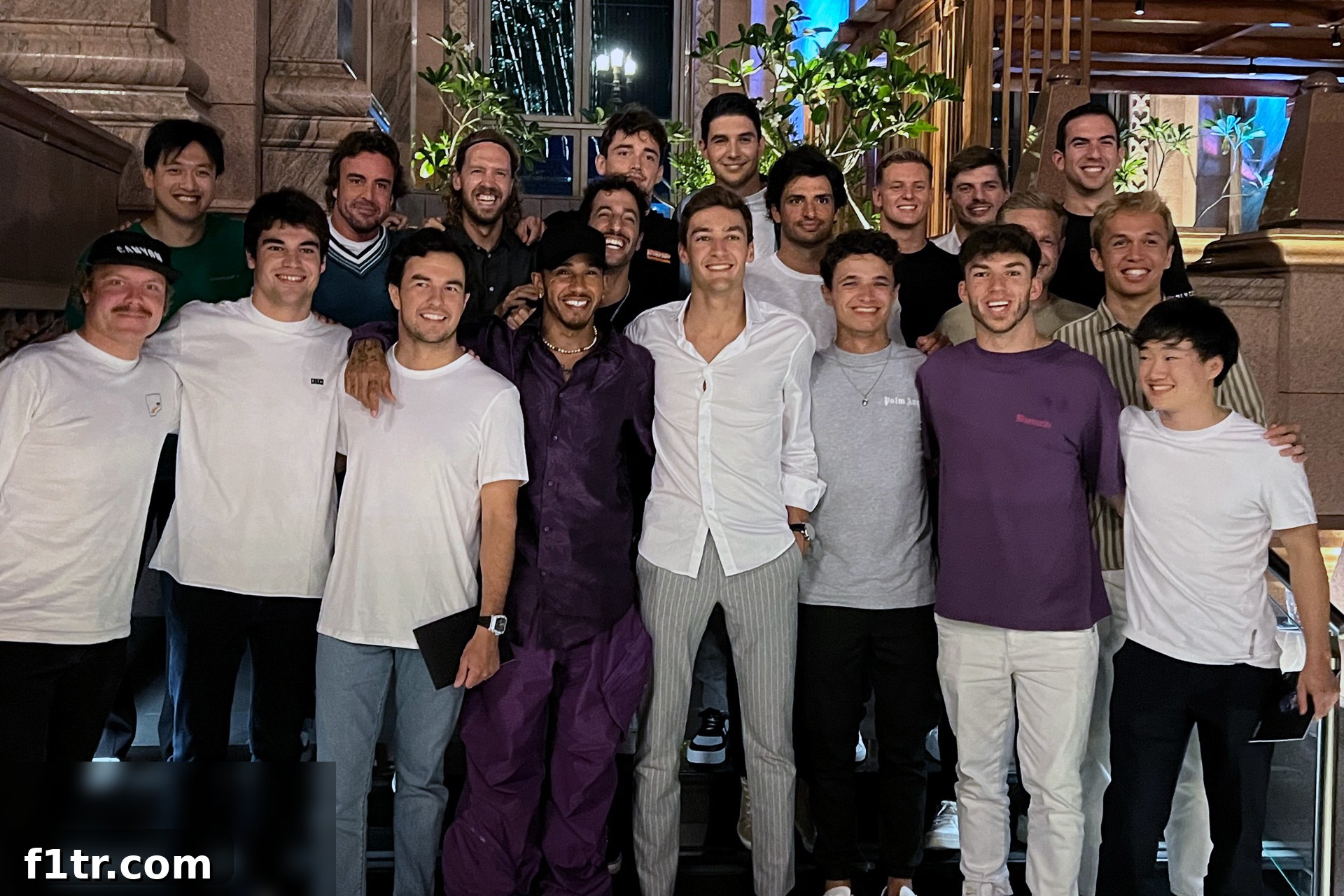
In a rare display of unity that transcended the fierce rivalries of Formula 1, all 20 drivers gathered on a Thursday evening in Abu Dhabi for an emotional farewell dinner honoring the retiring four-time world champion, Sebastian Vettel. This unprecedented gathering, a testament to the respect and camaraderie within the pinnacle of motorsport, marked a significant moment as the entire grid set aside their competitive instincts to celebrate one of the sport’s most respected figures. The occasion served not only as a tribute to Vettel’s illustrious career but also highlighted the unique bond shared by this elite group of athletes, often unseen by the public.
Images of the dinner, quickly shared across social media by the drivers themselves, offered fans a candid glimpse into the personal side of their heroes. This event was particularly noteworthy as it represented the first time all active F1 drivers had convened in such a social setting since the 2016 Chinese Grand Prix. The mastermind behind this memorable evening was none other than Vettel’s former championship rival, Lewis Hamilton.
Hamilton explained his motivation to the media, including RaceFans, stating, “I thought it was really important. That’s why I asked in Mexico whether they would be open to all doing a dinner to give Seb a farewell. We haven’t had a dinner [together] since years ago in China.” His initiative underscores a growing sense of solidarity among the drivers, moving beyond the track’s cutthroat environment to foster genuine connections. Hamilton’s proactive role in organizing such an event speaks volumes about the esteem in which Vettel is held, not just as a competitor but as a person, and signals a maturing culture within the F1 paddock.
During the dinner, Vettel took center stage to deliver a heartfelt speech, a moment that resonated deeply with everyone present. Lewis Hamilton later described the evening as “the best evening,” recalling, “We were all laughing so much, great stories, Seb is a great leader as well. He made a great speech, just trying to hand down some of his experiences that he’s had over these years particularly to the younger guys for their future.” This mentorship role, even in retirement, highlights Vettel’s enduring influence and his desire to impart wisdom gained from nearly two decades at the highest level of motorsport. His words likely offered invaluable perspectives on handling pressure, maintaining passion, and navigating the demanding world of Formula 1, serving as an inspiration for the sport’s next generation.
Fans, ever observant, meticulously scrutinized the circulating images of the F1 class of 2022 seated around the dinner table, searching for any subtle cues of loyalties or underlying hostilities. However, Alexander Albon swiftly debunked any speculation about strategic seating arrangements. “Whoever arrives just sits,” he clarified, emphasizing, “there’s no kind of musical chairs going on.” This simple assertion highlighted the relaxed and natural atmosphere of the evening, where genuine interaction superseded any competitive posturing.
Albon arrived at the restaurant alongside his Williams team mate, Nicholas Latifi, who, like Vettel, was potentially making his final Grand Prix start that weekend. Albon humorously recounted their early arrival: “Nicky and I were first to arrive. We were five minutes late and we were the first by 20 minutes, so we got to sit next to each other.” Their casual early bird status further underlined the spontaneous and unscripted nature of the gathering, allowing for natural pairings and conversations to unfold.
“Everyone seems to be good friends,” Albon reflected, painting a picture of a largely harmonious grid. “There’s not really any big rivalries, apart from a couple.” This statement offers a fascinating insight into the modern F1 paddock. Despite the intense on-track battles and the high stakes of professional racing, a foundation of mutual respect and even friendship appears to exist among many drivers. Albon elaborated on the reasons behind this camaraderie, pointing to their shared lifestyle: “But generally speaking, we all get along really well. I think we see each other more than ever now, just with the amount of races that we’re doing, all the travelling we’re doing, where we tend to be either sharing planes or whatever.”
He continued, “So we get to spend a lot of time with each other. We see each other more than our own families, as I’m sure you [media] guys see each other more than yours. So there’s a good spirit with the whole grid.” This poignant observation underscores the unique reality of Formula 1 drivers’ lives, where their professional duties often lead to more time spent with rivals than with loved ones. This shared experience of constant travel, pressure, and collective pursuit of excellence naturally forges bonds that extend beyond the confines of the race track, creating a profound sense of community within the paddock.
The possibility of such a large-scale social event had been hampered for two years by stringent Covid restrictions, making this gathering particularly poignant. For many younger drivers on the grid, it was their first opportunity to meet and interact with all their rivals simultaneously in a relaxed social setting. This allowed for conversations with drivers they might seldom encounter outside of official race weekends or media commitments.
Lando Norris articulated this fresh perspective: “It was my first time doing such a thing, I think it’s cool. You kind of grow up in the world of motorsport, you’re not forced to not like each other, but you don’t grow up to like each other. You’re always seeing them as enemies more than anything.” His reflections shed light on the competitive mindset instilled from a young age in racing. The dinner, therefore, represented a significant shift, allowing Norris to experience “quite a different feeling sitting there actually talking to everyone completely away from a race track and away from racing. So it’s nice. I spoke to some people I’ve almost never spoken to before.” This rare chance for genuine connection, free from the pressures of competition, revealed a different dimension to the relationships within the F1 community.
The drivers convened at the prestigious Hakkasan restaurant in Abu Dhabi, a detail that became important amidst circulating rumors. It was widely but inaccurately reported elsewhere that the F1 contingent was the party responsible for racking up an astronomical 615,000 Dirham (£140,000) bill that very night at Abu Dhabi’s branch of Nusr-Et, the notoriously expensive steakhouse chain owned by Instagram influencer Salt Bae. The clarification underscored the reality that while F1 drivers certainly enjoy a lavish lifestyle, their farewell dinner for Vettel was focused on camaraderie rather than extravagant displays of wealth.
Daniel Ricciardo, another driver facing an uncertain future in F1 as he headed into his final race for the foreseeable future, shared his experience of the evening. “A couple left early,” he noted, “while others stayed late, returning to base in the early hours of the following morning.” Ricciardo highlighted the joy of stepping away from the competitive environment: “Obviously we had a good excuse to do it for Seb as a bit of a farewell for him, but you kind of just forget when we all get in a room away from the competition of this environment it’s just quite nice.”
He continued, “We all have obviously a lot in common, probably more than we think actually. So it was just cool to enjoy each other’s company and not really talk racing and not talk competition. I felt like we all were just learning a bit more about each other away from the track, so that was nice.” Ricciardo’s comments emphasize the human element of Formula 1, where beneath the helmets and team colors, these athletes share universal experiences of dedication, sacrifice, and the relentless pursuit of excellence, fostering a mutual understanding that transcends national origins or team affiliations.
Fernando Alonso, the grid’s most experienced driver with a career spanning over two decades, offered a unique historical perspective on the gathering, having attended several such get-togethers throughout his illustrious 21-year career. Having once battled legends like Michael Schumacher, Mika Hakkinen, and David Coulthard, he now competes against a completely new generation of rivals, a shift he keenly observed.
“It was Jos Verstappen there when I started and now it’s Max,” the Alpine driver remarked, illustrating the generational shift. Alonso delved deeper into the evolving dynamics of the F1 paddock: “It’s just different. It was more respect [for the older generation] before, it was less of this younger generation or social media or whatever. Before it was like very strong characters in Formula 1, it was DC, it was Mika, it was Michael. It was very established which one was who.” He characterized the older era as one dominated by distinct, formidable personalities, where rivalries often held a more rigid and perhaps less overtly friendly edge.
Comparing it to the present, Alonso observed, “Now it’s a little bit more friendly in a different way. I don’t say fake, but all young, all friendly. Before it was different.” While acknowledging the difference in demeanor, he clarified his preference: “But I like it more now, I think it is more fun. Everyone is taking pictures, that’s the only thing you need to be careful of because you cannot have a bad moment because it will be all around the world, someone will be filming. But apart from that, I think it was good fun.” Alonso’s insights highlight the impact of social media and changing societal norms on the sport, creating a more interconnected and outwardly amicable environment among drivers, even if it comes with the added scrutiny of constant public visibility.
Hamilton’s team mate, George Russell, echoed the sentiment of universal enjoyment, admitting the evening proved “a lot more fun than we probably would have expected. We’ve sort of said we need it more often.” Russell articulated the unique bond that connects the F1 fraternity: “There’s only 20 [F1] drivers in the world, there’s only one another that can understand what we all sort of go through. And in a way that’s something quite special that we all share in common and in a way that all brings you a little bit closer. But when the helmet’s on, the helmet’s on.” His words perfectly capture the duality of F1 life: fierce adversaries on track, yet a tight-knit community sharing an unparalleled journey off it.
The resounding success of Vettel’s farewell dinner has sparked discussions about making such gatherings a regular fixture. Lewis Hamilton, a key instigator, expressed optimism for the future: “Afterwards we were like ‘let’s do it all the time’. Maybe we’ll make this an annual thing here, maybe we’ll have another one in the year perhaps.” This potential shift towards more frequent social interactions could significantly strengthen relationships within the paddock, fostering a healthier and more cohesive environment for the sport.
Beyond casual dinners, Hamilton also emphasized the value of solidifying connections among racers through the Grand Prix Drivers Association (GPDA), an organization that represents their collective interests within the championship. “There’s also a lot that we can do as the GPDA, as a united group,” said Hamilton, recognizing the immense platform and responsibility they collectively hold. “We have, I think, a responsibility, we’ve got a great platform each and every one of us collectively and it’s encouraging.”
He further elaborated on the potential influence of a unified GPDA: “Collectively that there’s lots of things that Formula 1 needs to really push forward on action-wise. It says we’re doing a lot of things, sustainability and those things, but really, really making sure we’re pushing through and doing the absolute best and maybe the GPDA can have a role in that.” This vision positions the GPDA not just as a body for driver welfare, but as a powerful advocate for broader issues such as sustainability and social responsibility within Formula 1, leveraging the collective voice and influence of its most prominent figures to drive meaningful change.
2022 Abu Dhabi Grand Prix – Related Articles
- Norris dissatisfied with solitary podium finish: “One isn’t enough”
- Verstappen achieves most dominant title win since Vettel in 2013
- Magnussen’s experience makes him ‘positive’ ousted Schumacher can return to F1
- Overtaking still difficult at Yas Marina despite 2021 track changes, say drivers
- Depressing to consider points lost says Gasly after AlphaTauri slump to ninth
Browse all 2022 Abu Dhabi Grand Prix articles