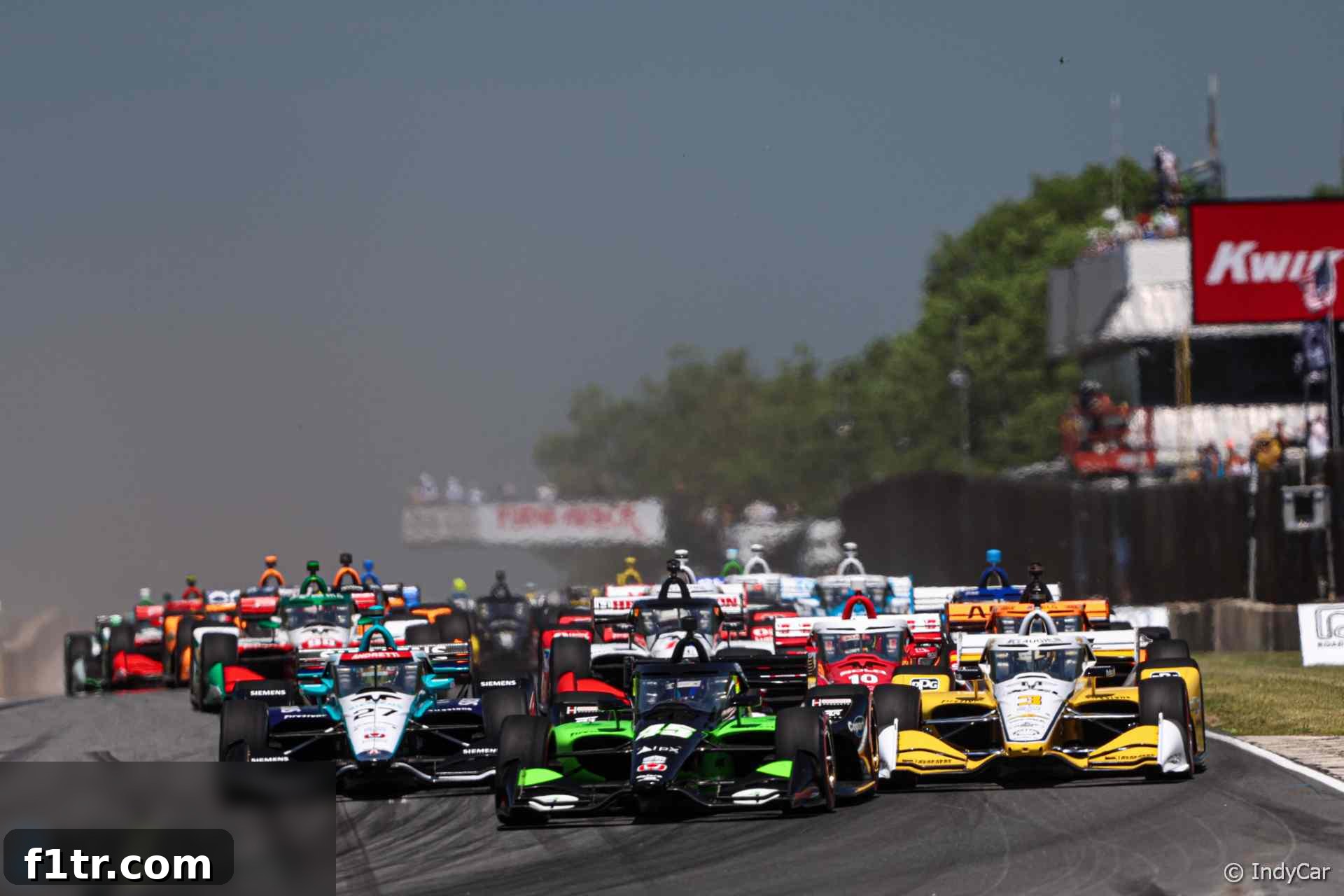
FIA Boosts IndyCar Superlicence Points, Paving Clearer Path to Formula 1
In a significant move that acknowledges the growing stature and competitive integrity of America’s premier open-wheel series, the FIA has announced a substantial revision to its Superlicence points allocation for IndyCar drivers. Starting in 2026, the NTT IndyCar Series will award a greater number of Superlicence points to its top performers, addressing long-standing criticisms that its previous valuation disproportionately favored European-based feeder categories like Formula 2 and Formula 3.
This long-awaited adjustment is poised to open a more direct and equitable pathway for talented IndyCar drivers aspiring to compete in Formula 1, reducing the need for them to transition to different series solely to accrue the necessary points. The decision reflects a broader recognition by the FIA of IndyCar’s high level of competition, its demanding schedule, and the exceptional skill required to succeed in its diverse array of circuits.
The FIA Superlicence system was initially implemented in 2015, primarily in response to the rapid promotion of a then-17-year-old Max Verstappen to Formula 1 with Toro Rosso. Designed to ensure that only adequately experienced and qualified drivers could enter F1, the system mandates that aspiring Grand Prix racers accumulate a minimum of 40 Superlicence points over a three-year period. While commendable in its intent to standardize driver eligibility, the previous allocation system sparked considerable debate, particularly concerning the relatively low points awarded to IndyCar compared to its European counterparts.
Under the prior 2025 regulations, the Formula 2 championship offered a total of 201 points across its top ten finishers, making it the most direct route to F1 eligibility. Formula 3, a tier below F2, surprisingly provided 128 points to its top ten drivers. In stark contrast, IndyCar—a series renowned for its wheel-to-wheel action, diverse tracks, and high-speed oval racing—only offered 124 points across its top ten. This disparity meant that even a champion in IndyCar might struggle to meet the 40-point threshold within three years without strong supplementary results, a stark undervaluation of a series many consider to be on par with, if not superior to, F2 in terms of driver skill and car performance.
The revised 2026 allocation seeks to rectify this imbalance. While Formula 2 will likely retain its dominant position with 40 points for its champion, the total points available for IndyCar’s top ten finishers will rise significantly to 158. Although still less than F2, this increase represents a substantial upgrade, making IndyCar a much more viable and respected pathway on the global motorsport ladder. This change acknowledges the intense competition, the physically demanding nature of IndyCar machinery without power steering, and the unique challenges presented by its calendar, which includes street circuits, traditional road courses, and high-speed ovals like the Indianapolis Motor Speedway.
The impact of this revised points system is best understood through the experiences of drivers like Colton Herta. Last year’s IndyCar championship runner-up, Herta, a driver widely considered to possess the talent for Formula 1, found himself moving to Formula 2 for the upcoming season. His primary motivation was to boost his Superlicence points tally, a clear indication of how the previous system forced promising talents from other prestigious series to alter their career trajectories unnecessarily. With the new allocation, future IndyCar contenders in similar positions may find their path to F1 significantly less convoluted, allowing them to focus on excelling in their current series rather than chasing points in another.
The influx of former Formula 1 drivers into IndyCar also underscores the North American series’ growing appeal and high standard. Mick Schumacher, for example, is set to join the IndyCar grid next year, following in the footsteps of fellow ex-F1 racers like Marcus Ericsson and Alexander Rossi. Both Ericsson and Rossi have not only found success in IndyCar but have also claimed victory in the series’ crown jewel event, the Indianapolis 500. Their transition highlights IndyCar’s reputation as a fiercely competitive championship where driver skill is paramount and opportunities for glory are abundant, further justifying the FIA’s decision to re-evaluate its Superlicence points.
Revised IndyCar Superlicence Points Allocation (2026)
The table below illustrates the updated Superlicence points distribution, comparing Formula 2, Formula 3, and the previous (2025) and new (2026) allocations for IndyCar.
| Championship Position | Formula 2 | Formula 3 | IndyCar (2025) | IndyCar (2026) |
|---|---|---|---|---|
| 1st | 40 | 30 | 40 | 40 |
| 2nd | 40 | 25 | 30 | 30 |
| 3rd | 40 | 20 | 20 | 25 |
| 4th | 30 | 15 | 10 | 20 |
| 5th | 20 | 12 | 8 | 15 |
| 6th | 10 | 9 | 6 | 10 |
| 7th | 8 | 7 | 4 | 8 |
| 8th | 6 | 5 | 3 | 6 |
| 9th | 4 | 3 | 2 | 3 |
| 10th | 3 | 2 | 1 | 1 |
A closer look at the revised table reveals the most significant gains for IndyCar drivers finishing in the crucial mid-pack positions. For instance, a third-place finish in IndyCar now yields 25 points, up from 20. Fourth place jumps from 10 to 20 points, a doubling that dramatically enhances a driver’s Superlicence prospects. Similarly, a fifth-place finish now awards 15 points, nearly doubling the previous 8. These increases are vital, as they make it far easier for consistently strong performers, even if they don’t win the championship, to accumulate points toward F1 eligibility.
The FIA’s decision to adjust the Superlicence points system for IndyCar is more than just a bureaucratic change; it represents a philosophical shift in how the governing body perceives the global motorsport landscape. By elevating IndyCar’s standing, the FIA acknowledges the strength and relevance of single-seater racing outside of Europe. This move could also encourage greater cross-pollination of talent between series, enriching both Formula 1 with a more diverse pool of drivers and IndyCar by solidifying its role as a legitimate breeding ground for Grand Prix aspirations.
Ultimately, this revised points system benefits everyone involved. Drivers like Herta will have clearer, more logical career paths. IndyCar gains further international recognition and legitimacy as a top-tier championship capable of producing F1-ready talent. And Formula 1 itself stands to gain from a potentially broader and more diverse pool of experienced, high-caliber drivers, irrespective of their geographical origin in the motorsport world. As the boundaries of global motorsport continue to blur, such adaptive regulations are crucial for fostering talent and ensuring that the best drivers find their way to the pinnacle of racing.
Advert | Become a RaceFans supporter andgo ad-free
Related IndyCar News & Insights
- IndyCar driver McLaughlin cleared of injury after crashing through barrier at Barber
- Schumacher says his IndyCar feels like ‘an F2 car, just with better tyres’
- IndyCar “way faster than Formula 1” in some corners, says Grosjean
- FIA to award more F1 Superlicence points to IndyCar drivers from 2026
- Schumacher to race full-time in IndyCar with RLL in 2026
Browse all IndyCar articles