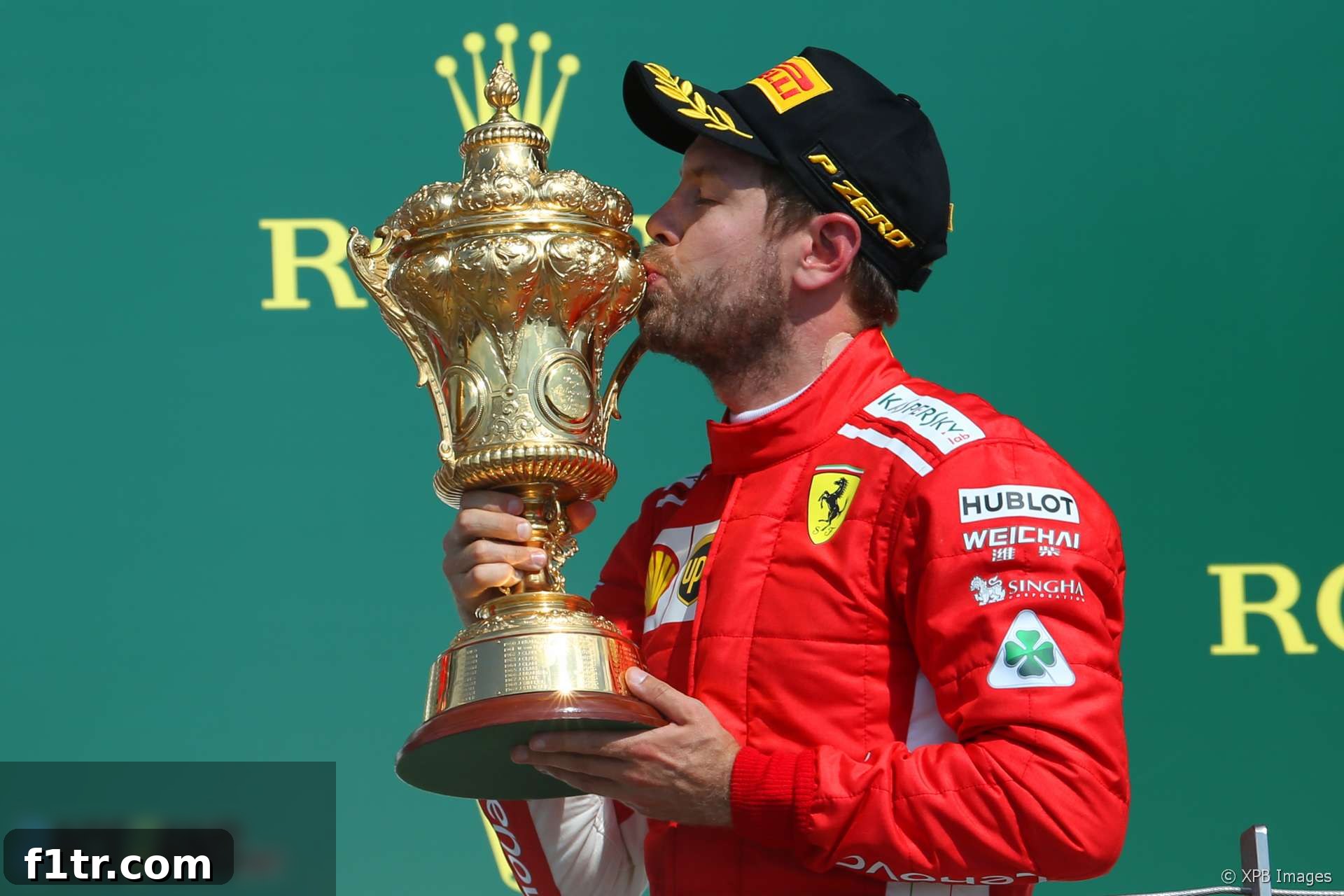
Vettel Conquers Silverstone: Ferrari’s Resurgence and Hamilton’s Home Grand Prix Heartbreak
In a thrilling spectacle at the 2018 British Grand Prix, Sebastian Vettel delivered a masterful performance, securing his fourth victory of the season and extending his lead in the championship. This triumph marked a significant moment for Ferrari, who hadn’t claimed a win at the iconic Silverstone circuit in seven years. The race was a rollercoaster of strategic gambles, intense wheel-to-wheel battles, and dramatic incidents, leaving fans on the edge of their seats and deepening the captivating rivalry between Ferrari and Mercedes.
Vettel, visibly elated, attributed his success to the considerable improvements Ferrari had brought to Silverstone. “It’s been a difficult track for us in the past,” he reflected, “but this year, I think we were a match, proving our significant strides forward.” Indeed, the Scuderia’s pace was undeniable throughout the weekend, setting the stage for a dramatic showdown against their formidable Mercedes rivals.
Hamilton’s Heartbreak at Home: A Disastrous Start and Costly Collision
The British Grand Prix weekend at Silverstone was characterized by an unseasonable heatwave. Temperatures soared above 30 degrees Celsius, baking the track and creating an atmosphere of intense pressure. The newly re-laid surface, while offering immense grip akin to Circuit de Catalunya and Paul Ricard, also presented a unique challenge with its surprising bumpiness, as noted by Lewis Hamilton. Track temperatures soared past 50 degrees Celsius, demanding meticulous tyre management and impeccable starts.
For Hamilton, starting second on the grid, the pressure of a home Grand Prix victory weighed heavily. As the lights went out, his Mercedes’ nearly 1,000bhp surged, but the initial communication between power and tarmac was flawed. “I just had a poor getaway,” Hamilton candidly admitted later, “too aggressive. I got wheelspin and lost ground immediately to the others.”
This momentary lapse proved catastrophic. Vettel, starting directly behind him, capitalized instantly, surging past the faltering Mercedes. Valtteri Bottas, launching from fourth, executed a far superior start than his problematic getaway in Austria a week prior, and swept past his teammate into second position as they navigated the challenging Abbey corner. The chaos, however, was far from over.
As the pack thundered into the first major braking zone at Village, Kimi Raikkonen, having gained momentum, found himself on the inside of Hamilton. Although the Mercedes driver left a reasonable amount of space, Raikkonen misjudged his braking point, snatching the brakes and colliding with the rear of Hamilton’s car. The impact sent Hamilton spinning wildly into the run-off area, dropping him to the very back of the field and utterly derailing his hopes for a straightforward home victory.
The incident immediately ignited controversy. Post-race, Hamilton himself fanned the flames of speculation, making insinuations about Ferrari’s “interesting tactics.” The predictable claims of an intentional, nefarious act of sabotage, rather than an innocent if clumsy misjudgement, grew louder amidst the tension of the championship battle. The race stewards, after reviewing the footage, ruled against Raikkonen, imposing a 10-second penalty – a decision that many deemed harsher than the five-second penalty Sebastian Vettel received for a similar incident at Paul Ricard earlier in the season.
FIA race director Charlie Whiting, while not directly involved in the stewards’ deliberations, later offered his perspective. “I can only think that they felt it was a little more serious than what Sebastian did in France,” he mused. “I don’t know their exact thought process, but I do know there was widespread criticism of the lenience of the penalty given in France, so perhaps that affected their decision-making here.” This disparity in penalties only added another layer of intrigue and contention to an already heated championship narrative.
Go ad-free for just £1 per month>> Find out more and sign up
Vettel Pulls Clear as Hamilton Mounts a Furious Recovery
Advert | Become a Supporter & go ad-free
From the moment he snatched the lead at Turn One, Sebastian Vettel was in imperious form. He wasted no time establishing a commanding lead, scorching away from Valtteri Bottas and building a six-second cushion within the opening ten laps. The Ferrari’s initial pace on the soft tyres was blistering, demonstrating the significant performance gains the team had made at a circuit that had previously been a weak point.
However, the scorching Silverstone temperatures soon began to take their toll on the soft compound tyres. As Mercedes had predicted, the Ferrari started to struggle with degradation in the latter half of the first stint. By lap 20, Bottas had managed to close the gap to 4.4 seconds, signaling that Vettel’s tyres were fading. Conscious of past tyre-related setbacks, particularly their experience in China, Ferrari reacted decisively, calling Vettel into the pits for fresh rubber. Bottas followed suit on the very next lap, maintaining the strategic chess match at the front.
While the leaders engaged in their strategic dance, Lewis Hamilton was orchestrating one of the most remarkable recovery drives of his career. Starting from near last after the Raikkonen collision, he sliced through the midfield with astonishing ease and aggression. On average, he passed more than one car per lap, demonstrating the sheer pace of the Mercedes and his unparalleled ability to carve through traffic. By lap 10, Hamilton had astonishingly climbed back into the top six, a testament to his talent and determination.
Despite his heroic efforts, the initial setback had cost him dearly. At the end of lap one, the gap to Vettel had been 13.7 seconds. By the time Hamilton cleared the midfield and found himself in clean air, that gap had more than doubled, illustrating the immense challenge that still lay ahead.
Yet, once both Vettel and Hamilton were running in clear air, the true pace of the Mercedes began to show. Over the subsequent 21 laps, Hamilton managed to shave a significant five seconds off Vettel’s lead. Later in the race, even after Vettel’s second pit stop equipped him with softer and fresher tyres, he struggled to pull away decisively from Hamilton, who was on older and harder compounds. This highlighted a crucial point: while Ferrari had raised their game, the Mercedes still possessed a fundamental speed advantage, particularly in the intense heat. Ultimately, however, it was Hamilton’s poor initial start, not a lack of car performance, that proved to be his undoing on this occasion.
Mercedes’ Safety Car Gamble and High-Stakes Strategy
Even with his impressive lead, Sebastian Vettel acknowledged Ferrari’s lingering vulnerabilities. “We probably still have some weaknesses in the race at different phases,” he admitted. “At the end of the first stint, I think Valtteri was a bit faster,” he added, indicating the ongoing challenge of maintaining tyre performance throughout a race distance. Had the race continued uninterrupted, Vettel might have faced a formidable struggle on his fading tyres with Bottas closing relentlessly in his mirrors.
However, the capricious nature of Formula 1 intervened. The first pivotal moment arrived when Marcus Ericsson, while attempting to activate his DRS on the Abbey straight in pursuit of Sergio Perez, suffered a catastrophic failure. His car snapped into a violent spin, careening into the barriers nose-first. The ensuing debris and track blockage necessitated the deployment of the Safety Car, completely resetting the race dynamics.
This Safety Car period presented a crucial strategic fork in the road. For Vettel, it was a golden opportunity to pit for a fresh set of medium compound tyres, erasing the concerns of his fading rubber. For Mercedes, it offered a chance to gain track position on Bottas, opting to keep him out on his older, medium tyres. Both teams seized their respective opportunities, setting the stage for a tense strategic showdown.
Bottas’s commitment to a long, 31-lap stint on the medium tyres was a high-stakes gamble. His cause was further aided – or complicated, depending on perspective – when the first Safety Car period was almost immediately followed by a second. Romain Grosjean and Carlos Sainz Jnr collided dramatically as they went side-by-side, triggering another massive, high-speed crash that scattered carbon fibre across the track. This second Safety Car effectively neutralized a significant portion of the race, extending Bottas’s tyre life and compressing the field once more.
In total, approximately ten laps of green flag racing were lost due to these incidents, profoundly impacting tyre strategies and race pace. When the Safety Car finally peeled into the pits and the race recommenced, Bottas found himself bravely fending off a charging Vettel. Behind them, Lewis Hamilton had miraculously climbed to third, a testament to his recovery and the Safety Car’s timing, while Kimi Raikkonen engaged in a furious scrap with Max Verstappen, adding another layer of excitement to the frantic restart.
Advert | Become a RaceFans supporter andgo ad-free
Vettel Reclaims the Lead in a Masterful Overtake
As the race restarted following the second Safety Car, Valtteri Bottas demonstrated exceptional composure, executing a pair of flawless restarts to maintain his lead over Sebastian Vettel. For several laps, the Finn showcased a masterclass in defensive driving, meticulously positioning his car to deny Vettel any opportunity to pass, despite the Ferrari’s advantage on fresher tyres. But as Bottas’s medium tyres began their inevitable decline, Vettel grew ever more menacing, his Ferrari seemingly glued to the Mercedes’ gearbox.
“It was quite intense,” Vettel recounted after the race. “Obviously, I had the advantage on the tyres, but he had the clean air. In the high-speed stuff, I was able to follow, but it became increasingly difficult the closer I got.” The duel was a captivating display of strategic racing and driving skill, with every corner and straight becoming a battleground.
Vettel, renowned for his patience and opportunistic timing, bided his time perfectly. On lap 46, he tucked in tightly behind Bottas as they approached Brooklands, the left-handed corner that has historically offered one of Silverstone’s prime overtaking zones. Bottas, sensing the pressure, defended robustly. The next time around, Bottas had a slightly poorer exit onto the straight, a fractional error that Vettel instantly recognized. Again, Vettel tucked in, riding the slipstream, and then, at the absolute last possible moment, he deftly jinked to the inside. Bottas was caught off guard, unable to react as Vettel seized the inside line with audacious bravery, clinching the lead and positioning himself for victory.
“I was able to surprise him,” Vettel explained, a hint of satisfaction in his voice. “I think he thought that I wouldn’t dare to go to the inside. The braking zone was coming quite fast, but I thought, ‘Okay, I have to go for it’ because I was obviously also struggling – the longer I spent behind him, struggling with my tyres as they got hotter, and losing that advantage that I had a little bit.” He continued, “I felt great when I was side by side and wasn’t sure if I would make the corner, but I did.” It was a decisive move, executed with precision and courage, that would ultimately define the race.
In the final laps, Bottas’s worn tyres, now severely degraded, left him vulnerable. His heroic defense crumbled, and he was unable to hold off both Lewis Hamilton and Kimi Raikkonen, who swiftly swept past him. While staying out on worn tyres had been a calculated gamble, a strategic risk worth taking in the moment, Bottas conceded in retrospect that it was “clearly the wrong decision,” underscoring the fine margins and unpredictable nature of Formula 1 strategy.
Midfield Mayhem: Red Bull’s Struggles and Unexpected Performances
While the focus remained on the dramatic battle for the lead, the midfield delivered its own share of excitement and misfortune. Red Bull, a team often in contention for podiums, never truly factored into the fight at the front. Their down-on-power Renault engines proved a significant handicap at Silverstone, a circuit where an increasing number of corners are now taken flat-out, demanding maximum horsepower. Max Verstappen, after a promising start, saw his race scuppered by a brake-by-wire problem, ultimately ending his charge for fifth place. This position was instead inherited by Daniel Ricciardo, who made a well-timed second pit stop just before the Safety Car was deployed, a fortuitous decision that paid dividends.
Haas, a team that had demonstrated strong qualifying pace, squandered their promising “best-of-the-rest” starting positions through an unfortunate internal incident. Romain Grosjean blundered into his teammate Kevin Magnussen, severely compromising both their races. Grosjean subsequently crashed out during the second Safety Car period, while Magnussen, despite the damage, managed to recover to a handy ninth place, salvaging some points for the American outfit.
In stark contrast, Nico Hulkenberg delivered an excellent performance for Renault, securing a robust sixth place. He initially came under pressure from the talented Charles Leclerc in the Sauber, who was showing impressive pace. Leclerc, attempting an aggressive early pit stop for an undercut to get ahead of the Renault, unfortunately retired with a loose wheel, a cruel blow after a promising run. “When you are pushing everything to the limit sometimes it happens, you do mistakes,” a philosophical Leclerc commented. “It’s a shame because we were fighting for P6… I think the undercut was working very well, but it happens and we’ll come back stronger.”
Esteban Ocon secured a solid seventh place for Force India. His teammate Sergio Perez was then promoted to the final points-paying position after Pierre Gasly received a penalty for barging into him late in the race. Perez was particularly fortunate to finish with a point, having narrowly avoided being collected by the Williams pair after spinning into the pit lane exit at the very start of the Grand Prix, highlighting the chaotic nature of the opening lap.
Fernando Alonso, in his McLaren, secured a commendable eighth place, once again extracting the maximum from his package. His teammate Stoffel Vandoorne endured a challenging weekend, expressing dissatisfaction with the balance and performance of his car throughout the event, ultimately finishing three places behind Alonso.
Advert | Become a RaceFans supporter andgo ad-free
Vettel Takes the Trophy: A Statement Victory for Ferrari
Saturday had presented an uncomfortable challenge for Sebastian Vettel, who reportedly had to rest his head in the car between sessions to ease the strain on his neck. However, Sunday’s triumphant performance more than compensated for any physical discomfort. His victory, while inadvertently aided by his teammate Kimi Raikkonen’s collision with Hamilton, was nonetheless a hard-fought win, characterized by strategic brilliance and decisive driving.
This crucial victory at Silverstone not only broke Ferrari’s seven-year winless streak at the circuit but also significantly bolstered Vettel’s championship aspirations, extending his lead to a critical eight points over Lewis Hamilton. It was a powerful statement from both Vettel and Ferrari, demonstrating their resolve and improved package in the hotly contested 2018 season.
Following the emotional race, Vettel spent a moment admiring his prize: the prestigious classic BRDC trophy. His name would now be etched onto it for the second time, adding another chapter to his illustrious career. He humorously noted, “The trophy obviously carries over names of previous winners, but it stopped in 2005, so I was wondering where the last 13 years have been.” He later learned, “When I came back to the podium room, they showed me that there’s another bit that they forgot to put on. But for sure it’s a very prestigious trophy with a lot of names.”
The discovery of the ‘missing’ names highlighted a poignant detail: prior to this weekend, the four most recent winners inscribed on that very trophy were all Lewis Hamilton’s. Missing out on a home victory, one he was clearly quick enough to clinch, would undoubtedly have rankled with Hamilton, who had dominated Silverstone in recent years. However, the championship battle is far from over, and Hamilton will undoubtedly relish the chance to return the favour: Vettel’s home race, the German Grand Prix, is next on the calendar, promising another exhilarating chapter in this thrilling Formula 1 season.
2018 British Grand Prix
- Hamilton equalled another Senna record at Silverstone
- 2018 British Grand Prix Star Performers
- Top ten pictures from the 2018 British Grand Prix
- Vettel denies Hamilton at home as Ferrari and Mercedes clash again
- Paddock Diary: British Grand Prix day four
Browse all 2018 British Grand Prix articles
F1 race reviews
- Antonelli lucks in for second win and becomes youngest F1 championship leader
- Emotional Antonelli grabs first Formula 1 victory in Chinese Grand Prix
- Russell sees off Ferrari threat to lead Mercedes one-two in Melbourne
- Norris clinches F1 title by two points as Verstappen wins finale at Yas Marina
- McLaren strategy blunder in Losail hands Verstappen crucial win and shot at title
Read all F1 race reviews