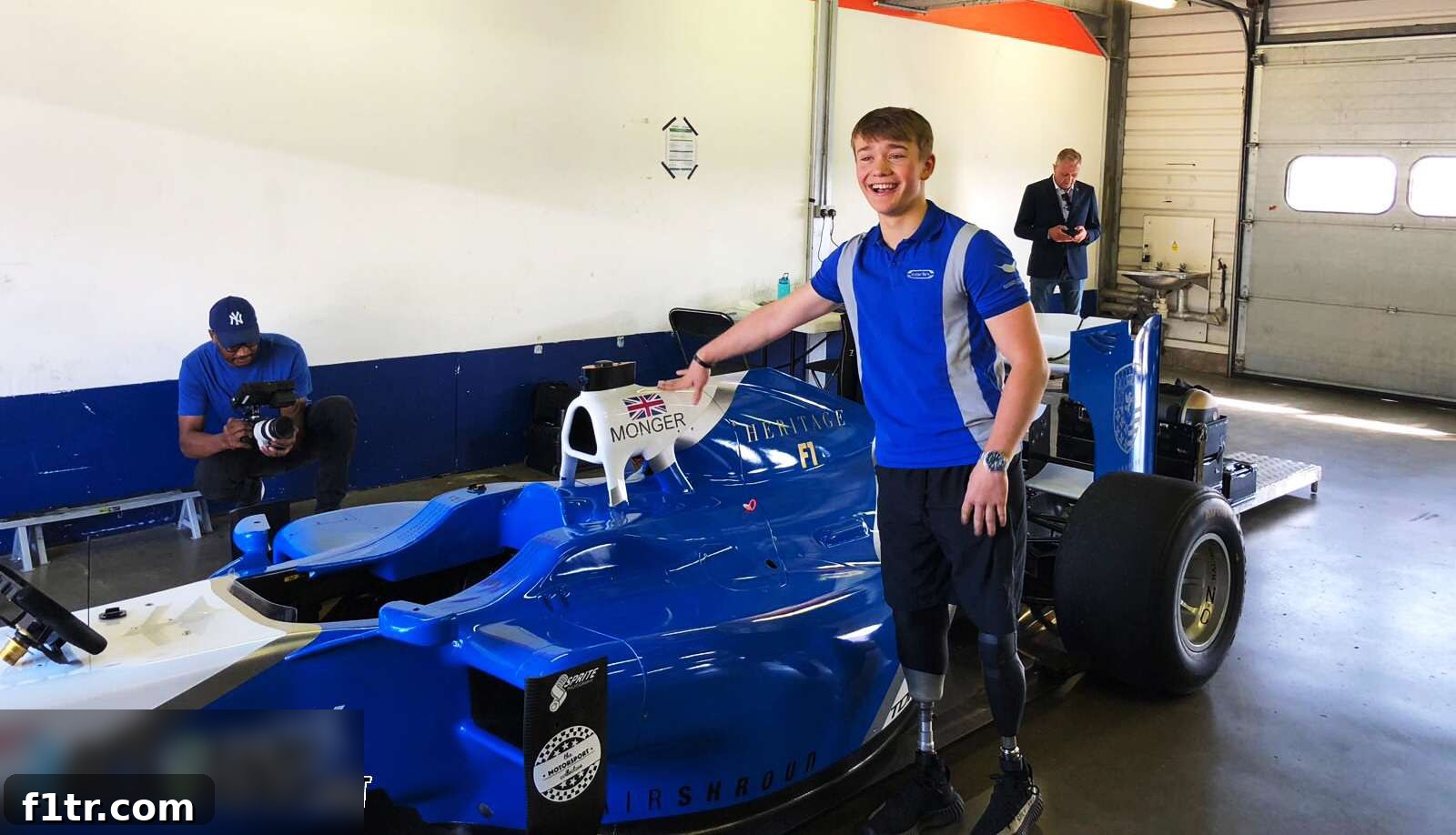
Billy Monger’s Inspirational Formula 1 Test: A Triumph of Spirit and Innovation
In a truly heartwarming and groundbreaking moment for motorsport, British F3 racer Billy Monger was given the surprise opportunity to test a Formula 1 car, specifically a Sauber C30, at the historic Rockingham circuit. This test, shrouded in secrecy until the very last minute, marked a significant milestone not just for Monger but for the broader landscape of adaptive motorsport.
Monger, whose incredible journey captured the world’s attention after he lost parts of both legs in a devastating Formula Four crash in 2017, was completely unaware that this life-changing experience awaited him. The surprise test was meticulously arranged by Heritage F1, a renowned supplier of historic F1 cars, demonstrating a profound commitment to pushing boundaries and inspiring others.
From Devastation to Determination: Billy Monger’s Remarkable Comeback
Billy Monger’s story is one of unparalleled courage and resilience. At just 17 years old, while competing in a British Formula 4 race at Donington Park, he was involved in a horrific accident that led to the amputation of both his lower legs. For many, such an injury would signify the end of a racing career. However, Billy, with his unwavering spirit, defied all expectations. Within months, he was back in a racing car, demonstrating an extraordinary will to compete.
His return to competitive motorsport in 2018, just a year after his accident, saw him participate in the British F3 Championship. Driving specially adapted cars, Monger not only competed but also achieved podium finishes, proving that physical limitations do not define a racer’s spirit or ability. His “BillyWhizz” nickname became synonymous with his tenacious pursuit of excellence and his ability to inspire millions worldwide. This F1 test was a natural, albeit dream-like, progression for a young man who continually shattered perceptions of what’s possible.
The Surprise Unveiled: A Dream Realized at Rockingham
The 19-year-old racing sensation woke up on this momentous day to discover he would be driving a 2011-specification Sauber C30. The choice of Rockingham circuit for this historic test was particularly poignant, as Monger had already raced there earlier in the year on its Sports Car course. This familiarity with the venue likely provided a small comfort amidst the overwhelming excitement and adrenaline of driving an F1 machine for the first time.
The element of surprise was crucial, making the experience even more special for Billy. Heritage F1’s dedication to keeping the test under wraps until the last possible moment undoubtedly amplified the emotional impact, turning a professional opportunity into a deeply personal triumph. It was a testament to the community’s desire to see Billy thrive and experience the pinnacle of motorsport.
Engineering for Inclusivity: Adapting an F1 Car for Hand Controls
One of the most remarkable aspects of this F1 test was the sophisticated adaptation of the Sauber C30 to accommodate Monger’s specific needs. To allow him to operate the high-performance machine, the car was equipped with specialized hand controls. This intricate engineering feat involved significant modifications, most notably replacing one of the standard clutch paddles on the steering wheel with a throttle control.
In a conventional Formula 1 car, drivers operate the throttle with their right foot and the brake with their left. Clutch operation is typically managed via paddles on the steering wheel for standing starts and gear changes. For Billy, with no use of his legs, these controls had to be ingeniously relocated. The conversion of a clutch paddle to a throttle meant that Billy could accelerate using his hand, while braking would likely be managed by another hand-operated lever, or potentially a modified steering wheel setup that combined braking and other functions. The precise control required to modulate an F1 car’s power delivery with a hand lever is immense, highlighting Billy’s exceptional skill and adaptability.
These modifications were not trivial; they required careful design, precise engineering, and rigorous track-testing to ensure both safety and optimal performance. The team behind the adaptations worked tirelessly to ensure the car was not only driveable but responsive, allowing Billy to truly experience the raw power and precision of an F1 machine. This commitment to adaptive technology sets a powerful precedent for making top-tier motorsport more accessible.
The Sauber C30: A Glimpse into F1 History
The chosen vehicle for this momentous occasion, the Sauber C30, holds a significant place in Formula 1 history. This car competed in the 2011 F1 season, showcasing its performance capabilities in the hands of talented drivers such as Sergio Perez, Kamui Kobayashi, and Pedro de la Rosa. The C30 was known for its competitive spirit and often delivered strong midfield performances, making it an excellent choice for a test of this nature.
Driven by a Ferrari V8 engine, the C30 represented a generation of F1 cars characterized by their aerodynamic sophistication and powerful, naturally aspirated engines. For Billy, stepping into this car was not just about driving an F1 machine; it was about experiencing a piece of modern racing heritage. The raw speed, immense downforce, and precise handling characteristics of the C30 would have provided an unparalleled sensation, vastly different from the British F3 cars he was accustomed to.
Before his first run, Monger underwent a meticulous seat fitting at the circuit. This crucial step ensures the driver is perfectly integrated with the car, allowing for maximum comfort, control, and safety, especially important given the car’s unique modifications. The anticipation around the circuit was palpable as Monger prepared to make his first laps, a moment eagerly awaited by all involved.
Billy’s own excitement was evident, sharing a moment with his fans:
Time to take her for a quick spin 😉😛 #BillyWhizz pic.twitter.com/7GZ9ddYRVt
— billywhizz (@BillyMonger) June 26, 2018
Beyond the Track: A Symbol of Hope and Progress
Billy Monger’s F1 test transcends a mere driving opportunity; it is a powerful symbol of human resilience, technological innovation, and the evolving inclusivity within motorsport. His ability to overcome such profound adversity and not only return to racing but aspire to the highest echelons of the sport has made him a global icon of inspiration.
This test sends a clear message to individuals facing similar challenges: dreams are not bound by physical limitations. It highlights the incredible advancements in adaptive technology that can open doors previously thought to be closed. For aspiring racers with disabilities, Monger’s journey, culminating in an F1 test, provides tangible proof that pathways exist, and with determination, support, and innovation, anything is possible.
The event also served to shine a spotlight on the often-overlooked area of adaptive racing. It encourages further research and development into hand controls and other modifications that can make high-performance vehicles accessible to a wider range of drivers. This isn’t just about F1; it’s about pushing boundaries across all levels of motorsport, fostering a more inclusive and diverse racing community.
The Future of Adaptive Racing and Billy Monger’s Path
While an F1 test does not automatically lead to an F1 career, it undeniably opens doors and creates opportunities. For Billy Monger, this experience provides invaluable feedback on his capabilities in an F1 car and offers unique insights into the technical and physical demands of the sport. It could lead to further testing opportunities, roles in simulator development, or even inspire a new category of adaptive racing at higher levels.
His courage has already prompted changes in regulations, such as the FIA’s introduction of a new license category for disabled drivers. This F1 test is another step in that progression, demonstrating that with the right adaptations, the speed and complexity of Formula 1 are within reach. Billy Monger continues to be a pioneering figure, constantly challenging the status quo and proving that passion, talent, and sheer willpower can overcome almost any obstacle.
This day at Rockingham was more than just a test drive; it was a celebration of triumph over adversity, a showcase of engineering ingenuity, and a powerful reaffirmation of the human spirit’s boundless capacity to dream and achieve. Billy Monger’s journey from a life-altering accident to the cockpit of a Formula 1 car is a narrative that will continue to inspire generations to come, solidifying his legacy as one of motorsport’s most influential figures.
2018 F1 season
- F1 feared “death knell” for Drive to Survive after Ferrari and Mercedes snub
- McLaren staff told us we were “totally crazy” to take Honda engines in 2018 – Tost
- ‘It doesn’t matter if we start last’: How Red Bull’s junior team aided Honda’s leap forward
- Honda’s jet division helped F1 engineers solve power unit problem
- McLaren Racing losses rise after Honda split
Browse all 2018 F1 season articles