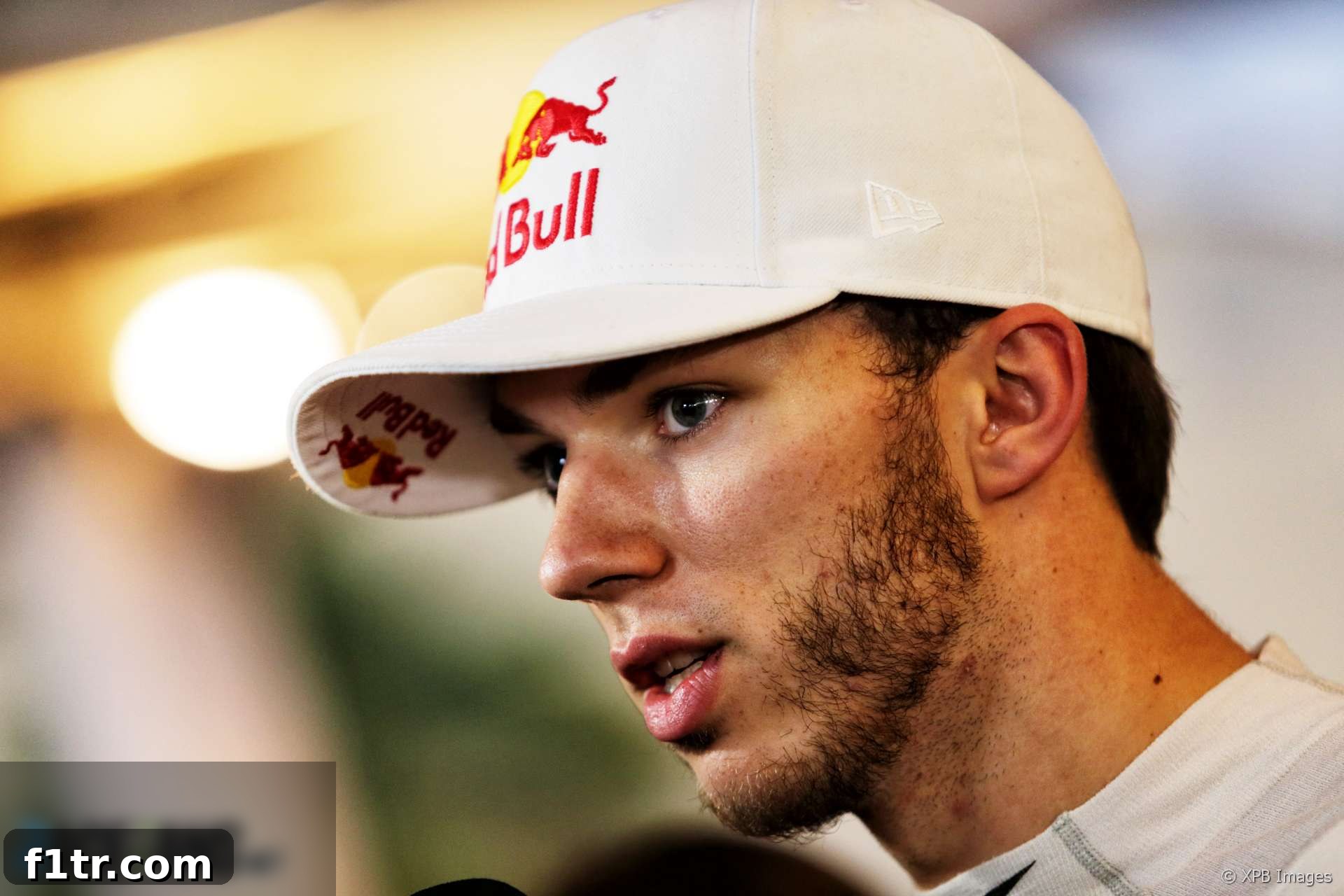
Pierre Gasly’s 2019 Formula 1 season was a profound narrative of challenge, resilience, and ultimately, redemption. Having faced the immense pressure of a Red Bull Racing seat, his tenure with the top team was cut short after a mere 12 starts. This swift demotion back to his former team, then known as Toro Rosso, could have been a career-ending blow for many. Yet, Gasly demonstrated remarkable fortitude, transforming a period of adversity into one of his most compelling performances. His journey from the crucible of a struggling Red Bull stint to a stunning podium finish with Toro Rosso at the Brazilian Grand Prix encapsulates the unpredictable and often brutal nature of Formula 1, while also showcasing the unyielding spirit of a driver determined to prove his worth. This article delves into the intricate details of Gasly’s rollercoaster year, analyzing the factors behind his struggles and celebrating his triumphant return to form.
The highly anticipated move to Red Bull Racing at the start of the 2019 season was meant to be the pinnacle of Pierre Gasly’s burgeoning career. Replacing Daniel Ricciardo, Gasly was tasked with partnering the formidable Max Verstappen in one of the sport’s most competitive teams. However, from the outset, Gasly struggled to adapt to the demanding RB15 chassis and the intense scrutiny that accompanies a top-tier drive. His qualifying pace consistently lagged behind that of his Dutch teammate, a stark contrast highlighted by numerous comparisons throughout the early races. While the Azerbaijan and Canadian Grands Prix offered fleeting glimpses of potential – with a lap time in Azerbaijan later deleted for a technical infringement and Verstappen encountering a red flag in Canada – these were exceptions rather than the rule. The performance gap to Verstappen remained stubbornly wide, even as late as the Hungarian Grand Prix, just before his unexpected demotion. Gasly himself has openly reflected on this challenging period, acknowledging a shared responsibility for the lack of performance.
“I think that [was] my responsibility partly,” he stated, adding that “maybe everybody in the team was [also] partly responsible for the lack of performance.” This period underscores the immense pressure on F1 drivers to perform instantly and consistently, especially when compared against an established star like Verstappen. The dynamic within a top team, the car’s setup philosophy, and the driver’s ability to extract its maximum potential all play critical roles, and in Gasly’s case, these elements never fully converged during his Red Bull tenure. He confessed, “Of course when you feel that there is potential that is not used, it’s is always annoying.” This frustration was palpable, as a driver’s career hinges on maximizing every opportunity.
Qualifying Performance: The Lap Time Metric
A critical indicator of Pierre Gasly’s transformation was evident in his qualifying performance. While at Red Bull, the data consistently illustrated a significant deficit to Max Verstappen’s lap times. Beyond the exceptions in Azerbaijan and Canada – the former clouded by a technical infringement and the latter by a red flag incident impacting Verstappen – Gasly frequently found himself several tenths, or even over a second, adrift of his teammate. This performance gap was a major contributing factor to his struggles, often forcing him to start races from a compromised position.
However, the move back to Toro Rosso brought about an immediate and marked improvement. The detailed analysis of qualifying lap times clearly showed a dramatic reduction in the gap to his new teammate, Daniil Kvyat. Not only did Gasly close the gap, but he often outperformed Kvyat, demonstrating a renewed comfort and confidence in the STR14 chassis. This shift wasn’t just about pace; it was about the ability to extract peak performance from the car over a single lap, a skill that had seemed elusive during his Red Bull tenure. This newfound qualifying prowess allowed him to start races higher up the grid, enabling cleaner starts and better strategic opportunities, thereby directly contributing to his consistent point-scoring finishes in the latter half of the season. A visual representation of qualifying lap time gaps would undeniably show Gasly’s performance curve dramatically improving after his return to Toro Rosso.
The decision to demote Pierre Gasly back to Toro Rosso after just 12 races was a harsh reality check, signaling the end of his Red Bull dream, at least for the short term. This professional setback was compounded by a deeply personal tragedy just as he rejoined his former team. During his very first race weekend back with Toro Rosso at the Belgian Grand Prix, Gasly faced the devastating news of his childhood friend Anthoine Hubert’s fatal accident in a Formula 2 race. This immense personal loss cast a dark shadow over his return, making his already challenging professional situation even more arduous. “It’s been such a rollercoaster for me this season,” Gasly remarked, a sentiment that resonated profoundly given the dual blows he had endured. Yet, it was through this crucible of personal grief and professional disappointment that Gasly began to forge a remarkable comeback. The adversity seemed to galvanize him, allowing him to channel his emotions into a renewed focus and determination on the track. His ability to navigate such immense personal pain while simultaneously rebuilding his F1 career is a testament to his profound mental strength and resilience, qualities that would soon define the latter half of his 2019 season.
Race Performance: From Start to Finish and Points Share
Returning to Toro Rosso, the team where he had previously honed his skills, proved to be the catalyst for Pierre Gasly’s incredible turnaround. The immediate shift in environment and dynamics seemed to unlock his true potential. Free from the intense glare and pressure of a championship-contending team, Gasly quickly found comfort and confidence within the familiar confines of Toro Rosso. His performances saw a dramatic improvement almost instantly, marked by consistent point-scoring finishes. This newfound consistency was a stark contrast to his earlier struggles, demonstrating a clear synergy with the Toro Rosso car and its engineering team.
Pierre Gasly’s improved race performance at Toro Rosso was equally, if not more, significant than his qualifying gains. His struggles in qualifying at Red Bull often meant he had to fight his way through the congested midfield, a task made harder by a car he wasn’t fully comfortable with. There were moments during his Red Bull stint, particularly in races like Monaco or even some early European rounds, where he showed flashes of the pace expected from a front-running car. Yet, these promising signs were often followed by disappointing outings, as seen in Germany and Hungary, where he found himself battling cars typically associated with the midfield, such as the McLarens and Alfa Romeos, rather than the Mercedes and Ferraris.
Upon his return to Toro Rosso, Gasly’s race craft flourished. Data reflecting “Start versus Finish” positions would have vividly illustrated his ability to make progress throughout races. He consistently advanced from his starting grid slot, showcasing intelligent race management, strong overtaking skills, and better tire preservation. This was further underlined by his “Share of Points” compared to his teammate and other midfield rivals. At Red Bull, his contribution to the team’s points tally was minimal compared to Verstappen. At Toro Rosso, however, Gasly became a primary point-scorer, often outperforming Daniil Kvyat and leading the charge for the Faenza-based squad. This translated into valuable constructors’ points and highlighted his resurgence as a reliable and effective Grand Prix driver.
The pinnacle of this resurgence arrived just seven races after his return, at the dramatic Brazilian Grand Prix. In a chaotic race filled with late Safety Car periods and unexpected twists, Gasly seized an astonishing opportunity. Holding off none other than Lewis Hamilton in a thrilling drag race to the finish line, he snatched a sensational second place, securing his maiden Formula 1 podium. This historic achievement was not only a personal triumph for Gasly but also a momentous occasion for Toro Rosso, marking only their third podium finish in the team’s history. “To end the season with my first podium in F1, in Toro Rosso, which was their third podium in history, of course, was something really special,” he proudly stated, capturing the profound significance of that moment. This spectacular result was not a fluke but the culmination of several weeks of strong performances, showcasing his ability to extract the maximum from the machinery available to him and perform under immense pressure. The Brazilian Grand Prix podium was the ultimate demonstration of this enhanced race performance, where he capitalized on chaos and executed a flawless race under pressure, illustrating a perfect blend of speed and strategic awareness that had been largely absent in the first half of the season. His capacity to perform consistently every weekend, which he directly attributed to the support from Toro Rosso, made his racing “more enjoyable” and ultimately more effective.
Reflections and The Crucial Team Sport Aspect
The transformative experience of 2019 provided Pierre Gasly with invaluable lessons, fundamentally reshaping his understanding of Formula 1 and his role within it. Looking back at his tumultuous time at Red Bull, Gasly admitted there were numerous aspects he would have approached differently. “Of course there were many, many, many things I would have done differently. But this is done. There were many lessons taken,” he reflected, indicating a mature self-assessment rather than dwelling on regret. This period forced him to introspect deeply about what he truly needed as a driver to perform at his peak. “As a driver I know a lot more about what I need,” he asserted, signifying a crucial step in his personal and professional development. This self-awareness extends beyond just car setup to the broader ecosystem of a Formula 1 team, including communication, support structures, and the mental space required for optimal performance.
Gasly clearly articulated that he views his career with a forward-looking perspective, using past challenges as building blocks for future success. “If I will need to do the same thing again there are a lot of things I will change. But now I just need to focus on the future. I’m 23 years old, I have many years in front of me. At the end of the day, my only answer will be on the track, and that’s the only thing I’m going to focus on.” This statement encapsulates his determination to let his on-track results speak for themselves, embracing the philosophy that performance is the ultimate arbiter in Formula 1. His ability to distill complex experiences into tangible lessons and apply them moving forward is a hallmark of a truly resilient athlete.
One of the most profound realizations Pierre Gasly had during the latter half of his 2019 season was the undeniable importance of Formula 1 being a true team sport. “In the second half of the season, the main lesson on my side that I’ve learned is I realised how much of a team sport Formula 1 is,” he emphasized. This wasn’t merely a theoretical understanding but a practical, lived experience that contrasted sharply with his Red Bull stint. At Toro Rosso, he found a supportive environment where he felt truly empowered. The team provided him with “everything I need to perform consistently every weekend,” which in turn fostered a sense of enjoyment and made his performances more consistent. This synergy between driver and team is vital in Formula 1; it’s not just about the fastest car or the most talented driver, but how effectively they work together to unlock potential. Gasly’s successful integration back into Toro Rosso, evident from their “really competitive races, really competitive weekends, couple of Q3s, points finishes,” since his return in Spa, underscores this point. The ability to communicate openly, receive tailored feedback, and feel understood by the engineers and strategists can be the difference between struggling and shining.
Despite his candor about learning from the experience, Gasly remained tight-lipped about the specific issues that plagued his Red Bull period. “I’ve got my book where I’ve written all the stuff that was not correct or were not the way I would have needed it to be,” he revealed, adding, “But for now, I’ll keep the book private.” This hints at deeper, perhaps more sensitive, issues within the Red Bull setup that he felt were beyond his immediate control or that he chose not to publicly air. Regardless of the details, his improved performance at Toro Rosso unequivocally demonstrated that when a driver finds the right environment and team support, their inherent talent can shine through, leading to truly remarkable outcomes.
Race: Reasons for Retirements
| Race | Retirement |
|---|---|
| Baku | Driveshaft |
Quotes: Dieter Rencken
While Pierre Gasly’s 2019 season was largely defined by his comeback, it was not entirely without setbacks. One notable retirement occurred during the Azerbaijan Grand Prix due to a driveshaft issue. This mechanical failure, though unfortunate, was an isolated incident and did not detract from the broader narrative of his growing confidence and performance later in the year.
2019 F1 Season Insights
Below are related articles and insights from the 2019 F1 season, offering further context to the high-stakes world Pierre Gasly navigated:
- Crying in the Melbourne car park at 2019 grand prix was my career low – Ocon
- McLaren Racing reports reduced £71 million loss in 2019
- Kvyat: Hockenheim podium last year was “my biggest achievement” so far
- How the FIA’s new encrypted fuel flow meter targets Ferrari’s suspected ‘aliasing’ trick
- “He smashed my office door”: 23 must-see moments from ‘Drive to Survive’ season two
Browse all 2019 F1 season articles
Pierre Gasly’s 2019 Formula 1 season stands as a compelling testament to his unwavering spirit and adaptable talent. From the crushing disappointment of a premature Red Bull departure and the profound personal grief of losing a friend, he forged a path of redemption. His return to Toro Rosso marked not a step down, but a pivotal opportunity to rediscover his form, culminating in a magnificent podium at the Brazilian Grand Prix. Through self-reflection and a renewed understanding of the intricate team dynamics of Formula 1, Gasly transformed a potential career nadir into a defining period of growth. His journey serves as a powerful reminder that in the high-stakes world of F1, resilience, adaptation, and the right team environment are just as crucial as raw speed. The lessons learned and the triumphs achieved in 2019 laid a robust foundation for Gasly’s subsequent successes, cementing his reputation as a formidable and mentally tough competitor on the global stage.