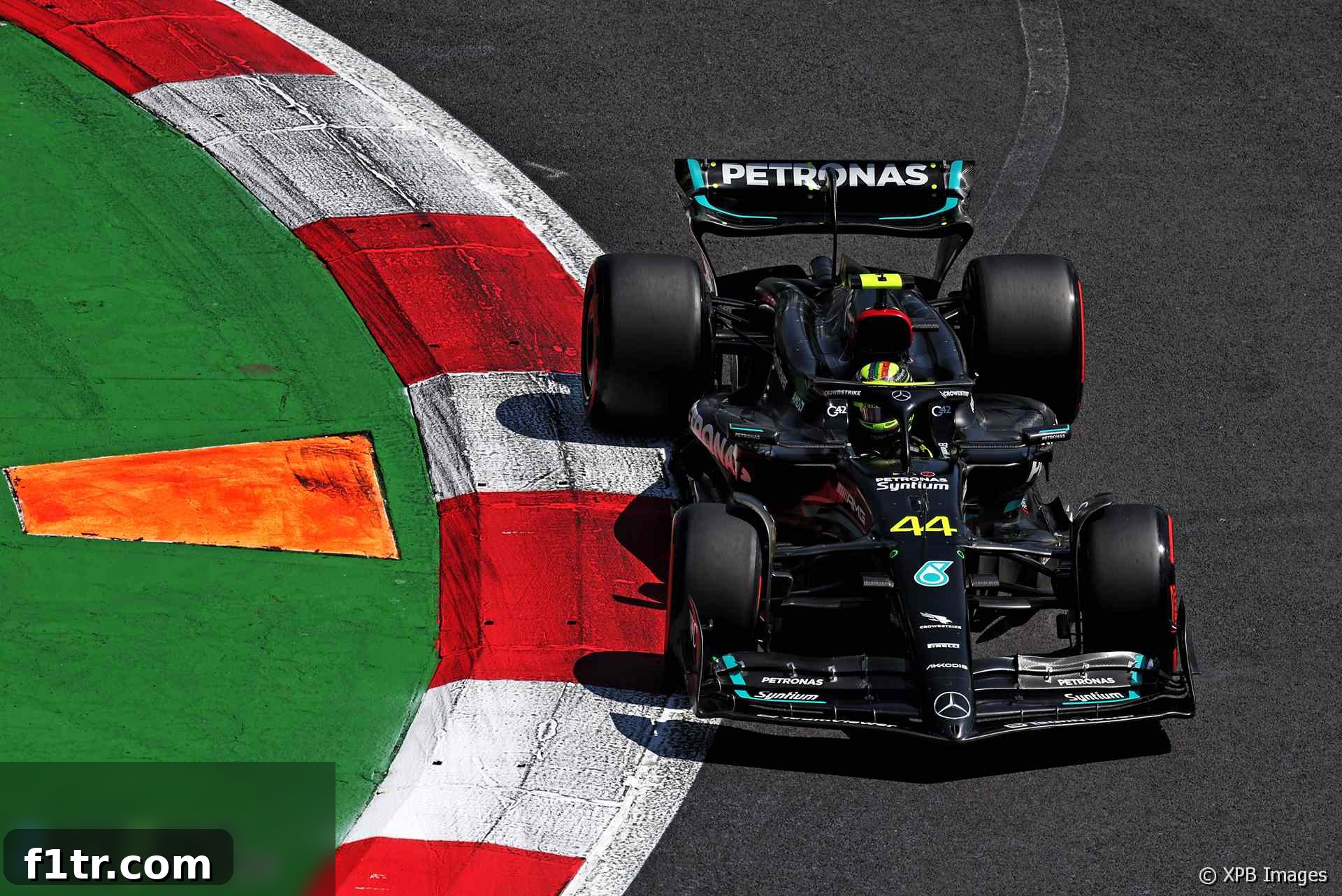
The high-altitude challenge of the Autodromo Hermanos Rodriguez proved to be a formidable adversary for Lewis Hamilton and his Mercedes W14 at the Mexican Grand Prix. Following a qualifying session that left both driver and team principal Toto Wolff expressing significant disappointment, Hamilton anticipates a gruelling race, highlighting the inherent difficulties his car faces on this unique circuit.
Securing the sixth position on the grid, Hamilton’s qualifying performance belied the struggles he experienced throughout the weekend. The seven-time world champion articulated a profound dissatisfaction with the W14’s balance, painting a vivid picture of a car that felt far from harmonious with the demands of the Mexican track.
“I’ve been struggling all weekend with this car,” Hamilton candidly revealed to Sky Sports after qualifying. His frustration was palpable as he elaborated, “The car’s been a bit of a nightmare to drive; it just doesn’t like this track.” This sentiment underscores the unique characteristics of the Autodromo Hermanos Rodriguez, where the thin air at over 2,200 meters above sea level significantly impacts aerodynamic efficiency and engine performance, making car setup and balance a delicate tightrope walk for engineers and drivers alike.
The challenges for Hamilton were evident from the final practice session, where he languished in 10th place. Despite making crucial setup adjustments ahead of qualifying, which he noted improved the car’s balance considerably, the underlying “peaky” nature of the W14 remained a persistent issue. A “peaky” car in Formula 1 is one that operates within a very narrow performance window, capable of delivering exceptional pace when everything aligns perfectly but becoming unpredictable and difficult to manage outside that sweet spot. This characteristic can be particularly punishing on a circuit like Mexico City, where rapid changes in direction and long, sweeping corners demand consistent grip and stability.
“We made some good changes going into qualifying, I was much, much happier with the car. I wish we’d done it in the morning, but then Q1 and Q2 weren’t looking too bad, Q2 second lap was great,” Hamilton explained, reflecting on the incremental progress. However, the ultimate performance ceiling of the W14 proved to be restrictive. “But the car is just really peaky. Sometimes it works, sometimes it doesn’t, and I just wasn’t able to extract much more from it again. I think, in a perfect world, maybe I could have been fifth, but that’s about it.” His assessment suggests that even with optimal execution, the car’s inherent limitations prevented him from challenging further up the grid, highlighting a fundamental performance deficit rather than simply a driving error.
Looking ahead to the race, Hamilton’s optimism was notably subdued. The forecast for Sunday’s Grand Prix appears to be fraught with difficulties for Mercedes. “It’s going to be a real challenge with that car tomorrow,” he conceded, pointing to a critical issue that has plagued Formula 1 cars at this venue: thermal management. “We’re overheating, brakes overheating, it’s going to be very hard for us to battle. I don’t know what kind of race we’re going to have, but it’s going to be on a knife’s edge.” The thinner air not only reduces aerodynamic downforce but also severely hampers cooling efficiency for engines, brakes, and other critical components. This means drivers must often manage temperatures meticulously, potentially compromising outright pace or aggressive overtaking manoeuvres, turning the race into a delicate balancing act of speed versus reliability.
Adding to the post-qualifying complexities, Hamilton also found himself under investigation by the stewards. The probe centered on an alleged failure to slow sufficiently under yellow flags, which were deployed after Fernando Alonso’s spin during Q1. Yellow flags are a critical safety measure, requiring drivers to significantly reduce speed to prevent further incidents. Hamilton, however, remained confident in his actions. “I lifted, and then I was slower,” he asserted, suggesting he complied with the regulations. Such investigations are standard procedure in Formula 1 and can sometimes result in grid penalties, adding another layer of uncertainty to Mercedes’ race day preparations.
Team principal Toto Wolff echoed Hamilton’s sentiments, acknowledging that the qualifying outcome – P6 for Hamilton and P8 for George Russell – fell short of Mercedes’ aspirations. “Less than we had hoped for from qualifying today,” Wolff admitted, underscoring the team’s ongoing struggle to consistently extract peak performance from the W14. While acknowledging the hard work and progress made, he highlighted the fine margins that define competitive qualifying in F1, especially at a track as sensitive as Mexico City. “We made some good steps with the car today, but we couldn’t put the lap times together when it really counted.”
Wolff specifically referenced the significant performance leap observed from competitors like Ferrari between Q2 and Q3, illustrating the razor-thin differences that separate positions on the grid. “Ferrari made a massive jump from Q2 to Q3, and you could see all the way through the session that it was all about fine margins – two or three seconds of out-lap pace, and getting the tyres perfectly in the window, or just slipping out of it.” Achieving optimal tyre temperature is a dark art in Formula 1, with the “tyre window” being a critical factor for grip and lap time. A tyre that is too cold or too hot will not perform as intended. For Mercedes, Wolff suspected this played a role in their final Q3 runs. “On our final new tyre, it looks like we were a bit too slow and the tyres a bit too cool – but it’s just tricky to find that sweet spot.” This explains why seemingly minor variations in out-lap strategy or track conditions can have a disproportionate impact on qualifying results.
Furthermore, Wolff shares Hamilton’s apprehension regarding the team’s ability to gain ground in the race. While Friday’s practice sessions hinted at a respectable long-run pace, the extensive setup changes implemented for qualifying introduce an element of doubt for race day. “We showed some decent race pace yesterday – but we don’t know if that will translate tomorrow, after the setup changes we made.” This uncertainty means the team heads into the Grand Prix with cautious optimism, knowing that the real test of their modifications will only come under race conditions. Despite the challenges, the objective remains clear and unwavering for the Silver Arrows: “But the only goal will be to move forward from where we start.” This commitment to pushing forward, regardless of the starting position, is a hallmark of Mercedes’ competitive spirit.
The Autodromo Hermanos Rodriguez, with its unique blend of long straights and tight, technical sections, combined with the extreme altitude, demands a finely tuned machine and an exceptional driver. The thin air reduces both engine power and aerodynamic downforce, forcing teams to run maximum wing levels to compensate, yet still experiencing less grip than at sea-level tracks. This paradox often leads to cars feeling unstable and prone to sliding, exacerbating issues of tyre degradation and thermal management. For the Mercedes W14, a car that has struggled with consistent balance throughout the 2023 season, these specific track characteristics appear to amplify its inherent weaknesses.
The 2023 season has been a journey of development and adaptation for Mercedes, as they continue to refine their concept and close the gap to the front-runners. While glimmers of strong performance have appeared at various races, consistency has remained an elusive goal. The Mexican Grand Prix qualifying session, therefore, serves as another data point in their ongoing quest to understand and optimize the W14. The difficulties encountered by Hamilton and Russell highlight that despite significant efforts, there are still specific track conditions where the car’s performance window remains too narrow to challenge for pole position or comfortably secure front-row starts.
As the team prepares for Sunday’s race, strategy will be paramount. Managing the severe overheating concerns, particularly for the brakes and power unit, will likely dictate the pace and aggression Hamilton and Russell can employ. Pit stop timings, tyre compound choices, and the ability to maintain consistent performance over long stints will all be critical factors. From P6, Hamilton will be aiming to minimize damage and ideally capitalize on any opportunities that arise from the cars ahead. For Russell starting from P8, similar challenges await, as both drivers will need to navigate a potentially chaotic opening lap and then settle into a rhythm that prioritizes reliability and efficient tyre usage over outright speed in certain phases. The “knife’s edge” prognosis suggests that the Mexican Grand Prix will be a testament to both driver skill in adverse conditions and the strategic prowess of the Mercedes pit wall.
In conclusion, Lewis Hamilton’s P6 start for the Mexican Grand Prix signals a weekend fraught with difficulty for Mercedes. The W14’s struggles with balance and the persistent issues of overheating at the challenging Autodromo Hermanos Rodriguez circuit have cast a shadow over their race prospects. Despite Hamilton’s best efforts to fine-tune the setup and Toto Wolff’s strategic insights into the qualifying session’s fine margins, the team faces an uphill battle. The upcoming race will undoubtedly test their resilience, strategic acumen, and the drivers’ ability to extract every ounce of performance from a car that clearly finds this particular track a “nightmare.” The goal remains clear: to move forward, learn, and fight for every possible championship point, turning adversity into a platform for future improvements.
Advert | Become a RaceFans supporter andgo ad-free
2023 Mexican Grand Prix: Related Insights
- ‘I’m so s*** in qualifying’: Norris berates himself despite pole-winning lap
- Ferrari reaping the benefits of having F1’s most closely-matched team mates
- Norris had “no chance” to beat Verstappen in Mexico even without Q1 exit
- Transcript: How Ricciardo’s race went awry soon after he was told to “bring it home”
- Mercedes see “very encouraging signs” from Austin floor update
Browse all 2023 Mexican Grand Prix articles