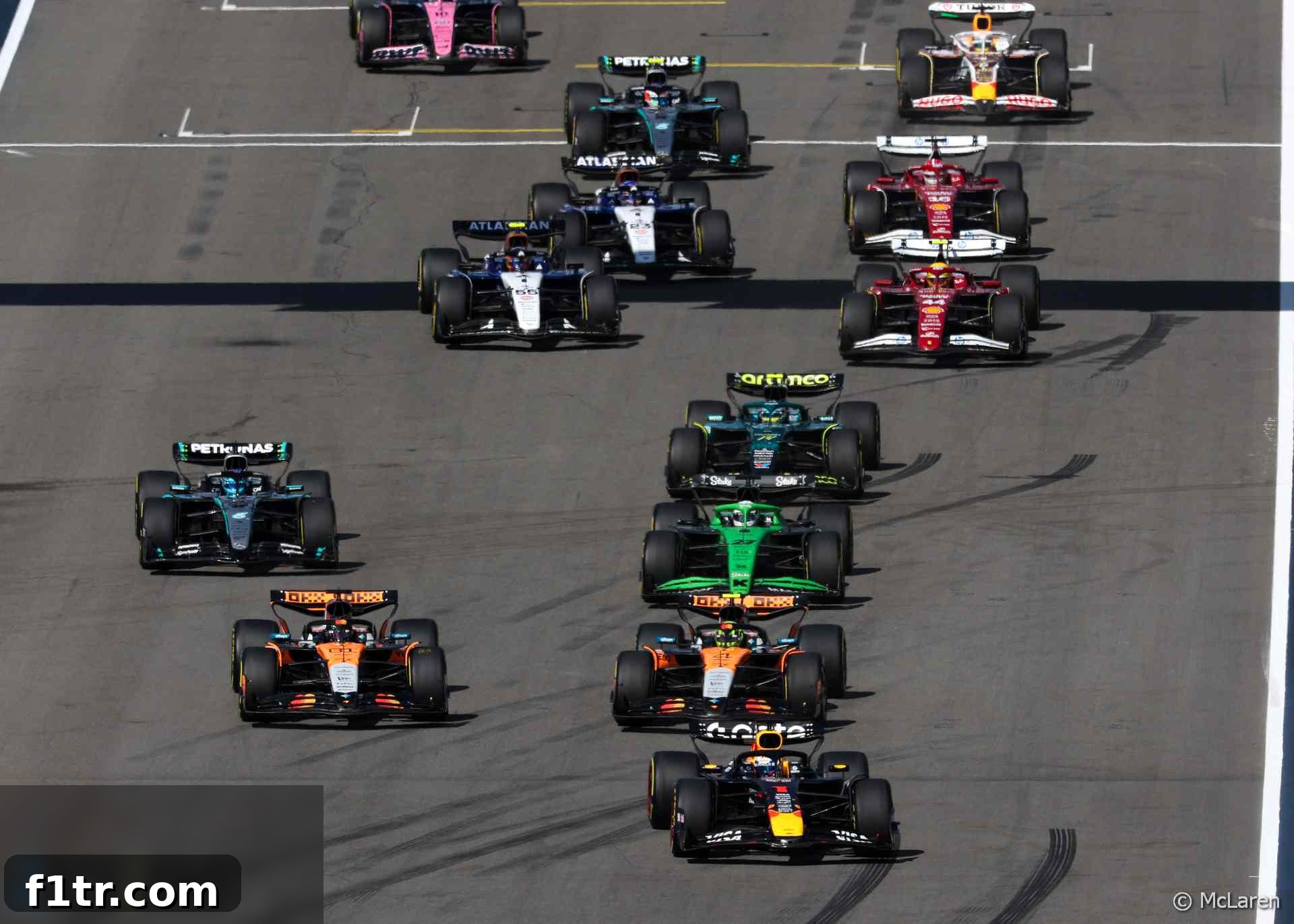
The 2025 United States Grand Prix weekend at the Circuit of the Americas was anticipated to be a pivotal moment in the championship battle, particularly after a dramatic incident at the start of the sprint race. However, the influence of two Safety Car periods during Saturday’s sprint and the challenging nature of overtakes on Sunday meant that the qualifying sessions for both races largely dictated the final results. This comprehensive review delves into the performance of each driver, offering an in-depth analysis of their individual weekends, from qualifying heroics to race-day challenges, all set against the backdrop of this high-stakes F1 event.
As the Formula 1 circus descended upon Austin, Texas, the stage was set for a thrilling display of speed, strategy, and skill. With the championship fight intensifying, every point earned at this iconic circuit held immense value. This breakdown will provide a detailed look at how each competitor navigated the unique demands of COTA, assessing their strengths, weaknesses, and key moments that defined their experience in the Lone Star State.
Lando Norris
Sprint race finish: Not classified
Qualified: 2nd (4 places ahead of team mate, -0.283s)
Grid: 2nd (4 places ahead of team mate)
Start: -1 place
Strategy: One-stop (M-S)
Finished: 2nd (3 places ahead of team mate)
Lando Norris arrived in Austin with strong momentum, proving his pace by being the fastest in practice sessions, SQ1, and SQ2 for the sprint race. Despite his impressive form, he was narrowly pipped to sprint pole position by Max Verstappen in a closely contested session, highlighting the intense competition at the front. His sprint race, however, ended in unfortunate circumstances when he was taken out in a multi-car incident at the very start, a setback that was entirely out of his control. This early retirement was a blow, denying him crucial points and race experience.
Demonstrating remarkable resilience, Norris bounced back emphatically in qualifying for the main Grand Prix, securing a brilliant second place on the grid. This strong Saturday performance underscored his raw speed and the McLaren car’s potential. Come Sunday, Norris initially struggled to hold his position against Charles Leclerc, who capitalized on softer tires to overtake him at the start. Adding to the pressure, Norris quickly picked up three strikes for track limits early in the race, forcing him to tread carefully and manage his driving with precision to avoid a penalty.
Despite these challenges, Norris displayed exceptional patience and race craft. He meticulously managed his tires and meticulously worked his way back, executing two superb overtakes on Leclerc to reclaim second place. His ability to recover and secure a podium finish after early setbacks showcased his growing maturity and race management skills. While a pole position in qualifying for the main race might have elevated his weekend further, his performance in the Grand Prix was undoubtedly a masterclass in controlled aggression and strategic driving, ultimately earning him a well-deserved runner-up spot.
8/10: Unlucky in the sprint race, but showcased impressive patience and strong race craft in the Grand Prix. A little more in qualifying could have sealed an even better weekend.
Oscar Piastri
Sprint race finish: Not classified
Qualified: 6th (4 places behind team mate, +0.283s)
Grid: 6th (4 places behind team mate)
Start: +1 place
Strategy: One-stop (M-S)
Finished: 5th (3 places behind team mate)
Oscar Piastri’s weekend began with promising pace, qualifying a strong third for the sprint race, albeit three-tenths of a second behind his teammate, Lando Norris. However, his sprint race aspirations were cut short at Turn One. His decision to try and cut back to the inside of Norris was a high-risk maneuver that unfortunately backfired spectacularly, contributing to the multi-car incident that saw both McLarens retire early. This was a missed opportunity for points and demonstrated the fine line between aggression and caution in Formula 1’s opening laps.
The struggles continued for Piastri in qualifying for the main Grand Prix, where he once again found himself significantly adrift of Norris, securing a sixth-place grid slot. This disparity in qualifying performance between the two McLaren drivers was a recurring theme throughout the weekend. In the Grand Prix itself, Piastri made a decent start, gaining one position from a slow-starting George Russell. However, from that point onward, his race lacked significant forward momentum. He largely maintained his position, never truly looking like he could challenge for higher places beyond the top five or six.
While he eventually finished fifth, three places behind his teammate, the performance felt somewhat subdued. The weekend highlighted areas for improvement, particularly in maximizing qualifying performance and managing race-start risks. For a driver of Piastri’s caliber, consistency and capitalizing on opportunities are key, and performances like this will need to be minimized as the championship progresses.
6/10: A weekend marred by a costly sprint race incident and an overall indifferent Grand Prix performance. Piastri needs to avoid such outings to maintain his championship ambitions.
Advert | Become a RaceFans supporter andgo ad-free
Charles Leclerc
Sprint race finish: 5th
Qualified: 3rd (2 places ahead of team mate, -0.105s)
Grid: 3rd (2 places ahead of team mate)
Start: +1 place
Strategy: One-stop (S-M)
Finished: 3rd (1 place ahead of team mate)
Charles Leclerc’s United States Grand Prix weekend began with a minor setback, as he lost valuable time at the end of practice due to a technical problem. Despite this, he showed solid pace in sprint race qualifying, narrowly being out-qualified by Lewis Hamilton. The sprint race itself proved to be a mixed bag. He took brilliant advantage of the chaos in the first-corner melee, expertly navigating the incidents to climb an impressive six positions and claim fourth place. However, a subsequent mistake allowed Hamilton to re-pass him, dropping him to fifth by the checkered flag.
Leclerc’s focus then shifted to the main Grand Prix qualifying, where he delivered a strong performance to secure an excellent third place on the grid, two places ahead of his teammate. This put him in a prime position to challenge for a podium. On Sunday, starting on the softer compound tires, Leclerc launched an aggressive attack, immediately gaining a place and putting up a fierce fight against Lando Norris. While he initially held Norris at bay, the McLaren ultimately had slightly better long-run pace, and Leclerc couldn’t quite contain him.
Despite not being able to hold off Norris for second, Leclerc drove a very intelligent and well-managed race, especially considering his tire choice. He consistently pushed, maintained a strong pace, and avoided significant errors, ultimately crossing the finish line in third place, securing a valuable podium for Ferrari. His Grand Prix performance was a clear highlight of his weekend, showing great skill and determination, even if the sprint race had some room for improvement.
7/10: An excellent performance in the Grand Prix secured a podium, though his sprint race was slightly sub-par with a critical error allowing Hamilton to pass.
Lewis Hamilton
Sprint race finish: 4th
Qualified: 5th (2 places behind team mate, +0.105s)
Grid: 5th (2 places behind team mate)
Start: +1 place
Strategy: One-stop (M-S)
Finished: 4th (1 place behind team mate)
Lewis Hamilton showcased his experience and race craft throughout the United States Grand Prix weekend. In sprint race qualifying, he managed to out-qualify his teammate, Charles Leclerc, notably when the Mercedes team utilized soft tires for the first time in the session. The sprint race saw him initially drop behind Leclerc in the first-corner incident but quickly regain his composure and re-pass his Ferrari rival to secure a strong fourth place. This demonstrated his ability to navigate chaotic situations and capitalize on opportunities.
For the main Grand Prix, Hamilton qualified fifth on the grid, just a tenth of a second behind Leclerc. At the start of the Grand Prix, he made a crucial gain, passing George Russell to move up a position. Throughout the early and middle stints of the race, Hamilton applied significant pressure on his teammate, who eventually pitted earlier. He managed his tires well for a considerable period, battling hard. However, towards the latter stages of his final stint on soft tires, he began to struggle with degradation, culminating in an apparent puncture on the very last lap.
Despite this late-race drama, Hamilton’s experience shone through as he still managed to out-run Oscar Piastri to hold onto fourth place, a testament to his sheer determination and ability to extract maximum performance even when facing adversity. His fighting spirit in the sprint race was commendable, although the final stint of the Grand Prix highlighted some challenges with tire management, which prevented him from potentially challenging for a podium.
7/10: Fought exceptionally well in the sprint race, showcasing his renowned tenacity. The final stint of the Grand Prix was less stellar, hampered by tire issues.
Advert | Become a RaceFans supporter andgo ad-free
Max Verstappen
Sprint race finish: 1st
Qualified: 1st (12 places ahead of team mate, -0.765s)
Grid: 1st (12 places ahead of team mate)
Start: Held position
Strategy: One-stop (M-S)
Finished: 1st (6 places ahead of team mate)
Max Verstappen’s United States Grand Prix weekend was a dominant display, reminiscent of his championship-winning form. He stamped his authority early by snatching pole position from Lando Norris at the very end of sprint race qualifying, demonstrating his incredible ability to pull out a lap when it truly matters. In the sprint race, he was largely untroubled by the dramatic incidents unfolding behind him at Turn One. He expertly fended off an early attack from George Russell, maintaining his lead and cruising to a comfortable victory, showcasing his superior pace and control.
Qualifying for the main Grand Prix saw Verstappen secure another vital pole position. His first Q3 run was so strong that it proved to be quick enough for pole, a crucial advantage as his team made a timing error, sending him out too late for another flying lap. Despite this small hiccup, his sheer speed ensured he remained at the front. On Sunday, Verstappen held his lead at the start with typical assertiveness, immediately establishing a rhythm that his rivals struggled to match.
Throughout the Grand Prix, Verstappen was never seriously threatened from behind. While Lando Norris grappled with Charles Leclerc for second place, Verstappen enjoyed clear air at the front, allowing him to manage his tires meticulously. He demonstrated complete control, ensuring his Red Bull performed optimally for the entire race distance. This masterful performance, characterized by unflappable precision and overwhelming pace, felt like a powerful return to his dominant 2023-specification form, leaving no doubt about his championship intentions.
9/10: A truly dominant performance, looking like a return to the formidable 2023-specification Verstappen, controlling both races with exceptional skill.
Yuki Tsunoda
Sprint race finish: 7th
Qualified: 13th (12 places behind team mate, +0.765s)
Grid: 13th (12 places behind team mate)
Start: +3 places
Strategy: One-stop (M-S)
Finished: 7th (6 places behind team mate)
Yuki Tsunoda’s weekend in Austin was a dramatic blend of frustration, aggression, and ultimately, valuable points. His sprint race qualifying was a misstep, as he wasn’t quick enough on his first lap, and then his team sent him out too late for a final run, resulting in a shocking early exit. The sprint race start saw him dive into Turn One very aggressively, making contact with Isack Hadjar, though fortunately, he avoided significant damage or a penalty. Amidst the subsequent carnage, Tsunoda skillfully navigated the chaos, moving up to an impressive seventh place, which he managed to hold until the end, securing crucial sprint points.
Grand Prix qualifying brought more frustration, as he angrily blamed teammates Lawson and Gasly after dropping out in Q2. Despite the mid-session drama, Tsunoda showcased his race craft on Sunday. He made a fantastic start, passing both Liam Lawson and Fernando Alonso, before executing a brilliant overtake on Nico Hulkenberg on the outside of Turn 11. He continued his charge, passing Oliver Bearman early in the Grand Prix. Later, he gained two more positions when Carlos Sainz made contact with Andrea Kimi Antonelli, further boosting his position.
However, his race was not without controversy. While defending against Bearman’s attack at Turn 15, Tsunoda clearly swerved, an aggressive move that, fortunately for him, went unnoticed by the stewards. Despite his somewhat controversial maneuvers, Tsunoda ultimately scored welcome points for his team, though he was fortunate to avoid penalties in both races. This weekend highlighted his raw speed and aggressive style, but also a need for greater control and consistency.
6/10: Scored valuable points for the team, demonstrating fierce race craft. However, he was fortunate to avoid penalties for some aggressive maneuvers in both the sprint and Grand Prix.
Advert | Become a RaceFans supporter andgo ad-free
Andrea Kimi Antonelli
Sprint race finish: 8th
Qualified: 7th (3 places behind team mate, +0.288s)
Grid: 7th (3 places behind team mate)
Start: Held position
Strategy: One-stop (M-S)
Finished: 13th (7 places behind team mate)
Andrea Kimi Antonelli’s United States Grand Prix weekend was a display of promising potential mixed with bitter misfortune. He openly admitted to making mistakes on his final SQ2 lap, which resulted in him narrowly missing out on the final round of sprint qualifying by mere thousandths of a second. Despite this, he showcased his overtaking prowess in the sprint race, executing a good move on Oliver Bearman, though the Haas driver controversially kept him behind by going off track. Antonelli’s race craft was evident as he managed to climb to eighth, securing points.
For the Grand Prix, Antonelli delivered a strong qualifying performance, securing seventh place on the grid, a respectable position though three places behind his teammate. He maintained this seventh position at the start, driving a clean opening lap. However, his race took a dramatic turn when he was knocked off the track by Carlos Sainz, an incident that unfairly dropped him all the way to last place. This contact severely compromised his race, dashing any hopes of scoring significant points.
Despite the major setback, Antonelli demonstrated commendable resilience, recovering to finish 13th. While his recovery drive was impressive, the early contact made it clear that points were never truly within reach after being forced to the back. It was an undoubtedly frustrating end to a weekend where his performance, particularly in qualifying and the sprint race, suggested he deserved much more from the Grand Prix, indicating a strong raw talent despite not being quite on par with his experienced teammate, George Russell.
7/10: Showed great promise and deserved much more from the Grand Prix, though he still has a margin to close to match his teammate, Russell.
George Russell
Sprint race finish: 2nd
Qualified: 4th (3 places ahead of team mate, -0.288s)
Grid: 4th (3 places ahead of team mate)
Start: -2 places
Strategy: One-stop (M-S)
Finished: 6th (7 places ahead of team mate)
George Russell’s weekend at the Circuit of the Americas was characterized by strong qualifying pace and a spirited sprint race, but a frustrating Grand Prix. He chose not to run soft tires until SQ3 in sprint qualifying, yet still managed to secure fifth place on the grid, albeit behind the impressive Nico Hulkenberg. In the sprint race, Russell expertly avoided the first-corner dramas, quickly moving up to second place. He then launched a bold lunge on Max Verstappen at Turn 12, a move that didn’t quite pay off but highlighted his feisty and aggressive approach to racing, ultimately securing a strong P2 finish.
His performance in qualifying for the main Grand Prix was equally impressive, leaving him just two-hundredths of a second off the front row, a testament to his ability to extract maximum performance from the car. However, the Grand Prix start proved to be his undoing. Taking a tight line into Turn One, he lost two crucial places, a setback from which he struggled to recover. From that point onwards, despite his best efforts, Russell simply didn’t have the pace to move forward through the field. He found himself largely stuck in position, unable to mount a significant challenge for higher points-scoring finishes.
While his feisty spirit in the sprint race and strong qualifying performances were commendable, the Grand Prix proved to be a source of frustration. The loss of positions at the start and the subsequent lack of race pace meant that a weekend with podium potential ultimately resulted in a sixth-place finish. This served as a reminder of how critical the opening lap can be in determining the outcome of a Formula 1 race.
8/10: Showed a feisty and aggressive spirit in the sprint race and strong qualifying form. However, a poor start thwarted his potential in the Grand Prix.
Advert | Become a RaceFans supporter andgo ad-free
Lance Stroll
Sprint race finish: 17th
Qualified: 18th (8 places behind team mate, +0.799s)
Grid: 19th (9 places behind team mate)
Start: +1 place
Strategy: One-stop (S-M)
Finished: 12th (2 places behind team mate)
Lance Stroll endured a particularly challenging and error-prone weekend at the United States Grand Prix. His sprint race qualifying was compromised by a mistake at Turn Six, forcing him to abort his second flying lap and resulting in an early exit from SQ2. The sprint race itself was disastrous; an ill-judged lunge on Esteban Ocon not only put both drivers out of the race but also earned Stroll a five-place grid penalty for the main Grand Prix, compounding his difficulties. This incident highlighted a lack of judgment and spatial awareness.
The struggles continued in qualifying for the main race, where he went off track in Q1, costing him a chance to advance to Q2 and extending his streak of qualifying defeats to his teammate, Fernando Alonso, to a concerning 30 consecutive Grand Prix. Starting from the back due to his penalty and poor qualifying, Stroll opted for a soft-medium strategy. He made a decent start, passing the hard-shod Alexander Albon and Esteban Ocon by Lap 3, showing some early intent. He then embarked on a remarkably long opening stint on the soft tires, demonstrating good tire management.
During this extended stint, he managed to overtake the medium-shod Alpine drivers, showcasing some positive race pace. Despite the series of setbacks and his overall poor performance through qualifying and the sprint, his ability to finish within four seconds of his vastly more experienced teammate, Alonso, at the checkered flag was a creditable recovery in the Grand Prix. However, this late recovery couldn’t overshadow a weekend largely defined by errors and a significant pace deficit to his teammate.
4/10: A weekend marred by costly errors and a significant qualifying deficit. While his Grand Prix recovery was creditable, it couldn’t redeem an otherwise poor showing.
Fernando Alonso
Sprint race finish: Not classified
Qualified: 10th (8 places ahead of team mate, -0.799s)
Grid: 10th (9 places ahead of team mate)
Start: -2 places
Strategy: One-stop (M-S)
Finished: 10th (2 places ahead of team mate)
Fernando Alonso demonstrated strong raw pace and experience throughout the United States Grand Prix weekend, but ultimately lacked the results his qualifying performances merited. He delivered an excellent sprint race qualifying performance, expertly navigating the session to secure a superb sixth place on the grid, significantly outperforming his teammate. However, his sprint race came to an abrupt end at the first corner. His move on Nico Hulkenberg, while not wildly optimistic, contributed to a multi-car crash that resulted in his retirement, an unfortunate victim of circumstances.
Undeterred, Alonso produced another solid job in qualifying for the main Grand Prix, securing a tenth-place grid slot. This consistent top-ten qualifying form underscored his ability to extract performance from the Aston Martin. However, the Grand Prix start proved challenging. A tight line into Turn One cost him two places, as he was passed by Yuki Tsunoda and Nico Hulkenberg, immediately putting him on the back foot. Despite this initial setback, Alonso showcased his characteristic resilience and race craft. He meticulously managed his race, and his efforts were rewarded when Carlos Sainz made contact with Andrea Kimi Antonelli, allowing Alonso to regain tenth place, securing a solitary point.
It was a weekend that felt like a series of missed opportunities for Alonso. His strong qualifying performances set him up for potentially much better results in both races, but external factors and initial race-start losses prevented him from fully capitalizing. While a single point might seem meager, securing it after starting tenth and facing early race incidents demonstrated his persistent fighting spirit, even if the overall outcome didn’t fully reflect his potential.
7/10: Showed excellent qualifying pace but was ultimately unlucky in the sprint race and couldn’t convert his strong grid position into a more substantial points haul in the Grand Prix.
Advert | Become a RaceFans supporter andgo ad-free
Franco Colapinto
Sprint race finish: 14th
Qualified: 15th (1 place behind team mate, +0.393s)
Grid: 15th (1 place behind team mate)
Start: -2 places
Strategy: One-stop (M-S)
Finished: 17th (2 places ahead of team mate)
Franco Colapinto’s United States Grand Prix weekend was a testament to his persistent effort and solid, albeit somewhat anonymous, performance. While he dropped out in SQ1 for the sprint race, it’s worth noting that the battle between him and his teammate was one of the closest on the entire grid, indicating a strong underlying pace. His sprint race was unfortunately compromised early on when he collected a puncture at the start, forcing him to fight from the back. Despite this setback, he showcased good recovery to finish 14th.
In qualifying for the main Grand Prix, Colapinto delivered tidy laps in Q1, which paid off by earning him a spot in the second round, a commendable achievement given the competitive nature of the field. However, the Grand Prix start saw him lose two positions, being passed by Gabriel Bortoleto and Esteban Ocon, who was notably on harder tires. He quickly recovered, re-passing Ocon on Lap 2. He then ran an impressively long opening stint, five laps longer than his teammate Pierre Gasly, demonstrating effective tire management and strategic patience.
Towards the end of the race, a slightly controversial moment occurred when he was instructed not to pass Gasly for 17th place but disregarded the team order and proceeded to overtake him anyway. This indicated his fierce competitive spirit, even in a battle for minor positions. Overall, there was almost nothing to choose between Colapinto and Gasly throughout the weekend, suggesting a parity in performance. The team’s decision to issue a team order for 17th place was questionable, as allowing them to race freely might have offered more insights into their relative abilities.
7/10: A weekend marked by consistent, solid performance and minimal difference to his teammate. The late-race team order, which he ignored, was a strange call given the circumstances.
Pierre Gasly
Sprint race finish: 10th
Qualified: 14th (1 place ahead of team mate, -0.393s)
Grid: 14th (1 place ahead of team mate)
Start: Held position
Strategy: One-stop (M-S)
Finished: 19th (2 places behind team mate)
Pierre Gasly’s United States Grand Prix weekend was a mixed bag, starting with promising flashes but ultimately concluding with a disappointing Grand Prix result. He performed commendably in sprint race qualifying, managing to secure a place in SQ2, though he couldn’t advance any further. In the sprint race itself, Gasly made an excellent start, picking up four places in the opening chaos. However, he struggled to maintain these positions, eventually being passed by Andrea Kimi Antonelli and Liam Lawson, finishing a respectable tenth.
He once again navigated through the first phase of qualifying for the main Grand Prix, lining up 14th on the grid, narrowly ahead of his teammate. At the start of the Grand Prix, Gasly held his position, avoiding any major incidents. He then became the first driver to switch from medium to soft tires, an aggressive strategy call. While this initially seemed to offer some pace, it ultimately led to significant struggles at the end of the race as his soft tires degraded severely. This meant he couldn’t sustain his pace, losing ground to competitors.
Towards the closing laps, Gasly was relegated to last place, being overtaken by Isack Hadjar, Franco Colapinto, and Gabriel Bortoleto. This dramatic drop through the field indicated that the Grand Prix strategy, while bold, was clearly too optimistic for the tire wear experienced on the Circuit of the Americas. Despite managing to extract a good amount of performance from his car in qualifying and the early phases of the races, the strategic gamble proved to be his undoing on Sunday, leading to a frustrating non-points finish.
7/10: Extracted a good performance from his car in qualifying and sprint race, but an overly optimistic Grand Prix strategy led to a disappointing finish.
Advert | Become a RaceFans supporter andgo ad-free
Esteban Ocon
Sprint race finish: 16th
Qualified: 17th (9 places behind team mate, +0.215s)
Grid: 17th (9 places behind team mate)
Start: +2 places
Strategy: One-stop (H-S)
Finished: 15th (6 places behind team mate)
Esteban Ocon experienced a challenging United States Grand Prix weekend, struggling to find pace and ultimately concluding with a disappointing result. His sprint race qualifying was marred by a mistake on his first lap in SQ1, and crucially, he failed to start his final flying lap in time, leading to an early exit. The sprint race itself ended prematurely for Ocon when he was taken out by Lance Stroll in an unfortunate incident, denying him the chance to make up positions.
The lack of confidence in high-speed corners continued to plague Ocon, as he once again failed to progress beyond Q1 in qualifying for the main Grand Prix, significantly behind his teammate. Despite these qualifying woes, Ocon managed a commendable start to the Grand Prix, gaining two places despite being on the harder compound tires. However, this progress was short-lived, as he lost those positions on the very next lap, highlighting the difficulties he faced in maintaining race pace and position.
Ocon was one of the first drivers to pit, switching off his hard tires early, indicating a strategy aimed at overcoming the initial tire choice. However, he struggled significantly towards the end of his long stint on soft tires, losing positions to both Andrea Kimi Antonelli and Alexander Albon. It seemed that Ocon simply didn’t click with the car’s new package this weekend, and the hard-soft strategy he adopted proved to be one of the least effective options, contributing to a frustrating fifteenth-place finish.
5/10: A difficult weekend for Ocon, who struggled to adapt to the new package and faced an unhelpful hard-soft strategy. Did not fully capitalize on opportunities.
Oliver Bearman
Sprint race finish: 15th
Qualified: 8th (9 places ahead of team mate, -0.215s)
Grid: 8th (9 places ahead of team mate)
Start: Held position
Strategy: One-stop (M-S)
Finished: 9th (6 places ahead of team mate)
Oliver Bearman’s United States Grand Prix weekend was a mixed bag of impressive qualifying and some debatable race incidents. He didn’t use Haas’s upgrade package until sprint race qualifying, and even then, he only managed one flying lap due to the team’s timing. In the sprint race, Bearman deservedly received a penalty for going off track at Turn 15 to keep Andrea Kimi Antonelli behind him, a move that was deemed unfair by the stewards. This incident cost him a points finish in the sprint.
Despite the sprint race setback, Bearman truly capitalized on Haas’s upgrades in qualifying for the main Grand Prix, delivering an outstanding performance to secure eighth place on the grid, significantly ahead of his teammate. This result was a testament to his raw speed and ability to quickly adapt. However, the Grand Prix start saw him lose positions to both Carlos Sainz and Yuki Tsunoda in the opening laps, putting him on the defensive. Later, while attempting to re-pass Tsunoda, Bearman spun, attributing the incident to his rival’s late change of line.
Despite these in-race challenges, Bearman demonstrated commendable recovery. After dropping behind Nico Hulkenberg, he fought back to salvage points for ninth place, a valuable contribution to the team. His performance was particularly impressive given that he had practiced with the older aerodynamic package, making his qualifying and race pace, post-upgrade, even more notable. While the sprint race move was a “silly” error, his overall driving in the Grand Prix showcased genuine potential and a strong understanding of the updated car.
7/10: A silly defensive move in the sprint race overshadowed an otherwise strong weekend, particularly his impressive qualifying and a determined Grand Prix drive given his limited practice with the new aerodynamics.
Advert | Become a RaceFans supporter andgo ad-free
Isack Hadjar
Sprint race finish: 12th
Qualified: 20th (8 places behind team mate)
Grid: 20th (8 places behind team mate)
Start: +1 place
Strategy: One-stop (H-M)
Finished: 16th (5 places behind team mate)
Isack Hadjar endured a frustrating and self-inflicted challenging weekend at the United States Grand Prix. In sprint race qualifying, he completed only a single lap in SQ2, finding the car extremely difficult to drive, which led to an early exit. His sprint race was then compromised on the first lap when he was hit by Yuki Tsunoda at Turn One, an incident that prevented him from avoiding the larger mess unfolding in front of him. He managed to finish 12th, but it was a tough start to the weekend.
The frustration escalated dramatically in qualifying for the main Grand Prix, where Hadjar crashed, an “unforgivable error” that left him fuming with himself and resulted in him starting from the very back of the grid in 20th place. For the Grand Prix, Hadjar was the only driver to opt for a hard-medium strategy, a unique approach to tire management. He started well, gaining one position. However, he quickly picked up three track limits strikes within the first few laps, showcasing his struggles with the circuit’s boundaries, though he fortunately avoided a penalty.
Despite his qualifying woes and early track limits issues, Hadjar showed some resolve, eventually passing Pierre Gasly to finish 16th. He later attributed his struggles with the car to a persistent ride issue, suggesting underlying problems with the car’s setup or balance. While he experienced some misfortune in the sprint race, his poor Grand Prix starting position was largely his own doing due to his qualifying crash, making it a weekend of missed opportunities and self-inflicted wounds.
5/10: A weekend of contrasting fortunes; misfortune in the sprint race was overshadowed by self-inflicted errors in qualifying, leaving him with only himself to blame for a poor Grand Prix.
Liam Lawson
Sprint race finish: 9th
Qualified: 12th (8 places ahead of team mate)
Grid: 12th (8 places ahead of team mate)
Start: -1 place
Strategy: One-stop (M-S)
Finished: 11th (5 places ahead of team mate)
Liam Lawson’s United States Grand Prix weekend was a tale of consistent performance and near-misses for points in both races. His sprint race qualifying was hampered by a track limits error in SQ2, which unfortunately ended his chances of qualifying higher. However, in the sprint race itself, Lawson demonstrated excellent situational awareness, rising four places to 12th amidst the first-lap pile-up. He then made a crucial overtake on Pierre Gasly after the Safety Car restart and was later promoted to ninth place due to Oliver Bearman’s penalty, securing a well-deserved point.
For the main Grand Prix, Lawson qualified 12th, a solid performance, though he later commented that a gust of wind compromised his final flying lap, suggesting even more potential. At the start of the Grand Prix, he lost one position to his teammate, Yuki Tsunoda, which put him on the back foot slightly. However, from that point onward, Lawson held his position with impressive consistency and maturity. He maintained a strong race pace and kept his car clean, ultimately finishing 11th, agonizingly close to scoring another championship point.
Throughout the weekend, Lawson showcased his calm demeanor and ability to extract good performance from the car, consistently outperforming his teammate. Despite not accumulating a significant points haul, his performances in both the sprint and the main race were solid, highlighting his readiness for Formula 1. The fact that he was only one place away from scoring points in both events underscores the fine margins in Formula 1 and the competitive nature of the midfield. A bit more luck or a slightly different scenario could have easily seen him add more points to his tally.
6/10: A solid, consistent weekend with strong pace, though he was agonizingly close to points in both races, finishing one place shy.
Advert | Become a RaceFans supporter andgo ad-free
Alexander Albon
Sprint race finish: 6th
Qualified: 19th (10 places behind team mate, +0.951s)
Grid: 18th (9 places behind team mate)
Start: -2 places
Strategy: Two-stop (H-M-S)
Finished: 14th
Alexander Albon’s United States Grand Prix weekend was a frustrating one, marked by setup challenges and a costly Grand Prix incident. He managed to join his teammate in SQ3 for the sprint race, showcasing initial pace. In the sprint race itself, Albon expertly navigated the first-lap melee, rising an impressive three places to sixth, a position he skillfully defended to the checkered flag, securing valuable sprint points for Williams.
However, the Grand Prix qualifying proved to be a significant struggle. Albon found his car’s handling very difficult due to changes made to fix a differential problem, which severely impacted his pace. Compounding this, a track limits breach in Q1 prevented him from advancing further, relegating him to a lowly 19th on the grid. His race on Sunday got off to a disastrous start when he made contact with Gabriel Bortoleto on the first lap, resulting in a spin that dropped him to the very back of the field. This incident effectively ended any realistic chances of a strong points finish.
Despite the early setback and the underlying handling issues, Albon demonstrated his typical fighting spirit, recovering from the spin to eventually finish 14th. While his sprint race performance was a definite highlight, the Grand Prix weekend was ultimately disappointing. Even considering the setup challenges with the differential, Albon would have expected to qualify and race far better for the main event. The Q1 exit and the first-lap incident proved to be insurmountable obstacles for him on Sunday.
5/10: A challenging weekend compounded by setup issues and a costly first-lap incident in the Grand Prix. Despite sprint race points, he should have performed better in the main event.
Carlos Sainz Jnr
Sprint race finish: 3rd
Qualified: 9th (10 places ahead of team mate, -0.951s)
Grid: 9th (9 places ahead of team mate)
Start: Held position
Finished: Not classified
Carlos Sainz Jnr experienced a dramatic weekend at the United States Grand Prix, showcasing strong potential on Saturday before a calamitous Sunday. He shrugged off lost running in practice to deliver a superb sprint race qualifying performance, notably out-qualifying his teammate, Alexander Albon, with his very first run on soft tires. In the sprint race, Sainz capitalized brilliantly on the multi-driver collision ahead of him, expertly navigating the chaos to move up to an impressive third place. He then demonstrated excellent defensive driving, resisting pressure from Charles Leclerc to secure a well-deserved sprint race podium.
Carrying that momentum into qualifying for the main Grand Prix, Sainz was the only Williams driver to progress beyond Q1, further highlighting his individual performance, and ultimately qualified ninth. At the start of the Grand Prix, he held his position, making a clean getaway. He then executed a decisive overtake on Oliver Bearman at Turn 15, showcasing his race craft. However, his race took a devastating turn when, attempting a similar move later in the race, he made contact with Andrea Kimi Antonelli. This incident forced him to retire from the Grand Prix, a cruel end to what had been a very promising weekend.
Sainz’s weekend was a stark contrast between Saturday’s heroics and Sunday’s heartbreak. His ability to extract pace from the Williams and secure a podium in the sprint race was highly commendable, demonstrating his skill and experience. However, the Grand Prix incident, particularly the contact with Antonelli, was a costly error that negated all the positive work from the earlier sessions, turning a potential points finish into a retirement. It was a clear example of the fine margins in Formula 1 racing, where one mistake can unravel an entire weekend’s effort.
6/10: A Saturday hero with a brilliant sprint race podium, but a Sunday zero after a critical incident forced his retirement from the Grand Prix.
Advert | Become a RaceFans supporter andgo ad-free
Nico Hulkenberg
Sprint race finish: 13th
Qualified: 11th (5 places ahead of team mate, -0.574s)
Grid: 11th (5 places ahead of team mate)
Start: Held position
Strategy: One-stop (M-S)
Finished: 8th (10 places ahead of team mate)
Nico Hulkenberg enjoyed a significantly improved United States Grand Prix weekend, particularly marked by a superb qualifying performance that set him up for his best result since Silverstone. He was on top form from the very beginning on Friday, delivering an exceptional sprint race qualifying performance to secure a fantastic fourth place on the grid, significantly outclassing his teammate. However, his hopes of capitalizing on this strong position were dashed at the very start of the sprint race when he was caught up in a multi-car collision involving Fernando Alonso and Oscar Piastri, an unfortunate end to his promising start.
Despite the sprint race setback, Hulkenberg carried his strong form into qualifying for the main Grand Prix. While he narrowly missed out on Q3, he still qualified 11th, demonstrating consistent pace and once again significantly outpacing his teammate. At the start of the Grand Prix, he held his position, navigating the first few corners cleanly. His race was then dramatically aided by incidents ahead, benefiting from Carlos Sainz, Andrea Kimi Antonelli, and Oliver Bearman all encountering trouble. These events effectively promoted him up the order without him having to fight for every position, allowing him to claim a very respectable eighth place.
This result was a testament to his strong qualifying form and the ability to stay out of trouble when others faltered. The weekend marked a significant upturn in his performance, delivering a strong points finish that was much needed. While some luck played a part in his Grand Prix result, his initial pace and clean driving were undeniable, making it a genuinely positive outing for the German driver.
8/10: A much-improved weekend for Hulkenberg, highlighted by superb qualifying performances that ultimately set him up for his best Grand Prix result since Silverstone.
Gabriel Bortoleto
Sprint race finish: 11th
Qualified: 16th (5 places behind team mate, +0.574s)
Grid: 16th (5 places behind team mate)
Start: Held position
Strategy: Two-stop (S-M-S)
Finished: 18th (10 places behind team mate)
Gabriel Bortoleto endured a tough and challenging United States Grand Prix weekend, compounded by unfortunate timing and strategic missteps. His sprint race qualifying was severely impacted by a track limits error in SQ1, a costly mistake that was further exacerbated when his team failed to get him out in time for another flying lap. This relegated him to last place on the grid, a difficult start to the weekend.
Despite starting from 20th, Bortoleto made an impressive start in the sprint race, gaining seven places. However, his progress was partially undone after the Safety Car restart when he was passed by Lance Stroll. In qualifying for the main Grand Prix, he narrowly missed the cut for Q2. He later commented that he felt he needed more laps on the unfamiliar Circuit of the Americas to fully adapt and extract pace, underscoring the challenge of a new track.
For the Grand Prix, Bortoleto was the only driver to attempt a two-stop strategy (soft-medium-soft). This aggressive approach might have paid off, but his race was badly compromised by a slow pit stop under a Virtual Safety Car period, which cost him significant track position and time. Despite this setback, he showed persistence, eventually passing Pierre Gasly for 18th place on the final lap. However, the overall result was disappointing, reflecting a challenging weekend that was made even more difficult by the pit stop problems and the inherent difficulties of learning a new circuit in a competitive environment.
5/10: A tough debut weekend for Bortoleto, who battled track limits and circuit unfamiliarity. His Grand Prix was further hampered by a costly slow pit stop under VSC.
Advert | Become a RaceFans supporter andgo ad-free
Over to you: Your 2025 United States Grand Prix Driver of the Weekend
After reviewing the highs, lows, and pivotal moments for each driver at the 2025 United States Grand Prix, we want to hear from you. Who do you believe delivered the most impressive performance last weekend at the Circuit of the Americas? Cast your vote for the driver who stood out most, whether it was through heroic overtakes, masterful strategy, or sheer resilience in the face of adversity. Find out if your fellow RaceFans share your view by participating in our poll below and joining the discussion.
- Vote for your 2025 United States Grand Prix Driver of the Weekend
Explore More from the 2025 United States Grand Prix
Delve deeper into the weekend’s action and related news with our collection of articles:
- Tsunoda apologised to Racing Bulls for “very unnecessary” comments on Lawson
- Sainz brands Mexican GP grid penalty “completely disproportionate”
- No more ‘repercussions’ for Norris: McLaren change stance after Austin collision
- Bearman feared he’d triggered ban with Antonelli incident in sprint race
- Every team except Sauber to run rookie driver during first practice in Mexico
Browse all 2025 United States Grand Prix articles