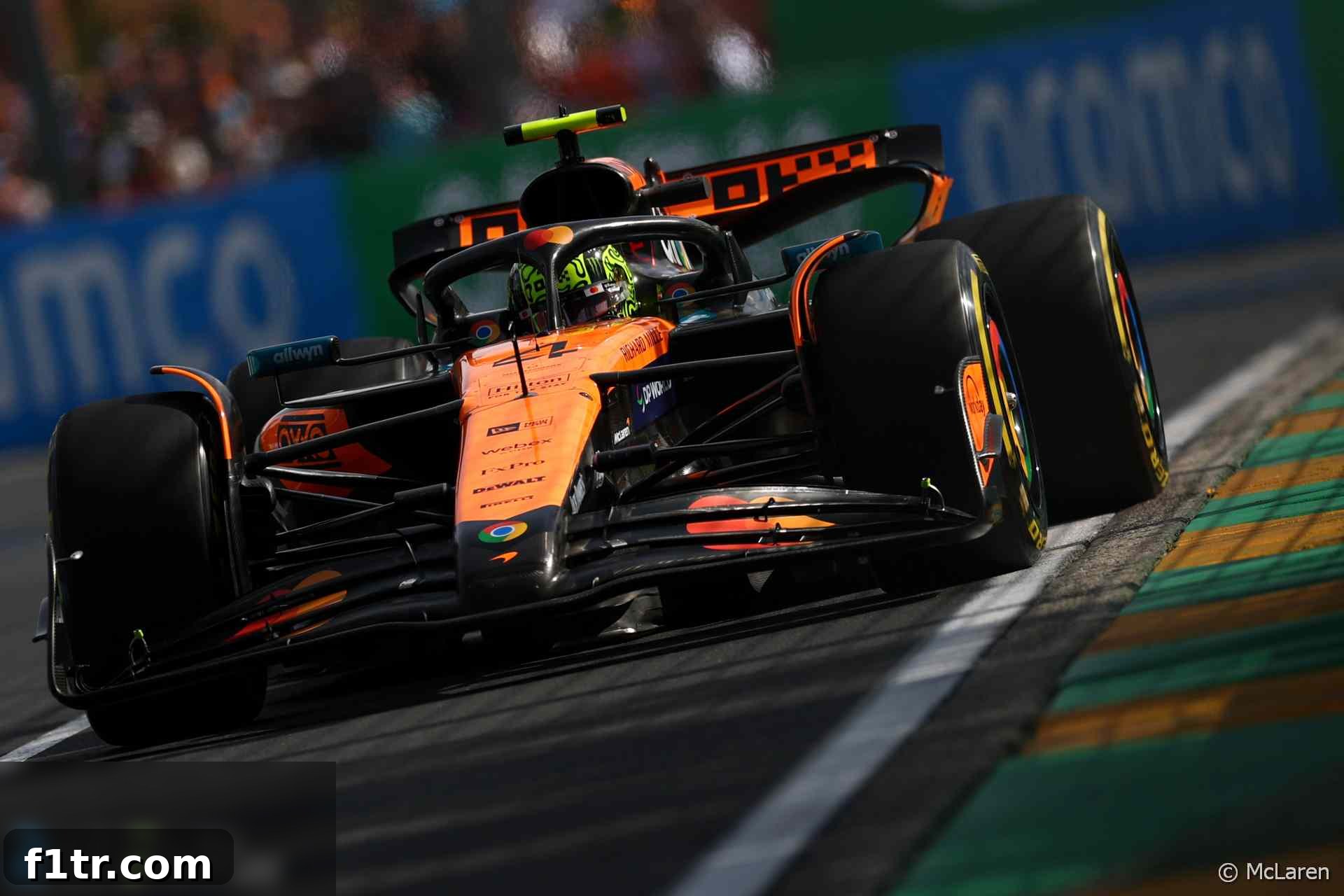
The highly anticipated 2025 Formula 1 Australian Grand Prix at the iconic Albert Park Circuit in Melbourne set the stage for a thrilling season, and the qualifying session did not disappoint. Spectators and pundits alike were treated to a spectacle of speed, precision, and strategic mastery, culminating in a sensational pole position for Lando Norris of McLaren. His blistering pace secured him the top spot on the grid, narrowly edging out his talented teammate Oscar Piastri, much to the delight of the local crowd and McLaren fans worldwide. Max Verstappen, the reigning champion, found himself in a competitive third place, highlighting the intense battles expected for Sunday’s main event.
Norris’s achievement marks a significant moment for McLaren, demonstrating the potential of their MCL39 chassis and the growing synergy within the team. The front-row lockout for the Woking-based outfit signals a strong contender status for the 2025 season, laying down a formidable challenge to rivals Red Bull and Ferrari. As the teams fine-tune their strategies for race day, the qualifying results have ignited discussions about tire wear, potential overtakes, and the ever-present threat of safety car deployments on this challenging street circuit.
The 2025 Australian Grand Prix Starting Grid: A McLaren Masterclass
Lando Norris delivered a truly exceptional performance during the qualifying rounds, clocking a sensational 1’15.096 lap time that cemented his pole position. This remarkable feat was not just a testament to his individual skill but also a strong indicator of McLaren’s formidable package for the 2025 season. Securing the fastest time at such a demanding circuit as Albert Park speaks volumes about the advancements made by the McLaren-Mercedes team with their MCL39.
Sharing the front row with Norris is his teammate, the equally talented Australian driver Oscar Piastri. With a lap time of 1’15.180, Piastri was incredibly close to snatching pole himself, demonstrating the raw pace and competitive spirit within the McLaren garage. This one-two lockout for McLaren on the grid is a dream scenario for the team and sets them up perfectly for a strong showing in their home race. The local hero will be eager to convert this front-row start into a podium finish, perhaps even a victory, in front of his adoring fans.
Row 2 sees the formidable Max Verstappen in his Red Bull-Honda RBPT RB21, starting from third position with a lap time of 1’15.481. While not on pole, Verstappen’s presence near the front is a constant reminder of Red Bull’s championship pedigree and their ability to challenge from any position. Alongside him is George Russell in the Mercedes W16, securing fourth place with a 1’15.546. Mercedes will be looking to capitalise on Russell’s strong start and challenge the front runners, hoping their new machine has the race pace to compete. This tight grouping at the top promises an electrifying start to the Grand Prix.
| Row | Driver & Team | |
|---|---|---|
| Row 1 | 1. (4) Lando Norris 1’15.096 McLaren-Mercedes MCL39 |
2. (81) Oscar Piastri 1’15.180 McLaren-Mercedes MCL39 |
| Row 2 | 3. (1) Max Verstappen 1’15.481 Red Bull-Honda RBPT RB21 |
4. (63) George Russell 1’15.546 Mercedes W16 |
| Row 3 | 5. (22) Yuki Tsunoda 1’15.670 Racing Bulls-Honda RBPT 02 |
6. (23) Alexander Albon 1’15.737 Williams-Mercedes FW47 |
| Row 4 | 7. (16) Charles Leclerc 1’15.755 Ferrari SF-25 |
8. (44) Lewis Hamilton 1’15.973 Ferrari SF-25 |
| Row 5 | 9. (10) Pierre Gasly 1’15.980 Alpine-Renault A525 |
10. (55) Carlos Sainz Jnr 1’16.062 Williams-Mercedes FW47 |
| Row 6 | 11. (6) Isack Hadjar 1’16.175 Racing Bulls-Honda RBPT 02 |
12. (14) Fernando Alonso 1’16.453 Aston Martin-Mercedes AMR25 |
| Row 7 | 13. (18) Lance Stroll 1’16.483 Aston Martin-Mercedes AMR25 |
14. (7) Jack Doohan 1’16.863 Alpine-Renault A525 |
| Row 8 | 15. (5) Gabriel Bortoleto 1’17.520 Sauber-Ferrari C45 |
16. (12) Andrea Kimi Antonelli 1’16.525 Mercedes W16 |
| Row 9 | 17. (27) Nico Hulkenberg 1’16.579 Sauber-Ferrari C45 |
18. (31) Esteban Ocon 1’17.147 Haas-Ferrari VF-25 |
| Row 10 | 19. (30) Liam Lawson 1’17.094 Red Bull-Honda RBPT RB21 |
20. (87) Oliver Bearman No time Haas-Ferrari VF-25 |
Midfield Mayhem and Surprises
Further down the grid, the battle for crucial points in the midfield promises to be just as fierce. Yuki Tsunoda showcased excellent form for Racing Bulls, placing his Honda RBPT 02 in an impressive fifth position. Alexander Albon, representing Williams-Mercedes with their FW47, continued to demonstrate his prowess by securing sixth, a vital result for the British team. Ferrari’s Charles Leclerc starts from seventh, indicating a challenging session for the Scuderia, especially with teammate Lewis Hamilton a row behind in eighth, both piloting the SF-25. It’s noteworthy to see Lewis Hamilton in a Ferrari, marking a significant chapter in his illustrious career. His performance will be closely watched as he adapts to his new team and car.
The top 10 was rounded out by Pierre Gasly for Alpine in ninth and Carlos Sainz Jnr for Williams in tenth. Sainz’s move to Williams is another intriguing storyline for the 2025 season, and his top-ten qualifying performance is a strong start with his new team. The Alpine A525 and Williams FW47 both appear competitive, setting the stage for exciting skirmishes in the main race.
Qualifying is not just about the top positions; it’s a relentless battle for every tenth of a second across the entire field. The difference between making it into Q3 or dropping out in Q2 or Q1 can be incredibly fine, as evidenced by the times. Drivers like Isack Hadjar (Racing Bulls), Fernando Alonso (Aston Martin), Lance Stroll (Aston Martin), Jack Doohan (Alpine), and Gabriel Bortoleto (Sauber) all pushed hard in Q2 but ultimately missed out on the final shoot-out. Their starting positions will make for an interesting strategic challenge on race day.
Detailed Qualifying Session Analysis: Q1, Q2, and Q3 Progression
The Australian Grand Prix qualifying followed the standard three-part format: Q1, Q2, and Q3, designed to progressively narrow the field down to the fastest 10 drivers. Each session demands peak performance and strategic tire management from both drivers and teams. The qualifying times provide a fascinating insight into how each driver managed the evolving track conditions and pushed their respective machines to the limit.
Lando Norris’s progression was nothing short of brilliant. He consistently improved his lap times through each session, culminating in his pole-setting lap. Starting with a strong 1’15.912 in Q1, he shaved off almost half a second in Q2 with a 1’15.415, and then another significant chunk in Q3, demonstrating perfect execution and confidence. Oscar Piastri mirrored his teammate’s progression, showing that the McLaren package had the pace right from the start of qualifying.
Max Verstappen, while third, also showed consistent improvement, but the gap to the McLarens in Q3 suggests they had a slight edge on this occasion. The “Q2 (v Q1)” and “Q3 (v Q2)” columns indicate the improvement (or lack thereof) in lap times between the sessions, offering a clear picture of driver and car performance. A negative value signifies an improvement, while a positive value, often marked in red or “bad” class, indicates a slower lap or a failure to improve sufficiently to advance.
| P. | Driver | Team | Q1 | Q2 (v Q1) | Q3 (v Q2) |
|---|---|---|---|---|---|
| 1 | Lando Norris | McLaren | 1’15.912 | 1’15.415 (-0.497s) | 1’15.096 (-0.319s) |
| 2 | Oscar Piastri | McLaren | 1’16.062 | 1’15.468 (-0.594s) | 1’15.180 (-0.288s) |
| 3 | Max Verstappen | Red Bull | 1’16.018 | 1’15.565 (-0.453s) | 1’15.481 (-0.084s) |
| 4 | George Russell | Mercedes | 1’15.971 | 1’15.798 (-0.173s) | 1’15.546 (-0.252s) |
| 5 | Yuki Tsunoda | Racing Bulls | 1’16.225 | 1’16.009 (-0.216s) | 1’15.670 (-0.339s) |
| 6 | Alexander Albon | Williams | 1’16.245 | 1’16.017 (-0.228s) | 1’15.737 (-0.280s) |
| 7 | Charles Leclerc | Ferrari | 1’16.029 | 1’15.827 (-0.202s) | 1’15.755 (-0.072s) |
| 8 | Lewis Hamilton | Ferrari | 1’16.213 | 1’15.919 (-0.294s) | 1’15.973 (+0.054s) |
| 9 | Pierre Gasly | Alpine | 1’16.328 | 1’16.112 (-0.216s) | 1’15.980 (-0.132s) |
| 10 | Carlos Sainz Jnr | Williams | 1’16.360 | 1’15.931 (-0.429s) | 1’16.062 (+0.131s) |
| 11 | Isack Hadjar | Racing Bulls | 1’16.354 | 1’16.175 (-0.179s) | Missed by 0.063s |
| 12 | Fernando Alonso | Aston Martin | 1’16.288 | 1’16.453 (+0.165s) | Missed by 0.341s |
| 13 | Lance Stroll | Aston Martin | 1’16.369 | 1’16.483 (+0.114s) | Missed by 0.371s |
| 14 | Jack Doohan | Alpine | 1’16.315 | 1’16.863 (+0.548s) | Missed by 0.751s |
| 15 | Gabriel Bortoleto | Sauber | 1’16.516 | 1’17.520 (+1.004s) | Missed by 1.408s |
| 16 | Andrea Kimi Antonelli | Mercedes | 1’16.525 | Missed by 0.009s | |
| 17 | Nico Hulkenberg | Sauber | 1’16.579 | Missed by 0.063s | |
| 18 | Liam Lawson | Red Bull | 1’17.094 | Missed by 0.578s | |
| 19 | Esteban Ocon | Haas | 1’17.147 | Missed by 0.631s | |
| 20 | Oliver Bearman | Haas |
Penalties and Their Race Day Implications
While qualifying establishes the raw pace, penalties can significantly alter a driver’s starting position and race strategy. For the 2025 Australian Grand Prix, two drivers will face the challenge of starting from the pit lane:
Liam Lawson of Red Bull and Oliver Bearman of Haas have both incurred penalties that mandate them to start from the pit lane. This decision can be triggered by various infringements, such as unscheduled power unit component changes, parc fermé violations, or procedural errors during qualifying. For both drivers, this presents a significant hurdle, as they will need to navigate through the entire field from the very back, making early race overtakes and a shrewd strategy absolutely critical to salvaging any points from their weekend. This could lead to some aggressive driving and unexpected movements on track, adding another layer of unpredictability to the race.
Anticipating Race Day in Melbourne
With Lando Norris on pole and Oscar Piastri alongside him, McLaren holds a strong hand for the Australian Grand Prix. However, Albert Park is known for its unpredictable nature, with past races often featuring safety cars and dramatic overtakes. The weather in Melbourne can also be fickle, potentially bringing rain that would throw all pre-race strategies out the window.
Max Verstappen, despite starting third, can never be counted out, and his Red Bull has proven formidable in race conditions. George Russell and the Ferrari duo of Leclerc and Hamilton will be eager to challenge the front-runners and make up ground. The midfield fight, involving Racing Bulls, Williams, Alpine, Aston Martin, Sauber, and Haas, will be intense as teams vie for every single point available. Tyre degradation, pit stop strategy, and driver skill under pressure will all play pivotal roles in determining the final outcome of what promises to be an enthralling 2025 Australian Grand Prix.
Discover More Formula 1 Insights
For those eager to delve deeper into the world of Formula 1, including driver profiles, team news, and expert analysis, explore the latest articles below:
- Controversies, Norris, Newey and more: Five new motorsport books reviewed
- One of F1’s greatest races happened 15 years ago today. Or did it?
- “Overtaking is overtaking”: Domenicali denies F1’s yo-yo racing is “artificial”
- The crashes F1 is trying to prevent may be rare – but the danger is obvious
- F1 returning to India soon after 2027 sounds like wishful thinking
Browse all Formula 1 articles