The Unpredictable Start: Unpacking the Thrilling 2020 Formula 1 Austrian Grand Prix
The opening race of the 2020 Formula 1 season, held at the challenging Red Bull Ring in Spielberg, Austria, immediately set a dramatic tone for the year. Far from being a straightforward affair, the 2020 F1 season opener was profoundly shaped by a series of Safety Car deployments, transforming conventional strategies and injecting an unparalleled level of excitement and unpredictability into the proceedings. Virtually every significant pit stop throughout the Grand Prix occurred under one of the three Safety Car periods, making tyre strategy and timing absolutely critical to a driver’s final position.
One of the earliest and most significant moments that reshaped the race was the early retirement of Red Bull’s Max Verstappen. Verstappen, a pre-race favourite and the only driver among the top 10 not to qualify on the soft compound, was out within a mere dozen laps. His Honda power unit gave up just as he was starting to match the lap times of race leader Valtteri Bottas on his medium tyres. His premature exit removed a key strategic variable from the race, as Red Bull’s aggressive home-circuit strategy vanished, leaving a void that would profoundly impact the competitive landscape.
When the first Safety Car was deployed on lap 26, the majority of the grid seized the opportunity for a ‘free’ pit stop. Most drivers wisely opted for the durable hard compound tyres, intending to run them to the end of the race. However, one notable exception was Sergio Perez of Racing Point. Perez, then leading, made a contrarian choice, opting for medium tyres. This decision left him strategically vulnerable later in the race, especially as rivals switched to fresher soft tyres. Adding to his woes, a five-second time penalty for speeding during his sole pit stop further compounded his challenges, effectively diminishing his chances for a higher finish.
Mercedes, typically masters of strategy, also faced their own set of challenges. Having successfully ‘stacked’ both Valtteri Bottas and Lewis Hamilton under the first Safety Car period, the team found itself scrambling during the second deployment. The rapid succession of Safety Cars left them with little time to bring both drivers in again. While the team later admitted it wasn’t their initial intention to pit both drivers, they conceded that this oversight might have been a critical mistake. This became painfully clear when a soft-tyre shod Alexander Albon launched an audacious attack on the Mercedes duo. The Red Bull driver, demonstrating blistering pace, was on track for a potential race win before a fateful collision with Hamilton ended his charge prematurely, a moment that added another layer of controversy and drama to an already action-packed race.
Without the intervention of multiple Safety Car periods, the 2020 Austrian Grand Prix would have almost certainly unfolded as a far more processional affair. The dynamic shifts in position, intense strategic battles, and nail-biting finishes were largely a direct consequence of these neutralised periods. Indeed, many of the significant changes in grid position across the field were not due to on-track overtakes but rather the result of an unusually high number of retirements, which further shuffled the pack and opened opportunities for unexpected heroes.
Driver Dynamics and Strategic Insights from the 2020 Austrian Grand Prix
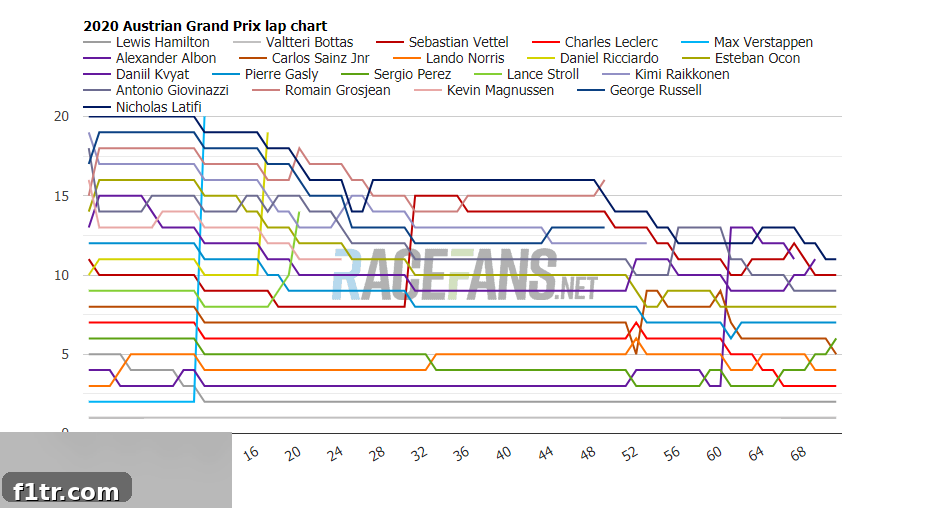
2020 Austrian Grand Prix Lap Chart Overview
The visual representation of each driver’s position on every lap provides an immediate understanding of the race flow. While interactive elements are not included here, this data tool typically allows fans to track the progress and struggles of each competitor, highlighting periods of gain, loss, or consistent performance. Observing the fluctuations, especially around Safety Car periods, illustrates the profound impact of strategic decisions and on-track incidents.
2020 Austrian Grand Prix Race Chart Analysis
The race chart, which traditionally illustrates the gaps between each driver relative to the leader’s average lap time, offers crucial insights into overall race pace and strategic pacing. Large gaps are often omitted to maintain clarity, allowing for a focused view on the competitive clusters. This chart is instrumental in understanding how different tyre strategies played out and how drivers managed their pace throughout the Grand Prix, especially after Safety Car restarts.
Position Change: From Start to Finish
The 2020 Austrian Grand Prix witnessed a variety of fortunes regarding position changes, largely influenced by the chaotic nature of the race and numerous retirements. Examining the raw data reveals interesting shifts:
| Driver | Start position | Lap one position change | Race position change |
|---|---|---|---|
| Lewis Hamilton | 5 | 0 | 3 |
| Valtteri Bottas | 1 | 0 | 0 |
| Sebastian Vettel | 11 | 1 | 1 |
| Charles Leclerc | 7 | 0 | 4 |
| Max Verstappen | 2 | 0 | |
| Alexander Albon | 4 | 0 | -9 |
| Carlos Sainz Jnr | 8 | 0 | 3 |
| Lando Norris | 3 | 0 | -1 |
| Daniel Ricciardo | 10 | -1 | |
| Esteban Ocon | 14 | -2 | 6 |
| Daniil Kvyat | 13 | -2 | 1 |
| Pierre Gasly | 12 | 0 | 5 |
| Sergio Perez | 6 | 0 | 0 |
| Lance Stroll | 9 | 0 | |
| Kimi Raikkonen | 19 | 2 | |
| Antonio Giovinazzi | 18 | 4 | 9 |
| Romain Grosjean | 15 | -3 | |
| Kevin Magnussen | 16 | 3 | |
| George Russell | 17 | -2 | |
| Nicholas Latifi | 20 | 0 | 9 |
Valtteri Bottas maintained his pole position throughout, securing a crucial victory. Lewis Hamilton, starting P5, impressively gained 3 positions to finish P2 (before his penalty was applied, which would drop him). However, the most striking gains came from Charles Leclerc, who climbed 4 places from P7 to P2, a remarkable performance given Ferrari’s challenging start to the season. Antonio Giovinazzi and Nicholas Latifi, starting P18 and P20 respectively, both made significant strides, gaining 9 positions each, capitalising on the numerous retirements ahead of them. Conversely, Alexander Albon’s promising race from P4 ended in disappointment and a significant drop in eventual classification due to his collision, symbolised by a -9 change.
2020 Austrian Grand Prix Lap Times Overview
This detailed breakdown of all driver lap times (excluding unusually slow laps) is vital for understanding individual performance and consistency. It allows analysts to pinpoint where drivers gained or lost time, evaluate the effectiveness of different tyre compounds over their stints, and identify moments of exceptional pace or struggle. The ability to toggle drivers provides a comparative view of their individual performances throughout the challenging race.
Fastest Laps: The Ultimate Display of Pace
Despite the strategic complexities, the 2020 Austrian Grand Prix delivered some blistering individual lap times. The battle for the fastest lap point was intense, with Lando Norris ultimately seizing it on the final lap:
| Rank | Driver | Car | Fastest lap | Gap | On lap |
|---|---|---|---|---|---|
| 1 | Lando Norris | McLaren-Renault | 1’07.475 | 71 | |
| 2 | Valtteri Bottas | Mercedes | 1’07.657 | 0.182 | 68 |
| 3 | Lewis Hamilton | Mercedes | 1’07.712 | 0.237 | 67 |
| 4 | Charles Leclerc | Ferrari | 1’07.901 | 0.426 | 64 |
| 5 | Carlos Sainz Jnr | McLaren-Renault | 1’07.974 | 0.499 | 63 |
| 6 | Sergio Perez | Racing Point-Mercedes | 1’08.305 | 0.830 | 63 |
| 7 | Alexander Albon | Red Bull-Honda | 1’08.432 | 0.957 | 50 |
| 8 | Sebastian Vettel | Ferrari | 1’08.623 | 1.148 | 71 |
| 9 | Antonio Giovinazzi | Alfa Romeo-Ferrari | 1’08.796 | 1.321 | 70 |
| 10 | Esteban Ocon | Renault | 1’08.912 | 1.437 | 70 |
| 11 | Pierre Gasly | AlphaTauri-Honda | 1’09.025 | 1.550 | 64 |
| 12 | Kimi Raikkonen | Alfa Romeo-Ferrari | 1’09.031 | 1.556 | 48 |
| 13 | Daniil Kvyat | AlphaTauri-Honda | 1’09.135 | 1.660 | 50 |
| 14 | George Russell | Williams-Mercedes | 1’09.317 | 1.842 | 49 |
| 15 | Max Verstappen | Red Bull-Honda | 1’09.351 | 1.876 | 5 |
| 16 | Nicholas Latifi | Williams-Mercedes | 1’09.662 | 2.187 | 63 |
| 17 | Romain Grosjean | Haas-Ferrari | 1’10.228 | 2.753 | 46 |
| 18 | Lance Stroll | Racing Point-Mercedes | 1’10.326 | 2.851 | 4 |
| 19 | Daniel Ricciardo | Renault | 1’10.610 | 3.135 | 8 |
| 20 | Kevin Magnussen | Haas-Ferrari | 1’10.720 | 3.245 | 23 |
Lando Norris’s sensational fastest lap of 1:07.475 on the very last lap (lap 71) was a highlight, cementing his well-deserved podium finish and securing the bonus point. Both Mercedes drivers, Valtteri Bottas and Lewis Hamilton, were very close, demonstrating their car’s inherent speed. Interestingly, Max Verstappen’s fastest lap came very early in the race (lap 5), showcasing his potential pace before his retirement. Drivers who ended their race on softer compounds, like Charles Leclerc, Carlos Sainz Jr., and Sebastian Vettel, were also able to put in competitive late-race efforts, reflecting the benefits of a staggered tyre strategy.
2020 Austrian Grand Prix Tyre Strategies: A Strategic Minefield
The numerous Safety Cars turned the tyre strategy for the 2020 Austrian Grand Prix into a complex and often reactive affair. Most drivers started on the C4 (soft) compound, intending an early switch. The first Safety Car on lap 26 proved to be the pivotal moment for mass pit stops, with the majority of the field changing to the durable C2 (hard) tyres, aiming for a one-stop race to the finish.
| Stint 1 | Stint 2 | Stint 3 | |
|---|---|---|---|
| Valtteri Bottas | C4 (26) | C2 (45) | |
| Lewis Hamilton | C4 (26) | C2 (45) | |
| Charles Leclerc | C4 (26) | C2 (25) | C3 (5) |
| Lando Norris | C4 (26) | C2 (25) | C3 (5) |
| Carlos Sainz Jnr | C4 (26) | C2 (26) | C3 (4) |
| Sergio Perez | C4 (26) | C3 (45) | |
| Pierre Gasly | C3 (26) | C2 (45) | |
| Esteban Ocon | C3 (26) | C2 (45) | |
| Antonio Giovinazzi | C3 (25) | C2 (30) | C4 (1) |
| Sebastian Vettel | C3 (26) | C2 (25) | C4 (5) |
| Nicholas Latifi | C3 (26) | C2 (25) | C4 (5) |
| Daniil Kvyat | C3 (26) | C2 (25) | C4 (5) |
| Alexander Albon | C4 (26) | C2 (25) | C4 (5) |
| Kimi Raikkonen | C3 (24) | C2 (27) | C4 (2) |
| George Russell | C3 (25) | C2 (24) | |
| Romain Grosjean | C3 (20) | C2 (29) | |
| Kevin Magnussen | C3 (24) | ||
| Lance Stroll | C4 (20) | ||
| Daniel Ricciardo | C4 (17) | ||
| Max Verstappen | C3 (11) |
Drivers like Valtteri Bottas and Lewis Hamilton successfully executed a straightforward one-stop C4-C2 strategy. However, the unique choice by Sergio Perez to go C4-C3 meant he was on the medium compound for a long second stint, differentiating his approach from the rest of the front-runners. Many drivers, including Charles Leclerc, Lando Norris, and Carlos Sainz Jnr, found themselves on a two-stop strategy, often ending on a C3 (medium) or C4 (soft) compound for a late push, directly contributing to the exciting finishes and fastest lap attempts. The retirements of prominent drivers like Max Verstappen, Daniel Ricciardo, and Lance Stroll cut short their planned strategies, further adding to the strategic unknowns.
2020 Austrian Grand Prix Pit Stop Times: Seconds That Count
In the high-stakes world of Formula 1, every millisecond counts, especially in the pit lane. The pit stop times from the 2020 Austrian Grand Prix underscore the critical role of team efficiency and precision:
| Driver | Team | Pit stop time | Gap | On lap | |
| 1 | Alexander Albon | Red Bull | 21.279 | 26 | |
| 2 | George Russell | Williams | 21.417 | 0.138 | 25 |
| 3 | Kimi Raikkonen | Alfa Romeo | 21.569 | 0.290 | 51 |
| 4 | Daniil Kvyat | Toro Rosso | 21.622 | 0.343 | 51 |
| 5 | Esteban Ocon | Renault | 21.683 | 0.404 | 26 |
| 6 | Carlos Sainz Jnr | McLaren | 21.805 | 0.526 | 52 |
| 7 | Alexander Albon | Red Bull | 21.842 | 0.563 | 51 |
| 8 | Lewis Hamilton | Mercedes | 21.850 | 0.571 | 26 |
| 9 | Nicholas Latifi | Williams | 21.918 | 0.639 | 51 |
| 10 | Lando Norris | McLaren | 21.921 | 0.642 | 51 |
| 11 | Valtteri Bottas | Mercedes | 21.937 | 0.658 | 26 |
| 12 | Charles Leclerc | Ferrari | 21.972 | 0.693 | 51 |
| 13 | Nicholas Latifi | Williams | 22.058 | 0.779 | 26 |
| 14 | Sebastian Vettel | Ferrari | 22.231 | 0.952 | 26 |
| 15 | Sergio Perez | Racing Point | 22.383 | 1.104 | 26 |
| 16 | Pierre Gasly | Toro Rosso | 22.466 | 1.187 | 26 |
| 17 | Sebastian Vettel | Ferrari | 22.738 | 1.459 | 51 |
| 18 | Charles Leclerc | Ferrari | 22.756 | 1.477 | 26 |
| 19 | Daniil Kvyat | Toro Rosso | 22.769 | 1.490 | 26 |
| 20 | Antonio Giovinazzi | Alfa Romeo | 22.800 | 1.521 | 55 |
| 21 | Kimi Raikkonen | Alfa Romeo | 23.229 | 1.950 | 24 |
| 22 | Romain Grosjean | Haas | 23.280 | 2.001 | 20 |
| 23 | Lando Norris | McLaren | 23.637 | 2.358 | 26 |
| 24 | Antonio Giovinazzi | Alfa Romeo | 23.659 | 2.380 | 25 |
| 25 | Carlos Sainz Jnr | McLaren | 23.827 | 2.548 | 26 |
Red Bull demonstrated remarkable pit stop efficiency, with Alexander Albon recording the fastest stop of 21.279 seconds. George Russell also showcased Williams’s capability with a rapid stop. The cluster of fast stops from various teams underscores the intense competition in the pit lane. While most teams delivered consistent times around the 21-22 second mark, some longer stops, particularly for drivers like Romain Grosjean, Lando Norris, and Carlos Sainz Jnr early in the race, could have compromised their race positions before later quick stops helped them recover. These split-second differences can have profound implications, especially during Safety Car periods where the field is compressed.
Conclusion: A Memorable Kick-off to the 2020 F1 Season
The 2020 Austrian Grand Prix proved to be an unforgettable start to a unique Formula 1 season. Defined by its three Safety Car periods, the race was a masterclass in strategic adaptation and a testament to driver resilience. From Max Verstappen’s early heartbreak to Sergio Perez’s daring tyre gamble, and the tantalising promise of an Alexander Albon victory, the Red Bull Ring delivered drama in spades. Valtteri Bottas secured a well-deserved victory, but it was the unexpected podium for Charles Leclerc and Lando Norris’s sensational fastest lap that truly captured the spirit of a Grand Prix that defied expectations. This race not only showcased the raw speed and talent of the drivers but also highlighted how external factors and split-second decisions can entirely rewrite the script of a Formula 1 event, leaving fans eagerly anticipating what the rest of the season would hold.
More on the 2020 Austrian Grand Prix:
- FIA issues new Austrian GP results after correcting Kvyat error
- Russell sees Mercedes as only possible alternative to Williams in 2021
- Hamilton: No “bad blood” with Albon after second collision in three races
- 2020 Austrian Grand Prix interactive data: lap charts, times and tyres
- 2020 Austrian Grand Prix Star Performers
Browse all 2020 Austrian Grand Prix articles