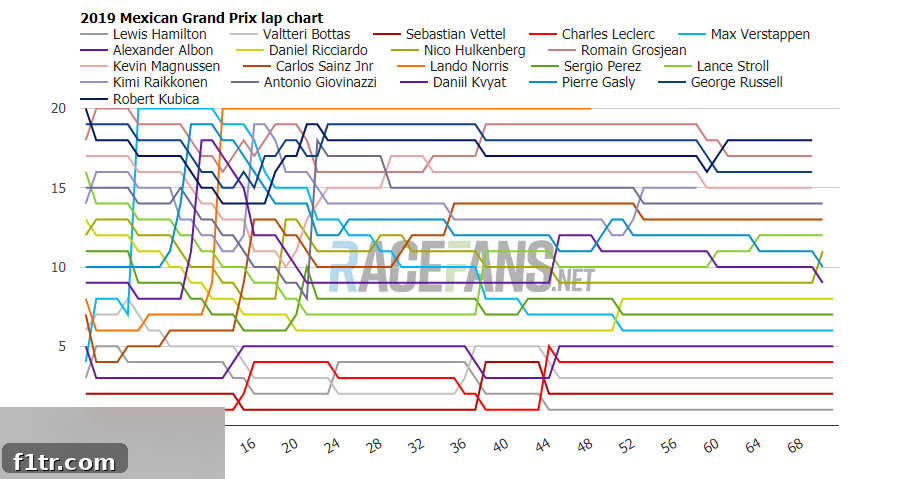
The 2019 Mexican Grand Prix was a high-stakes strategic battle that ultimately saw Mercedes outmaneuver Ferrari, securing a crucial victory for Lewis Hamilton. Before the race, pole-sitter Charles Leclerc famously remarked that controlling Turn 1 on the opening lap would grant a significant advantage. Indeed, Leclerc did emerge from the first corner in the lead, seemingly setting the stage for a dominant Ferrari performance. However, what unfolded over the subsequent laps was a masterclass in Formula 1 strategy, punctuated by crucial pit stop decisions that dramatically altered the race’s outcome and highlighted the intricate dance between team and driver.
Ferrari’s race strategy for Leclerc began to unravel surprisingly early. Just 15 laps into the race, the Monegasque driver was called into the pits, a decision that baffled many at the time and ultimately forced him onto a two-stop strategy. This move was primarily triggered by Red Bull’s aggressive play with Alexander Albon. Albon, who had made an impressive start to climb to third position, was brought in by Red Bull on lap 14. The aim was clear: equip him with fresher tyres to execute an ‘undercut’ on Sebastian Vettel, who was running ahead of him in second place. Ferrari found themselves in a difficult position. Reacting to Albon’s stop was necessary to protect Vettel’s position, but it also presented a challenging internal dynamic.
Had Ferrari pitted Vettel to cover Albon, there was a significant risk that Vettel, on newer tyres, would then be able to undercut his teammate Leclerc, who was still leading. To avoid this undesirable scenario of their own drivers battling through strategy, Ferrari opted to pit Leclerc instead, bringing him in on lap 15. Leclerc’s comments after the race confirmed this reasoning, stating, “We wanted to cover from Albon at first, which we did. And then from then on I think it was very difficult to do better.” This decision locked Leclerc into a two-stop strategy, as he was fitted with a second set of medium C3 tyres. While it protected his lead from the immediate threat of Albon’s undercut, it opened the door for rivals to pursue more flexible one-stop strategies, particularly with the more durable hard C2 compound.
Meanwhile, Sebastian Vettel continued his first stint, running much longer on his initial set of medium tyres. This extended run was aimed at allowing him to switch to the hard compound and complete the race with a single pit stop, a strategy that many of the front-runners were now targeting. However, Ferrari’s earlier decision to pit Leclerc so early left them vulnerable. This prolonged stint by Vettel, combined with the strategic flexibility of their rivals, proved to be another critical misstep. Mercedes, ever-alert to Ferrari’s dilemmas, saw their opportunity with Lewis Hamilton. The British driver pitted on lap 23 for hard tyres, executing a perfect undercut on Vettel. Despite Hamilton initially expressing reservations over team radio about the tyre choice and whether it would hold up for the remaining 48 laps, Mercedes’ calculation proved impeccable. Hamilton emerged ahead of Vettel, seizing a track position that he would not relinquish.
The contrasting outcomes for the two Ferrari drivers underscored the team’s strategic errors. Leclerc, forced onto an early two-stop, found himself battling through traffic in the latter stages of the race, making it difficult to regain lost ground. His fastest lap of the race, a 1’19.232 on lap 53, demonstrated the raw pace of the Ferrari but could not compensate for the strategic disadvantage. Vettel, despite running a long first stint and ultimately switching to hard tyres for a one-stop, was compromised by Hamilton’s earlier undercut. Mercedes’ ability to react decisively and exploit Ferrari’s indecision allowed Hamilton to manage his tyres brilliantly and secure an unexpected victory, further solidifying his championship lead.
Race Analysis: Unpacking the 2019 Mexican Grand Prix Data
A deeper dive into the race data reveals the intricacies of the strategic battle at Mexico City. The dynamic shifts in track position and the effectiveness of various pit stop timings paint a comprehensive picture of Mercedes’ triumph over Ferrari’s tactical missteps. While interactive charts are invaluable for real-time visualization, examining the underlying data provides crucial insights into why the race unfolded as it did.
Position Changes and Driver Performance
The “Position Change” table offers a stark illustration of who gained and lost ground. While Charles Leclerc started from pole and maintained his position on Lap 1, his overall race saw him drop three places by the checkered flag, a direct consequence of his two-stop strategy. In contrast, Lewis Hamilton started third, briefly lost two positions on Lap 1, but ultimately gained two positions over the race, clinching the victory. Valtteri Bottas also demonstrated strong recovery, climbing three positions from his sixth-place start. Alexander Albon, despite his aggressive early pit stop, maintained his starting position, showcasing the fine margins of the undercut strategy. On the other end of the spectrum, Max Verstappen endured a tough race, losing two positions from his fourth-place start, while Carlos Sainz Jnr suffered a significant drop of six places after an initially strong start.
Fastest Laps and Pace
Despite his strategic woes, Charles Leclerc showcased the inherent speed of the Ferrari by setting the fastest lap of the race with a 1’19.232 on lap 53, demonstrating his ability to push when clear of traffic and on fresh rubber. This was marginally quicker than Alexander Albon’s best of 1’19.325 and Sebastian Vettel’s 1’19.381, both indicative of the competitive pace from Ferrari and Red Bull. Lewis Hamilton’s best lap was a 1’19.461, remarkable given his prolonged stint on hard tyres, highlighting both the durability of the C2 compound and his exceptional tyre management skills. The closely matched fastest laps among the top contenders suggest that while Ferrari had outright pace, Mercedes executed a superior race strategy.
Tyre Strategies: The Deciding Factor
The tyre strategy table paints the clearest picture of the race’s turning point. Lewis Hamilton, Sebastian Vettel, and Valtteri Bottas all committed to a one-stop strategy, transitioning from the medium (C3) to the hard (C2) compound. Hamilton’s early switch to hards on lap 23 was the catalyst for his victory, allowing him to manage the tyre effectively for a long second stint. Vettel’s later pit stop on lap 37 meant he missed the crucial undercut window against Hamilton. In stark contrast, Charles Leclerc and Alexander Albon were forced into two-stop strategies, both using two sets of mediums (C3) before a final stint on hards (C2). This multi-stop approach, while offering bursts of speed, inevitably led to more time lost in the pit lane and battling through traffic, proving less efficient on the high-altitude Mexican circuit. Drivers like Daniel Ricciardo also showed success with alternative one-stop strategies, starting on hards and finishing on mediums.
Pit Stop Times: Efficiency and Exceptions
Ferrari demonstrated strong pit stop efficiency, with Sebastian Vettel recording the fastest stop at 21.862 seconds and Charles Leclerc not far behind with a 22.002-second stop on lap 15. Red Bull also showed strong pit lane performance with Alexander Albon’s stops. These quick turnarounds are crucial in tight strategic battles. However, the table also highlights some notable delays. Max Verstappen endured a lengthy 24.493-second stop on lap 5, contributing to his difficult race. Antonio Giovinazzi had an exceptionally long stop of 43.411 seconds, and Lando Norris’s stop of 123.388 seconds was due to a wheel issue that forced his retirement, illustrating how critical pit stop execution is to a driver’s race.
The 2019 Mexican Grand Prix ultimately served as a compelling narrative on the pivotal role of strategy in modern Formula 1. While Ferrari possessed the raw pace, their indecision and misjudgment in reacting to their rivals, particularly Red Bull’s early move with Albon, handed the initiative to Mercedes. Lewis Hamilton’s unwavering performance, coupled with Mercedes’ astute strategic calls and excellent tyre management, allowed them to turn a potential third-place finish into a victory. Ferrari’s inability to convert pole position into a win once again underscored the importance of a cohesive and adaptable race strategy, a lesson that would continue to shape the championship battle.
The race remains a classic example of how a single pit stop decision can cascade into race-winning or losing outcomes, proving that Grand Prix racing is as much a chess match off the track as it is a speed contest on it.
2019 Mexican Grand Prix Related Articles
- Why Leclerc’s penalty decision took four hours longer than Kvyat’s
- Ferrari must start converting pole positions into wins – Binotto
- 2019 Mexican Grand Prix Star Performers
- Mercedes: Lost ‘wouvre panel’ cost Hamilton seven seconds
- Horner defends Verstappen’s driving after Hamilton’s “torpedo” criticism
Browse all 2019 Mexican Grand Prix articles