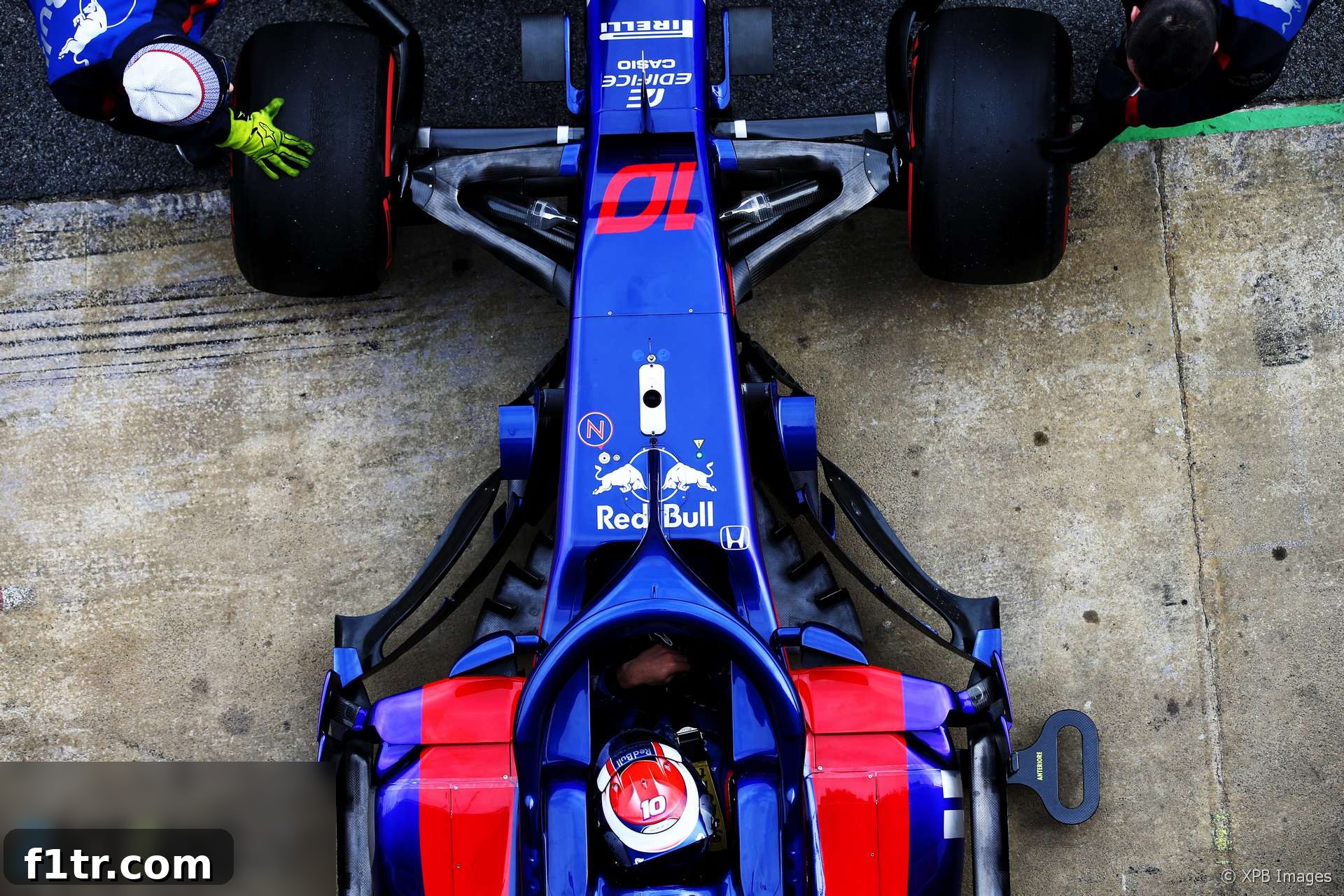
The dawn of a new Formula 1 season always brings with it a mix of anticipation and uncertainty, particularly during the crucial pre-season testing phase. Memories of previous years’ struggles and triumphs often linger, providing a backdrop against which new performances are measured. For the Honda power unit, the narrative has shifted dramatically from one year to the next. Just a year ago, the McLaren-Honda partnership became synonymous with frustration, its cars spending more time in the garage for engine changes than accumulating valuable mileage on track during pre-season runs.
Fast forward to the current testing season, and the picture couldn’t be more different. Partnered solely with Toro Rosso, Honda has orchestrated an impressive resurgence, with the STR13 chassis accumulating more testing mileage than any of its rivals. This remarkable turnaround in reliability and performance has not gone unnoticed, prompting Toro Rosso technical director James Key to offer a highly positive assessment of their new engine partner. This shift signals not just a change in fortune for Honda but potentially a significant shake-up in the competitive landscape of the 2018 F1 season.
Unpacking the Performance: Are Teams Quicker Than Last Year?
The conditions at the Circuit de Barcelona-Catalunya on Thursday proved challenging, mirroring the unpredictable nature of early spring weather. A wet start to the day gradually gave way to drier conditions in the afternoon, allowing teams to push their machinery closer to its true potential. Despite the varied track conditions, the initial lap times provided some intriguing insights into the progress made over the winter break.
Mercedes’ Lewis Hamilton, a seasoned champion, set the quickest time of the test so far. His impressive lap was achieved on medium tyres, which are considered the third-hardest of the seven compounds available to teams this year. This benchmark time remarkably matched Mercedes’ fastest effort from the previous year’s pre-season testing and was just under two-tenths off the pole position time set at the 2017 Spanish Grand Prix. While this already indicates strong performance, the consensus within the paddock is that significant gains are still to be unlocked as teams fine-tune their setups and drivers push harder.
Tyre manufacturer Pirelli has further fueled anticipation by predicting that lap times will dip below the 1 minute 18 second mark in the coming week of testing. This suggests a notable leap in overall performance compared to previous seasons, driven by new aerodynamic regulations and continuous chassis development. A more robust indicator of progress can be seen in the fact that half of the teams present have already posted lap times quicker than their best efforts during last year’s Spanish Grand Prix weekend. This early pace suggests that the 2018 cars are fundamentally faster, even in varied testing conditions. It is noteworthy, however, that McLaren currently leads this particular measure, having achieved their fastest time on the hyper-soft tyre – the softest compound available, which offers maximum grip but limited durability.
First Test Lap Time Analysis: A Snapshot of the Field
The initial week of pre-season testing provides a crucial, albeit often misleading, snapshot of the competitive order. Teams employ varying fuel loads, engine modes, and tyre strategies, making direct comparisons challenging. Nevertheless, the fastest times recorded offer a baseline for analysis:
Fastest times by team – first test
| Position | Team | Model | Time | Gap | Tyre |
|---|---|---|---|---|---|
| 1 | Mercedes | W09 | 1’19.333 | Medium | |
| 2 | Ferrari | SF71H | 1’19.673 | 0.340 | Soft |
| 3 | McLaren | MCL33 | 1’19.854 | 0.521 | Hyper-soft |
| 4 | Red Bull | RB14 | 1’20.179 | 0.846 | Medium |
| 5 | Haas | VF-18 | 1’20.317 | 0.984 | Super-soft |
| 6 | Renault | RS18 | 1’20.547 | 1.214 | Soft |
| 7 | Williams | FW41 | 1’21.142 | 1.809 | Soft |
| 8 | Toro Rosso | STR13 | 1’21.318 | 1.985 | Soft |
| 9 | Force India | VJM11 | 1’21.841 | 2.508 | Soft |
| 10 | Sauber | C37 | 1’22.721 | 3.388 | Soft |
Mercedes and Ferrari appear to be setting the early pace, with McLaren close behind. However, the varying tyre compounds used for these fastest laps are crucial to interpreting the data. Mercedes achieved their top time on the more durable medium compound, suggesting they have significant performance reserves on softer tyres. In contrast, McLaren’s reliance on the hyper-soft for their fastest lap might indicate a need to extract maximum grip to compete with the frontrunners, or it could be a strategic choice to test the absolute limits of their car. Red Bull, known for their development pace, posted a competitive time on mediums, hinting at strong underlying potential.
Mileage Watch: The True Test of Reliability
While outright lap times capture headlines, the true essence of pre-season testing lies in accumulating mileage. This allows teams to rigorously test components, gather data, and ensure reliability under race conditions. In this critical aspect, Toro Rosso’s performance with their Honda engine has been nothing short of a revelation. Their position at the top of the mileage chart is not just an encouraging step forward compared to Honda’s disastrous 2017 season, but an absolutely essential one.
As the sole team utilizing the Honda engine, Toro Rosso bears the responsibility of racking up extensive kilometers to accelerate the power unit’s development and prove its robustness. This is particularly significant given the stringent new regulations for the 2018 season, where each driver is permitted only three power units for an entire 21-race calendar. This translates into an average duty cycle of seven races per power unit, in addition to extensive practice and qualifying sessions. Therefore, the ability to cover significant distances without major issues during testing is paramount to avoid grid penalties later in the season.
Having successfully covered just over 1,500 kilometers with their Honda engine, Toro Rosso has already completed the equivalent of almost five race distances. This impressive feat puts them well on track to demonstrate the new engine’s capability to withstand the rigors of a full Grand Prix season. While the exact engine modes and conservative mapping they might be employing remain speculative, the fact that their lap times are not wildly out of step with their rivals further underscores the positive early signs of reliability and underlying performance potential.
Go ad-free for just £1 per month>> Find out more and sign up
Meanwhile, McLaren, after initially slumping to the foot of the mileage chart earlier in the week, largely due to some minor but frustrating technical faults – notably a “stupid 2-bolt” issue reported to have caused significant delay – experienced a highly productive Thursday. Their focused efforts propelled them significantly up the mileage standings. Adding to their satisfaction, McLaren has now covered more ground than fellow Renault engine users (branded as TAG-Heuer) Red Bull, signaling a more stable operational phase after their initial hiccups. This recovery is vital for McLaren as they seek to validate their new car and the Renault power unit after their challenging Honda years.
2018 Pre-Season Testing So Far: Mileage Breakdown
Here’s a detailed look at the distances covered by each team during the first phase of 2018 pre-season testing. This data is critical for assessing each team’s reliability and their progress in integrating new components and understanding their car’s behavior over long runs.
| Team | Distance |
|---|---|
| Toro Rosso | 1508.2km |
| Ferrari | 1387.2km |
| Mercedes | 1387.2km |
| Sauber | 1317.4km |
| Williams | 1284.8km |
| Renault | 1270.8km |
| McLaren | 1210.3km |
| Red Bull | 972.9km |
| Haas | 870.5km |
| Force India | 772.7km |
Toro Rosso’s commanding lead in mileage underscores the remarkable strides Honda has made in reliability. Ferrari and Mercedes, the usual frontrunners, are also putting in solid, consistent runs, indicative of well-sorted packages. McLaren’s climb up the chart after initial difficulties is a positive sign, while Red Bull appears to be taking a more measured approach, possibly focusing on specific test programs rather than outright mileage.
Historical Context: 2017 Pre-Season Testing Total Mileage
To put the current mileage figures into perspective, it’s useful to recall the total distances covered during the entirety of the 2017 pre-season testing. This provides a benchmark for how much ground teams typically aim to cover and highlights any significant deviations in the current year’s early running.
| Team | Distance |
|---|---|
| Mercedes | 5101.9km |
| Ferrari | 4445.5km |
| Williams | 3724km |
| Sauber | 3663.5km |
| Force India | 3654.2km |
| Red Bull | 3184km |
| Haas | 3170.1km |
| Renault | 2774.4km | Toro Rosso | 2718.5km |
| McLaren | 2127.3km |
Comparing the early 2018 figures with the 2017 totals, it’s clear that teams are still far from their overall targets. However, the initial consistency from teams like Toro Rosso, Ferrari, and Mercedes bodes well for reaching those targets without major reliability roadblocks. McLaren’s 2017 mileage, which was the lowest, starkly contrasts with Toro Rosso’s current top position, emphasizing the dramatic shift in Honda’s fortunes.
Looking Ahead: The Road to the 2018 F1 Season
The first week of pre-season testing has provided a compelling glimpse into the upcoming 2018 F1 season. Honda’s incredible reliability turnaround with Toro Rosso stands as the most prominent storyline, signaling a potential resurgence for the Japanese power unit manufacturer. While Mercedes and Ferrari appear to hold an early advantage in raw pace, the varying test programs and tyre strategies mean that definitive conclusions are still premature.
The focus will now shift to the second week of testing, where teams are expected to unveil more of their true performance potential, explore longer race simulations, and fine-tune their setups for the season opener. The delicate balance between outright speed and bulletproof reliability will ultimately define success in a season with fewer power unit components available. Fans can anticipate an exciting and unpredictable campaign, with Honda’s remarkable progress adding another fascinating dimension to the competitive narrative of Formula 1.
Related Articles: 2018 F1 Season Insights
- F1 feared “death knell” for Drive to Survive after Ferrari and Mercedes snub
- McLaren staff told us we were “totally crazy” to take Honda engines in 2018 – Tost
- ‘It doesn’t matter if we start last’: How Red Bull’s junior team aided Honda’s leap forward
- Honda’s jet division helped F1 engineers solve power unit problem
- McLaren Racing losses rise after Honda split
Browse all 2018 F1 season articles