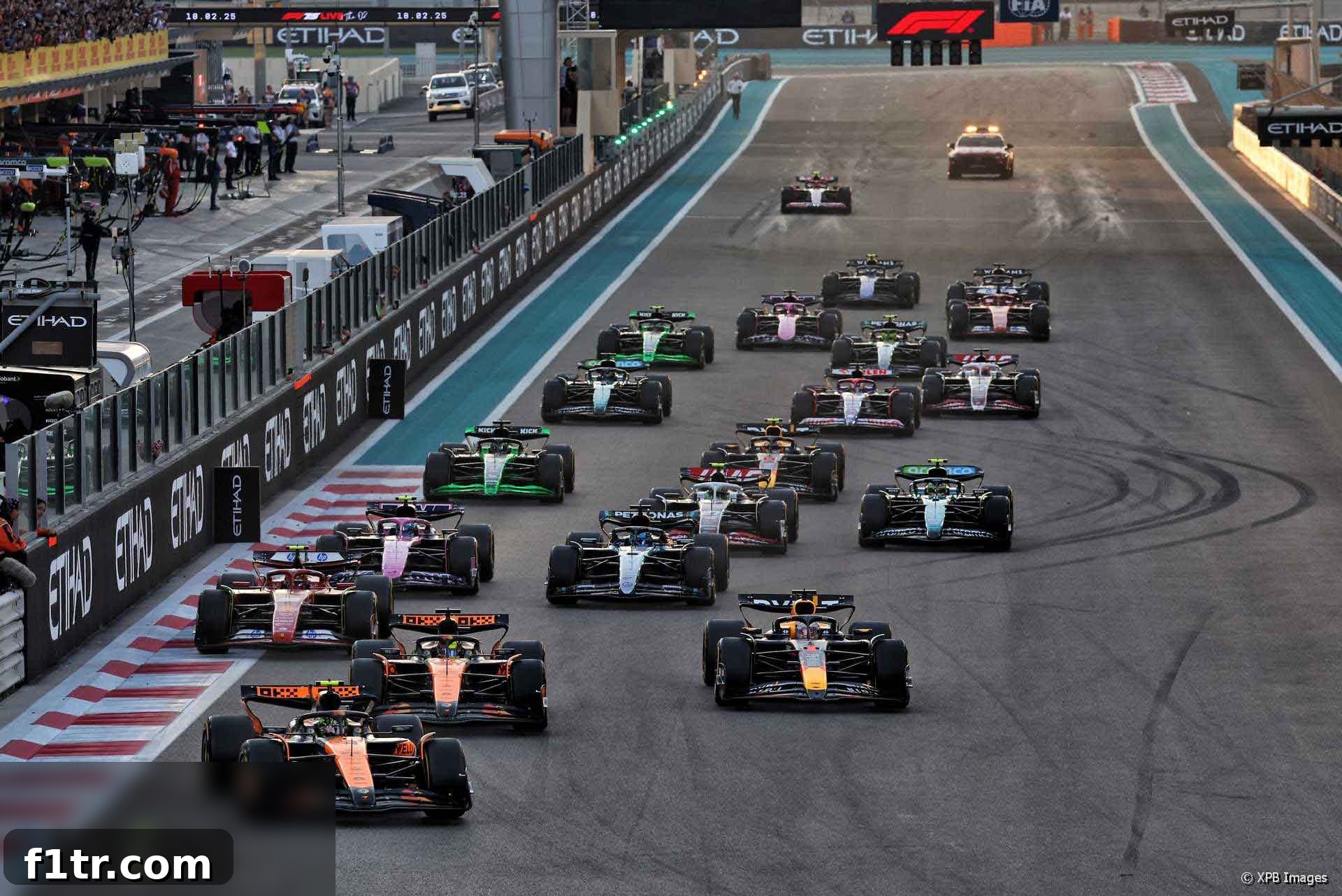
The stage is set, the tension is palpable, and the world of Formula 1 holds its breath. Only one dramatic scene remains in the thrilling 2025 Formula 1 World Championship: the championship-deciding final race at the iconic Yas Marina Circuit in Abu Dhabi. This is where legends are made, and titles are forged under the fading desert sun. With the drivers’ championship hanging precariously in the balance, fans globally are eagerly anticipating whether Lando Norris, Max Verstappen, or Oscar Piastri will emerge victorious to claim the ultimate glory. As we prepare for this monumental showdown, let’s delve into all the critical data and insights that could influence the outcome of this decisive race.
Advert | Become a Supporter & go ad-free
Anticipated Weather Conditions for the Abu Dhabi Grand Prix
For many years, the Formula 1 season finale moved from the often unpredictable weather of Interlagos to the consistent warmth of Yas Marina, effectively ending the era of capricious weather dramatically influencing world championship deciders. The Abu Dhabi Grand Prix is renowned for its stable and pleasant conditions, a stark contrast to venues where rain and temperature fluctuations can throw strategy into disarray. On Sunday, the forecast for Yas Marina anticipates the usual warm, dry weather as the sun begins its descent, leading to a gradual drop in ambient and track temperatures as the race progresses into the evening. This unique twilight setting, where the race starts in daylight and finishes under floodlights, presents a distinct challenge for tyre management and car setup, as teams must account for evolving track conditions. While rain is highly unlikely, the fading light and cooling asphalt can subtly shift grip levels, requiring drivers to adapt and engineers to plan their strategies meticulously. The consistency of the weather allows for more straightforward strategic planning, yet the championship stakes ensure that every variable, no matter how minor, will be scrutinized intensely.
The Crucial Race Start at Yas Marina
The run to the first corner at Yas Marina is comparatively short, similar in length to circuits like Singapore and Miami, making the initial sprint from pole position an electrifying moment. Despite its brevity, it’s not uncommon for the pole-winner to be challenged or even overtaken before Turn 1. A prime example of this occurred in the dramatic 2021 championship showdown, where Lewis Hamilton, starting from second on the grid, managed to get ahead of pole-sitter Max Verstappen into the first corner. This historic moment underscored the potential for immediate drama at the start of the Abu Dhabi Grand Prix. However, such instances have been rare in recent years; Verstappen successfully maintained his lead from pole in the last two editions of the race, as did Lando Norris 12 months ago. This suggests that while challenging, holding the lead from pole is often achievable, provided the driver executes a perfect start. The proximity of the first braking zone demands immediate traction and precise maneuvering, creating a high-pressure scenario where a split-second advantage can define the early stages of the race and potentially the entire championship battle.
Distance from pole position to first braking zone. Source: Mercedes
The memory of last year’s Turn 1 incident remains fresh, serving as a cautionary tale of the chaotic potential of championship-deciding starts. While Norris successfully won the run to Turn 1, his McLaren teammate Oscar Piastri, who started P2, unfortunately found himself spun around after contact with Verstappen, who had started from fourth on the grid. Such an incident highlights the razor-thin margins and aggressive tactics that can play out at the very beginning of a high-stakes race. For the championship contenders this year, navigating Turn 1 cleanly will be paramount, as any early contact or loss of position could prove devastating to their title aspirations. The opening lap, therefore, isn’t just about gaining positions; it’s about survival and setting the tone for the 58 laps that follow.
Advert | Become a RaceFans supporter andgo ad-free
Unraveling the Strategic Chessboard: Tyre Management and Team Tactics
Strategy at the Abu Dhabi Grand Prix is typically straightforward, with a one-stop approach being the most common and often the fastest route to victory in an ordinary race. While drivers may have experienced some tyre graining during Friday and Saturday practice sessions, as the Yas Marina track “rubbers in” and more grip is laid down by racing cars, this issue is expected to diminish significantly by Sunday’s main event. The predictable warm weather conditions further reinforce the likelihood of a single pit stop being the preferred tactical choice for most teams. However, the extraordinary circumstances of a championship decider mean that conventional wisdom could be thrown out the window. The immense pressure and the specific permutations required for each contender to win the title will undoubtedly have a profound bearing on the strategic decisions made by the leading teams.
Max Verstappen’s path to the championship is particularly challenging: he not only needs to win the race but also requires Lando Norris to finish outside the top three positions. This complex requirement opens the door for Red Bull to consider highly aggressive, even unconventional, strategies to try and wrong-foot McLaren. The irony, of course, is that Red Bull recently stumbled over their own feet with a strategic misstep just a week prior. Simply holding Norris up on track, hoping others might overtake him, is a plausible last resort, but one fraught with difficulty. As Verstappen himself acknowledged on Saturday, such tactics are incredibly tricky to execute successfully, citing Lewis Hamilton’s unsuccessful attempt nine years ago as an example. The subsequent changes to the Yas Marina circuit, designed to improve racing, haven’t necessarily made such blocking maneuvers any easier to pull off effectively.
Red Bull will almost certainly explore ways to tactically deploy Yuki Tsunoda, leveraging his position as an effective ally, much as they did with Sergio Perez in this very race four years ago. Tsunoda’s strong qualifying performance, placing him closer to the front than usual, makes him a valuable asset. His proven capability to assist Verstappen, demonstrated earlier in the season in Mexico by allowing his teammate through and then holding up the McLarens, underscores his potential role. Once Tsunoda falls approximately 22 seconds behind the leaders – the typical pit stop loss time at Yas Marina – he could be strategically brought into play, potentially to disrupt McLaren’s rhythm, create a pit window for Verstappen, or even act as a roadblock. The effectiveness of such a tactic hinges on perfect timing and execution, but it’s a card Red Bull will undoubtedly consider playing.
A significant strategic difference has emerged in the teams’ pre-race tyre choices. Red Bull has opted to save two fresh sets of medium tyres for Verstappen, providing him with flexibility for a potentially aggressive two-stop strategy or simply ensuring he has optimal rubber for crucial stints. In contrast, McLaren stands out as the only team to have stockpiled two brand-new sets of hard compound tyres for both Lando Norris and Oscar Piastri. This indicates a potential leaning towards a more conservative, durable strategy for McLaren, aiming for extended stints and minimizing pit stops. The hard tyres offer greater longevity and consistency, which could be advantageous if the race features long green-flag periods or if track temperatures remain high. This divergence in tyre allocation sets the stage for a fascinating strategic battle, as each team will attempt to leverage their chosen tyre compounds to gain a critical advantage in the chase for the championship.
Last year’s Abu Dhabi Grand Prix saw the majority of drivers opting for the medium compound to start the race, reflecting its versatility and performance balance in the initial stages:
| Pos. | Driver | Team | Tyre compound |
|---|---|---|---|
| 1 | Lando Norris | McLaren-Mercedes | Medium |
| 2 | Oscar Piastri | McLaren-Mercedes | Medium |
| 3 | Carlos Sainz Jnr | Ferrari | Medium |
| 4 | Max Verstappen | Red Bull-Honda RBPT | Medium |
| 5 | Pierre Gasly | Alpine-Renault | Medium |
| 6 | George Russell | Mercedes | Medium |
| 7 | Nico Hulkenberg | Haas-Ferrari | Medium |
| 8 | Fernando Alonso | Aston Martin-Mercedes | Medium |
| 9 | Valtteri Bottas | Sauber-Ferrari | Medium |
| 10 | Sergio Perez | Red Bull-Honda RBPT | Medium |
| 11 | Yuki Tsunoda | RB-Honda RBPT | Medium |
| 12 | Liam Lawson | RB-Honda RBPT | Medium |
| 13 | Lance Stroll | Aston Martin-Mercedes | Medium |
| 14 | Kevin Magnussen | Haas-Ferrari | Medium |
| 15 | Zhou Guanyu | Sauber-Ferrari | Medium |
| 16 | Lewis Hamilton | Mercedes | Hard |
| 17 | Jack Doohan | Alpine-Renault | Medium |
| 18 | Alexander Albon | Williams-Mercedes | Medium |
| 19 | Charles Leclerc | Ferrari | Medium |
| 20 | Franco Colapinto | Williams-Mercedes | Medium |
Each driver has the following sets of tyres available for the race:
| Tyres available for the race | Hard | Medium | Soft | |||
|---|---|---|---|---|---|---|
| Driver | New | Used | New | Used | New | Used |
| Max Verstappen | 1 | 0 | 2 | 0 | 0 | 3 |
| Lando Norris | 2 | 0 | 1 | 0 | 0 | 3 |
| Oscar Piastri | 2 | 0 | 1 | 0 | 0 | 3 |
| George Russell | 1 | 0 | 2 | 0 | 0 | 3 |
| Charles Leclerc | 1 | 0 | 1 | 1 | 0 | 3 |
| Fernando Alonso | 0 | 1 | 0 | 1 | 0 | 4 |
| Gabriel Bortoleto | 1 | 0 | 1 | 0 | 0 | 4 |
| Esteban Ocon | 1 | 0 | 1 | 0 | 0 | 4 |
| Isack Hadjar | 1 | 0 | 1 | 0 | 0 | 4 |
| Yuki Tsunoda | 1 | 0 | 1 | 0 | 0 | 4 |
| Oliver Bearman | 1 | 0 | 2 | 0 | 1 | 3 |
| Carlos Sainz Jnr | 1 | 0 | 1 | 0 | 1 | 4 |
| Liam Lawson | 1 | 0 | 1 | 0 | 1 | 4 |
| Andrea Kimi Antonelli | 1 | 0 | 1 | 0 | 1 | 4 |
| Lance Stroll | 0 | 1 | 0 | 1 | 1 | 4 |
| Lewis Hamilton | 1 | 0 | 1 | 1 | 2 | 2 |
| Alexander Albon | 1 | 0 | 1 | 0 | 3 | 2 |
| Nico Hulkenberg | 1 | 0 | 1 | 0 | 3 | 2 |
| Pierre Gasly | 1 | 0 | 1 | 1 | 2 | 2 |
| Franco Colapinto | 1 | 0 | 2 | 0 | 1 | 3 |
- The realistic scenario where McLaren could order Piastri to help Norris win the title
- If someone attempts Hamilton’s 2016 tactics the title fight will get complicated
Overtaking Dynamics and Track Challenges at Yas Marina
The Yas Marina Circuit features two crucial DRS zones, which remain unchanged from last year’s configuration, when the first zone at the exit of Turn 5 was shortened by 50 metres to fine-tune its effectiveness. The second DRS zone immediately follows at the exit of Turn 7, creating a double-opportunity sequence for drivers to attempt overtakes. While these zones are designed to promote passing, Yas Marina is still often described as a circuit where overtaking can be challenging, demanding perfect execution and a significant pace advantage. The circuit’s layout, particularly its slow-speed sections and tight chicanes, makes it difficult to follow closely, but the DRS zones on the long straights offer the best chances for action.
One notable characteristic of the Yas Marina Circuit is its generous run-off areas, which are largely paved with asphalt. While these provide a margin of safety for drivers pushing the limits, they also mean that cutting corners can lead to penalties for exceeding track limits, ensuring that drivers stay within the defined circuit boundaries. Another challenging aspect is the exit kerb at Turn 9, which is notoriously high and can unsettle cars, even launching them into the air if hit incorrectly. This was vividly demonstrated in the Formula 2 sprint race on Saturday, where Gabriele Mini experienced a significant incident due to this kerb. Such details highlight the precision required to navigate the circuit effectively and the potential for errors to be severely punished.
Regarding driver conduct and penalty points, the championship decider thankfully faces no immediate threats of a driver being banned for the inaugural race of 2026 due to accumulating too many penalty points. The only exception, and a distant one at that, is Oliver Bearman, who currently sits on nine penalty points. For the leading contenders, Lando Norris’s license is remarkably clean as of the last race, ensuring he can compete without the added pressure of potential future bans. This clear slate allows drivers to focus solely on the championship battle without worrying about disciplinary repercussions affecting their next season.
- Formula 1 drivers’ current penalty points
Advert | Become a RaceFans supporter andgo ad-free
Speed Trap Analysis: The Raw Power of Yas Marina
The speed trap data from qualifying offers crucial insights into the straight-line performance of each car and engine combination at Yas Marina. This metric is particularly significant on a circuit with long straights and prominent DRS zones, where top speed can make the difference between a successful overtake and a stalled attack. Yuki Tsunoda, driving for Red Bull (Honda RBPT), recorded an impressive top speed of 332.4 kph (206.5 mph), demonstrating the formidable power of the Honda RBPT engine and potentially highlighting a low-drag setup. Charles Leclerc’s Ferrari was close behind at 332.1 kph, showcasing the Ferrari power unit’s strength. Andrea Kimi Antonelli (Mercedes) and Max Verstappen (Red Bull) also featured prominently, indicating strong engine performance across the grid.
| P. | # | Driver | Car | Engine | Model | Max kph (mph) |
|---|---|---|---|---|---|---|
| 1 | 22 | Yuki Tsunoda | Red Bull | Honda RBPT | RB21 | 332.4 (206.5) |
| 2 | 16 | Charles Leclerc | Ferrari | Ferrari | SF-25 | 332.1 (206.4) |
| 3 | 12 | Andrea Kimi Antonelli | Mercedes | Mercedes | W16 | 331.6 (206.0) |
| 4 | 1 | Max Verstappen | Red Bull | Honda RBPT | RB21 | 330.8 (205.5) |
| 5 | 63 | George Russell | Mercedes | Mercedes | W16 | 330.6 (205.4) |
| 6 | 14 | Fernando Alonso | Aston Martin | Mercedes | AMR25 | 330.5 (205.4) |
| 7 | 27 | Nico Hulkenberg | Sauber | Ferrari | C45 | 330.3 (205.2) |
| 8 | 5 | Gabriel Bortoleto | Sauber | Ferrari | C45 | 329.3 (204.6) |
| 9 | 30 | Liam Lawson | Racing Bulls | Honda RBPT | 02 | 329.3 (204.6) |
| 10 | 4 | Lando Norris | McLaren | Mercedes | MCL39 | 329.1 (204.5) |
| 11 | 31 | Esteban Ocon | Haas | Ferrari | VF-25 | 329.1 (204.5) |
| 12 | 6 | Isack Hadjar | Racing Bulls | Honda RBPT | 02 | 329.1 (204.5) |
| 13 | 43 | Franco Colapinto | Alpine | Renault | A525 | 328.1 (203.9) |
| 14 | 10 | Pierre Gasly | Alpine | Renault | A525 | 328.1 (203.9) |
| 15 | 18 | Lance Stroll | Aston Martin | Mercedes | AMR25 | 327.9 (203.7) |
| 16 | 81 | Oscar Piastri | McLaren | Mercedes | MCL39 | 327.6 (203.6) |
| 17 | 87 | Oliver Bearman | Haas | Ferrari | VF-25 | 327.4 (203.4) |
| 18 | 44 | Lewis Hamilton | Ferrari | Ferrari | SF-25 | 327.1 (203.3) |
| 19 | 55 | Carlos Sainz Jnr | Williams | Mercedes | FW47 | 326.1 (202.6) |
| 20 | 23 | Alexander Albon | Williams | Mercedes | FW47 | 325.9 (202.5) |
While McLaren’s drivers, Lando Norris and Oscar Piastri, sit slightly lower on the speed trap list, their overall package and strategic tyre choices suggest that outright top speed isn’t their only focus. It’s often a trade-off between straight-line speed (low drag) and cornering grip (high downforce). The slightly lower trap speeds for the McLarens might indicate a higher downforce setup, which could be beneficial in the circuit’s more technical sections and for tyre preservation. The speed trap data provides a snapshot of potential strengths and weaknesses that will play out on race day, especially in the DRS zones where these differences in top speed become most apparent. For championship hopefuls, a slight advantage in either area can be decisive.
The Unpredictable Influence of Safety Cars
The Yas Marina Circuit has a mixed history with Safety Cars, famously etched into F1 lore due to the controversial conclusion of the 2021 race. Since that contentious event, Safety Car deployments in Abu Dhabi Grand Prix races have been remarkably sparse. Last year’s race, for instance, featured only a brief Virtual Safety Car (VSC) period from laps two to three, and this was the sole deployment of either a VSC or a full Safety Car since the dramatic 2021 finale. This scarcity suggests a generally clean racing record at the circuit in recent times, possibly aided by the wide run-off areas that minimize the need for recovery vehicles on track.
However, in a championship decider, the potential for a Safety Car or VSC to emerge casts a long shadow over every strategic plan. A Safety Car can neutralize gaps, offer ‘cheap’ pit stops, and completely reset the race dynamics, potentially creating opportunities or disasters for championship contenders. The timing of such an event could be the ultimate game-changer, forcing teams to make split-second decisions under immense pressure. The memory of 2021 serves as a stark reminder of how a late-race Safety Car can turn the championship on its head, illustrating that even in the most predictable conditions, unforeseen circumstances can dictate the outcome.
The Starting Grid for the 2025 Abu Dhabi Grand Prix
The starting grid is now set for this year’s highly anticipated race, determining the initial positions from which the championship battle will unfold. Any last-minute changes, such as penalties or technical issues, will be reflected here to ensure the most up-to-date information. The grid positions are not just about raw pace; they are a critical component of race strategy, dictating track position, pit stop windows, and the immediate challenges each driver faces. A strong qualifying performance has placed the contenders in prime positions, but as history has shown, anything can happen once the lights go out.
- 2025 Abu Dhabi Grand Prix grid
Advert | Become a RaceFans supporter andgo ad-free
Championship Implications: The Ultimate Stakes
The 2025 Formula 1 World Championship culminates in Abu Dhabi with the most thrilling of scenarios: a three-way fight for the title. The mathematics are intricate, and every position gained or lost will have monumental consequences. If the championship contenders simply maintain their starting positions until the chequered flag, Lando Norris will clinch the world championship by a narrow margin of five points over Max Verstappen. This scenario highlights the razor-thin margins and the immense pressure on all three drivers to perform flawlessly.
The various permutations for Norris, Verstappen, and Piastri to secure the championship are complex, ranging from straightforward wins to intricate points calculations based on their rivals’ finishing positions. Each team has undoubtedly meticulously analyzed these scenarios, shaping their strategic approaches for the race. The possibility of McLaren implementing team orders to aid Norris’s title bid, as explored in prior discussions, adds another layer of intrigue. Similarly, the specter of a driver attempting tactics reminiscent of Lewis Hamilton’s 2016 approach to slow down rivals and manipulate the race pace could make the title fight incredibly complicated and potentially contentious. This final race is not just a test of speed but also of nerve, strategy, and team cohesion, with the highest stakes imaginable in motorsport.
- How Norris, Verstappen and Piastri can win the championship in the final race
- Formula 1 drivers’ championship points calculator
Over to You: Share Your Predictions for the F1 Finale
As we stand on the brink of the 2025 Formula 1 World Championship decider, the anticipation is electric. How will this epic season conclude? Will we witness a typical Yas Marina procession, with the race order settling early on, or will the championship pressure ignite an unforgettable spectacle? Could the drama descend into a shameful farce, marred by controversy or contentious decisions reminiscent of past finales? Or are we poised for a race for the ages, a true classic that will be talked about for years to come? The Yas Marina Circuit holds the key to the most coveted prize in motorsport, and the world watches to see which driver will emerge as the 2025 Formula 1 World Champion.
Share your views, predictions, and hopes for the Abu Dhabi Grand Prix in the comments below. Let us know who you think will take the title and why.