Mercedes F1’s Challenging Finale: Wolff Expresses Relief as Season’s Final Qualifying Concludes Amidst Struggles
The 2023 Formula 1 season finale at the Yas Marina Circuit delivered yet another dose of disappointment for the Mercedes-AMG Petronas F1 Team, prompting team principal Toto Wolff to candidly express his relief that the final qualifying session was over. The team, a former dominant force in the sport, continues to grapple with the unpredictable performance of its W14 challenger, particularly under varying track conditions, casting a long shadow over their aspirations for the Constructors’ Championship runner-up spot.
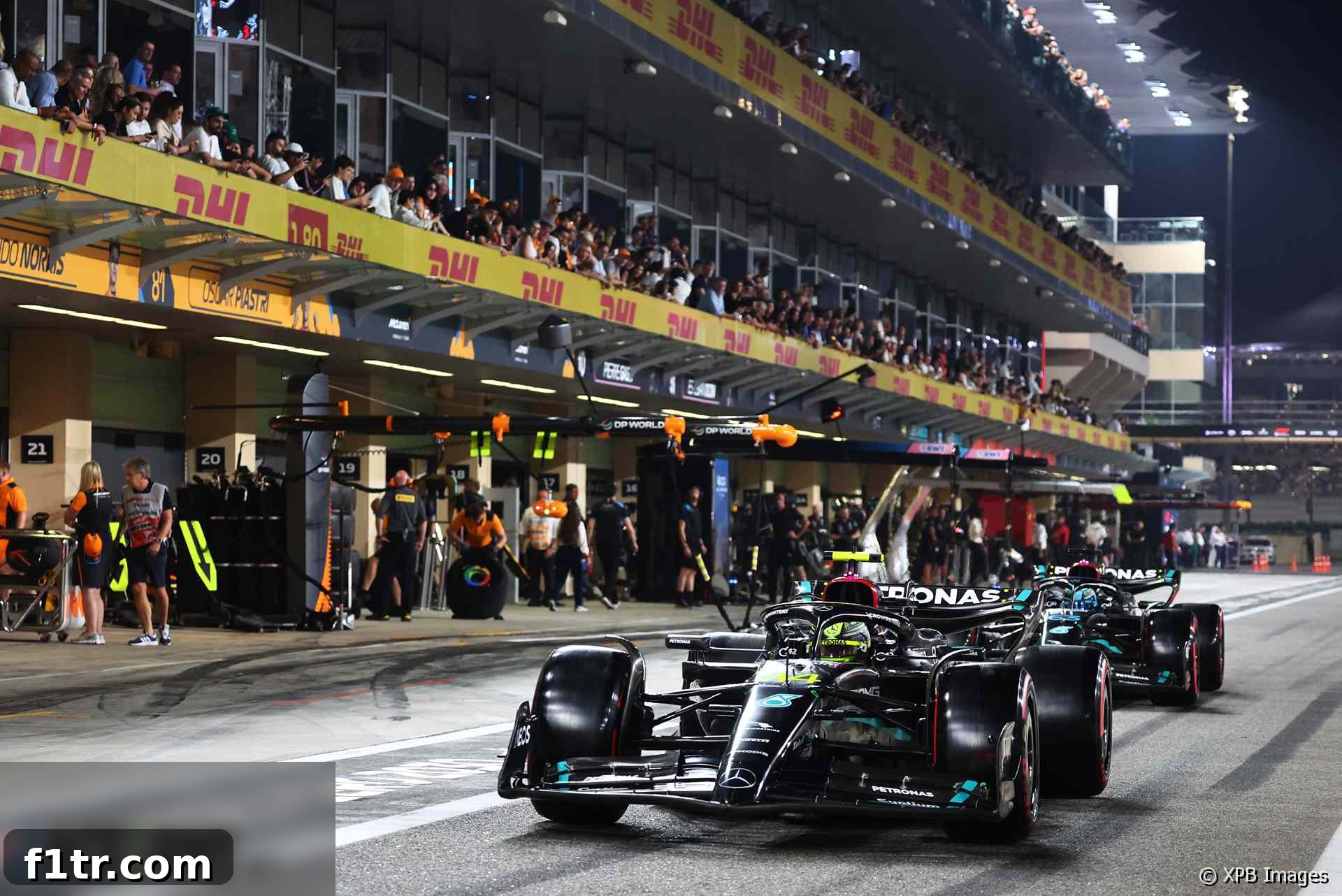
The qualifying session proved particularly challenging for seven-time world champion Lewis Hamilton. For the second consecutive race weekend, Hamilton failed to advance to the crucial Q3 segment, a rare occurrence for a driver of his calibre. Following his early exit, a visibly frustrated Hamilton relayed over team radio his suspicion that “there’s something wrong” with his car, highlighting a deep-seated issue that has plagued the team throughout much of the season. Toto Wolff later echoed these sentiments, confirming that Hamilton reported “just no grip” through large portions of Saturday’s running, painting a grim picture of the car’s handling characteristics.
W14’s Inconsistent Performance: A Tale of Two Temperatures
In contrast to Hamilton’s struggles, his teammate George Russell managed a more respectable performance, securing fourth place on the grid for Sunday’s Abu Dhabi Grand Prix. Russell’s qualifying effort, while not a pole position, offered a glimmer of hope for Mercedes in their ongoing battle for second place in the Constructors’ standings. Interestingly, Russell had shown formidable pace in the earlier practice sessions, particularly in FP1 and FP3, where he topped the timings. These sessions were conducted in warmer conditions, a stark contrast to the cooler track temperatures encountered during the evening qualifying session.
Wolff highlighted this sensitivity to temperature as a key factor in Mercedes’ fluctuating competitiveness. Speaking to Sky Sports, he remarked, “[Final practice] was even, I would say, dominant.” He further suggested that Lando Norris, who ultimately qualified P5, could have been equally competitive in FP3. However, when it came to the crucial qualifying hour, the W14 simply “didn’t come together.” Wolff conceded that the team’s expectations were for “higher temperatures” to persist, implying a setup optimized for warmer conditions that ultimately backfired as the track cooled. This inherent characteristic of the W14, performing well in certain conditions but struggling dramatically in others, has been a recurring theme throughout the 2023 campaign, often leaving the team scrambling for explanations and solutions.
The challenge of unlocking consistent performance from the W14 has been a source of immense frustration for the entire Mercedes team. Despite significant developmental efforts and numerous upgrades introduced throughout the year, the car has remained a temperamental beast, prone to moments of brilliance followed by puzzling dips in performance. This sensitivity to track temperature, particularly in the critical qualifying phase, has often cost Mercedes valuable grid positions, making their race weekends significantly harder. The contrast between their practice pace and qualifying struggles in Abu Dhabi perfectly encapsulates the W14’s unpredictable nature, a trait that the team is desperate to overcome with their 2024 challenger.
The Battle for Second: Mercedes vs. Ferrari in the Constructors’ Championship
As the final race of the season looms, Mercedes finds itself embroiled in a fierce battle with Ferrari for the coveted second position in the Constructors’ Championship. Mercedes currently holds a slender four-point advantage over their Italian rivals, making the Abu Dhabi Grand Prix a winner-takes-all showdown for the runner-up spot. The qualifying results set up a tantalizing strategic challenge for both teams.
Mercedes will start the race with George Russell in fourth, while Charles Leclerc of Ferrari secured a front-row start in second place, providing Ferrari with a significant strategic advantage. However, the Scuderia also suffered a setback with Carlos Sainz Jnr being eliminated in Q1, meaning only one Ferrari will start ahead of the two Mercedes cars. This mixed outcome means that while Leclerc poses a direct threat to Mercedes’ points haul, the overall strategic picture is complex. Mercedes will need both Russell and Hamilton to maximize their race performance, strategically manage tyre degradation, and potentially capitalize on any opportunities that arise to ensure they outscore Ferrari and secure P2 in the championship.
The significance of securing second place in the Constructors’ Championship extends beyond mere bragging rights. It carries substantial financial implications in terms of prize money and plays a crucial role in team morale and the perception of a season’s success. For Mercedes, a team accustomed to an era of unparalleled dominance, finishing second would represent a significant improvement over their third-place finish in 2022, even if it falls short of their ultimate goal of challenging for the title. The pressure is immense, and the strategic battle on Sunday will be a fitting conclusion to a highly competitive 2023 season.
Wolff’s Frustration and the Dawn of a New Chapter: Looking to 2024
Beyond the immediate championship battle, Toto Wolff’s comments reveal a deeper level of frustration with the team’s performance throughout the entire 2023 campaign. “I’m fed up with having explanations why it didn’t go well,” he stated emphatically, his words capturing the exhaustion of a season spent battling an unpredictable car. He cited the paradoxical nature of their performance: “We were good in the hot, we weren’t in the cold, the previous day it was the other way around.” This inconsistency has undoubtedly taken a toll on the team’s spirits.
Wolff’s palpable relief at the conclusion of qualifying stems from the opportunity to finally put the W14 and its inherent issues behind them. His declaration, “So I’m happy that this was the last qualifying of the season and we’re going to come with a new car,” signals a clear demarcation point. The 2023 season, marked by a persistent inability to consistently challenge for victories, will likely be remembered as one of the most challenging in Mercedes’ recent history. If the team fails to secure a victory in Abu Dhabi, it will mark their first winless season since 2011, a stark reminder of how far they have fallen from their peak of eight consecutive Constructors’ titles.
The anticipation for the W15, Mercedes’ 2024 challenger, is immense. The team has been openly discussing a fundamental shift in their design philosophy, moving away from the “zeropod” concept that defined the W13 and W14. The lessons learned from two difficult seasons, particularly the deep understanding gained about ground effect aerodynamics and the critical importance of a stable aerodynamic platform, are expected to inform every aspect of the new car’s development. Wolff’s forward-looking statement reflects the hope that the W15 will allow Mercedes to shed the inconsistencies of the past two years and once again contend at the very front of the grid, challenging Red Bull’s current dominance.
The 2023 season has been a crucible for Mercedes, testing their resilience and resolve. While the immediate focus remains on securing second in the Constructors’ Championship, the larger narrative is about setting the stage for a strong comeback in 2024. The team knows that significant changes are required, not just in car design but also in their understanding and approach to the new regulations. Wolff’s comments are not just an expression of frustration but also a testament to the team’s unwavering commitment to return to their championship-winning ways, with the final race of 2023 serving as a closing chapter to a difficult but ultimately informative period.
The Road Ahead for Mercedes
The Abu Dhabi Grand Prix is more than just a season finale; it’s a symbolic transition for Mercedes. It represents the end of an era defined by the challenging W14 and the beginning of a new chapter where lessons learned from adversity will hopefully be transformed into a championship-contending W15. The team’s engineers and strategists have gathered an invaluable amount of data and experience over the past two years, which will be crucial in refining their design methodologies and understanding of the current regulatory framework.
The focus will undoubtedly shift entirely to 2024 development, with the team aiming to eradicate the temperature sensitivity and lack of consistent grip that has plagued their current car. The aspiration is to provide both Lewis Hamilton and George Russell with a more predictable and competitive machine that allows them to extract maximum performance from every session, regardless of track conditions. The hope is that by fundamentally rethinking their aerodynamic philosophy and chassis design, Mercedes can build a car that not only challenges Red Bull but also allows their drivers to showcase their extraordinary talents without being hampered by an unpredictable package.
As the curtains fall on the 2023 Formula 1 season in Abu Dhabi, Mercedes F1 stands at a crossroads. While the immediate outcome of the Constructors’ battle with Ferrari remains uncertain, the long-term vision is clear: to reclaim their position at the pinnacle of motorsport. Toto Wolff’s frank assessment underscores a team eager to move on, equipped with the knowledge and determination to build a truly competitive car for the seasons to come. The final race of 2023 will not just close a chapter, but ignite the anticipation for a stronger, more competitive Mercedes in 2024.
2023 Abu Dhabi Grand Prix Related Articles
- Mercedes’ team photo shows we still have a long way to go on diversity – Hamilton
- Why luck was a factor in Perez’s penalty for “joke” comment
- Bottas and Zhou see encouraging signs from overhauled 2024 car
- Only Verstappen got the best from his car every weekend, rival team bosses admit
- How Sainz suffered the worst season finale for a driver since Schumacher in 1997
Browse all 2023 Abu Dhabi Grand Prix articles