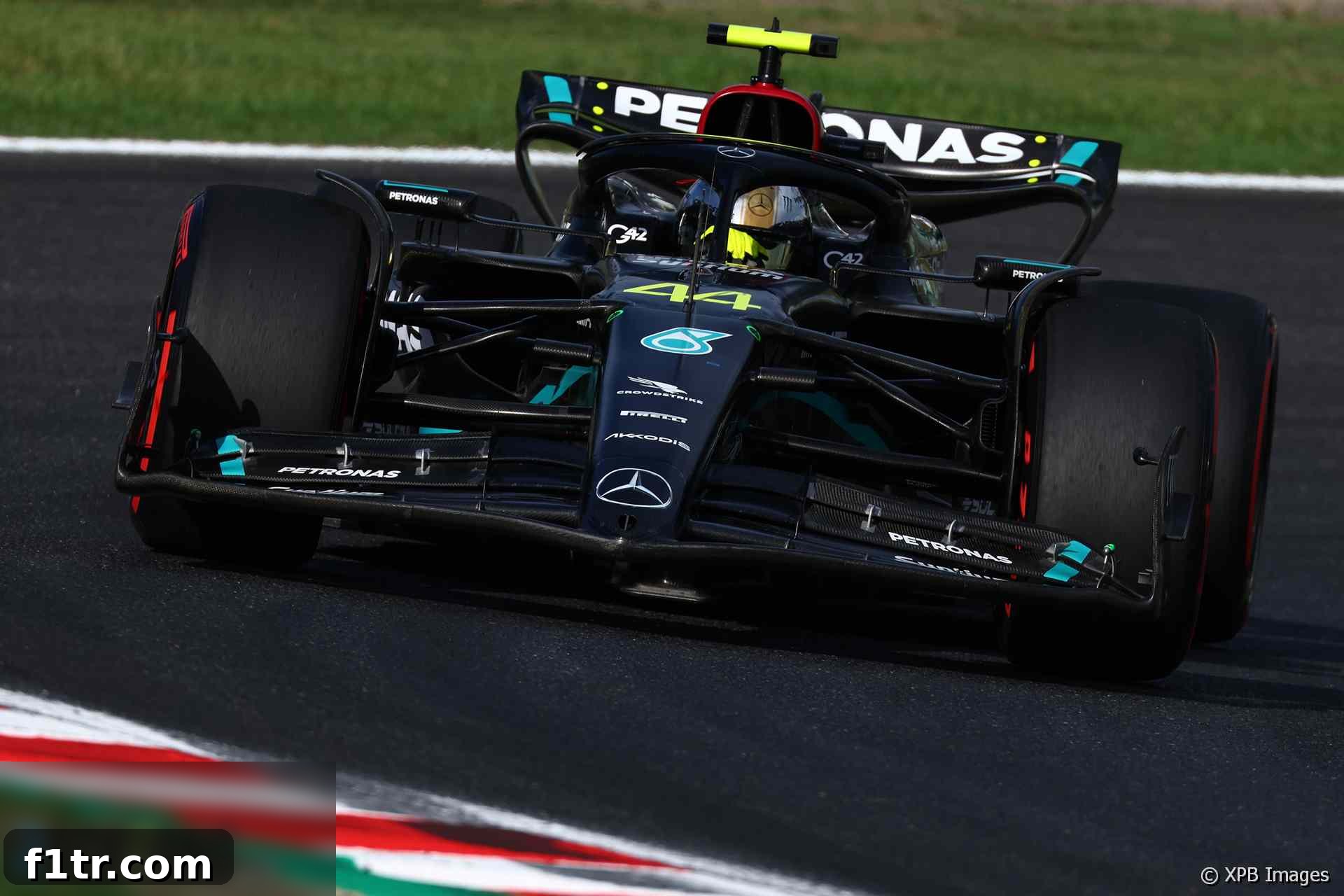
Mercedes’ Suzuka Struggles: Unpacking the W14’s High-Speed Corner Deficit
The iconic Suzuka Circuit, renowned for its challenging sequence of high-speed corners, once again exposed a fundamental weakness in the Mercedes-AMG Petronas Formula One Team’s W14 challenger. As qualifying for the Japanese Grand Prix concluded, both Mercedes drivers found themselves relegated to the fourth row of the grid, a significant over one-second deficit separating them from pole-winner Max Verstappen. This performance gap highlighted the team’s ongoing struggle to find optimal aerodynamic balance and consistent pace on circuits that demand peak high-speed performance.
Despite a difficult start to the weekend, Lewis Hamilton reported making considerable strides with his car’s setup between Friday practice and Saturday qualifying. However, even with these improvements, the inherent limitations of the W14, particularly its chronic lack of rear-end grip and downforce, proved insurmountable. Hamilton’s efforts to extract maximum performance were hampered by a car that simply couldn’t contend with the demands of Suzuka’s sweeping bends.
Hamilton on the “Nightmare” Balance and “Peaky” Car
“Yesterday was quite a nightmare, to be honest,” Hamilton candidly shared, reflecting on the initial setup challenges. “The balance was far from what you desire on a track as unforgiving as Suzuka. But the team put in some tremendous work overnight, and the car felt much improved today, perhaps as good a balance as we could possibly achieve given its characteristics.”
Yet, the fundamental issue remained unresolved. “The core problem is a massive deficit in rear downforce,” Hamilton elaborated. “This means we simply cannot carry anywhere near the speeds through that crucial first sector compared to our main rivals.” This deficiency directly translates to a significant loss of lap time, particularly evident in Suzuka’s unique layout where continuous high-speed cornering is paramount.
Mercedes has consistently battled to fine-tune their car across diverse circuit profiles throughout the current season. Hamilton described the W14 as “a very peaky car,” struggling to find a stable and predictable performance window. He likened the driving experience to “trying to balance a knife on its tip – it’s practically impossible.” This vivid analogy underscores the delicate and often unpredictable nature of the W14’s handling. “It’s never perfectly balanced; it’s always one way or the other, leading to either massive oversteer or pronounced understeer. You can never truly get it into the sweet spot,” Hamilton explained, highlighting the frustration of driving a car with such an narrow operating window. “You constantly strive to get it as close to the middle as possible, but it’s an incredibly difficult task each weekend. When I do manage to find a decent place, this is typically where we qualify.”
Suzuka’s Sector One: The Ultimate Test for the W14
The performance deficit for Mercedes was particularly glaring in Suzuka’s first sector. This demanding section features an exhilarating sequence of high-speed corners – the ‘S’ Curves, Dunlop, and Degner – which follow each other in rapid succession, requiring immense aerodynamic stability and precise car control. It was in this sector alone that Lewis Hamilton conceded over half a second to Max Verstappen, illustrating the profound impact of the W14’s limitations.
Andrew Shovlin, Mercedes’ esteemed head of trackside engineering, shed further light on the technical reasons behind their struggles. He pointed out that Suzuka’s high-speed demands are fundamentally different from the challenges posed by Marina Bay in Singapore, where the team had raced just a week prior. In Singapore, characterized by its predominantly low-speed, 90-degree corners, Mercedes had shown strong form, coming within a tenth of a second of securing pole position. This stark contrast underscores the W14’s specific vulnerabilities.
“Fundamentally, it all boils down to the corner speed range,” Shovlin explained. “Singapore is dominated by those slower, tighter turns, and over the course of the year, we’ve managed to add a fair bit of performance there. However, Suzuka tells a different story.”
“Specifically, if you look at the Red Bull and the McLaren, and we observed this as early as Silverstone with McLaren, they were exceptionally strong in corners like Stowe and through the Maggotts-Becketts complex. At Silverstone, they were actually the fastest in some of those critical high-speed sections. I believe that’s the biggest part of the performance swing we’re seeing here at Suzuka,” Shovlin noted, drawing a clear comparison between their car and the strengths of their rivals in similar high-speed environments.
Technical Deep Dive: Downforce, Ride Height, and Compounding Errors
Shovlin elaborated on the specific aerodynamic demands of Suzuka, particularly in Sector 1. “We’ll need to assess how the race unfolds tomorrow, but my current assessment is that this track necessitates a significant amount of downforce within a particular ride height range, and it appears our competitors likely possess more of that than we do.” This implies that the W14 struggles to generate consistent and effective downforce when operating at the optimal ride heights required for maximum performance through Suzuka’s fast corners, a critical aspect of modern F1 car design.
The unique nature of Sector 1, where “every corner sets you up for the next,” means that any initial instability or underperformance is severely compounded. “When you start running a little wide, or it takes you longer to turn the car, all those minor losses accumulate and multiply,” Shovlin explained. “This creates a chain reaction, even leading to detrimental tyre temperature effects because the car isn’t flowing correctly. Consequently, it’s a sector where you frequently observe a significant difference in lap times, sometimes a full second, purely because drivers are struggling with their car’s balance. Suzuka truly punishes any imperfection.” Given these conditions, Shovlin concluded, “It’s not a massive surprise that a Red Bull, with Max at the wheel, is performing so exceptionally well here.” His comments highlight the intricate relationship between car setup, driver input, and track characteristics, especially in aerodynamically sensitive sections like Suzuka’s first sector.
Implications for Mercedes’ Championship Battle and Future Development
The recurring high-speed weakness of the W14, vividly exposed at Suzuka, carries significant implications for Mercedes’ remaining 2023 season and their long-term development strategy. While they have shown flashes of brilliance on specific track layouts, their inconsistency in managing the car’s peaky performance window on circuits demanding high-speed aero efficiency remains a major hurdle. This technical characteristic affects not only their aspirations to challenge Red Bull for race wins but also their tight battle for second place in the Constructors’ Championship against a resurgent Ferrari and an improving McLaren.
The data gathered from Suzuka will be crucial for Mercedes as they continue to refine their understanding of the W14 and, more importantly, inform the design philosophy for their 2024 challenger. Addressing the fundamental lack of rear-end stability and expanding the car’s operational window in high-speed conditions will be paramount if they are to mount a more consistent challenge at the front of the grid next season. The team’s engineers face the complex task of designing a car that offers both robust downforce and a wider setup flexibility, allowing drivers to extract maximum performance across the diverse F1 calendar without encountering the “knife-edge” handling described by Hamilton.
While the immediate focus shifts to the race, where strategic calls and tyre management will play a role, the qualifying performance at Suzuka serves as a stark reminder of the underlying aerodynamic challenges Mercedes still faces. The gap to Red Bull, particularly in the high-speed sections, underscores the benchmark they must reach to truly compete for championships in the new ground-effect era of Formula 1.
Become a RaceFans Supporter and Go Ad-Free
RaceFans thrives thanks to the dedicated and generous support of its readers. By contributing a small monthly or annual sum (£1 per month or £12 per year, or the equivalent in your local currency), you can directly help us cover the essential costs of creating, hosting, and continually developing RaceFans – ensuring a vibrant future for our independent F1 coverage.
Join the RaceFans Supporter community today, enjoy an uninterrupted, ad-free browsing experience across the site, and actively contribute to the sport’s independent journalism. Discover more and sign up using the links below:
- Become a RaceFans Supporter
- RaceFans Supporter FAQ – Your Questions Answered
2023 Japanese Grand Prix Coverage
Explore more insights and analysis from the 2023 Japanese Grand Prix weekend:
- Norris: Red Bull’s dominance down to ‘small things which make a big difference’
- Mercedes must halve deficit to Red Bull before 2024 season starts – Hamilton
- Mercedes expect “tight” fight for second in championship after Ferrari gains
- Norris breaks Hulkenberg’s record for most points without a win in F1
- Transcript: What Alonso really meant by being “thrown to the lions” at Suzuka
Browse all 2023 Japanese Grand Prix articles