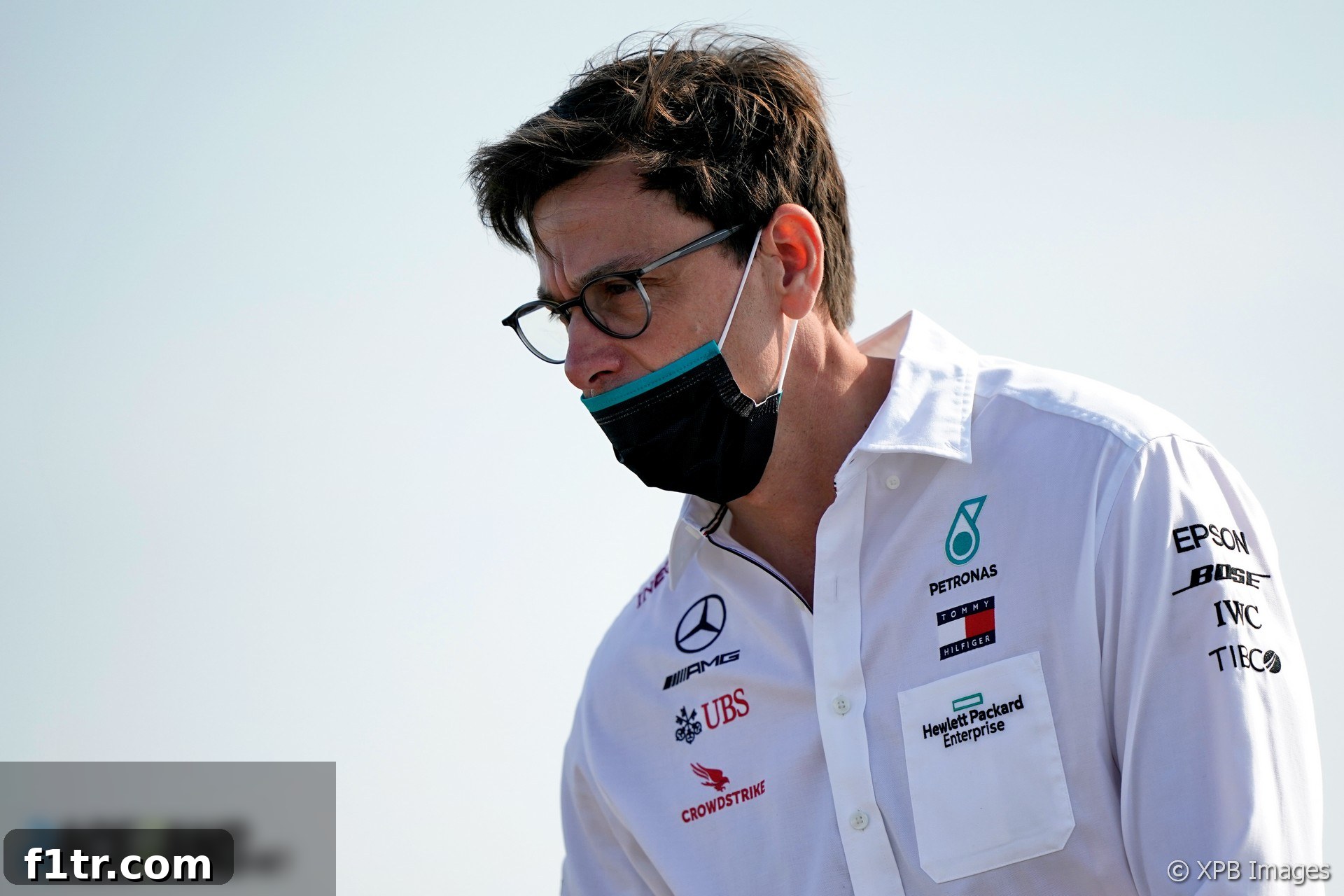
The intricate world of Formula 1 regulations has been rocked by the controversial ‘Pink Mercedes’ saga, specifically concerning Racing Point’s RP20 brake ducts. At the heart of this storm stands Mercedes team principal Toto Wolff, who remains steadfastly confident that his team faces no risk of breaching rules, even as appeals against the FIA’s initial verdict loom large.
The controversy ignited after five teams – a significant half of the Formula 1 grid – served notice of their intention to appeal the FIA’s verdict delivered on the cars dubbed the ‘pink Mercedes’. Stewards had concluded that Racing Point violated the sporting regulations by utilizing parts received from Mercedes as the foundation for designing the rear brake ducts on their RP20 challenger. This decision has sparked a prolonged and often contentious debate across the paddock, highlighting the delicate balance between innovation, collaboration, and fair competition in motorsport.
Racing Point’s reasons for contesting the verdict are clear: a hefty €400,000 (£360,000) fine and a deduction of 15 constructors’ championship points. However, the four rival teams – Ferrari, McLaren, Williams, and the original protest initiators, Renault – hold various objections. Their concerns primarily revolve around two aspects: the decision itself, which controversially permits Racing Point to continue using the disputed ducts, and the perceived leniency of the sanctions, which many believe do not adequately punish the breach or deter future ‘copycat’ designs.
Speaking on the matter, Wolff foresaw a potentially drawn-out and complex legal battle should the case escalate to the International Court of Appeal (ICA). He predicted “a very long, very messy argument involving top legal counsel and lawyers,” acknowledging the uncertain outcomes for all parties involved, including Renault and Racing Point.
Central to this heated dispute is a crucial alteration in Formula 1’s technical regulations between the 2019 and 2020 seasons. In 2019, teams were permitted to procure non-listed components, such as brake ducts, from competitors. However, for the 2020 season, brake ducts were reclassified as ‘listed parts.’ This redefinition mandated that all teams must independently design and manufacture their own listed components, making them proprietary to each constructor. This regulatory shift forms the bedrock of the entire ‘Pink Mercedes’ controversy.
Racing Point was found to be in breach of these updated sporting regulations because the rear brake ducts on their 2020 car were explicitly modelled on those designed by Mercedes for their 2019 season. A critical detail that complicates the matter is that while Racing Point had access to both front and rear Mercedes brake ducts last year, they never actually raced with the rear ducts during the 2019 season. This distinction plays a significant role in the interpretation of the rules.
Despite penalizing the team for the infringement, the FIA made a pivotal determination: Racing Point would not be barred from continuing to use the contentious parts. Their reasoning was based on two key points: firstly, the parts themselves conformed to the technical regulations, meaning they were physically compliant and safe. Secondly, and perhaps more significantly, the FIA recognized that the team could not simply “unlearn” the design information and intellectual property they had already acquired and implemented. Disqualifying them or forcing an immediate redesign was deemed impractical and potentially disproportionate given the circumstances.
Advert | Become a RaceFans supporter andgo ad-free
Wolff expressed his belief that the FIA’s judgment was an attempt to “act sensibly” under incredibly complex circumstances. He acknowledged the difficulty of the situation, stating, “I’m obviously not an integral part of this protest so I’m not sure I should really comment on the case, speaking for Racing Point. As far as I have read the verdict, I think that because the regulations are tremendously complicated, and there has never been a situation where a non-listed part became a listed part, that the FIA tried to somehow bridge the gap of finding a solution that was acceptable to all parties.”
He continued to elaborate on Racing Point’s perspective and the practicalities of the situation: “Obviously for Racing Point, they strongly feel that they haven’t been in breach. As it has been found out the possible breach was that they haven’t designed something – the rear brake ducts – from the beginning and it’s not their proprietary design. The breach has happened and they cannot unlearn what they already know. They have had these brake ducts on the car. They can also not change them.” Wolff further argued that the logical consequence of insisting on a proprietary design, if the current ones were deemed illegal, would be a complete disqualification, which he considered an extreme measure. He even posited that if Racing Point were to redesign the components themselves, the outcome would likely be functionally identical due to the established knowledge and performance parameters.
The stewards’ verdict brought to light that “a complete set of Mercedes 2019 [brake ducts]… arrived at Racing Point on or about January 6th, 2020.” Racing Point CEO Otmar Szafnauer explained this transfer as being for “spares to run in winter testing,” intended as a contingency in case their own newly designed parts weren’t ready in time. While the stewards deemed this transfer a breach of the regulations, they qualified it as not “significant” because “there was nothing in the transfer that had not been legitimately provided to Racing Point in 2019 under the then in force regulations.” This nuance is crucial, suggesting a breach due to the *timing* and *context* of the parts becoming ‘listed,’ rather than an outright illegal acquisition of information.
Wolff emphatically stated that the verdict cleared Mercedes of any wrongdoing. “We feel 100% comfortable with our position,” he asserted. “We’ve read the rules over and over again. The verdict that came out is extremely complicated. It comes up with an interpretation that is new. New to all of us.” He reiterated that Mercedes had supplied certain data in 2019, which was “totally within the rules” at that time. Addressing the January 6th date, Wolff maintained that it had “no material effect on any of the action because the whole thing was delivered much earlier and all the CAD drawings and designers were delivered much earlier.” Both Mercedes and Racing Point, he stressed, remain convinced that their actions were fully compliant with the regulations.
Looking ahead to the potential appeal, Wolff remained unfazed by any possible repercussions for Mercedes. “At the end, to be honest, there is zero worry on our side – and when I say zero, I mean zero – that we were in any breach,” he declared with absolute certainty. He extended this confidence to Racing Point, stating, “Nor do I think that Racing Point was in breach.” While acknowledging that an appeal to the ICA would likely be “a complex matter” due to its highly technical nature, he expressed strong doubts about any adverse outcome for Mercedes. This unwavering stance underscores the team’s belief in their diligent interpretation and adherence to the evolving regulations.
The “clone car” debate has wider implications for the sport, touching upon the very essence of Formula 1’s design philosophy and the protection of intellectual property. The ability of a team to replicate parts, or even entire car concepts, from a competitor raises questions about the long-term viability of independent innovation and the cost of competition. If smaller teams can achieve competitive performance by mimicking successful designs, it could potentially reduce the incentive for groundbreaking original research and development, blurring the lines between customer teams and true constructors. The FIA’s attempts to navigate this complex terrain reflect a broader challenge in balancing competitive equity with the traditional power dynamics of the sport, especially as budget caps and convergence are increasingly prioritized.
The ongoing saga of the Racing Point brake ducts is more than just a dispute over a single component; it’s a litmus test for how Formula 1 interprets and enforces its rules in an era of rapidly evolving technology and ever-tighter competition. The outcome of the appeals will not only determine Racing Point’s final championship standing for 2020 but could also set a precedent for future design collaborations and the enforcement of ‘listed parts’ regulations across the grid, significantly shaping the sport’s identity for years to come.
Advert | Become a RaceFans supporter andgo ad-free
2020 F1 season
- Grosjean to make F1 test return tomorrow for first time since Bahrain horror crash
- Pictures: Wrecked chassis from Grosjean’s Bahrain fireball crash to go on display
- Bottas vs Rosberg: Hamilton’s Mercedes team mates compared after 78 races each
- F1 revenues fell by $877 million in Covid-struck 2020 season
- Hamilton and Mercedes finally announce new deal for 2021 season
Browse all 2020 F1 season articles