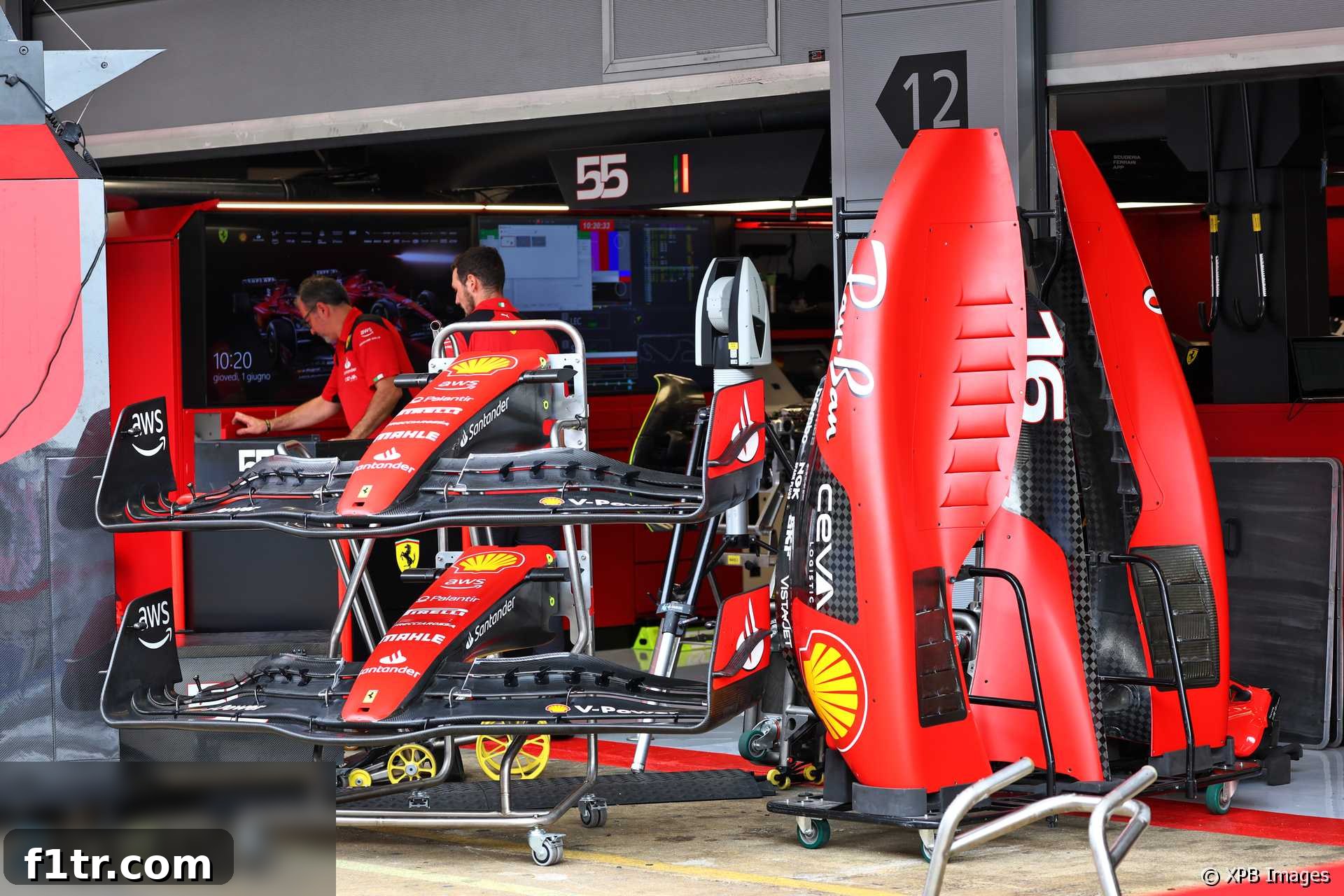
The hallowed tarmac of the Circuit de Catalunya played host to a crucial moment for Scuderia Ferrari at this weekend’s Spanish Grand Prix. The Italian giants, reeling from a disappointing start to the 2023 Formula 1 season, unveiled a significant aerodynamic upgrade package for their SF-23 challenger, an update originally earmarked for a much later stage in the championship calendar. This accelerated introduction underscores the immense pressure and urgency within the Maranello factory to rectify their performance deficit and reclaim their competitive edge.
Ferrari’s Bold Gamble: Accelerating the SF-23 Upgrade
Ferrari’s decision to fast-track this comprehensive upgrade package speaks volumes about their current predicament. After leading the early stages of the 2022 world championship, the team has endured a challenging start to the current season, finding themselves languishing fourth in the constructors’ standings with only a single podium finish to their name. This stark contrast to their previous performance has prompted an extraordinary effort behind the scenes.
Spanish driver Carlos Sainz Jnr offered a glimpse into the monumental undertaking by his team. “You cannot imagine the effort Maranello has done in trying to bring this package forward,” Sainz explained. “It was supposed to come a lot later in the season, and the whole factory was just flat-out these last few months, because of the situation, to try and bring it earlier.” This candid admission highlights the intense commitment and resources poured into accelerating the development cycle, a testament to Ferrari’s ambition and refusal to yield.
Bringing forward an F1 upgrade of this magnitude is no small feat. It involves a meticulous coordination of design, simulation, manufacturing, and logistical challenges, all while adhering to the stringent cost cap regulations. Engineers work tirelessly, often around the clock, to refine designs, produce new components, and ensure they meet the rigorous safety and performance standards of Formula 1. The sheer scale of this effort signifies a pivotal moment for Ferrari’s 2023 campaign, representing not just a set of new parts, but a renewed declaration of intent.
A New Direction: Targeting Driveability and Consistency
The changes introduced to the SF-23 are more than just incremental improvements; they signal a fundamental shift in Ferrari’s development philosophy. According to Sainz, the upgrades represent “a bit of a new direction, a bit into what we believe should be the right path into developing this car.” This re-evaluation of their design principles aims to address the core weaknesses that have plagued the SF-23 since the beginning of the season. The primary objective is clear: to transform the car into a more “driveable, more consistent, better in the race,” characteristics that Sainz readily identifies as their “main weakness.”
For a Formula 1 car, driveability translates into how predictably and easily a driver can extract performance from the machine across various conditions. Consistency, particularly over long race stints, is paramount for tyre management and strategic flexibility. Ferrari’s struggles with race pace and tyre degradation have been well-documented, often seeing their strong qualifying performances evaporate on Sunday afternoons. A car that is easier to drive and more consistent allows drivers to push closer to the limit for longer periods without inducing excessive tyre wear or making costly errors. This upgrade, therefore, seeks to provide a more stable and predictable aerodynamic platform, enabling Sainz and Charles Leclerc to better manage their tyres and maintain competitive lap times throughout a Grand Prix.
However, Sainz was also quick to manage expectations, emphasizing that this is just the beginning of a longer journey. “You’ve seen it hasn’t been an easy start to the season and we’ve been struggling,” he admitted. “But it is true that with this first step into this direction, we try and correct the deficiencies we have. We also know that this upgrade is not going to change our life from one race to another. It’s the first step of many steps to come still.” This measured outlook is crucial, acknowledging that fundamental shifts in car performance require sustained effort and multiple development phases rather than a single ‘silver bullet’ solution.
Leclerc’s Cautious Optimism: Taming the Peaky SF-23
Sainz’s teammate, Charles Leclerc, echoed the sentiment of cautious optimism, stating that the team is “not expecting any big miracles, to be honest” from the new components. Yet, he harbors hope that this package marks the commencement of a steady stream of improvements. “From now on, we want to try and bring some small upgrades every race. This one should go in the right direction, but I don’t think it will be a massive change.” This strategy of continuous, incremental upgrades is a common approach in modern F1, allowing teams to react quickly to data and refine their designs throughout the season.
Leclerc’s insights shed further light on the SF-23’s inherent characteristics. He described the car as “extremely peaky,” a term often used to describe a vehicle that performs exceptionally well under very specific, narrow operating windows but struggles significantly outside of them. “In qualifying on the one-lap pace with new tyres, the wind, we know exactly how to drive the car, it’s okay,” Leclerc explained. “But as soon as we go a little bit out of those conditions, we lose so much downforce overall.” This “peaky” nature explains Ferrari’s flashes of brilliance in qualifying, often securing front-row starts, only to be outmaneuvered by rivals with more consistent race pace on Sundays. Factors like varying wind conditions, tyre degradation, fuel load changes, and even track temperature fluctuations can push a peaky car out of its optimal performance window, leading to a dramatic drop-off in performance.
The objective of the upgrade, from Leclerc’s perspective, is not merely to gain raw performance but to improve this critical driveability. “We have been working a lot on that with this new car, so this will help us. Not gain that much performance, but to at least be a bit more consistent throughout the weekend, which hopefully will help us to have a better result on the Sunday.” A more consistent car allows drivers to push harder without fear of sudden losses in grip or balance, enhancing confidence and ultimately contributing to stronger race results.
Circuit de Catalunya: The Ultimate Testbed for F1 Upgrades
The choice of the Circuit de Catalunya for the debut of these crucial upgrades is far from coincidental. Barcelona’s track layout is renowned for being an exceptional proving ground for Formula 1 cars, earning its reputation as a comprehensive barometer of a car’s aerodynamic efficiency and overall balance. Leclerc underscored this point, noting, “Barcelona is known for [being] probably the best track to understand exactly where you are with the car. So I think it’s really good to have these new upgrades here and to understand where are we so we can confirm still our weaknesses.”
The circuit’s diverse array of corners, ranging from fast, sweeping bends like Turn 3 and Turn 9, to technical, slow-speed sections like the final chicane, subjects the car to a wide spectrum of aerodynamic loads and handling characteristics. The long main straight also provides an excellent opportunity to assess drag levels and engine performance, while the undulating topography adds another layer of complexity. Teams often refer to Barcelona as a “full-package circuit” because if a car performs well here, it typically indicates a fundamentally sound design that can adapt to most other tracks on the calendar. For Ferrari, confirming their identified weaknesses and validating the effectiveness of their new developmental direction on such a demanding circuit is paramount. The data gathered from the Spanish Grand Prix will be invaluable in guiding their future development path and refining the SF-23 throughout the remainder of the season.
“I think in our mind, even though we’ve had very different tracks, it’s very clear for us where we need to work, and that is mostly on race pace and having a car that is a bit easier to drive,” Leclerc concluded. “I think this is a perfect track to see whether this upgrade is going in the right direction for us.” The Spanish Grand Prix, therefore, represents not just another race, but a critical evaluation point for Ferrari’s season and potentially their long-term trajectory.
Bringing the F1 news from the source
RaceFans strives to bring its readers news directly from the key players in Formula 1. We are able to do this thanks in part to the generous backing of our RaceFans Supporters.
By contributing £1 per month or £12 per year (or the equivalent in other currencies) you can help cover the costs involved in producing original journalism: Travelling, writing, creating, hosting, contacting and developing.
We have been proudly supported by our readers for over 10 years. If you enjoy our independent coverage, please consider becoming a RaceFans Supporter today. As a bonus, all our Supporters can also browse the site ad-free. Sign up or find out more via the links below:
- Become a RaceFans Supporter
- RaceFans Supporter FAQ
2023 Spanish Grand Prix: Related Articles
- Ben Sulayem raises safety concerns over “too many people on the grid” at races
- Why Ferrari say their change in design is the result of “discipline”, not “copying”
- Hamilton and Russell were seeking tow from Sainz when they collided – Mercedes
- Red Bull’s Spanish GP diffuser update was ‘inspired by rivals’ including Williams
- Why McLaren always doubted second-row start in Spain would lead to points finish
Browse all 2023 Spanish Grand Prix articles