The 2021 Formula 1 Portuguese Grand Prix at Portimão delivered a captivating weekend of racing, offering a blend of nail-biting finishes, significant milestones, and crucial championship developments. While Lewis Hamilton once again demonstrated his formidable prowess with a hard-fought victory, the event was equally defined by the razor-thin margins of elite competition and the remarkable narratives unfolding across the grid. From championship leaders to teams battling at the tail end, Portimão provided a rich tapestry of stories, reinforcing the unpredictable and thrilling nature of Formula 1.
Lewis Hamilton: A Century of Poles Nears as Victories Accumulate
Lewis Hamilton, the reigning world champion, found himself tantalizingly close to achieving his monumental 100th career pole position at the Portuguese Grand Prix. The margin of difference was almost imperceptible – a mere seven-thousandths of a second separated him from this historic milestone. Such an incredibly fine margin underscores the intensity of competition at the pinnacle of motorsport and the relentless pursuit of perfection required to succeed.
Despite missing out on pole, Hamilton swiftly turned his focus to race day. His victory at Portimão marked his 97th career win, moving him ever closer to a century of Grand Prix triumphs. This particular win held added significance, as it was at this very circuit last year that Hamilton surpassed Michael Schumacher’s long-standing record for the most Grand Prix victories. His continued dominance, even in the face of fierce challenges, firmly cements his status as one of Formula 1’s all-time greats and a central figure in the 2021 championship battle.
Valtteri Bottas and the Battle for Pole Position
Valtteri Bottas snatched pole position from his Mercedes teammate by the smallest of margins, a difference of just 0.007 seconds. This exceptionally tight qualifying result mirrored their battle at the 2019 British Grand Prix, where they also shared the front row in the same order, separated by an equally minuscule 0.006 seconds. Bottas’s impressive performance secured his 17th career pole position, a significant achievement that places him level with the legendary Jackie Stewart in the F1 record books. Securing pole not only provides a strategic advantage for the race but also serves as a crucial confidence booster for Bottas in his efforts to challenge for the championship.
Beyond his qualifying heroics, Bottas also recorded the 17th fastest lap of his career during the race, an accomplishment that aligns him numerically with Rubens Barrichello. While the ultimate race result didn’t favor him as much as qualifying, these individual milestones highlight Bottas’s raw speed and his ability to extract performance from the Mercedes W12. Such performances are vital for Mercedes’ Constructors’ Championship ambitions and for Bottas to maintain his position as a front-running contender.
Max Verstappen’s Track Limits Infringement and the Front-Runner Challenge
Max Verstappen, a primary challenger to Hamilton’s dominance, was also in the hunt for significant achievements at Portimão. He narrowly missed out on what would have been his 11th fastest lap due to a track limits infringement, a recurring theme in modern Formula 1. These regulations, rigorously enforced, emphasize the precision and discipline required at every stage of a Grand Prix weekend. Verstappen’s aggressive driving style, while often thrilling, sometimes pushes these boundaries, impacting his statistical record.
Despite this, Verstappen remains a formidable force. The championship narrative this season is heavily defined by the intense rivalry between Hamilton and Verstappen, with every point and every position crucial. The Portimão race further underscored that no advantage is guaranteed, and the Red Bull-Mercedes duel is set to be a season-long spectacle, promising many more thrilling encounters.
A Record-Breaking Podium Trio: Hamilton, Verstappen, and Bottas
The Portuguese Grand Prix saw a familiar sight on the podium: Hamilton, Verstappen, and Bottas sharing the rostrum. This was not just another podium; it marked the 15th occasion these three drivers have occupied the top three positions in a Formula 1 race. This remarkable statistic sets a new record for the most times the same three drivers have shared a Grand Prix podium, surpassing the previous record of 14 shared by Hamilton, Sebastian Vettel, and Nico Rosberg. This consistency at the very front reflects the current competitive landscape of Formula 1, where Mercedes and Red Bull, along with their lead drivers, have established a clear advantage over the rest of the field. It highlights an era dominated by a specific triumvirate of talent, setting new benchmarks for shared success.
Sergio Perez’s Adaptation to Red Bull Racing
Sergio Perez continues his journey of adapting to life at Red Bull Racing. While he secured a solid fourth place in yesterday’s race, he is still striving for his inaugural podium finish with the team. However, the Portuguese Grand Prix did offer a significant milestone for Perez: for the first time, he led a race driving a Red Bull car. He spearheaded the field for 13 laps, marking his seventh Grand Prix where he has held the lead. This demonstration of pace and track position is an encouraging sign for both Perez and Red Bull, indicating growing comfort and understanding of the car and team strategy. As the season progresses, the expectation for Perez to consistently challenge for podiums will intensify, as his performance is crucial for Red Bull’s fight against Mercedes in the Constructors’ Championship.
Lando Norris: McLaren’s Consistent Star on the Rise
Lando Norris once again proved his exceptional consistency and talent at Portimão, finishing fifth. For the fourth consecutive race, Norris was the highest-placed driver outside of the dominant Mercedes and Red Bull teams. This remarkable run of form has propelled him to an impressive third position in the Drivers’ Championship standings at this early stage of the season. While it’s a challenging ask for him to maintain this position ahead of seasoned campaigners like Bottas and Perez over a full season, his current performance is a testament to his maturity, skill, and the significant strides McLaren has made. Norris’s consistent point-scoring is invaluable for McLaren’s battle in the Constructors’ Championship, particularly against rivals like Ferrari and Alpine.
McLaren’s All-Round Success and Team Consistency
McLaren’s weekend was a story of success across the board. The team now stands as the only constructor to have finished in the points with both cars at every race so far this year, a clear indicator of their reliability and competitive package. Even though Daniel Ricciardo faced a challenging qualifying, his recovery drive added valuable points. Furthermore, McLaren’s triumphs extended beyond Formula 1: their IndyCar sibling, McLaren SP, clinched its first IndyCar victory since Johnny Rutherford’s win at Atlanta in 1979, with Patricio O’Ward taking the checkered flag. This broader success across different motorsport disciplines underscores McLaren’s renewed strength and ambitious trajectory as a global racing entity.
Alpine’s Best Weekend Yet and Steady Progress
The Portuguese Grand Prix represented by far the strongest weekend in Alpine’s short, three-race history since rebranding from Renault. Esteban Ocon delivered an impressive sixth place on the grid, translating into a strong seventh at the chequered flag. His performance was ably supported by Fernando Alonso, who secured an eighth-place finish. These results mark significant high points for the French squad, which had achieved three podiums in its previous iteration as Renault last year. The double points finish signals a positive trend for Alpine, demonstrating that their development efforts are beginning to pay dividends and that they are steadily climbing the competitive ladder in the midfield battle.
Daniel Ricciardo’s Adaptation Challenge at McLaren
While McLaren celebrated collective success, Daniel Ricciardo is still in the process of fully “clicking” with his new car. The Australian endured a tough qualifying session, going out in Q1 and starting 16th – his worst grid position since the 2019 Japanese Grand Prix at Suzuka. This highlights the challenges experienced by drivers transitioning to new teams and different car philosophies. However, Ricciardo showcased his renowned racecraft and tenacity, recovering to finish ninth and secure points. His ability to claw back positions and contribute to McLaren’s points tally even on a difficult weekend is a testament to his skill and perseverance, promising stronger performances as he continues to integrate with the team.
Ferrari’s Mixed Fortunes and Sainz’s Struggles
For Ferrari, the Portuguese Grand Prix presented a mixed bag of results. While they’ve shown flashes of competitiveness this season, Carlos Sainz Jnr finished in 11th place, just outside the points. This marked Ferrari’s first race this year where at least one of their cars didn’t score points. Sainz, after a strong start to the season, faced challenges with tire management and race pace, preventing him from converting a promising qualifying position into a points finish. This result underscores the tight competition in the midfield and the fine margins that separate scoring points from missing out, pushing Ferrari to continuously optimize their race strategy and car performance.
Alfa Romeo’s Weekend of Frustration
Alfa Romeo’s efforts to score points at Portimão were plagued by misfortune both on and off the track. Their bid to overturn Kimi Raikkonen’s Emilia-Romagna Grand Prix penalty was unsuccessful, denying them previously earned points. The race itself brought further frustration when Raikkonen was forced to retire after an unfortunate collision with his teammate, Antonio Giovinazzi. While Giovinazzi managed to reach the finish line, his 12th place result meant that Alfa Romeo’s points tally for the season remained at zero. This string of events highlights the challenges faced by teams in the lower midfield, where every opportunity to score points is crucial and incidents can prove incredibly costly.
Haas and Williams: Small Victories Amidst Challenges
For Haas, the points drought continued, yet the Portuguese Grand Prix offered a small but significant moment of triumph. Mick Schumacher’s late-race overtake on Nicholas Latifi meant that Haas was, for the first time this year, classified ahead of a running rival. This seemingly minor achievement is a crucial morale booster for a team in a rebuilding phase, as it signifies progress and the ability to compete, even at the very back of the grid.
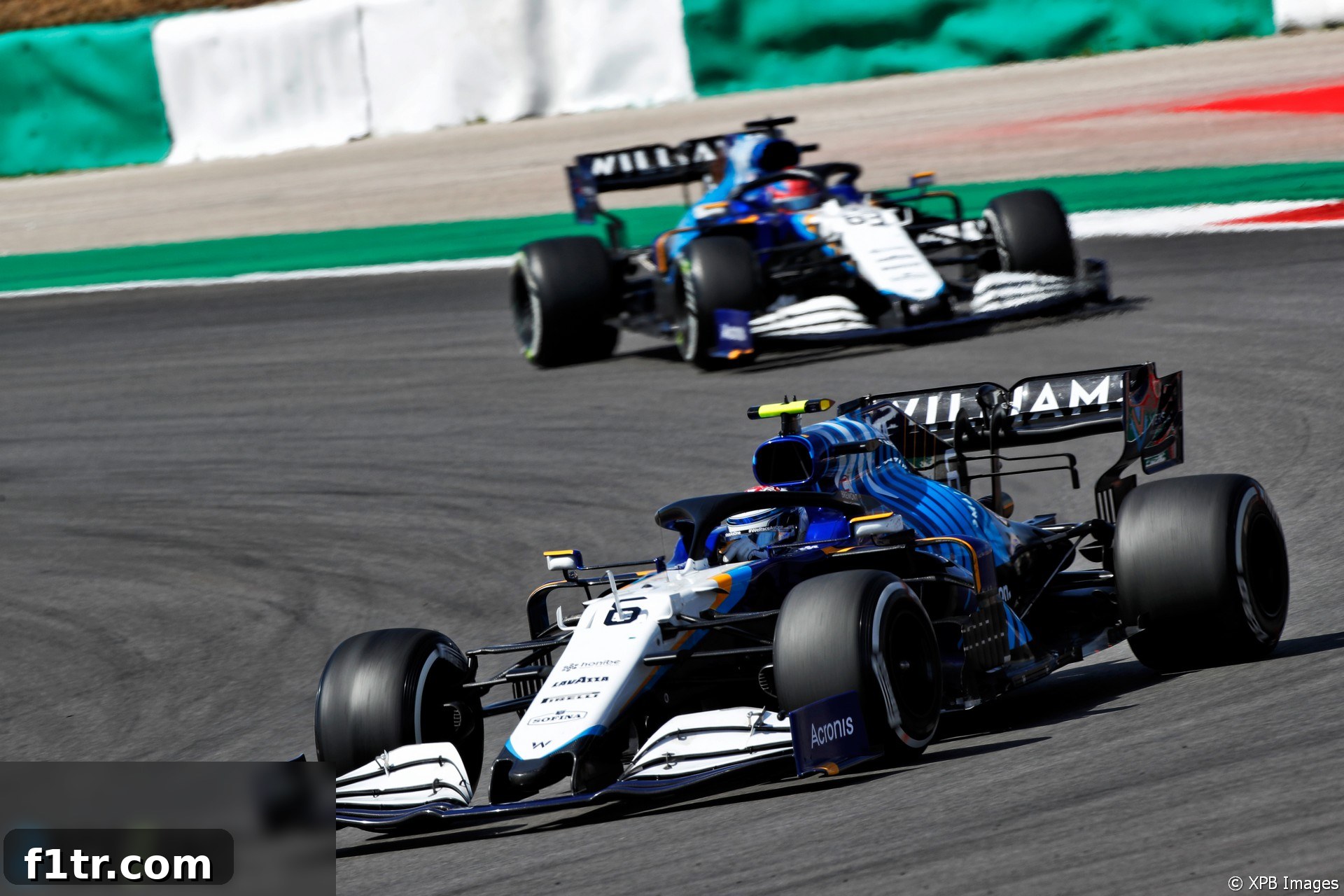
Williams, meanwhile, experienced a bittersweet weekend. George Russell’s impressive 11th place on the grid brought temporary cheer, matching his starting position from last year’s Styrian Grand Prix. Crucially, this strong qualifying performance was achieved purely on merit, without the aid of any grid penalties for competitors, further emphasizing Russell’s exceptional talent. However, the stark reality of Williams’s current race pace became evident on Sunday, as Russell dropped to 16th at the chequered flag. The disparity between their qualifying prowess and race performance was striking: Russell was just 0.05 seconds away from reaching Q3 on Saturday, yet a massive 73 seconds away from finishing in the points on Sunday. This gap illustrates the fundamental challenges Williams faces in converting raw speed into race results. The team’s longest-ever point-less run now stands at an extended 30 races in a row, a stark reminder of the long road ahead.
Championship Landscape and Future Prospects
With 20 races still remaining in this year’s 23-round calendar, there is ample time for fortunes to change and streaks to be broken. Furthermore, the addition of a trio of Sprint Qualifying races this season introduces three extra points-scoring opportunities, potentially altering the dynamics of the championship battles. These innovative new race formats are designed to inject more excitement and unpredictability into the Grand Prix weekends, offering teams and drivers additional chances to secure crucial championship points. The championship remains wide open, promising an enthralling season filled with intense competition, strategic battles, and the relentless pursuit of perfection from every team and driver on the grid.
The Portuguese Grand Prix served as a compelling chapter in the 2021 Formula 1 season, delivering memorable moments and setting the stage for future battles. The razor-thin margins at the front, the consistent performances of rising stars like Lando Norris, and the determined efforts of teams throughout the grid all contributed to a captivating weekend of racing. As the season progresses, every Grand Prix will be crucial, with championship contenders and midfield heroes alike fighting for every advantage. The narratives from Portimão will undoubtedly continue to unfold as Formula 1 charges towards its thrilling conclusion.
2021 Portuguese Grand Prix Insights and Analysis
- Pirelli’s tyre choice for Portuguese GP wasn’t “too hard”, Hamilton concedes
- Who are the top F1 juniors bidding for a grand prix debut in 2022?
- 2021 Portuguese Grand Prix Star Performers
- Race gains encourage Ricciardo after ‘unacceptable’ qualifying performance
- Sainz says top-five finish was possible after first no-score for Ferrari
Browse all 2021 Portuguese Grand Prix articles