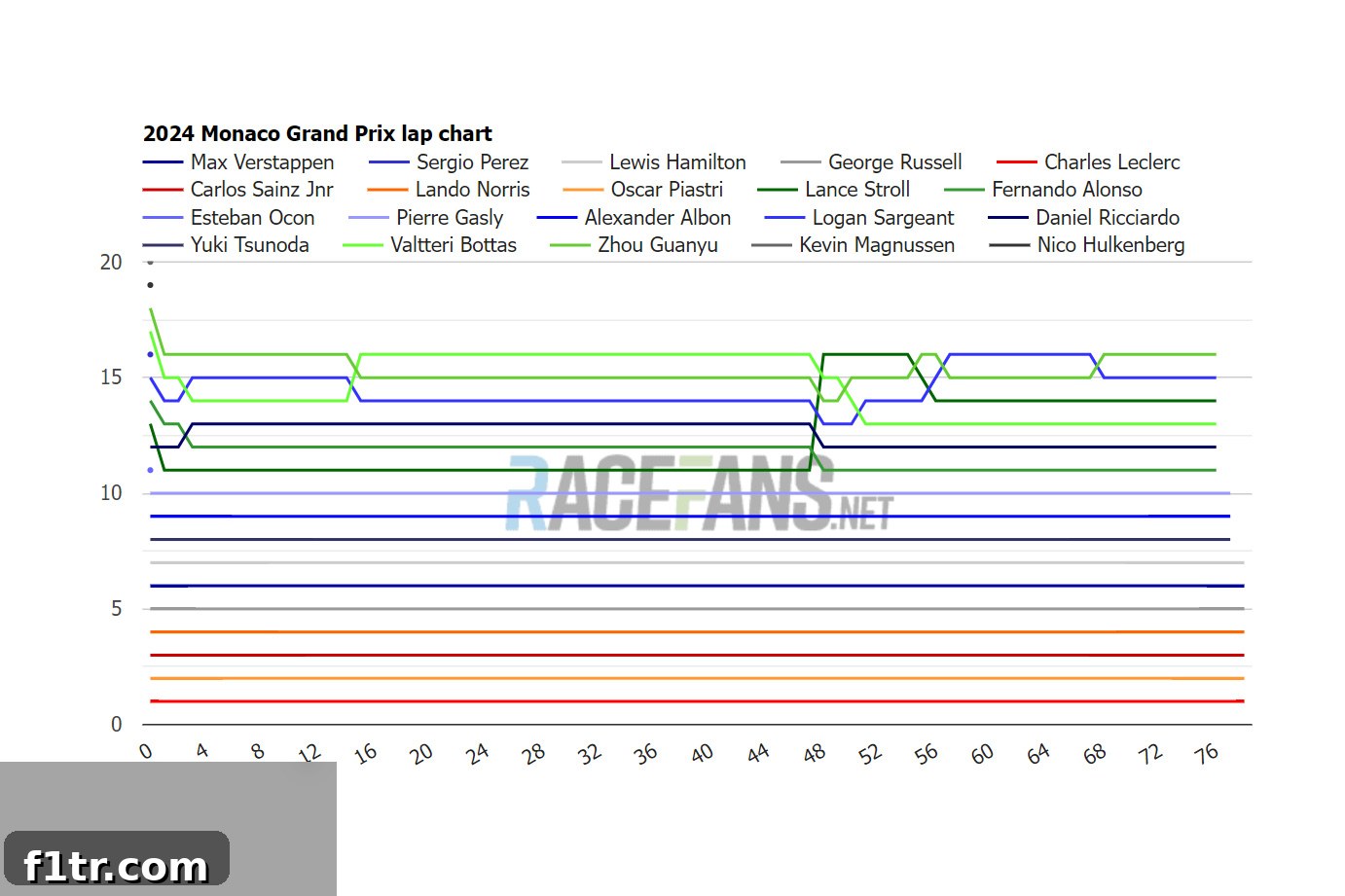
The 2024 Monaco Grand Prix will undoubtedly be remembered as one of Formula 1’s most peculiar and, for many, most frustrating races in recent memory. A dramatic first-lap collision, combined with the inherent challenges of the iconic Monte Carlo street circuit and specific quirks of F1 regulations, culminated in an exceptionally slow and processional event. What unfolded was a strategic stalemate that saw the top ten finishers cross the line in the exact same order they started, an unprecedented occurrence in Formula 1 history.
Advert | Become a Supporter & go ad-free
The race’s unusual character was set in motion just seconds after the lights went out. A multi-car pile-up on the opening lap proved to be the pivotal incident. As the field surged up Beau Rivage, Sergio Perez of Red Bull, along with both Haas drivers, Kevin Magnussen and Nico Hulkenberg, were involved in a significant crash. Perez’s car suffered extensive damage, effectively tearing it apart and scattering substantial debris across the track. The impact also severely damaged the protective barriers, leaving race control with no alternative but to deploy the red flags. This immediate halt to proceedings not only brought the race to a standstill but also inadvertently triggered a strategic reset that would dictate the entire afternoon.
The red flag period, a common occurrence in Formula 1 but rarely seen so early in a race, offered an unforeseen strategic advantage. Under F1 regulations, a red flag allows teams to change tyres without incurring the usual time penalty of a pit stop during green flag conditions. This meant virtually every pit wall strategist seized the opportunity. Whether their drivers had started on the medium or hard compound tyres, they universally opted to switch to the opposing compound. This “free” tyre change allowed them to fulfill the mandatory tyre change requirement for the race, enabling them to complete the remaining laps on a single set of tyres without needing any further stops.
For the leading four cars – Charles Leclerc, Oscar Piastri, Carlos Sainz Jnr (who, despite an early puncture, was able to regain his starting position thanks to the red flag), and Lando Norris – this meant committing to a long stint on the hard compound tyres. Drivers like George Russell and Max Verstappen, who started further back, found themselves facing the challenge of making their mediums last until the chequered flag. Curiously, Williams made a questionable call by leaving Logan Sargeant on the same tyre compound, a decision that eventually forced him to make a separate pit stop later in the race, dropping him to the back of the field and highlighting a rare strategic misstep in an otherwise static race.
The consequence of nearly everyone completing their mandatory stop under the red flag was the effective elimination of any significant strategic variation. With everyone running on what was essentially a one-stop (or rather, a zero-stop under green flag conditions) strategy, the primary objective for the front-runners shifted. Their goal was to manage tyre wear and, crucially, to avoid creating any gaps behind them. The fear was that if a significant gap emerged, a trailing driver could pit for a fresh, more aggressive tyre compound (like the softs, which would not last the full race but could offer a short burst of speed) and potentially gain a position. This strategic dance led to an extraordinarily low pace at the front, creating a “Monaco train” effect where drivers were deliberately driving well within their car’s capabilities to maintain tight spacing.
Race leader Charles Leclerc was instrumental in controlling this pace. He carefully modulated his speed, ensuring that George Russell, running in third place, never fell sufficiently behind Lando Norris in fourth. If Russell had created a large enough gap to Norris, the McLaren driver could have attempted a pit stop for new tyres without losing track position to Russell. This delicate balance meant Leclerc sacrificed outright speed for strategic control, effectively neutralizing any potential threats from behind. The strategy was a masterclass in defensive driving and strategic management, even if it came at the cost of exhilarating racing.
This unusually slow pace was not lost on the drivers themselves. Second-placed Oscar Piastri, despite being right on Leclerc’s gearbox for much of the early phase, found himself considering a bold move. “I had an attempt about 10 or 15 laps in, into turn eight,” Piastri recounted. “We were going pretty slow. I think at one point we were going slower than Formula 2.” This candid observation underscored the almost bizarre nature of the race, where Formula 1 cars, designed for blistering speed, were circulating at a pace more akin to junior categories. Piastri’s reflection continued, “When you’re going that slow, you’ve got a fair few options. But I kind of knew that once I showed my hand in where I was going to try and overtake, that he would probably be wise to it from there. So I managed to get very close in turn seven, one lap. I tried to show the nose in turn eight but he reacted just quick enough, so after that point I knew I was going to be very limited on options.” His words perfectly encapsulated the strategic deadlock and the immense difficulty of attempting an overtake on the narrow streets of Monaco, even when the pace was artificially suppressed.
Further back in the field, strategic intricacies continued to play out, albeit with limited impact on the top positions. Mercedes opted to bring Lewis Hamilton in for a second, proper pit stop when he had sufficient a gap behind him. This was a tactical move to give him fresh tyres and a chance to push for the fastest lap. However, Mercedes made a slight miscalculation, failing to ensure Hamilton maintained optimal pace on his out-lap. This momentary lapse provided sixth-placed Max Verstappen with an unexpected window of opportunity. Seeing Hamilton’s slightly compromised out-lap, Red Bull swiftly reacted, bringing Verstappen in for his own pit stop. Fortunately for Mercedes, Russell had enough pace in hand to edge away from the charging Red Bull as it closed in, preventing any position change. This small but intense battle for track position highlighted the fine margins that define F1 strategy, even in a seemingly quiet race.
Once Hamilton and Verstappen had completed their pit stops, Leclerc was finally given the green light to increase his pace. However, Piastri, running in second, found himself unable to match the Ferrari driver’s surge. His tyres began to degrade, and a contributing factor was potentially the floor damage sustained earlier in the race. While Carlos Sainz Jnr’s early incident initially seemed like a puncture for the Ferrari driver, it had also caused a slight collision with Piastri’s McLaren, resulting in subtle damage to the Australian’s car. “I think for the first half of the race, it was impossible to tell what the penalty of that [damage] was,” Piastri explained. “Towards the end, probably a combination of trying to keep the pace of the race reasonably quick, plus the floor, I just struggled a little bit. The last 10 laps or so, I was pretty happy we were in Monaco.” Driving a compromised car on the unforgiving Monaco street circuit is an immense challenge, and Piastri’s resilience was commendable, even as his pace began to fade.
Yet, even Piastri’s struggle didn’t create a significant enough opportunity for Carlos Sainz Jnr, behind him, to mount a serious attack. The fundamental difficulty of overtaking in Monaco, coupled with the strategic uniformity brought about by the red flag tyre changes, meant that the grid effectively became locked in place. In an unprecedented turn of events, there were absolutely no position changes within the top ten throughout the entire duration of the race under green flag conditions – a statistic that underscored the profound strategic deadlock and the circuit’s unique challenges. This lack of on-track action fueled further debate among fans and pundits about the future format and place of the Monaco Grand Prix on the Formula 1 calendar, given its undeniable historical significance but increasing struggles to deliver compelling racing.
Advert | Become a RaceFans supporter andgo ad-free
2024 Monaco Grand Prix Lap Chart
The progression of each driver’s position across every lap of the race. Use the interactive controls below to highlight individual drivers or reset the view.
Advert | Become a RaceFans supporter andgo ad-free
2024 Monaco Grand Prix Race Chart
An overview of the time gaps between each driver and the leader’s average lap time throughout the race. Extremely large gaps have been omitted for clarity. Navigate the chart by scrolling to zoom, dragging to pan, and right-clicking to reset. Toggle driver data using the controls below.
2024 Monaco Grand Prix Lap Times
Detailed lap times recorded by each driver during the race, presented in seconds (excluding exceptionally slow laps). Utilize the controls below to zoom, pan, and filter individual driver performances.
Advert | Become a RaceFans supporter andgo ad-free
2024 Monaco Grand Prix Fastest Laps
A compilation of each driver’s fastest single lap achieved during the 2024 Monaco Grand Prix.
| Rank | # | Driver | Car | Lap time | Gap | Avg. speed (kph) | Lap no. |
|---|---|---|---|---|---|---|---|
| 1 | 44 | Lewis Hamilton | Mercedes | 1’14.165 | 161.98 | 63 | |
| 2 | 1 | Max Verstappen | Red Bull-Honda RBPT | 1’14.569 | 0.404 | 161.1 | 58 |
| 3 | 24 | Zhou Guanyu | Sauber-Ferrari | 1’14.718 | 0.553 | 160.78 | 75 |
| 4 | 22 | Yuki Tsunoda | RB-Honda RBPT | 1’14.720 | 0.555 | 160.78 | 77 |
| 5 | 55 | Carlos Sainz Jnr | Ferrari | 1’14.726 | 0.561 | 160.76 | 62 |
| 6 | 16 | Charles Leclerc | Ferrari | 1’15.162 | 0.997 | 159.83 | 71 |
| 7 | 63 | George Russell | Mercedes | 1’15.228 | 1.063 | 159.69 | 73 |
| 8 | 2 | Logan Sargeant | Williams-Mercedes | 1’15.525 | 1.360 | 159.06 | 62 |
| 9 | 10 | Pierre Gasly | Alpine-Renault | 1’15.625 | 1.460 | 158.85 | 77 |
| 10 | 4 | Lando Norris | McLaren-Mercedes | 1’15.742 | 1.577 | 158.61 | 64 |
| 11 | 81 | Oscar Piastri | McLaren-Mercedes | 1’16.281 | 2.116 | 157.49 | 73 |
| 12 | 77 | Valtteri Bottas | Sauber-Ferrari | 1’16.561 | 2.396 | 156.91 | 17 |
| 13 | 18 | Lance Stroll | Aston Martin-Mercedes | 1’16.710 | 2.545 | 156.61 | 59 |
| 14 | 23 | Alexander Albon | Williams-Mercedes | 1’17.060 | 2.895 | 155.89 | 77 |
| 15 | 3 | Daniel Ricciardo | RB-Honda RBPT | 1’17.172 | 3.007 | 155.67 | 46 |
| 16 | 14 | Fernando Alonso | Aston Martin-Mercedes | 1’17.939 | 3.774 | 154.14 | 68 |
2024 Monaco Grand Prix Tyre Strategies
An overview of the tyre compounds used by each driver throughout the 2024 Monaco Grand Prix.
Advert | Become a RaceFans supporter andgo ad-free
2024 Monaco Grand Prix Pit Stop Times
A breakdown of the duration of each driver’s pit stops during the race, including full stop times and comparison to the fastest stop.
| Rank | # | Driver | Team | Complete stop time (s) | Gap to best (s) | Stop no. | Lap no. |
|---|---|---|---|---|---|---|---|
| 1 | 1 | Max Verstappen | Red Bull | 23.813 | 2 | 52 | |
| 2 | 18 | Lance Stroll | Aston Martin | 24.132 | 0.319 | 2 | 42 |
| 3 | 44 | Lewis Hamilton | Mercedes | 24.232 | 0.419 | 2 | 51 |
| 4 | 77 | Valtteri Bottas | Sauber | 24.239 | 0.426 | 2 | 15 |
| 5 | 24 | Zhou Guanyu | Sauber | 24.367 | 0.554 | 2 | 70 |
| 6 | 18 | Lance Stroll | Aston Martin | 28.211 | 4.398 | 3 | 48 |
2024 Monaco Grand Prix Related Articles
- Formula 1 will fix red flag rule loophole which ruined Monaco GP – Domenicali
- Magnussen ‘could have backed off but didn’t’ in Monaco crash, says team boss
- Ocon defends his driving after ‘hurtful abuse’ over Monaco GP crash with Gasly
- How the midfield’s hottest team mate rivalry boiled over
- “He’s really dangerous”: Unheard driver radio from F1’s slow show in Monaco
Browse all 2024 Monaco Grand Prix articles