Max Verstappen’s Controversial Mexico GP: A Deep Dive into Penalties and F1 Racing Standards
Max Verstappen once again found himself at the epicenter of a storm of controversy at the Mexico Grand Prix, marking the second consecutive race where his aggressive driving style led to significant penalties. On this occasion, he received two separate penalties for a pair of incidents involving Lando Norris, both occurring within the same dramatic lap. These decisions ignited a fervent debate across the Formula 1 paddock and among fans, with opinions sharply divided on the fairness and severity of the stewards’ rulings.
Predictably, Verstappen’s team argued that the two 10-second penalties were excessively harsh for the racing clashes with Norris. Conversely, McLaren, Norris’s team, felt that the penalties did not go far enough to address what they perceived as dangerous driving. The incidents have sparked a crucial discussion about racing etiquette, the interpretation of rules, and the consistency of stewarding in modern Formula 1. But what exactly happened, and how did the F1 community react to these pivotal moments that sent shockwaves through the championship?
Advert | Become a Supporter & go ad-free
The Incidents Unpacked: A Lap of High Drama
The lap in question was fraught with tension and highlighted the fine line between aggressive, hard racing and potentially illegal maneuvers. Two distinct incidents, mere moments apart, captured the attention of spectators and stewards alike, each contributing to Verstappen’s controversial day and shaping the narrative of the Mexico Grand Prix.
Incident 1: Turn Four – The Battle for Track Position
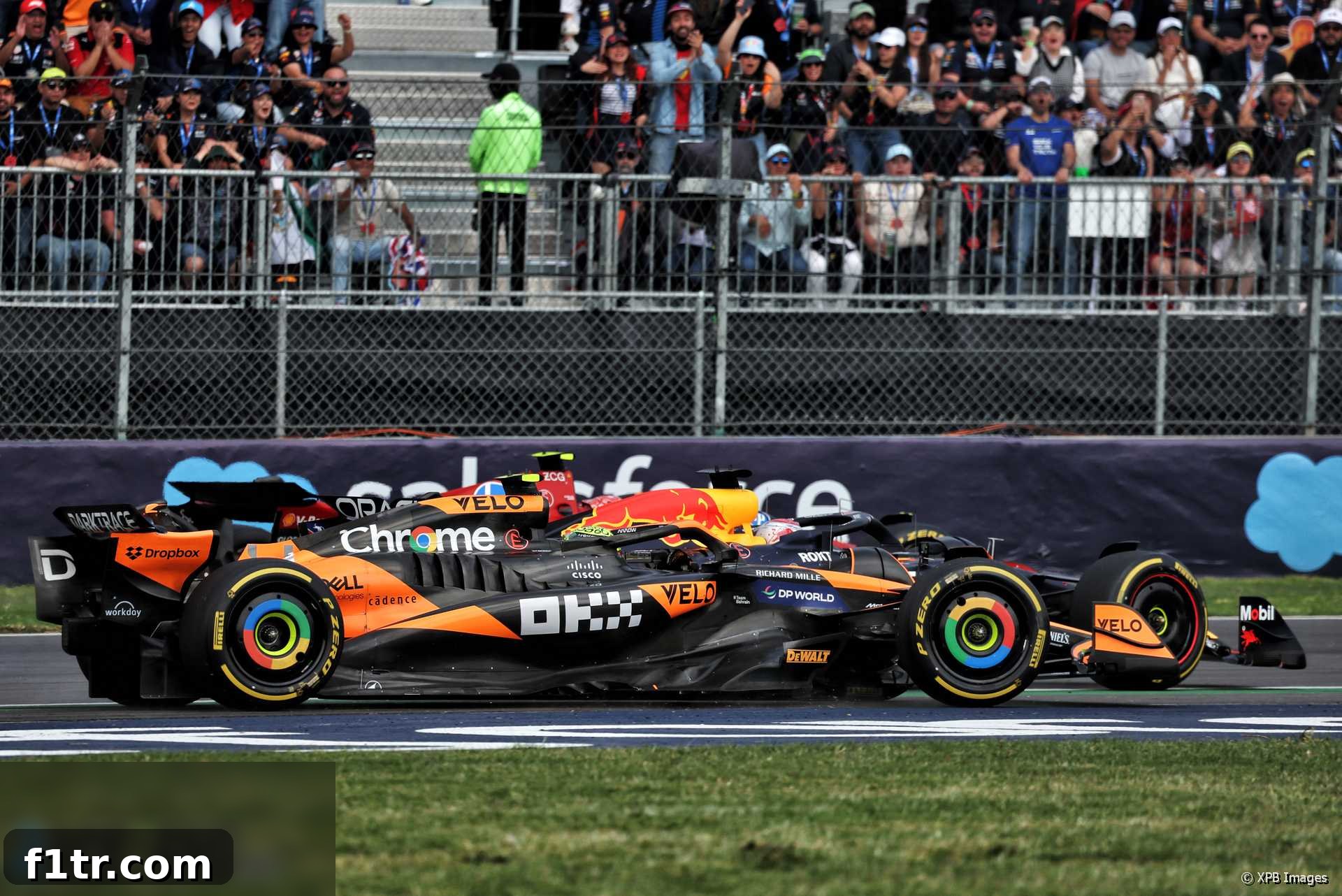
As the cars hurtled towards the sharp left-hander of Turn 4, Lando Norris skillfully maneuvered his McLaren alongside Max Verstappen on the outside. Norris appeared committed to taking the wide line through the corner, positioning his car on a trajectory that suggested he would complete the overtake around Verstappen’s exterior. However, as the two drivers turned into the apex, the gap between them rapidly diminished. Verstappen’s racing line seemed to converge with Norris’s, leading to a squeeze that ultimately forced Norris off the track. The McLaren driver, having nowhere else to go, had to take to the run-off area to avoid a major collision, momentarily losing significant track position.
Upon rejoining the track, Norris found himself ahead of both Verstappen and the then-race leader, Carlos Sainz Jnr. Demonstrating strict adherence to racing rules regarding gaining an unfair advantage, Norris immediately conceded the position to Sainz, allowing the leader to pass unhindered. This first incident immediately put Verstappen under scrutiny for potentially exceeding track limits and forcing a competitor off the racing surface, a maneuver strictly regulated in Formula 1’s sporting code.
Incident 2: Turn Seven – Aggression or Misjudgment?
Almost immediately following the contentious Turn 4 episode, the two drivers were once again embroiled in a clash, this time at Turn 7. In a bold move, Max Verstappen made an assertive lunge down the inside of Lando Norris. The maneuver was undeniably aggressive, aiming to seize the critical inside line into the corner. Sensing the imminent danger of contact and a potential race-ending crash, Norris took decisive avoiding action, opting to drive onto the run-off area himself rather than risk a collision. Verstappen, unable to hold his racing line due to the ambitious nature of his move, also ran wide and ended up on the same run-off. Despite both drivers momentarily leaving the track, Verstappen managed to maintain or even gain a lasting advantage by remaining ahead of Norris as they rejoined the circuit, a clear breach of F1’s “leaving the track and gaining an advantage” rule.
This second incident further inflamed tensions, raising profound questions about Verstappen’s judgment and his consistent willingness to push the boundaries of fair racing. For many, it underscored a pattern of aggressive driving that, while often thrilling for spectators and a hallmark of his championship-winning style, consistently brings him into conflict with rivals and the ever-watchful race stewards.
Voices from the Cockpit and Paddock: Driver and Team Reactions
The immediate aftermath of these incidents saw strong, emotional reactions from both drivers, reflecting their differing perspectives on what transpired on the track. These comments, both during and after the race, were pivotal in shaping public opinion and influencing the stewards’ subsequent deliberations, highlighting the intense pressure and high stakes of Formula 1.
Norris’s Frustration: “This Guy is Dangerous”
Speaking over his team radio immediately after the Turn 4 incident, Lando Norris voiced his clear belief that he had been “ahead the whole way through the corner,” suggesting he had established his position fairly. His frustration escalated significantly after the Turn 7 clash, culminating in an emphatic exclamation: “This guy is dangerous! I just had to avoid a crash. It’s the same as last time. I’m going to end up in a wall in a minute.” The pointed reference to “last time” harked back to a similar close call between the pair at the United States Grand Prix in Austin just a week prior, suggesting a concerning pattern of incidents that was clearly bothering the young McLaren driver. Norris further elaborated on his viewpoint, stating, “It’s two different incidents. He overtook me off the track and pushed me off,” articulating his firm belief that Verstappen not only gained an unfair advantage by leaving the track but also actively forced him off the racing line in both instances.
Verstappen’s Perspective: A Question of Penalty Severity
Interestingly, Max Verstappen did not offer immediate commentary on the incidents over his team radio, or perhaps his responses were censored for broadcast. However, in his post-race interview with Sky Sports, he acknowledged the penalties but focused more on their cumulative impact rather than directly disputing the incidents themselves. “At the end of the day it’s also not about agreeing or disagreeing about the penalty,” Verstappen stated, “The only thing is, 20 seconds, it’s quite a lot.” This comment suggested a pragmatic recognition of the situation but a clear feeling that the total 20-second penalty, comprising two separate 10-second sanctions, was disproportionate to the perceived infractions. Verstappen’s racing philosophy often involves pushing limits, and his comments frequently reflect a belief that such incidents are simply an unavoidable part of competitive, wheel-to-wheel racing at the highest level.
Norris, however, reiterated his stance that his evasive actions alone prevented a more severe outcome: “If I didn’t do what I did today and avoid him, I’d probably be out of the race.” This stark warning highlighted the critical safety implications of Verstappen’s maneuvers from Norris’s viewpoint, emphasizing the potential for major accidents.
Team Stances: Divided Opinions on Justice
The teams themselves naturally adopted positions aligned with their drivers, each seeking to defend their corner in the wake of the controversy. Red Bull Racing, Verstappen’s team, would have likely argued for a more lenient view, perhaps categorizing the incidents as hard but fair racing, or emphasizing that the cumulative 20-second penalty was overly punitive for what they considered standard racing incidents. Their position would be to staunchly defend their star driver’s aggressive style, often seen as a key component of his success and a characteristic cherished by his fans. Conversely, McLaren’s stance would have been one of seeking stricter enforcement, advocating for penalties that truly deterred such behavior and unequivocally ensured driver safety. This division in opinion is a common feature of F1 controversies, where strategic rhetoric often accompanies the sporting debate, aiming to influence both stewards and public perception.
Advert | Become a RaceFans supporter andgo ad-free
The Stewards’ Official Verdict: Rationale and Ramifications
The race stewards, tasked with impartial judgment and the rigorous application of Formula 1’s extensive sporting regulations, ultimately held Max Verstappen responsible for both incidents, issuing separate 10-second time penalties for each. Their detailed explanations provided crucial insight into the intricacies of F1 rule enforcement and the challenges of adjudicating on-track battles.
For the Turn 4 incident, the stewards meticulously reviewed the onboard footage and telemetry, concluding that Lando Norris’s driving was entirely within the rules and that he had established a legitimate claim to the outside line. They found that Verstappen had indeed forced Norris off the track, an action deemed illegal under F1’s “leaving a car’s width” guidelines, which dictate that a driver must allow sufficient room for a competitor on the outside when racing side-by-side through a corner. Verstappen’s failure to do so, effectively squeezing Norris off the racing surface, led to the imposition of the first penalty.
Regarding the Turn 7 incident, the stewards viewed it as a case where Verstappen attempted an aggressive overtaking maneuver on Norris, failed to complete the move cleanly, and subsequently ran wide off the track along with Norris. Crucially, they noted that Verstappen “left the track and kept the lasting advantage gaining the position, incidentally forcing Norris off the track.” The concept of “lasting advantage” is paramount here: even if a driver leaves the track inadvertently, they must relinquish any benefit gained from doing so. By rejoining ahead and maintaining that position, Verstappen was judged to have gained an unfair advantage by failing to cede the position, thus warranting a second, independent penalty.
Initially, the stewards did not issue any penalty points on Verstappen’s superlicence for either incident, a decision that immediately raised eyebrows among some observers. However, approximately an hour after the Turn 4 decision was first published, an updated version was released. This revised verdict saw Verstappen receive two penalty points on his licence specifically for the Turn 4 incident. This change sparked further discussion and minor controversy, raising questions about the initial oversight and the process of reviewing such decisions. It underscored the complexity and the often-subjective nature inherent in F1 stewarding, where initial calls can be reviewed and amended.
Penalty Points System: What It Means for Drivers
The addition of penalty points is a significant and cumulative consequence in Formula 1, distinct from time penalties applied to a single race result. Drivers accumulate points on their superlicence for various infractions throughout a 12-month rolling period. Reaching a total of 12 penalty points results in an automatic one-race ban, a severe sanction that can have significant implications for a driver’s championship aspirations and their team’s performance. While two points for the Turn 4 incident might not immediately push Verstappen to the brink of a ban, it adds to his running tally and serves as a formal warning, highlighting the cumulative effect of aggressive or rule-breaking driving over a season. The lack of penalty points for the Turn 7 incident, despite a time penalty, also drew scrutiny, with some arguing that forcing a driver off track and gaining an advantage should consistently warrant penalty points to act as a stronger deterrent.
Analyzing the Fallout: Consistency, Controversy, and the Future of F1 Racing
The Max Verstappen and Lando Norris incidents at the Mexico GP transcended mere sporting penalties; they opened a broader dialogue within Formula 1 about the very nature of racing, the role of regulations, and the persistent challenges faced by race stewards in a fast-paced, high-stakes environment.
The Debate on Stewarding Consistency
One of the most recurring and passionately debated themes in Formula 1 is the perceived inconsistency of stewarding decisions. Fans, drivers, and teams frequently express frustration when similar incidents appear to yield different outcomes or varying levels of punishment. The Mexico GP penalties for Verstappen, particularly the delayed addition of penalty points for Turn 4, fueled this long-standing debate. Critics argue that such inconsistencies undermine confidence in the system, making it difficult for drivers to understand the precise boundaries of acceptable racing and leading to a sense of unfairness. Proponents, however, contend that every incident in Formula 1 is inherently unique, with subtle nuances of speed, angle, driver intent, and track conditions making direct comparisons challenging, and that stewards operate under immense pressure to make split-second judgments based on limited evidence in real-time.
Impact on the Championship and Driver Reputations
While the Mexico GP incidents did not directly alter the championship outcome for Verstappen in that particular race, a cumulative effect of such penalties, particularly penalty points, can have significant implications over a season. More broadly, these incidents contribute significantly to the public perception and reputation of drivers. Max Verstappen, known globally for his uncompromising and aggressively spectacular driving style, often walks a tightrope between brilliant, daring racing and contentious maneuvers that push the limits. Incidents like these reinforce that image, simultaneously earning him ardent fans who admire his tenacity and critics who view his driving as overly aggressive or even dangerous. For Lando Norris, his vocal frustration resonated with many who champion fair play and driver safety, potentially bolstering his image as a principled and talented racer unwilling to be intimidated.
Towards a Clearer Racing Standard?
The events at the Mexico GP serve as a poignant reminder of the eternal tension between exhilarating, wheel-to-wheel racing and the fundamental need for clear, consistently enforced regulations to ensure safety and fairness. Formula 1 continually seeks to strike a delicate balance that allows for thrilling competition without compromising driver welfare or the integrity of the sport. Incidents involving contact or forcing drivers off track are among the most difficult for stewards to adjudicate, often requiring a nuanced understanding of intent, consequences, and the underlying spirit of racing. Moving forward, continued open dialogue among drivers, teams, and the FIA will be essential to refine racing standards and ensure that both on-track battles and their subsequent judgments are understood, accepted, and universally respected by all stakeholders, promoting a more transparent and predictable framework for competitive racing in Formula 1.
Your Voice: Join the Discussion
The debate surrounding these incidents is far from settled, and your opinion as a passionate Formula 1 enthusiast is invaluable. Below, we present the results of our polls, reflecting initial reader sentiment on the penalties issued to Max Verstappen for the controversial clashes with Lando Norris at the Mexico Grand Prix. These results offer a snapshot of how the wider F1 community perceived the fairness and appropriateness of the stewards’ decisions.
Advert | Become a RaceFans supporter andgo ad-free
Incident 1: Turn Four
Verstappen was given a 10-second time penalty and two penalty points on his licence.
Verstappen’s penalty for the incident at turn four was:
- No opinion (0%)
- Far too lenient (9%)
- Slightly too lenient (11%)
- Correct (57%)
- Slightly too harsh (14%)
- Far too harsh (8%)
Total Voters: 201
Incident 2: Turn Seven
Verstappen was given a 10-second time penalty and no penalty points on his licence.
Verstappen’s penalty for the incident at turn seven was:
- No opinion (0%)
- Far too lenient (23%)
- Slightly too lenient (32%)
- Correct (38%)
- Slightly too harsh (6%)
- Far too harsh (2%)
Total Voters: 185
A RaceFans account is typically required in order to vote in such polls and engage with the community. If you wish to participate in future discussions and contribute your verdict on racing incidents, consider registering an account or learning more about participation and membership.
Miss nothing from RaceFans
Get a daily email with all our latest stories – and nothing else. No marketing, no ads. Sign up here:
Advert | Become a RaceFans supporter andgo ad-free
Debates and polls
Here are more recent debates and polls you might find engaging from the world of Formula 1:
- What must Formula 1 fix with its new rules – and what should it leave unchanged?
- ADUO: Do F1 teams who fall behind deserve to get help to catch up?
- F1 is considering doubling its sprint races. Do you want more or fewer?
- Will this be a fight or a rout? 20 questions for the 2026 Formula 1 season
- Which Formula 1 team has the best-looking car – and the worst – for the 2026 season?
Browse all debates and polls