Mercedes W13’s Flaws Detected on Day One: Unpacking the 2022 F1 Season Struggles and Triumphs
The 2022 Formula 1 season marked an unprecedented period of struggle for Mercedes-AMG Petronas F1 Team, a stark contrast to their decade of dominance. The shortcomings of their W13 challenger, which led to their least competitive performance in recent memory, were astonishingly identified during the car’s inaugural track run, the team has candidly revealed. This immediate detection set the stage for a season-long battle against unexpected aerodynamic phenomena and a relentless pursuit of understanding their new machine.
Advert | Become a Supporter & go ad-free
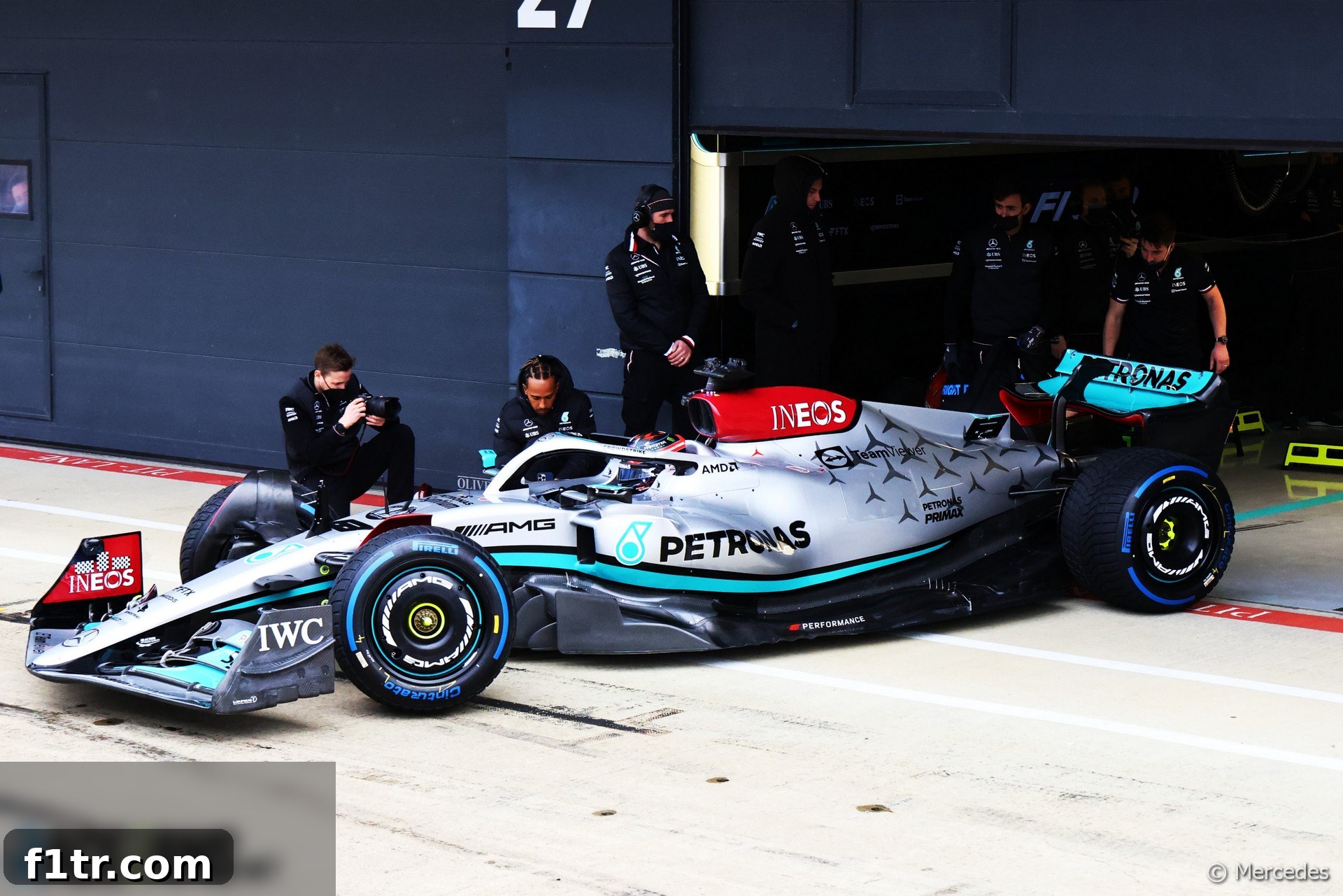
The highly anticipated W13 was unveiled and launched at the iconic Silverstone Circuit on February 18th. On that pivotal day, seven-time world champion Lewis Hamilton and his new teammate George Russell took the wheel for the very first time. While the atmosphere was filled with the usual pre-season optimism, behind the scenes, a different narrative was already beginning to unfold. Andrew Shovlin, Mercedes’ head of trackside operations, confirmed that it was during this initial filming day that the team first grasped the unsettling reality: the W13 was simply not performing as anticipated.
“To be honest, the signs were there from the very, very early running, even on the filming day that we did at Silverstone,” Shovlin explained in a revealing video released by the team. This early apprehension quickly escalated into serious concern as pre-season testing commenced, painting a clearer, and more troubling, picture of their 2022 contender.
The Bahrain Breakthrough, or Lack Thereof
The depth of the team’s struggles became glaringly apparent over two subsequent three-day tests, first at the demanding Circuit de Catalunya in Barcelona, and later at the fast-flowing Bahrain International Circuit. While Barcelona offered some initial data, it was Bahrain that truly highlighted the gravity of the situation.
“We then went for three days in Barcelona and the car was not that competitive,” Shovlin recalled, reflecting on the initial disappointment. “But we were expecting a big update that we were going to bring to Bahrain. That was the point that we realised that we had a serious issue, at that Bahrain test.” This particular test was pivotal, as Mercedes had planned to introduce a significant aerodynamic package, hoping it would unlock the W13’s potential and rectify the initial problems. This update included the now-infamous ‘zero sidepod’ design, a radical approach that instantly became the talking point of the paddock.
Mercedes introduced their aggressive ‘zero sidepod’ design in Bahrain, an innovative and visually striking aerodynamic concept designed to push the boundaries of downforce generation. The expectation was that this bold move would propel them back to the front of the grid. However, reality hit hard. “We put the update kit on and it simply didn’t make the car go quicker,” Shovlin revealed, underscoring the team’s profound disappointment. This lack of performance gain indicated a fundamental flaw that went deeper than just external aero elements, pointing towards an inherent characteristic of the car – primarily, the severe “porpoising” or aerodynamic bouncing that plagued the W13. This phenomenon, where the car rapidly oscillates up and down at high speeds, made it incredibly difficult for drivers to control and extract maximum performance. “Now, it’s been an interesting year from there on, but it has been a lot of work to do to try and get on top of those problems,” Shovlin added, highlighting the colossal task that lay ahead for the engineering team.
Mid-Season Resurgence: The Spanish Grand Prix Turning Point
Despite the early setbacks and the disheartening results in the initial races, the Mercedes team, known for its resilience and engineering prowess, never gave up. Slowly but surely, they began to unravel the complex mysteries of the W13. A significant turning point arrived when the championship returned to the Circuit de Catalunya for the Spanish Grand Prix in May. This race proved to be a pivotal moment in their season-long recovery.
Advert | Become a RaceFans supporter andgo ad-free
“That was the one where we made the biggest step in getting on top of the aero bouncing phenomenon, and we were able to have pretty good performance,” Shovlin confirmed. The team’s focused efforts on understanding and mitigating porpoising started to bear fruit. By making crucial adjustments to the car’s floor and suspension setup, they managed to significantly reduce the bouncing, allowing Lewis Hamilton and George Russell to drive closer to the car’s true potential. This breakthrough not only improved their raw pace but also provided invaluable data, giving them clearer direction for future development.
Addressing the porpoising issue, however, uncovered other underlying problems. “But also it allowed us to see that once we’d solved that issue, there were still other issues to solve with the ride of the car. It wasn’t very good over the bumps, and it gave us the clarity to work on those next steps,” Shovlin explained. This candid admission highlights the iterative nature of Formula 1 development – fixing one problem often reveals another. The improved aero stability meant the team could then focus on refining the car’s ride quality, making it more compliant over kerbs and bumps, which is crucial for driver confidence and lap time consistency across various circuits.
“Whilst it was only a small step in the right direction from a learning point of view, it was a really important update,” Shovlin concluded regarding the Spanish Grand Prix package. This statement encapsulates the meticulous, data-driven approach Mercedes employs; every gain, no matter how small, contributes significantly to the overall understanding and long-term improvement of the car.
The Road to Victory: Austin Update and Interlagos Triumph
The painstaking work throughout the season eventually led to tangible rewards. After enduring almost the entire season without a single victory – a stark anomaly for a team accustomed to winning multiple races per year – a further critical update was introduced at the Circuit of the Americas (COTA) in the United States Grand Prix. This update proved to be the final piece of the puzzle, bringing the W13 significantly closer to the front-running pace of Red Bull and Ferrari.
The impact of the COTA update was immediate and profound, culminating in a spectacular breakthrough victory for George Russell just two rounds later at the Brazilian Grand Prix in Interlagos. Russell’s dominant performance, securing both the Sprint Race win and the Grand Prix victory, marked not only his maiden Formula 1 win but also Mercedes’ first triumph of the challenging 2022 season. It was a testament to the team’s unwavering dedication and ability to overcome adversity, demonstrating that their understanding of the W13 had finally reached a critical mass.
Lessons Learned and the W14 Horizon
Looking back at the tumultuous 2022 campaign, Andrew Shovlin is optimistic that the team now possesses a comprehensive understanding of all the problems they encountered with their W13 design. This hard-won knowledge is now being meticulously applied to the development of next year’s W14 challenger, fueling hopes for a return to championship contention.
“It’s fair to say that by the time you’ve got to the end of the season, you’ve raced across a whole range of circuits, you should have pretty much understood all the issues and certainly by the end of the year,” Shovlin confidently stated. He highlighted that while some car problems persisted and made them less competitive at certain tracks, these were no longer new, baffling issues. Instead, they were anticipated challenges that the team had been working on for quite a while, indicating a clear diagnostic pathway.
“Now, the big body of work that’s been going on for the last number of months has been to make sure that those issues on the 13 don’t get carried into the 14. We made good progress there, and you can see that in some of the later updates, particularly the update that we brought to Austin, just put us that bit closer to the front,” Shovlin elaborated. This commitment to eliminating legacy issues from one car to the next is crucial for any successful Formula 1 team. The ability to isolate, understand, and then eradicate fundamental design flaws is what separates champions from contenders.
“A lot of our focus was making sure we can develop an update kit, bring it to the track and actually see it translate to performance, and hopefully the culmination of that work will mean that we can get an altogether more competitive package together for next year,” Shovlin concluded, expressing the team’s ambition. The 2022 season, despite its difficulties, served as an invaluable learning experience for Mercedes. It forced them to dig deep, question their fundamental principles, and ultimately emerge with a stronger, more nuanced understanding of the new ground effect regulations. The journey from initial detection of flaws to celebrating a victory, and now to designing the W14, is a powerful narrative of resilience, engineering excellence, and the relentless pursuit of perfection in Formula 1.
Advert | Become a RaceFans supporter andgo ad-free
Further Reading on the 2022 F1 Season
- Mercedes told me “you’re wrong” about 2022 car’s problems – Hamilton
- FIA confirms all 10 F1 teams complied with 2022 cost cap
- Steiner “not ashamed” of panning “slow” Schumacher in Drive to Survive
- Albon believes year out of F1 improved him as a driver
- Hamilton sees diversity gains in F1 years on from his ‘traumatising’ experience of racism
Browse all 2022 F1 season articles