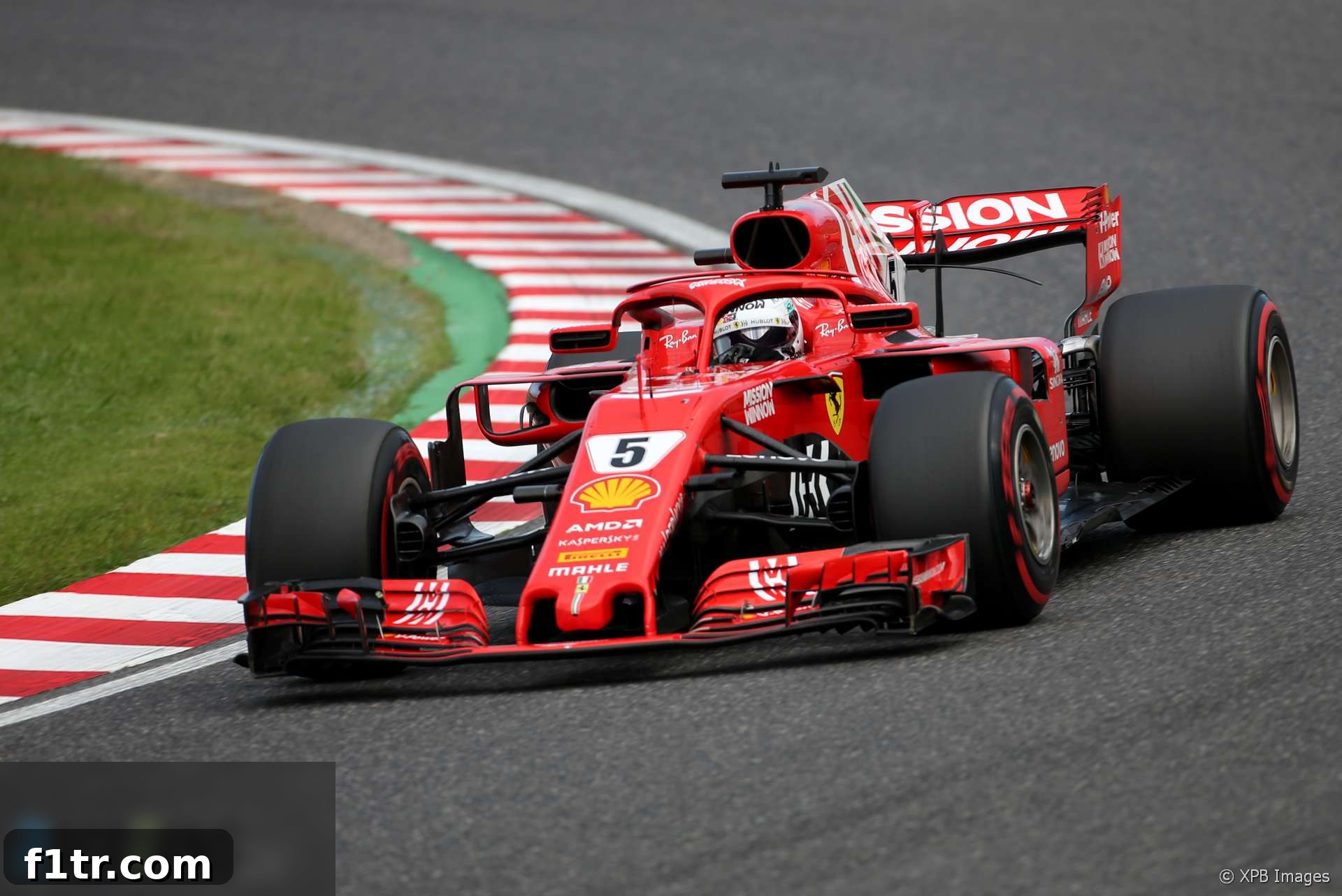
As the 2018 Formula 1 season approached its climax, the Japanese Grand Prix at the iconic Suzuka International Racing Course presented a critical juncture in the championship battle. What once seemed a tightly contested fight for supremacy between Mercedes and Ferrari had, in recent weeks, begun to tilt decisively in favour of the Silver Arrows. Suzuka, renowned for its challenging high-speed corners and demanding layout, was expected to provide a stage for a fierce showdown. However, the qualifying session painted a starkly different picture, one of Mercedes consolidating their grip and Ferrari once again faltering under pressure.
Mercedes, with their formidable W09, had diligently worked through their mid-season struggles, making significant performance strides that saw them pull ahead. Conversely, their rivals at Scuderia Ferrari appeared to be unravelling, repeatedly squandering opportunities that could have kept their championship hopes alive. The Suzuka qualifying session served as yet another painful illustration of this trend, handing Mercedes a commanding advantage heading into what promised to be a crucial race.
Advert | Become a Supporter & go ad-free
Qualifying: A Tale of Two Teams
The Suzuka circuit is a true test of a Formula 1 car and driver, demanding absolute precision and commitment through its unique figure-of-eight layout. Corners like the Esses, Degner, Spoon, and the 130R require a perfect balance of downforce and mechanical grip, making qualifying a high-stakes affair. Going into Saturday’s session, Ferrari undoubtedly harboured ambitions of challenging Mercedes for the front row, especially given their car’s inherent strengths in certain conditions. While their SF71H might not have been outright quicker than the W09, a front-row start for at least one of their drivers was certainly within reach, provided Mercedes made any slight misstep.
Instead, it was Ferrari that stumbled spectacularly. The critical error occurred in the pivotal Q3 session when both Sebastian Vettel and Kimi Räikkönen were sent out on the intermediate tyres, despite the track rapidly drying. This misjudgment by the team, expecting rain that never intensified, put their drivers at an immediate disadvantage against Mercedes, who correctly opted for slick tyres. Compounding this strategic blunder, both Ferrari drivers made similar, critical errors through the fast and unforgiving Spoon curve, costing them valuable tenths. The outcome was a devastating blow: a complete front-row lockout for Mercedes, with Lewis Hamilton on pole position and Valtteri Bottas alongside him. Their closest competitor, a surprisingly strong Max Verstappen in the Red Bull, found himself starting from third, ahead of the Ferraris.
This perfect execution from Mercedes not only secured them the prime starting positions but also delivered a significant psychological blow to their rivals. With the fastest two cars starting side-by-side, Mercedes are ideally positioned to control the crucial run down to Turn 1, dictating the pace and strategy for the entire race. Suzuka, for all its glory as a driver’s circuit, is notoriously challenging for overtaking, making a front-row start an almost insurmountable advantage.
Race Day Dynamics: Weather, Tyres, and Strategic Gambles
While Mercedes holds a commanding position, Formula 1 is never without its variables. The forecast for race day indicates warmer conditions than seen during practice and qualifying. This introduces an element of the unknown, as higher track temperatures can significantly impact tyre degradation and car balance. The Mercedes W09, despite its overall strength, has shown vulnerabilities in particularly hot conditions, with the Austrian Grand Prix earlier in the season serving as a pertinent example where they struggled. This factor offers a glimmer of hope for the chasing pack, suggesting that Mercedes might not have an entirely unchallenged afternoon.
Crucially, Mercedes has also made a bold strategic decision by opting to start the race on the harder, Soft compound tyres. This choice grants them greater flexibility and potentially a longer first stint, allowing them to manage tyre wear more effectively and potentially run a one-stop strategy with ease. Interestingly, Romain Grosjean of Haas has made a similar courageous tyre call, positioning him strongly to score maximum ‘best of the rest’ points for his team in the midfield battle, a decision his teammate Kevin Magnussen wasn’t able to replicate.
The warmer conditions, however, could spell trouble for several key contenders starting on the more fragile Super-soft tyres. Both Ferraris, the Force Indias, the Toro Rossos, and Max Verstappen find themselves in this predicament. While the Super-soft offers superior initial grip, its shorter lifespan could lead to early degradation and force an earlier pit stop, potentially compromising their race. Meanwhile, Charles Leclerc, having been promoted to 10th on the grid, is expected to start on a new set of Soft tyres. This strategic advantage, combined with Sauber’s demonstrated ability to unlock strong race pace on Sundays (as seen in Sochi), makes Leclerc a significant threat to Grosjean and other midfield runners.
Vettel’s Steep Uphill Battle and the Championship’s Fate
Heading into the Japanese Grand Prix weekend, Sebastian Vettel had openly acknowledged his dwindling championship hopes, yet he stressed the imperative for Ferrari to capitalise on any potential Mercedes missteps. Sadly for him and the Tifosi, this is precisely what his team failed to do in qualifying, leaving him in a dismal eighth position on the grid. Starting so far back on a track where overtaking is notoriously difficult means Vettel faces an incredibly steep uphill battle to salvage a meaningful result.
It’s challenging to envision a scenario where Vettel can prevent Lewis Hamilton from extending his already significant 50-point championship lead. A substantial points gain for Hamilton in Japan would bring the prospect of an early coronation in North America—either at the US Grand Prix or potentially Mexico—into sharp focus. For Vettel, even a perfect start might only see him challenging for fifth place if Kimi Räikkönen manages to get ahead of Max Verstappen. The dream of a fifth world championship for Vettel, which looked so promising earlier in the season, is rapidly fading into an improbable fantasy.
On paper, all signs point to Lewis Hamilton asserting his dominance and running away with this race, further solidifying Mercedes’ seemingly unassailable position in the constructors’ championship as well. Unless Suzuka produces a truly unforeseen shock, the 2018 Formula 1 Drivers’ Championship looks set to be decided much sooner than many anticipated, echoing the early conclusion of the previous season. The combination of Mercedes’ refined performance and Ferrari’s critical errors has created an almost insurmountable gap, leaving fans to wonder what might have been.
Go ad-free for just £1 per month>> Find out more and sign up
Qualifying times in full
| Driver | Car | Q1 | Q2 (vs Q1) | Q3 (vs Q2) | |
| 1 | Lewis Hamilton | Mercedes | 1’28.702 | 1’28.017 (-0.685) | 1’27.760 (-0.257) |
| 2 | Valtteri Bottas | Mercedes | 1’29.297 | 1’27.987 (-1.310) | 1’28.059 (+0.072) |
| 3 | Max Verstappen | Red Bull | 1’29.480 | 1’28.849 (-0.631) | 1’29.057 (+0.208) |
| 4 | Kimi Raikkonen | Ferrari | 1’29.631 | 1’28.595 (-1.036) | 1’29.521 (+0.926) |
| 5 | Romain Grosjean | Haas | 1’29.724 | 1’29.678 (-0.046) | 1’29.761 (+0.083) |
| 6 | Brendon Hartley | Toro Rosso | 1’30.248 | 1’29.848 (-0.400) | 1’30.023 (+0.175) |
| 7 | Pierre Gasly | Toro Rosso | 1’30.137 | 1’29.810 (-0.327) | 1’30.093 (+0.283) |
| 8 | Esteban Ocon | Force India | 1’29.899 | 1’29.538 (-0.361) | 1’30.126 (+0.588) |
| 9 | Sebastian Vettel | Ferrari | 1’29.049 | 1’28.279 (-0.770) | 1’32.192 (+3.913) |
| 10 | Sergio Perez | Force India | 1’30.247 | 1’29.567 (-0.680) | 1’37.229 (+7.662) |
| 11 | Charles Leclerc | Sauber | 1’29.706 | 1’29.864 (+0.158) | |
| 12 | Kevin Magnussen | Haas | 1’30.219 | 1’30.226 (+0.007) | |
| 13 | Carlos Sainz Jnr | Renault | 1’30.236 | 1’30.490 (+0.254) | |
| 14 | Lance Stroll | Williams | 1’30.317 | 1’30.714 (+0.397) | |
| 15 | Daniel Ricciardo | Red Bull | 1’29.806 | ||
| 16 | Nico Hulkenberg | Renault | 1’30.361 | ||
| 17 | Sergey Sirotkin | Williams | 1’30.372 | ||
| 18 | Fernando Alonso | McLaren | 1’30.573 | ||
| 19 | Stoffel Vandoorne | McLaren | 1’31.041 | ||
| 20 | Marcus Ericsson | Sauber | 1’31.213 |
Sector times
| Driver | Sector 1 | Sector 2 | Sector 3 |
|---|---|---|---|
| Lewis Hamilton | 30.913 (2) | 39.588 (1) | 17.253 (2) |
| Valtteri Bottas | 30.895 (1) | 39.708 (3) | 17.287 (3) |
| Max Verstappen | 31.361 (4) | 40.040 (5) | 17.441 (5) |
| Kimi Raikkonen | 31.460 (6) | 39.882 (4) | 17.199 (1) |
| Romain Grosjean | 31.418 (5) | 40.552 (13) | 17.501 (7) |
| Brendon Hartley | 31.818 (12) | 40.401 (10) | 17.573 (9) |
| Pierre Gasly | 31.703 (8) | 40.442 (11) | 17.625 (12) |
| Esteban Ocon | 31.794 (10) | 40.258 (8) | 17.466 (6) |
| Sebastian Vettel | 31.268 (3) | 39.681 (2) | 17.330 (4) |
| Sergio Perez | 31.671 (7) | 40.367 (9) | 17.529 (8) |
| Charles Leclerc | 31.803 (11) | 40.215 (7) | 17.578 (11) |
| Kevin Magnussen | 31.757 (9) | 40.743 (17) | 17.577 (10) |
| Carlos Sainz Jnr | 31.880 (13) | 40.670 (14) | 17.686 (17) |
| Lance Stroll | 31.936 (14) | 40.710 (16) | 17.671 (15) |
| Daniel Ricciardo | 31.963 (15) | 40.195 (6) | 17.648 (14) |
| Nico Hulkenberg | 32.106 (18) | 40.443 (12) | 17.671 (15) |
| Sergey Sirotkin | 31.963 (15) | 40.702 (15) | 17.707 (19) |
| Fernando Alonso | 32.065 (17) | 40.808 (18) | 17.700 (18) |
| Stoffel Vandoorne | 32.204 (19) | 40.914 (19) | 17.830 (20) |
| Marcus Ericsson | 32.521 (20) | 41.050 (20) | 17.642 (13) |
Speed trap
| Pos | Driver | Car | Engine | Speed (kph/mph) | Gap |
|---|---|---|---|---|---|
| 1 | Kimi Raikkonen | Ferrari | Ferrari | 306.2 (190.3) | |
| 2 | Lewis Hamilton | Mercedes | Mercedes | 304.6 (189.3) | -1.6 |
| 3 | Sebastian Vettel | Ferrari | Ferrari | 304.3 (189.1) | -1.9 |
| 4 | Valtteri Bottas | Mercedes | Mercedes | 304.3 (189.1) | -1.9 |
| 5 | Charles Leclerc | Sauber | Ferrari | 302.6 (188.0) | -3.6 |
| 6 | Esteban Ocon | Force India | Mercedes | 302.3 (187.8) | -3.9 |
| 7 | Sergey Sirotkin | Williams | Mercedes | 300.2 (186.5) | -6.0 |
| 8 | Marcus Ericsson | Sauber | Ferrari | 299.5 (186.1) | -6.7 |
| 9 | Sergio Perez | Force India | Mercedes | 299.2 (185.9) | -7.0 |
| 10 | Lance Stroll | Williams | Mercedes | 299.0 (185.8) | -7.2 |
| 11 | Romain Grosjean | Haas | Ferrari | 297.7 (185.0) | -8.5 |
| 12 | Kevin Magnussen | Haas | Ferrari | 297.3 (184.7) | -8.9 |
| 13 | Brendon Hartley | Toro Rosso | Honda | 296.6 (184.3) | -9.6 |
| 14 | Pierre Gasly | Toro Rosso | Honda | 295.1 (183.4) | -11.1 |
| 15 | Fernando Alonso | McLaren | Renault | 294.8 (183.2) | -11.4 |
| 16 | Stoffel Vandoorne | McLaren | Renault | 294.7 (183.1) | -11.5 |
| 17 | Max Verstappen | Red Bull | TAG Heuer | 294.5 (183.0) | -11.7 |
| 18 | Carlos Sainz Jnr | Renault | Renault | 291.0 (180.8) | -15.2 |
| 19 | Daniel Ricciardo | Red Bull | TAG Heuer | 290.8 (180.7) | -15.4 |
| 20 | Nico Hulkenberg | Renault | Renault | 290.2 (180.3) | -16.0 |
Advert | Become a RaceFans supporter andgo ad-free
Remaining tyres
| Driver | Team | Medium | Soft | Super-soft | |||
|---|---|---|---|---|---|---|---|
| New | Used | New | Used | New | Used | ||
| Lewis Hamilton | Mercedes | 1 | 0 | 1 | 1 | 1 | 2 |
| Valtteri Bottas | Mercedes | 1 | 0 | 1 | 1 | 0 | 3 |
| Sebastian Vettel | Ferrari | 1 | 0 | 1 | 0 | 1 | 3 |
| Kimi Raikkonen | Ferrari | 1 | 0 | 1 | 0 | 1 | 3 |
| Daniel Ricciardo | Red Bull | 1 | 0 | 1 | 0 | 3 | 2 |
| Max Verstappen | Red Bull | 1 | 0 | 2 | 0 | 0 | 3 |
| Sergio Perez | Force India | 1 | 0 | 1 | 0 | 0 | 4 |
| Esteban Ocon | Force India | 1 | 0 | 1 | 0 | 0 | 4 |
| Lance Stroll | Williams | 1 | 0 | 1 | 1 | 1 | 3 |
| Sergey Sirotkin | Williams | 1 | 0 | 1 | 1 | 2 | 2 |
| Carlos Sainz Jnr | Renault | 1 | 0 | 1 | 0 | 1 | 4 |
| Nico Hulkenberg | Renault | 1 | 0 | 1 | 0 | 2 | 3 |
| Pierre Gasly | Toro Rosso | 1 | 0 | 1 | 0 | 0 | 4 |
| Brendon Hartley | Toro Rosso | 1 | 0 | 1 | 0 | 0 | 4 |
| Romain Grosjean | Haas | 1 | 0 | 0 | 2 | 0 | 3 |
| Kevin Magnussen | Haas | 1 | 0 | 1 | 1 | 1 | 3 |
| Fernando Alonso | McLaren | 1 | 0 | 2 | 0 | 2 | 2 |
| Stoffel Vandoorne | McLaren | 1 | 0 | 2 | 1 | 1 | 2 |
| Marcus Ericsson | Sauber | 1 | 0 | 1 | 0 | 4 | 1 |
| Charles Leclerc | Sauber | 1 | 0 | 1 | 0 | 1 | 4 |
Advert | Become a RaceFans supporter andgo ad-free
Over to you
Given the dramatic qualifying session and the strategic nuances for race day, where do you predict Sebastian Vettel will finish at the Japanese Grand Prix? Can Max Verstappen, starting from third, manage to hold off the Ferraris, or perhaps even challenge the dominant Mercedes duo?
Share your insights and predictions for the 2018 Japanese Grand Prix in the comments section below.
2018 Japanese Grand Prix
- 2018 Japanese Grand Prix team radio highlights
- 2018 Japanese Grand Prix Star Performers
- Mercedes take first back-to-back one-twos since 2016
- Top ten pictures from the 2018 Japanese Grand Prix
- Hamilton on cusp of fifth title as Vettel throws in the towel
Browse all 2018 Japanese Grand Prix articles