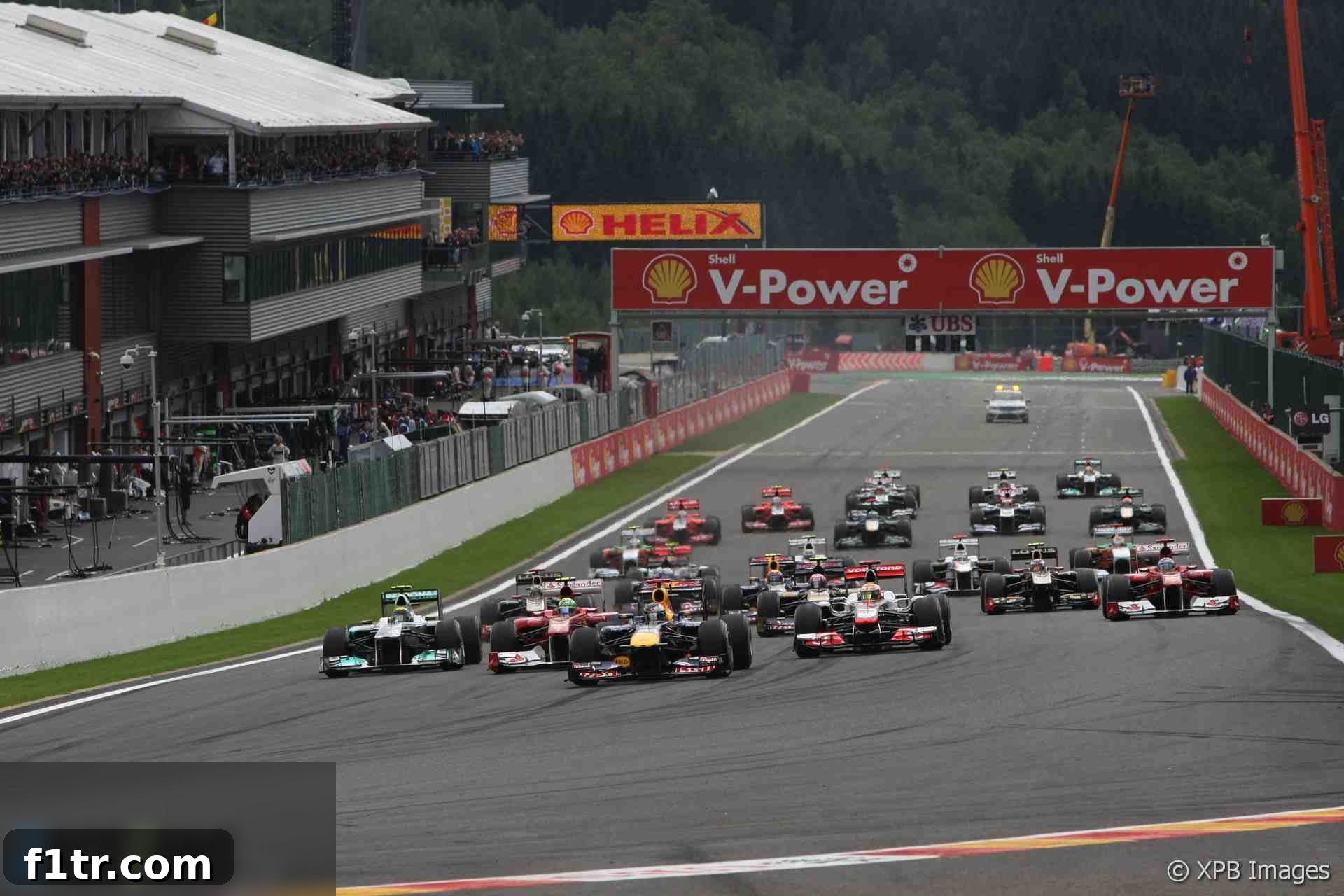
Sebastian Vettel masterfully converted his ninth pole position of the season into a commanding seventh victory at the legendary Spa-Francorchamps circuit, solidifying his grip on the 2011 Formula 1 World Championship. However, the Red Bull driver’s triumph was far from a simple lights-to-flag affair, as the Belgian Grand Prix delivered a captivating spectacle of strategic gambles, dramatic overtakes, and unexpected twists.
Advert | Become a Supporter & go ad-free
Despite a strong start, Vettel found himself dropping down the order after an early and bold pit stop decision. His teammate, Mark Webber, recovered brilliantly from a difficult start to secure a strong second place, ensuring a valuable one-two finish for Red Bull. Meanwhile, Jenson Button demonstrated exceptional race craft, fighting his way up an incredible ten positions from 13th on the grid to claim the final spot on the podium.
A Dramatic Opening: Rosberg Seizes the Initiative
As the five red lights extinguished, Sebastian Vettel maintained his pole position lead into La Source, but it was Nico Rosberg who launched his Mercedes with astonishing vigour. His car, visibly smoking from the rear, rocketed forward, snatching second place before boldly overtaking Vettel for the lead at Les Combes. This immediate challenge set the tone for an unpredictable race.
Behind the leading duo, the two Ferraris also made impressive starts. Felipe Massa swiftly moved past Lewis Hamilton into third, while Fernando Alonso, despite being forced wide at La Source by an incident further back, applied immense pressure on the McLaren driver. Alonso’s determination paid off on the second lap, as he expertly navigated past Hamilton before the Drag Reduction System (DRS) was even activated, signalling the McLaren’s early struggles with straight-line speed.
Once DRS became available, the complexion of the race began to change rapidly. Vettel quickly reeled in Rosberg, utilizing the advantage to reclaim the lead. However, his tenure at the front was brief. Red Bull Racing had been acutely aware of potential tyre blistering issues, which had surfaced during qualifying. In a bold strategic move, Webber was called in after just four laps, followed by Vettel one lap later.
This early double pit stop handed the lead back to Rosberg for a single lap. He soon found himself vulnerable to a series of overtakes from drivers behind him who were yet to stop and could deploy DRS. First, Alonso, who had already dispatched his teammate Massa at Rivage on the previous lap, surged past. Hamilton followed suit, mimicking Alonso’s move past Massa, adding another layer of complexity to the developing race narrative.
Alonso, after leading for one lap, then made his own pit stop, promoting Hamilton to first place. Emerging from the pits, Alonso found himself just ahead of Webber, but the Red Bull driver was not to be denied. In a breathtaking display of bravery and skill, Webber thrust his car alongside Alonso’s into the legendary Eau Rouge, completing a stunning overtake to regain track position.
Hamilton’s High-Speed Collision and Safety Car Drama
Lewis Hamilton’s stint in the lead lasted just two laps before he made his scheduled pit stop. He rejoined the race in eighth position, behind the Sauber of Kamui Kobayashi and Force India’s Adrian Sutil.
Advert | Become a RaceFans supporter andgo ad-free
Hamilton effortlessly passed Sutil, but his subsequent battle with Kobayashi unfolded into one of the most controversial moments of the weekend. Hamilton had overtaken Kobayashi, whose car was already nursing a damaged front wing, and kept his DRS open as they approached the high-speed Les Combes corner. Perhaps expecting Kobayashi to yield, Hamilton moved towards the racing line. However, the tenacious Sauber driver had not dropped back entirely, and the two cars made contact.
The impact was devastating for Hamilton, who was pitched into the barrier at high speed, completely demolishing an advertising hoarding before his McLaren came to a halt. Kobayashi, remarkably, was able to continue, albeit with further damage. The wreckage prompted the immediate deployment of the safety car, which proved to be a pivotal moment in the race.
The safety car period was a significant boon for Sebastian Vettel. Running at a reduced speed, he was able to make his crucial second pit stop without losing substantial track time to his rivals. This strategic advantage allowed him to rejoin the race in a strong position, while Fernando Alonso temporarily inherited the lead.
Mark Webber, who did not need to make another stop at this point, briefly held second place. However, once the safety car pulled in, Vettel wasted no time. With superior pace and a clear run, he swiftly passed his teammate. On the very next lap, Vettel expertly overtook Alonso once more, decisively reclaiming the lead of the 2011 Belgian Grand Prix, a position he would not relinquish.
Button’s Magnificent Drive to the Podium
Jenson Button’s race started with an early setback, sustaining front wing damage that initially hampered his progress from his 13th grid slot. However, as the safety car period concluded and the race resumed, Button began an absolutely sensational charge through the field.
Displaying phenomenal pace and tactical brilliance, Button methodically picked off his competitors. He first dispatched seven-time world champion Michael Schumacher, then Adrian Sutil, followed by Felipe Massa, and finally Nico Rosberg, propelling himself into an impressive fourth place. His relentless progress kept him well within striking distance of the leaders, and when Vettel eventually made his final pit stop, he briefly emerged behind Button.
However, the McLaren, despite Button’s incredible performance, simply could not match the raw pace of the Red Bull. Vettel quickly found a way past Button, solidifying his lead once again. Button then joined Alonso and Webber in making a final pit stop for fresh medium compound tyres. Alonso, struggling for pace on his new set, soon found himself vulnerable. First, a charging Mark Webber swept past him, and then Jenson Button completed his remarkable comeback by overtaking the Ferrari driver to secure third place, capping off an extraordinary performance.
The question of whether Red Bull would issue team orders to hold position between Vettel and Webber became a moot point, as Vettel’s dominant pace meant Webber simply couldn’t close the gap. The top two positions were set.
Schumacher’s Unforgettable Comeback
While Button was busy claiming third place from Alonso, an equally captivating battle was unfolding further down the order. Remarkably, Michael Schumacher, celebrating his 20th anniversary in Formula 1 at his favourite track, had orchestrated an astounding recovery drive from 24th and last on the grid. He not only climbed through the entire field but also managed to overtake his teammate Nico Rosberg to snatch an incredible fifth place, demonstrating flashes of his legendary brilliance.
Adrian Sutil secured a solid seventh for Force India, finishing ahead of Felipe Massa. Massa’s race, which had started so promisingly, was unfortunately compromised by a puncture that necessitated an unscheduled extra pit stop. He began the final lap in ninth but gained a position from Vitaly Petrov, whose Renault slowed dramatically in the closing moments.
Pastor Maldonado delivered a crucial performance for Williams, claiming the final championship point for tenth place – a significant milestone as it marked the first point of his burgeoning Formula 1 career.
Paul di Resta finished 11th, his race hampered by losing a portion of his front wing at the very first corner after contact with Timo Glock. Kamui Kobayashi, despite his earlier incident with Hamilton, managed to finish 12th.
Advert | Become a RaceFans supporter andgo ad-free
Incidents and Penalties: A Race of High Drama
Bruno Senna, making his debut race for Renault, finished 13th. His race was marred by a similar first-lap error to Timo Glock, resulting in a drive-through penalty for braking too late and colliding with Jaime Alguersuari, forcing the Toro Rosso driver into retirement. The other Toro Rosso of Sebastien Buemi also failed to finish, after being hit by Sergio Perez.
Jarno Trulli led the two Lotuses home, with his teammate Heikki Kovalainen having fallen victim to Glock’s aggressive first-corner lunge which also affected Di Resta.
Rubens Barrichello dropped to 16th after making contact with Kamui Kobayashi at the chicane late in the race. Behind him were the Marussia Virgins of Jerome d’Ambrosio and Timo Glock, with Vitantonio Liuzzi being the last classified finisher.
Team mate Daniel Ricciardo was another retiree, despite having run as high as 15th earlier in the race.
Vettel’s Unstoppable March to the Championship
Sebastian Vettel’s latest victory at the 2011 Belgian Grand Prix was more than just another win; it was a profound statement of his dominance. By this point in the season, he had already amassed more points in just 12 races than he did in his entire championship-winning campaign of 2010. While the title was not yet mathematically sealed, Red Bull’s perfect result at Spa-Francorchamps – a circuit that historically had not been their strongest – underscored their formidable package and the relentless consistency of their lead driver. The destiny of the 2011 Formula 1 World Championships now seemed all but inevitable, firmly in the grasp of Sebastian Vettel and Red Bull Racing.
2011 Belgian Grand Prix
- Rate the race result: 2011 Belgian Grand Prix
- In the Paddock Club and in the stands at Spa
- Leimer’s crash and in the pits at McLaren – fans’ videos from Spa
- 2011 Belgian Grand Prix: complete race review
- Vote for your Belgian GP driver of the weekend
- Red Bull: Newey relieved after “scariest race ever”
- McLaren: Button hit by debris in first-lap scare
- Ferrari: Harder tyres still the car’s weakness
- Mercedes: Schumacher climbs 19 places to fifth
- Renault: Petrov buoyed by R31 upgrades
Browse all 2011 Belgian Grand Prix articles