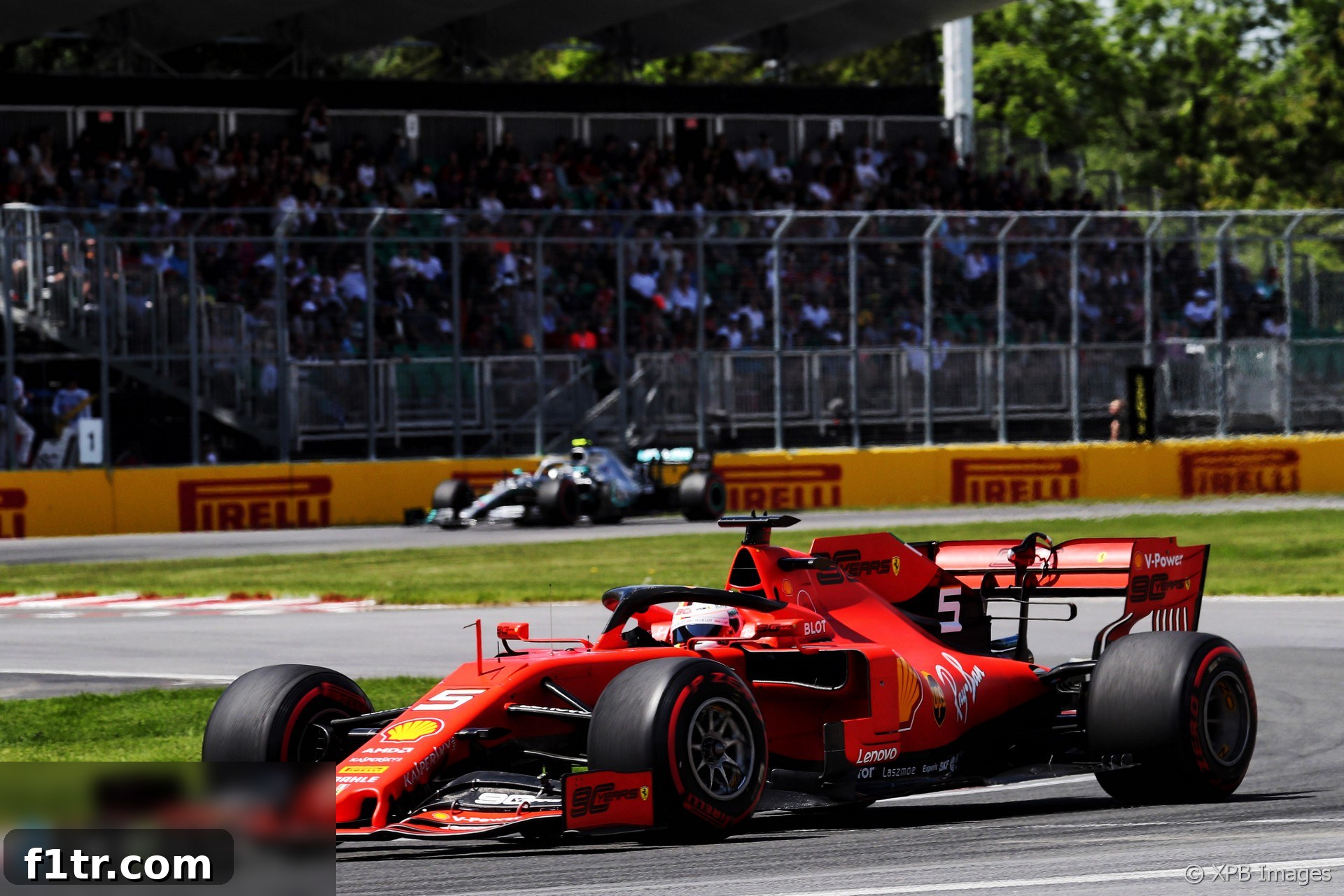
The 2019 Formula 1 Canadian Grand Prix became an indelible chapter in the sport’s rich history, not for a spectacular overtakes or a dominant display, but for a highly contentious penalty that stripped Sebastian Vettel of victory and ignited a fiery debate across the motorsport world. In a decision that echoed through the paddock and amongst fans for weeks, Vettel was handed a five-second time penalty for an incident involving Lewis Hamilton, a ruling that would ultimately cost him the race win and add two significant points to his super license.
The drama unfolded in the latter stages of the race at Montreal’s Circuit Gilles Villeneuve. Vettel, driving for Ferrari, was leading the Grand Prix with Hamilton in close pursuit. On lap 48, as the German driver navigated the treacherous Turn 3 chicane, he ran wide onto the grass. In his desperate attempt to regain control and re-join the track, his car drifted towards the racing line at Turn 4, forcing Hamilton, who was perfectly positioned to challenge, to take immediate and decisive evasive action to avoid a high-speed collision. Hamilton momentarily had to brake and maneuver his Mercedes, allowing Vettel to retain the lead.
While Vettel crossed the finish line first, the jubilation was short-lived. The race stewards quickly intervened, launching an investigation into the incident. After careful review, they determined that Vettel’s re-entry onto the circuit was “unsafe,” a breach of the sporting regulations designed to ensure driver safety and fair competition. The official verdict stated: “Car five [Vettel] left the track at turn three, rejoined the track at turn four in an unsafe manner and forced car 44 off track. Car 44 had to take evasive action to avoid a collision.”
This ruling carried significant consequences. The five-second time penalty, when applied, relegated Vettel to second place, handing the victory to his arch-rival, Lewis Hamilton. Beyond the immediate race result, the stewards also imposed two penalty points on Vettel’s super license. This brought his running total to seven penalty points within a 12-month period. For F1 drivers, accumulating twelve penalty points in a year results in an automatic one-race ban, making every point crucial and adding immense pressure.
The decision instantly polarized opinions. Many argued that Vettel, having gone off track and battling to control his car on slippery grass, had no malicious intent and simply reacted to an incredibly challenging situation. They contended that it was a racing incident, an unfortunate consequence of pushing the limits, and that Hamilton merely had to lift off, not necessarily take extreme evasive action that warranted such a severe penalty. Others, however, firmly supported the stewards’ decision, emphasizing the paramount importance of safety and the rule that drivers must re-join the track safely without impeding or endangering other competitors.
Vettel’s Post-Race Radio Outburst: Raw Emotion and Frustration
The immediate aftermath of the penalty saw an outpouring of raw emotion from Sebastian Vettel. His team radio communications, broadcast globally, captured the depth of his frustration and anger. His words were not just a complaint but a passionate defense of his driving and a stark challenge to the fairness of the stewarding decision. As he returned to the pits, the tension was palpable:
| To Vettel: | OK and mode slow. |
| Vettel: | No, no, no, guys. No, no, no. Not like that. Not like that. No, no, no. Seriously, you have to be an absolutely blind man to think that you can go through the grass and then control your car. I was lucky that I did not hit the wall. Where the hell I am supposed to go? This is a wrong world, tell you, this is not fair. Great crowd, great race, grazie ragazzi. |
| To Vettel: | OK Seb I think you win the race on track, that’s more important. Grazie mille. We appreciate your efforts. Keep your head down. |
| Vettel: | I’m not staying calm. This is not fair. It’s just not fair. |
| To Vettel: | And cool the brakes, please. |
| Vettel: | I am cooling the brakes. |
| Vettel: | I’m angry. And I think you know why. And I have a right to be angry. I don’t care what people say. |
| To Vettel: | And into the pit lane. |
| Vettel: | Copy that. |
Vettel’s passionate outburst encapsulated the sentiment of many drivers who often feel disconnected from the stewarding decisions made by officials who aren’t experiencing the race from inside the cockpit at speeds exceeding 200 mph. His argument hinged on the near impossibility of controlling a car on wet grass and the instinctual need to steer towards the safest available tarmac. He felt cornered, both literally on the track and figuratively by the regulations. The mention of “lucky that I did not hit the wall” highlighted the genuine danger he perceived in his situation, suggesting his actions were more about self-preservation than deliberate obstruction.
This radio exchange wasn’t just a fleeting moment of frustration; it became emblematic of a broader discussion within Formula 1 regarding the consistency and interpretation of stewarding decisions. For Vettel, who had already faced a string of challenging races and perceived injustices throughout his career, this penalty in Canada felt like a significant blow, not just to his race result but to his sense of fairness within the sport.
The Aftermath: Fan Reactions, Media Scrutiny, and Sporting Implications
The controversy surrounding the Canadian Grand Prix penalty quickly escalated beyond the immediate post-race discussions. Social media platforms were awash with heated debates, with fans dissecting every angle of the incident. Many felt that such “sporting” penalties diluted the excitement of racing and that drivers should be allowed to race harder without fear of disproportionate punishment for borderline incidents. Others maintained that rules are rules, and safety must always be paramount, especially when multi-million dollar machinery is involved at such high speeds.
Media outlets globally provided extensive coverage, analyzing the incident from technical, legal, and emotional standpoints. Pundits and former drivers weighed in, often divided on whether the penalty was justified. Some compared it to previous controversial decisions, lamenting a perceived lack of consistency from the stewards over the years. The incident undoubtedly added an extra layer of tension to the already fierce championship battle between Mercedes and Ferrari, and specifically between Hamilton and Vettel, two of the sport’s most decorated drivers.
For Ferrari, the loss of a hard-fought victory was a bitter pill to swallow, particularly in a season where they were struggling to match Mercedes’ dominant pace. A win for Vettel would have provided a much-needed morale boost and crucial championship points. The penalty, however, further widened the gap, making their pursuit of the Constructors’ and Drivers’ championships even more arduous.
The incident also rekindled discussions about the role of technology in stewarding. While sophisticated telemetry and multiple camera angles provide unprecedented insight, the human element of interpretation remains, leading to subjective decisions that can dramatically alter race outcomes. This particular penalty served as a poignant reminder that despite the objective data available, the nuances of racing judgment are complex and often contentious.
A Lasting Legacy of Controversy
The 2019 Canadian Grand Prix incident and Sebastian Vettel’s subsequent penalty became a touchstone moment in the 2019 F1 season, symbolizing the delicate balance between aggressive racing, driver safety, and the rules that govern the pinnacle of motorsport. It highlighted the intense pressures on drivers, the unforgiving nature of the track, and the profound impact of every stewarding decision.
While the immediate sting of losing the victory eventually faded, the memory of Vettel’s raw emotion and the divided opinions surrounding the penalty persist. It remains a prime example of how a single decision can overshadow an entire race, provoke widespread debate, and contribute to the ongoing narrative of Formula 1’s quest for fair, thrilling, and safe competition. The incident solidified its place in F1 lore, not just as a penalty, but as a moment that encapsulated the passion, frustration, and inherent controversy that often define the sport.
2019 F1 Season Related Articles
- Crying in the Melbourne car park at 2019 grand prix was my career low – Ocon
- McLaren Racing reports reduced £71 million loss in 2019
- Kvyat: Hockenheim podium last year was “my biggest achievement” so far
- How the FIA’s new encrypted fuel flow meter targets Ferrari’s suspected ‘aliasing’ trick
- “He smashed my office door”: 23 must-see moments from ‘Drive to Survive’ season two
Browse all 2019 F1 season articles