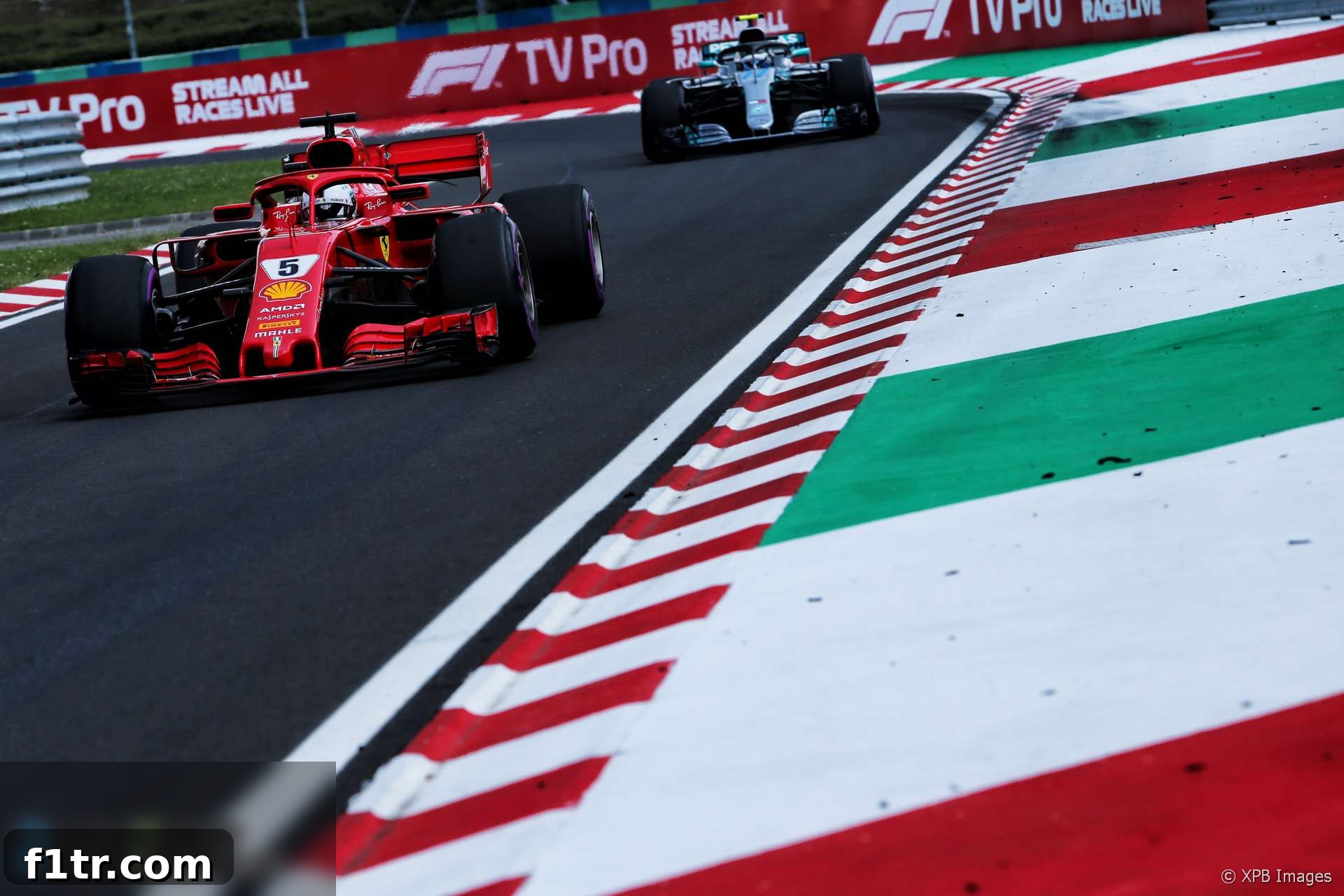
Sebastian Vettel Reflects on Hungarian GP Contact with Bottas: A Lucky Escape and Renewed Optimism for Ferrari
Formula 1 driver Sebastian Vettel has openly described himself as “lucky” to have evaded a potential catastrophe following contact with Mercedes’ Valtteri Bottas during the closing stages of the Hungarian Grand Prix. The incident, which occurred as the two titans battled fiercely for second place, saw Bottas’s Mercedes making contact with the rear of Vettel’s Ferrari, sending a jolt through both camps and raising immediate concerns for the championship-contending German.
Despite the high-speed impact and the visible damage to Bottas’s front wing, Vettel’s Ferrari remarkably escaped with minimal harm. This stroke of fortune, as Vettel himself acknowledged post-race, prevented what could have been a far more severe outcome, potentially including a race-ending puncture or significant aerodynamic damage that would have cost him vital championship points.
The Tense Battle for Second: Understanding the Incident
The Hungarian Grand Prix is renowned for its tight, twisty layout, often compared to a street circuit, where overtaking is notoriously difficult. This makes any on-track skirmish particularly perilous, especially when two drivers are pushing the limits for a podium finish. As the race neared its dramatic conclusion, the intensity escalated, with Vettel and Bottas locked in a wheel-to-wheel struggle that encapsulated the fierce rivalry of the 2018 Formula 1 season.
Vettel recounted the moments leading up to the contact, shedding light on the challenging conditions inherent in Formula 1 racing. “When you’re so close behind another car, you practically have no grip at all,” Vettel explained, emphasizing the aerodynamic complexities that make overtakes a high-risk maneuver. “So I’m not surprised he locked up, but we were quite lucky that he didn’t take us out. I could’ve had a puncture as well, and it could’ve been a disaster, but in that case, it was obviously good to get the move and get ahead.”
The lack of grip experienced by a trailing car is a fundamental aspect of modern Formula 1 aerodynamics, where the disturbed air from the car ahead drastically reduces downforce. This phenomenon makes braking zones particularly challenging, increasing the likelihood of locking up tyres. Bottas, in hot pursuit and aiming for an overtake or at least to defend his position, clearly succumbed to these pressures, misjudging his braking point or experiencing reduced grip that led to his front tyres locking and subsequent contact. For Vettel, who had successfully completed his pass, the contact was an unwanted surprise, but one that his car was robust enough to withstand, albeit narrowly.
Strategic Gambit and the Art of Tyre Management
The incident was just one chapter in a race fraught with strategic intricacies and on-track drama for Vettel. Earlier in the Grand Prix, Vettel had found himself in a commanding position, inheriting the lead from championship rival Lewis Hamilton as part of an extended opening stint on soft compound tyres. Ferrari’s strategy appeared to be paying dividends, setting him up for a strong performance.
However, an unforeseen pit stop issue disrupted Ferrari’s meticulously planned race. A slow tyre change saw Vettel lose precious seconds and, crucially, drop behind Bottas’s Mercedes. This setback forced Vettel into a challenging chase, transforming his race from one of managing a lead to one of aggressively pursuing an overtake on track.
“Obviously, we should’ve been ahead, so there was something not entirely correct,” Vettel conceded, acknowledging the pit stop error that complicated his afternoon. “But once you’re behind, it doesn’t matter, and I had to find a way past on the track.” This statement encapsulates the mindset of a top-tier racing driver: swiftly moving past setbacks and focusing on the immediate challenge at hand.
Vettel’s subsequent strategy against Bottas was a masterclass in patience and tyre management. Knowing the characteristics of the soft compound tyres – specifically their tendency to degrade towards the end of a stint, especially the rear tyres – Vettel opted for a cautious approach rather than an immediate, risky attack. “Knowing from the first stint with these soft tyres that they will drop off at the end and the rears will be in trouble, I wasn’t rushing with 30 laps to go to pass him,” he explained. “I was sitting back, waiting for the last ten laps to try and close on him, knowing I would get more and more in range to try and do something, and that’s what we did.”
This calculated patience paid off. By conserving his tyres, particularly his rear tyres which are crucial for traction, Vettel ensured he had a performance advantage when it mattered most. In the final laps, as Bottas’s tyres began to fade, Vettel pounced. “At Turn 1, he defended, and I got a good exit and had DRS and obviously more traction with my rears that I’d tried to take care of earlier to be in that position,” Vettel elaborated on the decisive moment. “Then I think I was ahead, and I was quite surprised when I got the hit from behind. But I think he had no grip being so close to me at that point.” This detailed account highlights the nuanced interplay of strategy, car performance, driver skill, and the fine margins that define success in Formula 1.
Championship Aspirations and Ferrari’s Fighting Spirit
Despite the dramatic conclusion to the Hungarian Grand Prix and the loss of further ground to Lewis Hamilton in the intense championship battle, Sebastian Vettel maintains an unwavering sense of optimism regarding Ferrari’s prospects for the remainder of the season. His outlook is characterized by resilience and a belief in the team’s ability to challenge Mercedes for the title.
“Obviously, last week was a disaster if you look at the result and what it could have been, but now it’s like that, I can’t rewind the clock, and I’m happy to look forward,” Vettel stated, referring to the German Grand Prix where a late-race crash while leading cost him a crucial victory. This forward-looking approach is essential for any athlete competing at the highest level, allowing them to learn from past setbacks without being consumed by them.
Vettel expressed profound confidence in the Scuderia Ferrari’s machinery. “I think we have a car we can fight with,” he affirmed, underlining the potential within the SF71H chassis. He acknowledged the ebb and flow of performance between the two top teams, recalling specific races: “I think in France, they were faster than us. And then in two or three races, we’re able to get back to being matched and probably just a little ahead in qualifying and generally able to fight in qualifying.” This indicates a clear understanding of where Ferrari stands in relation to Mercedes and the areas where they need to push harder.
The unpredictable element of weather, often referred to light-heartedly as divine intervention in racing circles, also featured in Vettel’s reflections. “It seems that the rain god has a Mercedes in his garage, but I’m sure we can get him an upgrade for the second half of the season,” he quipped, a testament to his good humor even amid serious competition. While a lighthearted remark, it subtly highlights how external factors, such as changing weather conditions, can significantly impact race outcomes and sometimes seem to favor one team over another.
Ultimately, Vettel’s message is one of determination and belief in collective effort. “So I’m quite confident if we have the speed and can improve our car still from where we are that we can still be in the mix and in the fight,” he declared. “I’m happy with how the season’s went so far, and I believe there’s more to come.” This unwavering spirit is critical for Ferrari as they head into the crucial second half of the Formula 1 season, where every point, every strategic decision, and every on-track battle will play a pivotal role in determining the ultimate champion.
The Hungarian Grand Prix, with its close shave and strategic complexity, served as another thrilling reminder of the high stakes and relentless competition at the pinnacle of motorsport. For Sebastian Vettel, it was a day of a lucky escape, a hard-fought recovery, and a reaffirmation of his and Ferrari’s enduring championship aspirations.
2018 F1 season
- F1 feared “death knell” for Drive to Survive after Ferrari and Mercedes snub
- McLaren staff told us we were “totally crazy” to take Honda engines in 2018 – Tost
- ‘It doesn’t matter if we start last’: How Red Bull’s junior team aided Honda’s leap forward
- Honda’s jet division helped F1 engineers solve power unit problem
- McLaren Racing losses rise after Honda split
Browse all 2018 F1 season articles