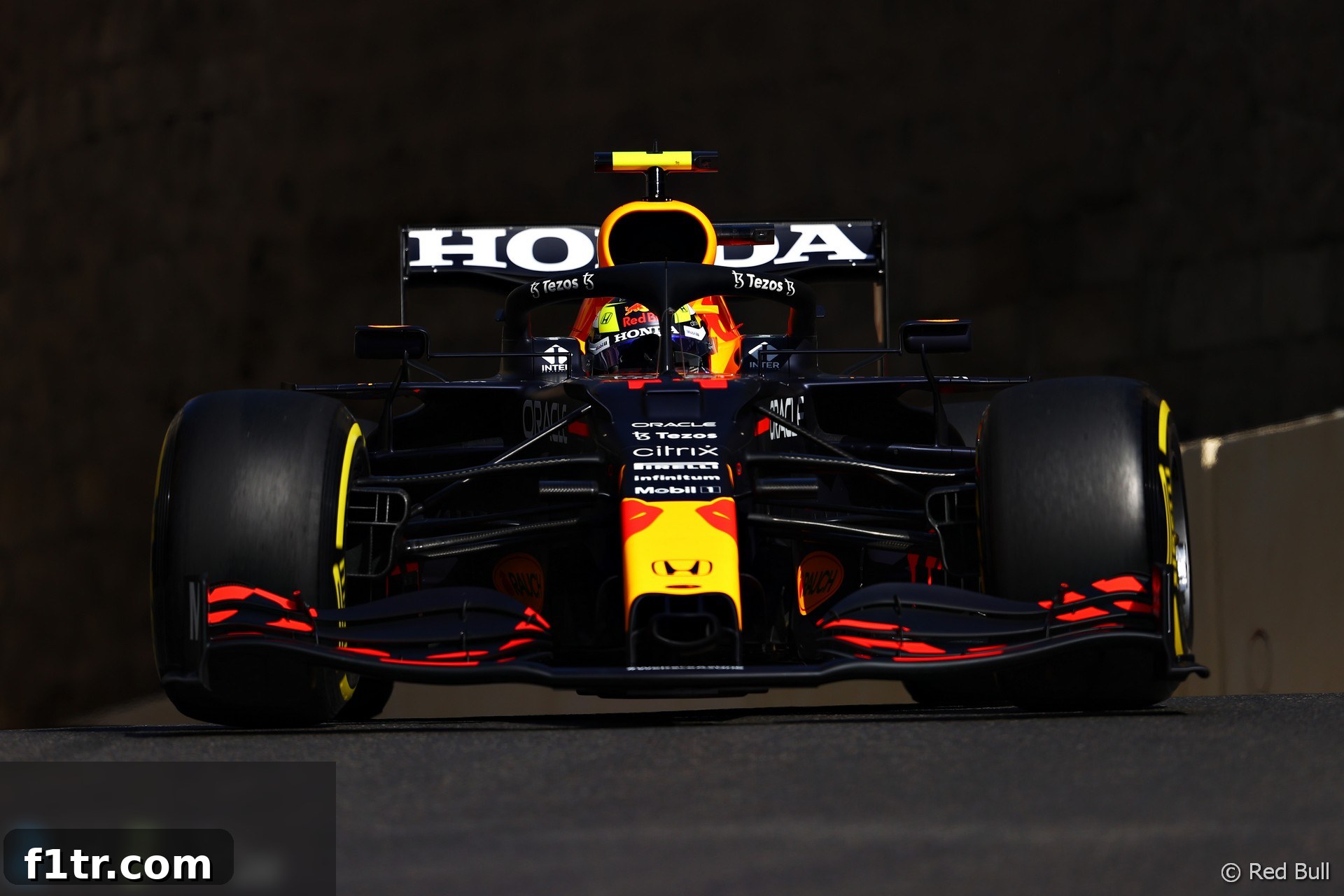
Red Bull and Ferrari have again shown stronger pace than Mercedes at the Azerbaijan Grand Prix so far, echoing their advantage in Monaco. The question now is whether that form will translate into qualifying.
Red Bull’s speed is not surprising. Ferrari’s competitiveness and McLaren’s occasional bursts of pace were also visible in Monaco, and though Baku’s layout differs in many areas, the castle sector bears similarities to the tight, technical sections of Monaco.
What is more notable is Mercedes’ relative lack of pace. After second practice the world champions were effectively the seventh-fastest team. Their drivers ended the day 11th and 16th on the timesheets, leaving them looking more concerned with reaching Q3 than fighting for pole.
On and off the pace
Two clear trends emerged from single-lap running in Baku: Red Bull currently set the benchmark, and Mercedes are a long way off it.
Red Bull’s advantage doesn’t appear to be a fluke from a perfect tow; it looks like genuine single-lap speed. Max Verstappen lost time to traffic in first practice, and Sergio Perez didn’t complete a typical representative lap for much of the session, which the team said was due to his programme. Despite that, Verstappen topped the opening session and Perez led second practice in a Red Bull one-two, with the Ferraris close behind. In past seasons Mercedes might have hidden their true pace on a Friday, but it’s unlikely they would conceal a full second of performance unless something unusual was happening.
If any Mercedes-powered team was disguising form, McLaren might be the most likely. Their cars ran long stints in the afternoon without appearing to prioritise qualifying simulations. AlphaTauri also looked stronger on a quicker circuit; Pierre Gasly has often featured in the top five on Fridays this year, and team-mate Yuki Tsunoda’s tighter, team-managed training appeared to narrow the gap, with Tsunoda ending second practice ahead of Lewis Hamilton.
The Mercedes drivers struggled to explain their pace shortfall after the session. Valtteri Bottas cited lack of grip, while Hamilton sounded puzzled after his qualifying-simulation run in second practice.
| Bonnington | P8, one second to Perez now who is P1. Valtteri has yet to set time on the soft tyre. |
| Bonnington | To Perez, two-tenths sector one. Keep an eye out for Mazepin, behind. Two tenths sector one, four [tenths] sector two. Then Giovinazzi will be the car behind, two-and-a-half seconds. |
| Hamilton | Have we got more laps or is that it? |
| Bonnington | If you take one more lap, it will be strat 14. |
| Hamilton | Do whatever you need to do, I’m not going to go faster. |
| Bonnington | Okay, copy, it’s up to you if you want to use it for learning, but otherwise we’re ready to box and get on with the long run. |
| Hamilton | I’ll use it if I’ve got it. |
| Hamilton | I don’t really know where the all time is, to be honest. |
Tyre wars
Pirelli brought the same tyre compounds to Baku that were used in Monaco. Mercedes struggled to get those tyres into their optimal window in the principality, and similar issues have resurfaced this weekend. Unlike Monaco, where Mercedes preferred warmer conditions, Baku has seen much higher track temperatures—around 50°C during second practice versus the 20s at Monaco—adding a fresh variable to tyre behaviour.
The Mercedes car appears to favour harder compounds this year, and Baku’s conditions seem to reinforce that trait. Conversely, Ferrari’s strong showing at the end of practice came with caveats: radio messages revealed both Ferrari drivers were dealing with overheating, which forced them to consider opening bodywork to improve cooling and potentially sacrificed aerodynamic efficiency.
Charles Leclerc damaged his front wing early in second practice after a heavy impact with the turn 15 barrier, then reported significant tyre graining later in the session. On six-lap-old medium tyres he warned the team he was losing the tyres quickly and asked to pit, worried about losing control. Ferrari’s decision to run low downforce for better top-speed on Baku’s long straights may have traded some qualifying pace for tyre longevity, which could be a disadvantage on Sunday where overtaking opportunities are relatively plentiful.
Towing power
Baku’s long, often windy straights make slipstreaming valuable: following another car closely reduces aerodynamic drag and can deliver a large speed boost. Daniel Ricciardo estimated a successful tow can be worth up to half a second—an enormous margin that can split the midfield.
Ricciardo had a solid opening day, leading team-mate Lando Norris in first practice and remaining close in the second. McLaren didn’t appear to prioritise outright qualifying simulations in the afternoon. Red Bull’s intra-team priority for who gets track position during qualifying could be decisive: Verstappen explained their alternating rule for who leaves the pits first across weekends, a practice designed to balance tow opportunities and track position.
Verstappen admitted it’s difficult to plan a perfect tow at Baku and that luck often plays a role. The best approach is to do the most complete lap you can and hope circumstances align. A tow’s effect was clear in practice when Antonio Giovinazzi set the fastest third sector overall despite running a relatively modest car—an example of how a well-timed slipstream can vault a driver ahead of faster competitors in other sectors.
While only a few lower-ranked teams made the most of tow during practice, qualifying could produce surprises if a perfectly timed slipstream in Q1 or Q2 lifts an unexpected car into Q3. Officials have warned drivers against deliberately slowing in the final sector to orchestrate tow gaps, a tactic that has caused controversy in past seasons.
Quotes: Dieter Rencken
Combined practice times
| Pos | Driver | Car | FP1 | FP2 | Total laps |
|---|---|---|---|---|---|
| 1 | Sergio Perez | Red Bull-Honda | 1’43.630 | 1’42.115 | 38 |
| 2 | Max Verstappen | Red Bull-Honda | 1’43.184 | 1’42.216 | 41 |
| 3 | Carlos Sainz Jnr | Ferrari | 1’43.521 | 1’42.243 | 44 |
| 4 | Charles Leclerc | Ferrari | 1’43.227 | 1’42.436 | 42 |
| 5 | Pierre Gasly | AlphaTauri-Honda | 1’43.757 | 1’42.534 | 49 |
| 6 | Fernando Alonso | Alpine-Renault | 1’45.084 | 1’42.693 | 48 |
| 7 | Antonio Giovinazzi | Alfa Romeo-Ferrari | 1’45.092 | 1’42.941 | 45 |
| 8 | Lando Norris | McLaren-Mercedes | 1’43.996 | 1’43.018 | 44 |
| 9 | Esteban Ocon | Alpine-Renault | 1’45.446 | 1’43.020 | 46 |
| 10 | Yuki Tsunoda | AlphaTauri-Honda | 1’45.384 | 1’43.130 | 50 |
| 11 | Lewis Hamilton | Mercedes | 1’43.893 | 1’43.156 | 43 |
| 12 | Kimi Raikkonen | Alfa Romeo-Ferrari | 1’44.943 | 1’43.220 | 41 |
| 13 | Daniel Ricciardo | McLaren-Mercedes | 1’43.732 | 1’43.298 | 47 |
| 14 | Lance Stroll | Aston Martin-Mercedes | 1’45.234 | 1’43.812 | 43 |
| 15 | Sebastian Vettel | Aston Martin-Mercedes | 1’45.415 | 1’43.881 | 45 |
| 16 | Valtteri Bottas | Mercedes | 1’44.891 | 1’44.184 | 42 |
| 17 | George Russell | Williams-Mercedes | 1’45.452 | 1’44.557 | 47 |
| 18 | Nikita Mazepin | Haas-Ferrari | 1’46.945 | 1’45.563 | 41 |
| 19 | Nicholas Latifi | Williams-Mercedes | 1’45.774 | 1’46.983 | 26 |
| 20 | Mick Schumacher | Haas-Ferrari | 1’46.899 | 1’46.095 | 31 |
Looking ahead
Friday’s running underlined Red Bull and Ferrari’s strong one-lap pace and highlighted Mercedes’ difficulties with grip and tyre performance. Baku’s long straights and variable wind make tow strategy important, but also unpredictable—drivers and teams must balance the risk of trying to engineer a slipstream with the need to produce a clean, fast lap.
Qualifying will test whether Red Bull can convert their Friday advantage into pole, whether Ferrari can manage tyre life while keeping top-end speed, and whether Mercedes can unlock more single-lap performance. With track temperature, tyre behaviour and the fickle benefit of a tow all playing a role, Saturday promises an intriguing battle for grid position.
Advert | Become a Supporter & go ad-free