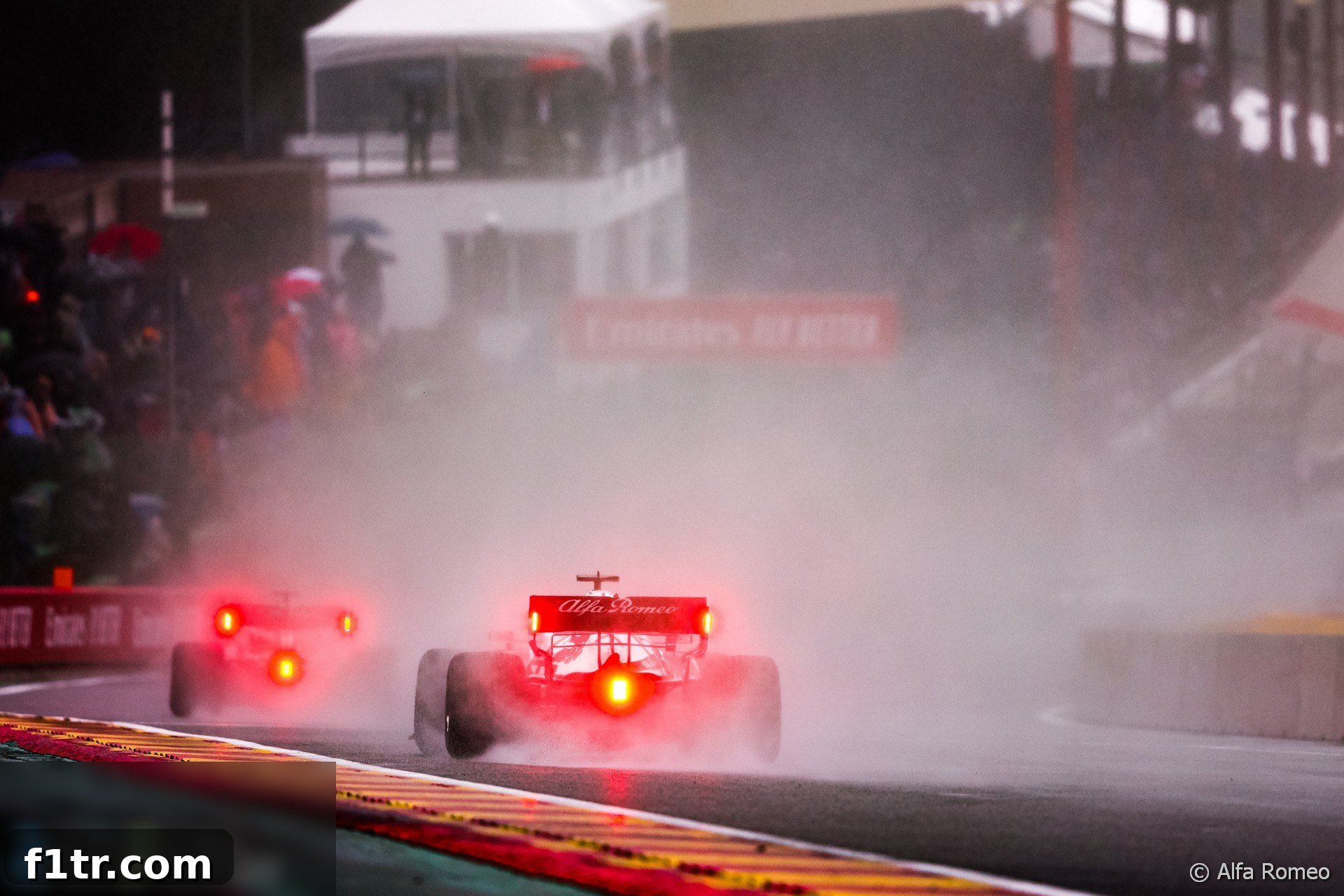
The legendary circuit of Spa-Francorchamps, renowned for its challenging layout and unpredictable Ardennes weather, once again cast a shadow of concern over the Formula 1 paddock ahead of the Belgian Grand Prix weekend. As forecasts predicted pervasive wet conditions, drivers voiced their collective trust in the FIA and Race Director Niels Wittich to make the critical safety calls, determining whether racing conditions would be too perilous. This crucial discussion unfolded against the backdrop of a recent tragic accident at Spa involving Formula Regional racer Dilano van ‘t Hoff, a stark reminder of the extreme dangers posed by limited visibility in heavy spray.
The racing world was shaken by the incident earlier this month, where 18-year-old Dilano van ‘t Hoff lost his life. The Dutchman’s car spun at the treacherous Kemmel kink following a late Safety Car restart, an area where the circuit’s high-speed nature and elevation changes combine to create unique hazards. Crucially, the subsequent impact with an unsighted rival was attributed to the dense wall of spray kicked up by over 20 cars, rendering visibility virtually zero. This tragic event has significantly heightened scrutiny on safety protocols for wet weather racing, particularly at a circuit as demanding as Spa-Francorchamps. The memories of the 2021 Belgian Grand Prix, which was infamously abandoned after only three laps behind the Safety Car due to torrential rain and insurmountable safety concerns, further underscore the precedent and ongoing challenge.
Drivers United: The Critical Issue of Visibility
Ahead of a demanding weekend that included a Saturday sprint race preceding Sunday’s main grand prix, the topic of visibility dominated driver discussions. Ferrari driver Charles Leclerc articulated the profound challenge faced by drivers in wet conditions. “It’s really difficult to put into words what we are seeing, apart from saying that we are seeing nothing,” Leclerc stated emphatically. He stressed that drivers are not exaggerating the danger: “But we are not exaggerating when we say we don’t see anything. We really don’t see anything when it’s raining.”
Leclerc highlighted this as a pervasive issue across motorsport, not just Formula 1. “This is a really big problem for Formula 1, for motorsport in general. Any single seaters now, we have quite a bit of downforce, there’s quite a lot of spray and then this causes quite a lot of incidents just because we cannot react to what there is in front.” He acknowledged the complexity of finding a solution but expressed confidence in the sport’s governing body. “Easy to say that, much more difficult to find a solution for that. But I know that the FIA is on it and is obviously trying to do the best on that.” His comments underscore the psychological burden on drivers, who are expected to perform at the limits of human capability while effectively blind to their immediate surroundings.
Balancing Safety with the Spectacle of Racing
Leclerc’s teammate, Carlos Sainz Jnr, when queried by RaceFans about the likelihood of racing should conditions match the wet forecasts, offered a nuanced perspective. While he expressed a willingness to race, he firmly placed safety as the ultimate arbiter. “If I can see in the car, then of course I will recommend the race director and make sure we try and run,” Sainz affirmed. This statement encapsulates the inherent desire of every competitive driver to race, to push the limits, and to entertain the fans.
However, Sainz quickly tempered this enthusiasm with a grave warning. “At the same time, if you cannot see, it’s leaving everything down to luck and fate and I think we’ve learned our lesson recently and I think we need to not fall too much into into the pressure of having to run just because we need to put on a show and just because it’s the right thing for the sport if the conditions are not safe enough.” His poignant reference to “learned our lesson recently” is a direct and somber acknowledgment of the recent tragedies that have underscored the fragility of life in motorsport.
Sainz elaborated on the drivers’ unique position. “I will go out there whatever the conditions are. But obviously as drivers we always need to give our guidance to the FIA if we can actually see in case of an accident or anything in front of us, how many metres ahead we can see.” He emphasized the collective responsibility. “Like all 20 drivers we are asked for our opinion and I will give my opinion all the time. My number one priority will always be safety, but also as soon as everything is ready, I would be the first one screaming to run at this beautiful track because I love driving it in the dry but I also love driving it in the wet.” His comments perfectly illustrate the tightrope walk between passion for racing and the unyielding imperative of safety, especially at a track he clearly adores for its raw challenge, even in adverse conditions.
Driver Input: A Cornerstone of Safety Decisions
Alpine driver Pierre Gasly, who organized a running event at Spa in tribute to his late friend Anthoine Hubert – tragically killed in an F2 race crash at Raidillon – powerfully advocated for the FIA to heed driver input. “I think they’ve got to rely on the feel of the driver and I think in these conditions they made the right decision some years ago when unfortunately there wasn’t a race start,” Gasly explained, referring to the 2021 event.
Gasly underlined that the drivers’ reluctance to race in extreme conditions is not born of a lack of desire, but rather a profound understanding of the risks. “It’s not because we don’t want to race, it’s just because there could be a tragic incident, like that occurred some weeks ago, and no one wants that. So I think they’ve got to rely on us.” He stressed the FIA’s extensive experience with rainy conditions, not just at Spa. “Obviously, they know from past experience, not only in Spa, but just in rainy conditions, that visibility is the most dangerous parameter. I think they know where the line is and I think all those drivers will guide them in making the right choices.” Gasly’s perspective highlights the invaluable, firsthand knowledge that only those behind the wheel can provide, making their feedback indispensable to the race director’s ultimate decision-making process.
Beyond Spa: A Universal Challenge for Modern F1
Reigning world champion Max Verstappen offered a broader perspective, asserting that concerns over visibility in wet conditions are not exclusive to the Spa circuit, but rather a systemic issue for modern Formula 1 cars. “Honestly, I don’t think it’s really track-related,” he said in response to a question from RaceFans. While acknowledging specific circuit dangers – “You have dangerous corners, yes, and in the wet, there is always more risk” – he reiterated his faith in the decision-makers. “But I think everyone is competent enough to make the right calls. If you can drive, you can drive. And if it’s too wet, it’s too wet.”
Verstappen then pinpointed a significant factor contributing to the exacerbated spray: the evolution of F1 car design, particularly the wider tires introduced in 2017. Front wheel widths grew from 245mm to 305mm, and rears increased from 325mm to 405mm six years ago. “I think also that we went to the bigger tyres, that makes it worse because there’s more [water] displacement,” said the world champion. “Just the shape of the car, it’s so big, you have more spray.” This technical insight from Verstappen underscores how design changes, aimed at improving grip and spectacle in dry conditions, can inadvertently worsen safety challenges in the wet.
He vividly recalled a harrowing experience from his past, emphasizing the long-standing nature of the problem. “It was worse than it was in 2016, but in 2016 it was also bad. I remember the race in Brazil where I was in the back after the pit stop, I didn’t even see Fernando [Alonso] spinning off the track, the whole straight I kept it flat but I didn’t see anything. But of course, by knowing where you’re going from all the other laps, you just keep it pinned.” His recollection paints a terrifying picture of professional drivers relying on instinct and memory over sight at speeds exceeding 200 mph. “But if there would have been someone standing, you would have just completely driven through it. So it’s bad, but it has been bad for a very long time, so I don’t think there is a lot at the moment that we can do about it.”
Verstappen concluded by expressing his belief in the race director’s judgment, forged through experience and collaboration with drivers. “I think that we have spent quite a bit of time in briefings and I think also from his side now he’s done quite a few races now. I think you also listen to the Safety Car a bit, you think you will know if it’s safe or not.” However, he also offered a pragmatic, if stark, reality check regarding wet weather racing itself: “But the visibility is going to be bad anyway, otherwise we cannot have any rain races anymore.” This highlights the inherent trade-off in motorsport: the thrill of racing in challenging conditions versus the absolute limits of safety.
The FIA’s Mandate and the Future of Wet Weather Racing
The collective sentiments of the F1 drivers – from Leclerc’s dire warnings about zero visibility, to Sainz’s plea for safety over spectacle, Gasly’s emphasis on driver consultation, and Verstappen’s technical insights and historical perspective – converge on a singular truth: wet weather racing at the pinnacle of motorsport is an exceptionally complex challenge. The FIA, led by the Race Director, bears the immense responsibility of navigating these treacherous waters. Their decisions must integrate detailed weather forecasts, real-time track observations, technical data, and crucially, the direct, unvarnished feedback from the drivers themselves.
While the desire for thrilling, challenging races remains, the recent tragedies serve as an enduring reminder that safety must always be paramount. The ongoing dialogue between drivers and the FIA is vital to ensure that Formula 1 continues to evolve, seeking technological advancements and procedural improvements that can mitigate risks without sterilizing the sport. The expectation for future Belgian Grand Prix events, and indeed all wet races, is a delicate balance where the roar of engines only commences when every measure has been taken to safeguard those behind the wheel.
2023 Belgian Grand Prix Related Insights
- Haas drivers fear losing battle for seventh after “grim weekend” in Spa
- Mercedes optimistic they’re “in the right place for winter” with development plan
- Ferrari not convinced by call to equalise engines: ‘Renault is not so far away’
- Ferrari staying “calm” amid swings in performance from race to race
- Pirelli proposes new “super-intermediate” to address wet weather tyre problems
Browse all 2023 Belgian Grand Prix articles