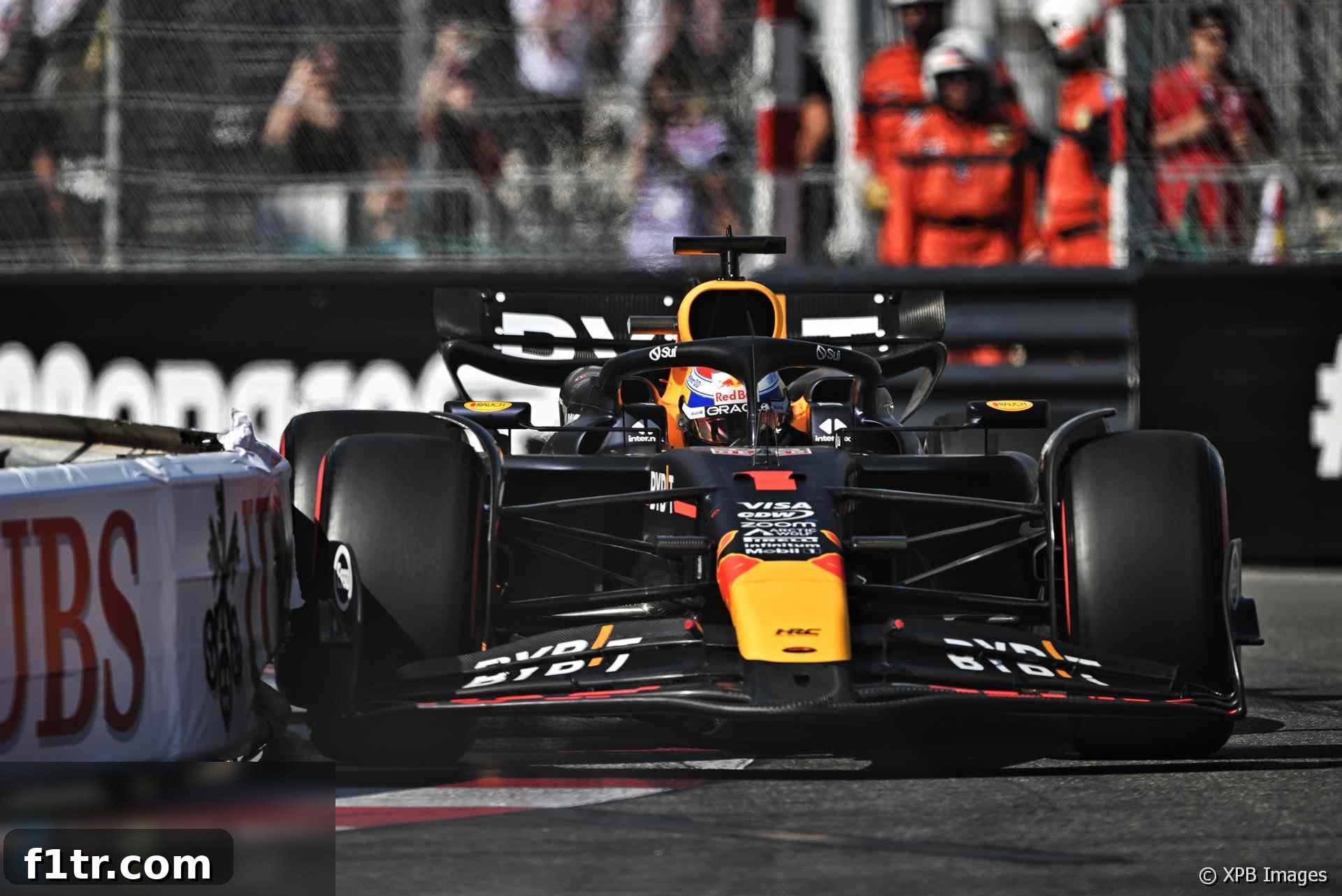
Max Verstappen’s Monaco Setback: Red Bull’s Kerb Weakness Sparks Wider Season Concerns
The glitz and glamour of the Monaco Grand Prix often bring unexpected twists, and for reigning world champion Max Verstappen and Red Bull Racing, the 2024 edition delivered a stark reality check. For the first time this season, Verstappen failed to secure pole position, a testament to the significant performance hurdles the team encountered on the iconic street circuit. Starting from a relatively distant sixth place, Verstappen articulated a critical flaw in his Red Bull RB20: its severe weakness in riding the kerbs, a limitation he believes could plague the team at other challenging tracks later in the Formula 1 season.
Verstappen’s Disappointment and the Kerb Conundrum
Throughout much of the qualifying session, Verstappen was locked in a fierce battle, often appearing to be on the cusp of challenging eventual pole-winner Charles Leclerc. However, a crucial error at the first corner during his final Q3 run proved costly, leaving him almost three-tenths of a second adrift of the Ferrari driver. While a sixth-place start would be acceptable for many, for a driver accustomed to absolute dominance, it represented a significant setback.
“I’m not disappointed with the position, I’m just disappointed with our performance,” Verstappen candidly shared with Sky Sports after qualifying. He emphasized that this struggle was not entirely unforeseen. “It’s not something that came as a surprise to me because I knew, of course, our limitations already coming into this weekend.” This pre-existing knowledge highlights a fundamental design or setup issue that Red Bull had identified but seemingly couldn’t fully mitigate before the crucial qualifying session.
The core of the problem, according to Verstappen, lies in the RB20’s inability to effectively handle the kerbs, particularly in Monaco’s numerous low-speed corners where drivers must maximize track width. “It’s been bad,” he stated, elaborating on the visceral experience from within the cockpit. “I can’t take any kerbs. In the middle sector I’m driving around the kerbs and it honestly feels like I’m driving a go-kart with no suspension and no damping. So it’s very difficult for us.” This vivid description paints a picture of a car that is jarringly stiff and unforgiving when subjected to the bumps and ridges of the kerbs, preventing Verstappen from extracting maximum performance and vital milliseconds.
While the car showed glimpses of its usual pace in high-speed sections – areas less reliant on aggressive kerb riding – these gains were ultimately nullified by the deficiencies elsewhere. “I felt really comfortable in the high-speed corners, at least that was enjoyable. But in the lows we were just losing too much,” he explained. The intricate, low-speed nature of Monaco, characterized by its numerous turns and reliance on precision and kerb usage, brutally exposed this Achilles’ heel of the Red Bull package. “You can gain in a few places but we lose out way too much in all the low-speed where it’s bumpy and the car is just jumping around,” he added, underscoring the consistent drain on lap time.
Implications for Upcoming Races: A Looming Challenge
Verstappen’s concerns extend far beyond the narrow confines of Monte Carlo. He fears that this inherent problem with kerb compliance will compromise the team’s performance at several upcoming circuits on the Formula 1 calendar. “There are a few more tracks coming up where it’s bumpy and you need to ride kerbs,” he warned, highlighting a potential recurring theme for Red Bull. Circuits like Singapore, Baku, or even some sections of European tracks are known for their bumpy surfaces and aggressive kerb requirements, which could present similar challenges for the RB20. “So it’s definitely a limitation for us.”
For the Monaco race itself, the outlook from P6 was pragmatic, if not optimistic. “Looking at tomorrow, if it’s just a straightforward race then there’s not that much that you can do. The cars are so wide, so big that you can’t pass. But we’ll just try to stick with them,” Verstappen acknowledged. Monaco is notoriously difficult for overtaking, meaning qualifying position is paramount. Without a significant pace advantage over the cars ahead, a recovery drive would be extremely challenging. “We don’t have the fastest car, it’s not like we qualified out of position. So there’s also not like a pace advantage or whatever that we can use. But we’ll see what happens.” This sober assessment from the usually supremely confident Dutchman underscored the depth of Red Bull’s struggle in Monaco.
Perez’s Pitfall: Traffic and a “Total Disaster” in Q1
The woes for Red Bull were compounded by a truly dismal qualifying performance from Verstappen’s team mate, Sergio Perez. The Mexican driver failed to progress beyond the first round of qualifying (Q1), a shocking result for a front-running team. Perez attributed his early exit primarily to traffic, a common but particularly detrimental factor on the congested Monaco circuit.
“We’ve been struggling all the weekend through,” Perez admitted, indicating a broader struggle with the car’s setup and balance from the outset of the event. “We could not really get on top of what we’ve been doing with the car. We’ve been changing a lot.” This constant experimentation suggests that Red Bull was struggling to find a comfortable and effective setup for Perez, exacerbated by the car’s underlying characteristics. “We just couldn’t get in the rhythm in qualifying and that meant that we were just quite far off initially.”
His final Q1 attempt, however, was derailed by circumstances beyond his immediate control. “Then on my final lap when things were looking good, I got the traffic into six, into seven and those couple of tenths were enough.” In a session where margins are often measured in thousandths of a second, even minor impediments can have catastrophic consequences. “I think I was half a second off from P1. So the margins were extremely tight out there.” Indeed, the entire Q1 field was incredibly close, making any loss of time critical. “Definitely we should have been in Q3,” Perez asserted, reflecting on the potential for a much better outcome. “Given the margins are so small, just getting the perfect lap in will have changed dramatically the lap. Top five or something like that, we were fifth this morning. So, a total disaster.” His frustration was palpable, turning what could have been a strong qualifying into a catastrophic result that severely compromised his entire race weekend.
Red Bull’s Monaco Misery: A Season Anomaly or Deeper Issue?
Red Bull Racing has enjoyed a dominant start to the 2024 Formula 1 season, with Max Verstappen frequently leading from the front. Their struggles in Monaco, therefore, represent a significant anomaly. The unique characteristics of the Monaco Grand Prix circuit – incredibly tight, slow-speed corners, minimal straights, and an absolute premium on mechanical grip and the ability to ride kerbs without unsettling the car – appear to have exposed a specific vulnerability in the RB20’s design philosophy. While the car excels in high-speed aero efficiency and fast corners, its compliance over bumps and kerbs seems to be a notable weakness.
This raises questions about whether Red Bull’s pursuit of extreme aerodynamic efficiency at the cost of suspension compliance might hinder them on certain track types. While teams often make trade-offs, the “go-kart with no suspension” analogy from Verstappen suggests this is more than just a minor compromise. Their rivals, particularly Ferrari and McLaren, demonstrated superior performance in Monaco, suggesting they have found a better balance between aero performance and mechanical grip, especially over bumpy surfaces. Red Bull will need to swiftly address this characteristic if they are to maintain their championship advantage, as the F1 calendar features a diverse range of circuits, some of which will undoubtedly test this specific vulnerability.
Monaco: The Ultimate Test of Chassis and Driver
Monaco has always been a crucible for both car and driver. The circuit demands exceptional precision, unwavering confidence, and a car that can react instantly to driver inputs while absorbing the constant punishment of bumps and kerbs. A car that is too stiff or lacks sufficient damping can be twitchy and unpredictable, making it nearly impossible for drivers to push to the absolute limit. This year, it appears the RB20 struggled to provide Verstappen and Perez with the platform they needed to excel in this unique environment, highlighting that even the most dominant teams can find their kryptonite on the right (or wrong) circuit.
Looking Ahead: What Does This Mean for the Championship?
While one race result does not define a championship, Red Bull’s performance in Monaco serves as a crucial warning shot. Their rivals, especially Ferrari and McLaren, have made significant strides, consistently closing the performance gap. If the kerb-riding issue proves to be a fundamental characteristic of the RB20 that cannot be easily engineered out through setup changes, it could open the door for a much closer championship battle. The ability to perform consistently across all track types, including those that are bumpy or require aggressive kerb use, will be vital for Red Bull to secure both the Drivers’ and Constructors’ titles.
The team’s technical strategists will undoubtedly be dissecting every data point from Monaco, aiming to understand the root cause of this limitation and develop solutions. Whether it requires significant upgrades to the suspension, a fundamental rethink of car setup philosophy for specific tracks, or a combination of both, Red Bull faces a challenge that extends beyond a single Grand Prix. Their ability to adapt and overcome this newly identified weakness will be a defining factor in the unfolding 2024 Formula 1 season.
Related Articles: 2024 Monaco Grand Prix Insights
- Formula 1 will fix red flag rule loophole which ruined Monaco GP – Domenicali
- Magnussen ‘could have backed off but didn’t’ in Monaco crash, says team boss
- Ocon defends his driving after ‘hurtful abuse’ over Monaco GP crash with Gasly
- How the midfield’s hottest team mate rivalry boiled over
- “He’s really dangerous”: Unheard driver radio from F1’s slow show in Monaco
Browse all 2024 Monaco Grand Prix articles