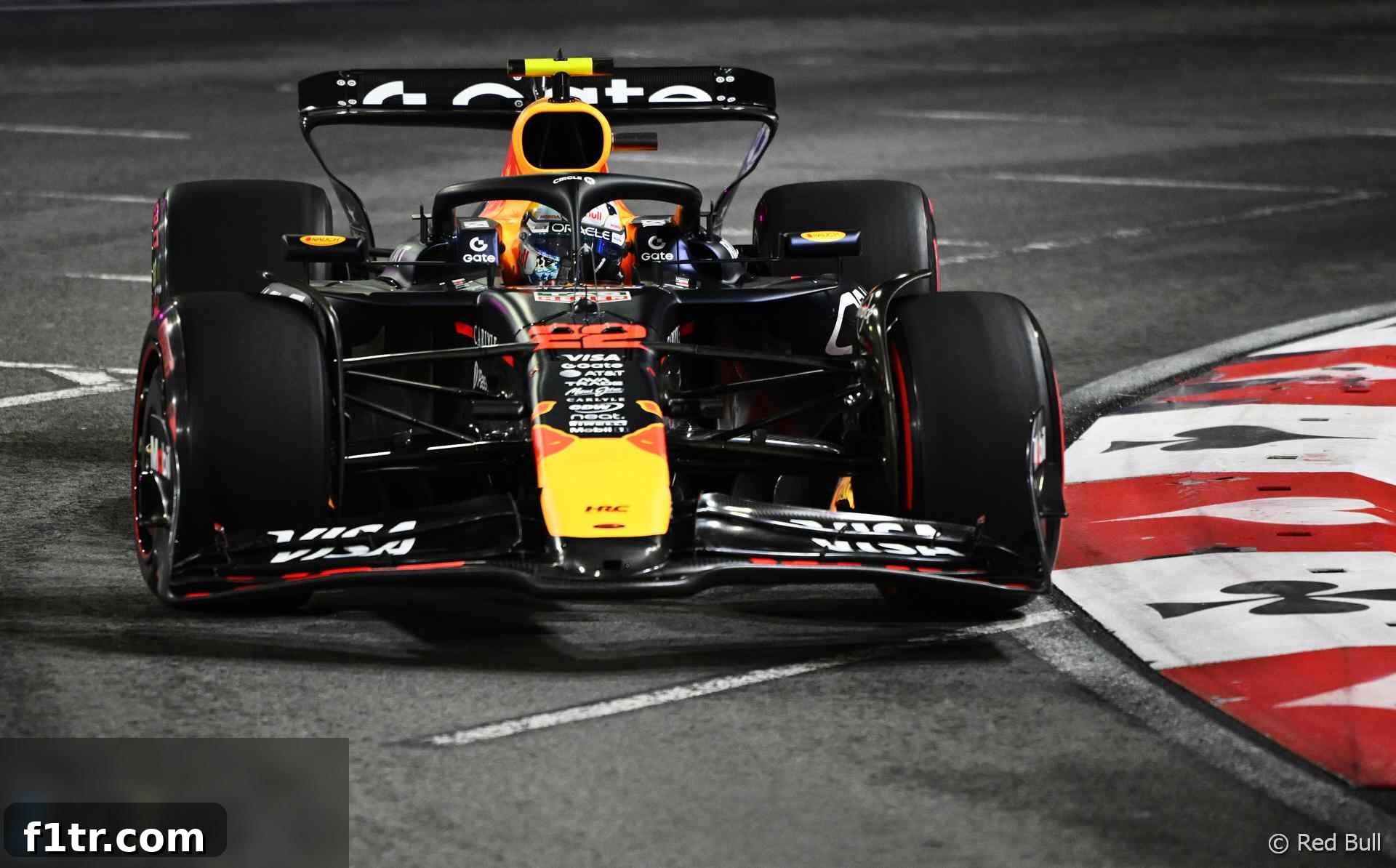
Yuki Tsunoda’s Quest for Consistency: Potential vs. Performance in Formula 1
In the high-stakes world of Formula 1, where every tenth of a second and every championship point can define a career, Yuki Tsunoda finds himself at a pivotal juncture. Despite a challenging run of results, the Japanese driver remains steadfast in his conviction that he is making tangible progress within the Red Bull ecosystem. His recent outing at the Las Vegas Grand Prix, however, served as a stark reminder of the fine line between raw potential and the elusive art of converting it into concrete outcomes.
The Las Vegas event marked the 14th consecutive Grand Prix where Tsunoda failed to register a championship point, a statistic that underscores the pressure building on the young talent. He ultimately finished 12th in the desert city, benefiting from the disqualification of both McLaren drivers, yet the underlying narrative of a race marred by misfortune and missed opportunities persisted.
The Las Vegas Grand Prix: A Tale of Missed Opportunities
Tsunoda’s Las Vegas weekend began with a promising display of pace, hinting at the potential that his supporters and the Red Bull management so often highlight. However, the foundational element of a strong race weekend – qualifying – quickly unravelled due to circumstances largely beyond his control. Red Bull, his parent team, openly accepted blame for his elimination in the first round of qualifying, attributing the setback to a critical error with his tyre pressures. This oversight forced Tsunoda to start the Grand Prix from the pit lane, an immediate and significant handicap on a circuit known for its challenges in overtaking and tyre management.
Starting from the pit lane inherently places a driver on the back foot, compelling them to adapt their strategy and fight through the pack. For Tsunoda, this challenge was compounded by a cruel twist of fate during the race itself. He opted for an early pit stop at the end of lap one, a strategic decision that, under different circumstances, might have paid dividends. However, on the very next lap, a Virtual Safety Car (VSC) period was deployed. This timing proved disastrous for Tsunoda, as it allowed several competitors, including Andrea Kimi Antonelli, Pierre Gasly, and Liam Lawson, to pit under more favourable conditions, effectively gaining track position and time on him.
Reflecting on the incident, Tsunoda expressed his frustration: “That was very unfortunate for my race. The [Virtual] Safety Car [was deployed] right after I pitted. So that’s not ideal at all, and that’s it really.” He elaborated on the domino effect of this misfortune, stating, “I stayed in the dirty air afterwards because people came into the pits. It feels like everything is so far going against me.” This sentiment perfectly encapsulates the exasperation of a driver who feels luck is simply not on their side, despite their best efforts.
Unlocking Pace: Glimmers of Promise in Practice Sessions
Despite the race-day woes, Tsunoda’s weekend was not entirely devoid of positives. During the practice sessions, particularly Free Practice 1, he showcased impressive speed, even outpacing his highly esteemed teammate, Max Verstappen. This performance was a potent reminder of the raw talent and underlying pace that Tsunoda possesses, often hidden beneath layers of unfortunate events or operational missteps.
“I think the pace I’ve shown until qualifying was good and qualifying was just completely not in my control and a lost opportunity,” he asserted. This distinction between his intrinsic speed and the external factors affecting his results is a recurring theme in his career. While acknowledging the tough reality of his situation, he remains optimistic about his fundamental progress: “At least the pace itself, I guess, is going the right direction but it’s frustrating that I know I couldn’t really show it in the result.”
The ability to match or even momentarily surpass a driver of Verstappen’s calibre in practice is a significant feat, offering a glimpse into Tsunoda’s true potential. Such performances are crucial for his self-belief and for demonstrating to the Red Bull hierarchy that he has the underlying speed required to compete at the highest level. However, F1 is a results-driven business, and practice sessions, while indicative, do not award championship points.
The Red Bull Conundrum: Future Uncertainty and High Expectations
Tsunoda’s future within the Red Bull family remains a subject of ongoing speculation. The team has yet to officially confirm his seat for the upcoming season, a decision that weighs heavily on any driver in his position. For a Red Bull junior, the pressure to perform and deliver consistent results is immense, as the pipeline of talented drivers vying for a spot is relentlessly competitive. Tsunoda was initially promoted to the F1 grid with AlphaTauri (now known as RB) as part of Red Bull’s stringent development program, and his journey has been one of flashes of brilliance interspersed with learning curves.
He believes that his performances, especially his pace advantage over Verstappen in multiple practice sessions, have not gone unnoticed by the team. “Multiple times – FP1, FP2, FP3 – in multiple laps I was ahead of Max in performance runs,” he highlighted. “I think [that’s] something that I didn’t have and we didn’t see probably for a long time.” This observation underscores a genuine improvement in his raw speed and car control, suggesting a maturation of his driving style.
However, Tsunoda is also acutely aware of Verstappen’s exceptional qualities, particularly in qualifying, where the Dutchman consistently extracts the maximum from his machine. “Obviously one of his strengths is he’ll bring the car on his level, into another level in qualifying, which is his strength,” Tsunoda conceded. Despite this, he maintained his personal confidence: “But also I had confidence as well into qualifying [that] I can perform better than the other race weekends, and these things happen.”
The core challenge for Tsunoda, and indeed for any driver looking to secure a long-term future in F1, is to translate this demonstrated potential and intermittent pace into consistent race finishes and, crucially, championship points. The Red Bull leadership demands a holistic package: speed, consistency, race craft, and the ability to avoid costly errors. While his speed has been evident, the overall execution, particularly in high-pressure qualifying and race scenarios, needs refinement.
The Path Forward: Converting Potential into Tangible Results
The conversation around Yuki Tsunoda often revolves around his raw talent and aggressive driving style, which has drawn both admiration and scrutiny. He has shown flashes of brilliance throughout his career, capable of pulling off impressive overtakes and demonstrating formidable pace when the conditions align. However, the path to becoming a top-tier Formula 1 driver requires more than just speed; it demands a relentless pursuit of perfection, strategic acumen, and the mental fortitude to overcome adversity.
For Tsunoda, the upcoming races, starting with Qatar, represent critical opportunities to solidify his position and silence any doubts about his future. His determination is clear: “I guess people noticed it. But at the same time what I want is a result – and, obviously, the team as well. But we can’t keep pointing like this in terms of this mistake [in qualifying] and everything. So [we need to] tidy it up for Qatar.” This statement reflects a mature understanding of the situation – accountability for what can be controlled and a clear focus on the future.
The Red Bull driver program is renowned for its ruthlessness, but also for its commitment to nurturing talent. Tsunoda’s journey so far has been a testament to his resilience and continuous learning. His ability to identify areas for improvement, coupled with the proven speed he occasionally demonstrates, suggests he has the ingredients to succeed. The critical missing piece is the consistent conversion of these ingredients into a steady stream of points and robust race performances, free from the kind of operational errors or ill-timed luck that plagued him in Las Vegas.
Conclusion: A Crucial Juncture for Yuki Tsunoda
Yuki Tsunoda stands at a crucial crossroads in his Formula 1 career. His raw speed and undeniable talent are evident, particularly when measured against the formidable benchmark of Max Verstappen in practice sessions. However, the consistent inability to convert this potential into tangible results, often due to a combination of team errors and unfortunate circumstances, creates a challenging narrative. The unconfirmed status of his contract for next season only amplifies the pressure to perform.
The upcoming races will be instrumental in defining his immediate future. For Tsunoda to secure his place within the Red Bull family and continue his Formula 1 dream, he must demonstrate an unwavering ability to perform consistently, minimize errors, and capitalize on every opportunity. The journey from being a driver with “potential” to one who delivers “results” is the ultimate test in Formula 1, and it is a test that Yuki Tsunoda is determined to pass.