Mexican Grand Prix Qualifying: Top Drivers Cleared After Intense Stewards’ Investigations
Max Verstappen, Lewis Hamilton, Fernando Alonso, and George Russell have all been exonerated by the FIA stewards following a series of in-depth investigations that scrutinised their conduct during the qualifying session for the Mexican Grand Prix. The decisions came after separate probes into alleged impeding at the pit exit and a failure to adequately slow down under yellow flags, incidents that collectively ignited significant discussion and controversy within the Formula 1 community.
The Pit Exit Conundrum: Congestion and Conflicting Rules in Q1
The opening phase of qualifying, Q1, is often a high-stakes scramble where drivers meticulously seek optimal track position to secure a clear lap time free from traffic. At the Mexican Grand Prix, this inherent tension escalated into a contentious sequence of events at the pit exit during the frantic final five minutes of the session. Three prominent drivers – Max Verstappen, Fernando Alonso, and George Russell – found themselves under the microscope of the stewards for actions perceived as impeding their rivals, sparking a debate about driver responsibility versus systemic rule limitations.
With just four minutes remaining on the Q1 clock, a peculiar scenario unfolded on the Autódromo Hermanos Rodríguez circuit. A mere three cars were actively circulating, while a substantial fleet of seventeen cars remained clustered in the pit lane. This impending mass exit from the pits, a frequent occurrence in the desperate closing stages of qualifying as teams send drivers out for a final attempt, laid the groundwork for the incidents that would later trigger a comprehensive steward investigation. Yuki Tsunoda was the initial driver to emerge, quickly followed by Sergio Perez and Kevin Magnussen, initiating a tightly packed train of cars all eager to find a gap.
Verstappen, Alonso, Russell: Navigating the Bottleneck
As the grid began to form its convoy, Max Verstappen, behind the wheel of his Red Bull, found himself trailing Magnussen. In a strategic manoeuvre to create a vital gap to the Haas ahead – which was exiting the pit lane at a deliberately measured pace – Verstappen drastically reduced his speed. He crossed the white pit exit line at a crawling pace, estimated at around 10 kilometers per hour. While he maintained a slow, rolling momentum without ever coming to a complete standstill, it took him approximately 14 seconds to eventually pick up racing speed. This calculated slowdown, aimed at achieving optimal tire temperature and clear air for his crucial flying lap, inadvertently created a significant bottleneck and frustration for those queuing behind him.
Immediately following Verstappen’s gradual departure, Lance Stroll and Nico Hulkenberg exited the pits in close succession. Next in the queue was Fernando Alonso. The experienced Aston Martin driver received explicit instructions from his team to “make a gap at pit exit.” Responding to both his team’s directive and the chaotic situation unfolding, Alonso adopted a more definitive approach: he brought his car to a complete halt at the white pit exit line. He then proceeded to exit the pits at an even slower rate than Verstappen had, all the while with Carlos Sainz Jnr’s Ferrari directly behind him, experiencing a clear and unavoidable impediment.
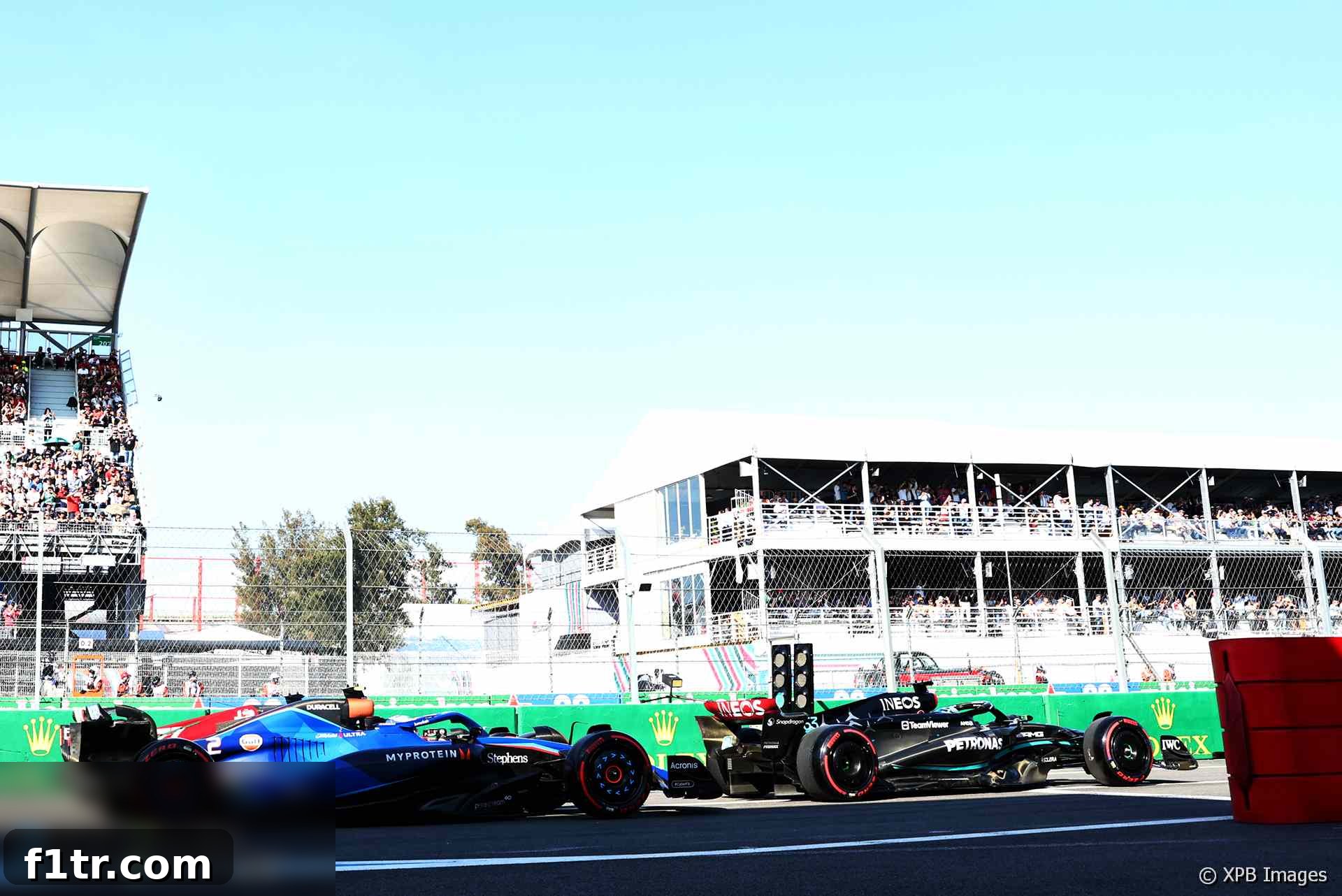
Once Alonso and Sainz eventually managed to accelerate, George Russell was the subsequent driver positioned at the pit exit line. Echoing Alonso’s strategy, Russell also came to a full and complete stop, patiently allowing the cars ahead of him to pull away before he too accelerated. His evident frustration was broadcast over the team radio, where he candidly described the entire situation as a “total shitshow.” Russell eventually pulled away, managing to pass Sainz after crossing the Safety Car line located at the end of the pit lane, a testament to the severe congestion that had gripped the pit exit during those critical moments.
Enhance your F1 experience: Become a RaceFans supporter and go ad-free.
Stewards’ Rationale: Blaming the Rules, Prioritising Safety
Following an exhaustive investigation into these intricate pit exit incidents, the FIA stewards ultimately cleared all three drivers – Verstappen, Alonso, and Russell – of any wrongdoing concerning impeding their rivals. Their detailed reasoning meticulously identified the root cause of the congestion not as deliberate driver misconduct or reckless driving, but directly as an unintended consequence of the ‘minimum lap time’ restriction. This rule, originally implemented to prevent cars from dangerously backing up or driving excessively slowly on track in the final sector during qualifying, paradoxically led to the very congestion it aimed to eliminate, albeit in the confines of the pit exit area.
The stewards’ official explanation brought crucial clarity to the complex dilemma confronting drivers. They stated: “The stewards consider that the entire set of incidents occurred as a direct result of the implementation of the minimum lap time between Safety Car lines 2 and 1 which is designed (correctly so, in our view) to avoid dangerous backing-up of cars on the circuit during qualification.” They went on to acknowledge the inherently conflicting requirements placed upon drivers during these moments: “We note that there are contrary requirements on drivers in that they must respect the minimum time, they are attempting to create manageable gaps to cars in front, yet they are also required to avoid unnecessarily stopping at the pit exit or driving unnecessarily slowly. It was also particularly noted that the race director accepted that these contrary requirements exist.” This highlights the challenging tightrope drivers must walk between various safety and performance regulations.
Crucially, the stewards unequivocally emphasized their strong preference for pit lane congestion over the potentially far more dangerous scenario of significant speed differentials on the main track. They elaborated: “All parties including the stewards are firmly of the view that it is better to have the potential of cars backing-up in the pit lane or at the pit exit, instead of the potentially dangerous situation of large speed differences on track.” While recognizing the persistent and unresolved problem of cars bunching up at the pit exit, they regrettably conceded their current inability to offer an immediate or perfectly viable solution. “We consider that in the main all drivers involved in these incidents were acting in good faith and with safety as a priority. We also accept that race direction has taken the correct approach in applying the minimum lap time. It is desirable that a better solution be found for the pit exit however at this stage, what that solution would be, is unknown.” This candid admission underscores a fundamental systemic challenge that Formula 1’s governing bodies will need to proactively address for future qualifying sessions, especially as car counts remain high and track time remains at a premium.
Yellow Flag Drama: Hamilton Cleared, Sargeant Penalised
Beyond the sagas unfolding at the pit exit, Lewis Hamilton also found himself under intense scrutiny for a separate incident: an alleged failure to adequately slow down under yellow flags during the tumultuous final moments of the very same Q1 session. This specific incident was triggered when Fernando Alonso, experiencing an unfortunate spin, lost control of his Aston Martin at the exit of turn three with merely one minute remaining on the clock, leaving his car positioned awkwardly and perilously across the circuit.
In response to the hazard, yellow flags were promptly displayed at various marshal posts and digitally to alert approaching drivers to the potential danger posed by Alonso’s stricken car. Several cars that passed the scene prior to Hamilton demonstrated a clear and noticeable lift-off the throttle. As Hamilton commenced his own critical push lap, his seasoned race engineer, Peter Bonnington, provided a timely warning: “So we have a yellow, yellow – turn three exit. Alonso facing the wrong way,” Bonnington informed him. “It’s just a single yellow, so just need a lift.” This communication is vital for driver safety and compliance.
However, the situation proved to be exceptionally fluid and, critically, confusing for Hamilton. As he rounded turn two, the yellow flag signal was momentarily lifted, theoretically permitting him to continue pushing without restriction. Yet, almost immediately upon entering the sector where Alonso’s stationary or slowly moving car was located, the race control system re-indicated a yellow flag in the area. This second yellow signal lasted for a fleeting two seconds, precisely as Hamilton drove past Alonso’s Aston Martin, which by then was gradually returning to speed and moving off the racing line. This rapid change in signaling was central to the stewards’ final decision.
Get exclusive content and more: Become a RaceFans supporter and go ad-free.
Hamilton’s Clearance Contrasted with Sargeant’s Penalty
After an exhaustive review of telemetry data and all available onboard footage, the stewards ultimately concluded that Lewis Hamilton had not breached the regulations regarding yellow flags. Their comprehensive explanation meticulously highlighted the inconsistent and brief nature of the warning signals he received: “The onboard video clearly shows there is no light or flag displayed to car 44 [Hamilton] on the straight into turn one, then a green light shows as he enters turn two, which is followed by two pulses of a yellow light, then moments later, the light panel is blank.” Furthermore, they noted a slight, compliant reduction in speed, confirming his adherence to the spirit of the rule: “The driver was slightly slower in the mini sector than on his previous push lap. Our determination is that there was no breach of the regulations.” This decision underscores the paramount importance of clear, unambiguous, and consistent signaling for drivers operating in such high-speed, high-pressure environments.
In stark contrast to Hamilton’s clearance, Williams driver Logan Sargeant, who also faced investigation for a similar yellow flag offence in the same session, received a significant 10-place grid penalty. Sargeant’s transgression was deemed more severe because the stewards determined he had overtaken another driver and, crucially, failed to adequately slow down while passing Alonso’s car, which was still facing the wrong way across the circuit and posed a more immediate danger. This critical distinction highlights the nuanced interpretation of yellow flag infringements; while Hamilton experienced fleeting and inconsistent signals and demonstrated a lift, Sargeant’s actions were judged to be a more direct and less cautious contravention of the established safety protocol, leading to a tangible penalty for the American rookie driver.
Broader Implications: The Future of F1 Qualifying Rules and Safety
The events of the Mexican Grand Prix qualifying session serve as a potent reminder of the enduring challenges confronting Formula 1’s regulatory bodies, teams, and drivers in their perpetual quest to balance competitive intensity with paramount safety. The twin controversies surrounding pit exit impeding and the precise application of yellow flag protocols highlight critical areas where existing rules, while fundamentally well-intentioned, can inadvertently generate unforeseen complexities and profound dilemmas for drivers competing at the absolute limit.
The stewards’ candid acknowledgement of “contrary requirements” for drivers concerning minimum lap times and appropriate pit exit conduct is particularly insightful. It unequivocally signals a pressing need for a more comprehensive and holistic review of current qualifying procedures. Potential systemic solutions could involve a complete revision of the minimum lap time rule to explicitly incorporate and account for pit exit conditions, or perhaps even exploring alternative track layouts or dedicated, separated pit exit lanes at specific venues to more effectively mitigate congestion. The current compromise, which prioritizes pit lane backing-up over the potentially far more dangerous scenario of large speed differentials on the main track, while logically sound from a safety standpoint, is undeniably suboptimal and contributes directly to driver frustration, the specter of investigations, and the risk of penalties.
Similarly, the contrasting outcomes for Lewis Hamilton and Logan Sargeant regarding their respective yellow flag incidents vividly illustrate the incredibly fine margins involved and the critical importance of consistent and unambiguous signaling. While modern digital flag panels and sophisticated GPS-based systems provide drivers with real-time information, instances of flickering, delayed, or conflicting signals, as experienced by Hamilton, can severely compromise a driver’s ability to react both appropriately and safely. This necessitates continuous refinement and rigorous testing of race control systems and communication protocols to ensure absolute clarity and reliability, especially during moments of heightened danger where split-second decisions are paramount.
Ultimately, the Mexican Grand Prix qualifying session served as a powerful and vivid reminder of the intricate and delicate dance between raw speed, strategic ingenuity, and unwavering safety in Formula 1. As the sport continues its relentless evolution, the FIA and race organizers will undoubtedly draw crucial lessons from these incidents, striving to meticulously refine rules and procedures. The overarching goal remains to ensure the integrity of fair competition while simultaneously fortifying the safety net for its elite drivers. The ongoing search for a truly “better solution” for the pit exit congestion and the implementation of universally clearer flag protocols will undoubtedly remain a significant and central focus for the future development of Formula 1 regulations.
Support our independent journalism: Become a RaceFans supporter and go ad-free.
2023 Mexican Grand Prix: Related Articles & Insights
- ‘I’m so s*** in qualifying’: Norris berates himself despite pole-winning lap
- Ferrari reaping the benefits of having F1’s most closely-matched team mates
- Norris had “no chance” to beat Verstappen in Mexico even without Q1 exit
- Transcript: How Ricciardo’s race went awry soon after he was told to “bring it home”
- Mercedes see “very encouraging signs” from Austin floor update
Browse all 2023 Mexican Grand Prix articles and analyses