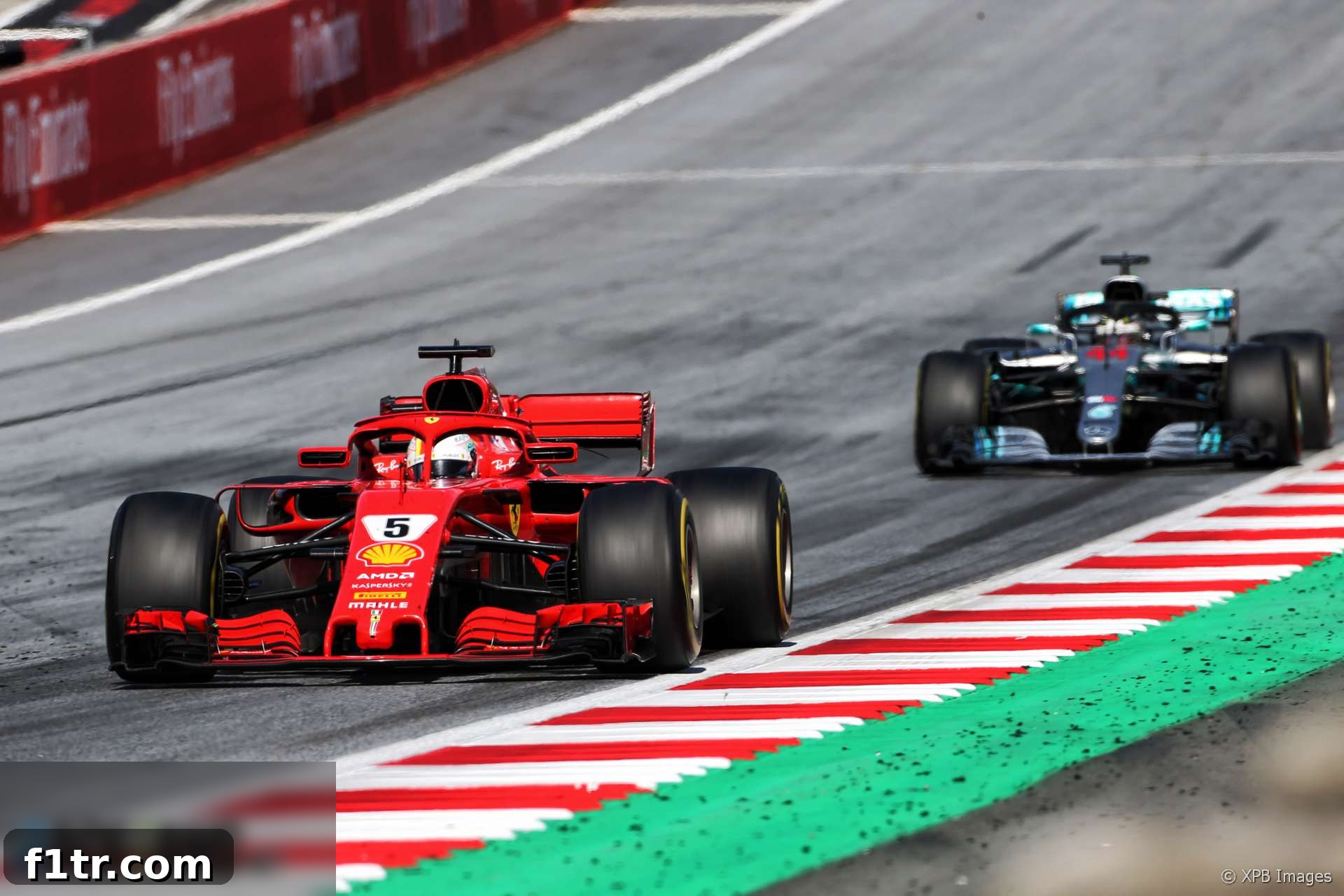
Sebastian Vettel’s 2018 F1 Title Challenge: A Season of Unfulfilled Promise for Ferrari
The 2018 Formula 1 season began with an electrifying surge from Sebastian Vettel and Ferrari, immediately placing Lewis Hamilton and Mercedes on high alert. Following a sustained period of dominance for the Silver Arrows since the inception of the V6 hybrid turbo era, Ferrari’s formidable early performance suggested the most formidable threat to their supremacy yet. Vettel’s victories in the opening two races were not just wins; they were a profound statement, signaling a genuine shift in the competitive landscape and igniting hopes for a championship battle that promised to be intense and unpredictable.
Advert | Become a Supporter & go ad-free
The Explosive Start: Ferrari’s Commanding Presence
While an element of fortune, specifically a well-timed Virtual Safety Car period, helped propel Vettel to victory in the season opener in Australia, Ferrari’s underlying pace was unequivocally strong. This was no mere stroke of luck; across the initial rounds of the championship, the Scuderia consistently demonstrated formidable speed and strategic acumen. This marked a significant leap forward from their already much-improved showing in 2017, unequivocally positioning the SF71H as a genuinely potent championship contender. The car’s superb balance, aerodynamic efficiency, and impressive straight-line speed rendered it a formidable force across a diverse range of circuit layouts.
Ferrari’s ascendancy was further underscored by their qualifying statistics. A remarkable seven races into the season, Ferrari had secured four pole positions, compared to Mercedes’ two. This metric vividly highlighted their raw pace advantage, demonstrating that on pure performance terms, they frequently held the upper hand. Indeed, well past the halfway point in the championship, it was more often Ferrari who arrived at a race weekend with the quicker car, a testament to the relentless efforts of their engineering team and their aggressive development approach.
Mid-Season Stumbles: Squandered Opportunities and Mounting Pressure
Despite their undeniable raw pace, Ferrari regrettably struggled to consistently convert this advantage into victories during the crucial mid-season phase. Circuits like the Hockenheimring and Hungaroring, where the SF71H showcased immense potential, transformed into painful reminders of squandered opportunities. The German Grand Prix, in particular, stands out as a watershed moment in the championship narrative. While leading comfortably in front of his home crowd, Sebastian Vettel made a critical and uncharacteristic error, sliding off track in tricky damp conditions and crashing out. This single, devastating incident not only cost him a significant haul of championship points but also handed Lewis Hamilton an unexpected and pivotal victory, effectively swinging the championship momentum decisively in Mercedes’ favour.
The psychological toll of such a mistake, occurring in a home race with a championship at stake, cannot be overstated. It placed immense pressure on Vettel, who was not only chasing his fifth world title but also aiming to deliver Ferrari’s first drivers’ championship since Kimi Räikkönen’s triumph in 2007. These failures to convert pole positions or strong race pace into definitive wins began to erode Ferrari’s championship lead, allowing Mercedes and Hamilton to remain within striking distance, even on weekends where their W09 might not have been the absolute fastest car on track.
The Belgian Grand Prix: A Powerful Display of Ferrari’s Raw Pace
The Belgian Grand Prix at Spa-Francorchamps offered another unequivocal demonstration of Ferrari’s impressive performance envelope. The SF71H was not merely quick; it was devastatingly effective in a straight line, enabling Vettel to pass Hamilton on the iconic Kemmel Straight with a remarkable ease that suggested the Mercedes W09 was metaphorically “towing a caravan.” This striking visual was a powerful testament to Ferrari’s potent power unit and their highly efficient, low-drag aerodynamic package. Furthermore, the W09 visibly struggled with excessive rear tire degradation in the slower corners, highlighting another crucial area where Ferrari held a significant advantage on that particular weekend. This dominant performance at Spa was a strong indication that when Ferrari managed to perfectly coalesce all elements of their package, they were truly formidable and capable of overwhelming the competition.
The Singapore Turning Point: Development Missteps and Mercedes’ Formidable Resurgence
However, the tide began to turn with dramatic swiftness after the Belgian Grand Prix. Mercedes, meticulously learning from their challenging encounter in Belgium, returned significantly stronger and more competitive. This resurgence was particularly poignant and evident at the Singapore Grand Prix, a street circuit where Mercedes had historically struggled with both outright pace and tire management. Their remarkable ability to adapt, analyze, and overcome a long-standing weakness at such a critical juncture underscored their formidable technical prowess and relentless commitment to continuous performance improvement.
Conversely, this crucial period coincided with Ferrari embarking on what Sebastian Vettel would later candidly describe as going “down a blind alley” with their development path. As Vettel himself reflected with noticeable introspection later in the season in Brazil, “Along the way something went wrong and we need to make sure that we learn from it. Something went wrong and then we didn’t go and develop in the right direction.” This stark admission pointed to critical misjudgments in their car’s upgrade trajectory, potentially impacting key areas such as aerodynamics, chassis balance, or even how the car optimally interacted with the temperamental Pirelli tires. While Mercedes consistently introduced effective upgrades that enhanced their car’s existing strengths and mitigated its weaknesses, Ferrari’s efforts unfortunately seemed to lead them astray, resulting in a damaging performance plateau or, worse, a regression.
This unexpected and ill-timed development slump ultimately proved to be the final nail in the coffin for Vettel’s championship aspirations. Ferrari’s performance didn’t truly recover or emerge from this dip until the championship had already arrived in Austin for the United States Grand Prix. By then, however, Lewis Hamilton had shrewdly capitalized on every opportunity, building an unassailable lead, and the drivers’ title was firmly within his grasp, rendering Ferrari’s belated return to competitive form largely academic.
Advert | Become a RaceFans supporter andgo ad-free
Analyzing the Pace Advantage: Ferrari vs. Mercedes in 2018
When Lewis Hamilton mathematically secured his championship at the 19th round of the season in Mexico, Mercedes held a narrow 10-9 lead over Ferrari in terms of which team had been the quickest each weekend. While this marginal difference might initially suggest a closely matched championship, the critical distinction lay in the *nature* of their respective performance advantages. When Mercedes possessed an edge, it tended to be a more comfortable, comprehensive, and decisive one, allowing Hamilton to expertly control races, manage his tires effectively, and execute strategy with greater flexibility. Ferrari’s quicker weekends, while frequent and often exhilarating, frequently came with greater inherent operational challenges or a smaller buffer, demanding absolute perfection to convert into maximum points.
On average, Mercedes exhibited an impressive level of consistency, being approximately 0.13% off the ultimate pace over the 19 races it took Hamilton to clinch the title, compared to Ferrari’s 0.23%. However, this statistical overview necessitates careful qualification. A significant proportion of Mercedes’ strongest performances and most comfortable victories materialised in the latter half of the season, precisely when Hamilton had already established a substantial and psychologically important championship lead. This allowed them to operate with reduced pressure and potentially take calculated risks with race strategy or experimental car setups, further amplifying their advantage.
Indeed, by the Italian Grand Prix at Monza, a spiritual home for Ferrari where Hamilton impressively extended his lead over Vettel to a commanding 30 points, Ferrari had demonstrably been quicker than Mercedes in an astounding nine out of 14 races. This compelling data strongly suggests that Ferrari possessed a car that was, for a considerable and critical portion of the season, objectively faster or at least on par with the Mercedes W09. The fundamental problem was not an inherent lack of outright speed; rather, it was a collective failure to consistently maximize that speed and, crucially, convert it into the championship points necessary to sustain a title challenge.
Hamilton and Vettel’s Four Worst Finishes (at championship decision point)
| Lewis Hamilton | Sebastian Vettel | ||||
|---|---|---|---|---|---|
| DNF | Austria | Power unit failure | DNF | Germany | Crashed from the lead |
| 5th | Canada | 8th | China | Collided with Verstappen | |
| 4th | China | 6th | Japan | Collided with Verstappen | |
| 4th | Mexico | 5th | France | Collided with Bottas | |
Performance details at the point the championship was decided
Driver Errors and the Immense Weight of Expectation
The infobox detailing the worst finishes of both Lewis Hamilton and Sebastian Vettel illuminates a profoundly crucial aspect of the 2018 season: the disproportionate impact of driver errors. While Hamilton experienced an unfortunate power unit failure in Austria and some comparatively weaker performances, Vettel’s list of ‘worst finishes’ is heavily punctuated by self-inflicted incidents and costly collisions. His dramatic crash from the lead at the German Grand Prix was arguably the most impactful, transforming a certain victory into a DNF and swinging a significant 25-point haul away from him, directly into Hamilton’s favour. Subsequent collisions with the aggressive Max Verstappen in China and Japan, as well as a misjudgment leading to contact with Valtteri Bottas in France, further eroded his points tally and demonstrated moments of misjudgment under the immense pressure of a title fight.
These errors, particularly the Hockenheim crash, were not isolated occurrences; they represented a pattern that ultimately cost Vettel dearly. In a championship battle against a driver of Lewis Hamilton’s unparalleled consistency and a team as relentlessly efficient as Mercedes, every single point becomes absolutely critical. Hamilton, on the other hand, maintained a remarkable level of consistency and composure throughout the season, making fewer significant mistakes and capitalizing ruthlessly on any opportunities presented by his rival’s missteps.
The Unfulfilled Promise: A Car Capable of Delivering the Championship
So, does the narrative hold that Sebastian Vettel truly lost the championship despite having a faster car? The nuanced answer leans towards “not quite,” but it is undeniable that he certainly possessed a car with which he *could* have unequivocally won the championship, or at the very least, pushed Lewis Hamilton to the absolute final race of the season. The SF71H was a formidable challenger, showcasing flashes of brilliant pace, innovative design, and strategic flexibility throughout the season. The critical and ultimately decisive issue was the team’s collective inability – encompassing both driver execution and crucial strategic and developmental decisions – to consistently harness that immense potential to its fullest extent.
Ferrari’s debilitating slump in performance, particularly from the pivotal Singapore Grand Prix through to the Japanese Grand Prix, ultimately sealed Vettel’s title hopes. This period witnessed Mercedes unleash their full potential, responding brilliantly to challenges, while Ferrari, conversely, faltered. However, had Vettel made more effective use of the highly competitive machine he commanded in the earlier phases of the season, consistently avoiding critical errors and maximizing his points haul from strong weekends, it is not difficult to envision a scenario where the title fight would have been far closer, potentially extending all the way to a dramatic and nail-biting season finale.
“Clearly we missed something,” Vettel reflected with a deep sense of introspection. “Not on purpose and not because something by default is set wrong. So it’s up to us to find a fix for it and make sure it doesn’t happen again.” This sentiment perfectly encapsulates the profound frustration and the lingering question mark that hangs over Ferrari’s 2018 campaign: a season of immense promise and genuine potential, ultimately undone by a series of critical missteps and missed opportunities that proved too costly to overcome in the face of relentless competition.
Quotes: Dieter Rencken
Advert | Become a RaceFans supporter andgo ad-free
Related Articles on the 2018 F1 Season
- F1 feared “death knell” for Drive to Survive after Ferrari and Mercedes snub
- McLaren staff told us we were “totally crazy” to take Honda engines in 2018 – Tost
- ‘It doesn’t matter if we start last’: How Red Bull’s junior team aided Honda’s leap forward
- Honda’s jet division helped F1 engineers solve power unit problem
- McLaren Racing losses rise after Honda split
Browse all 2018 F1 season articles