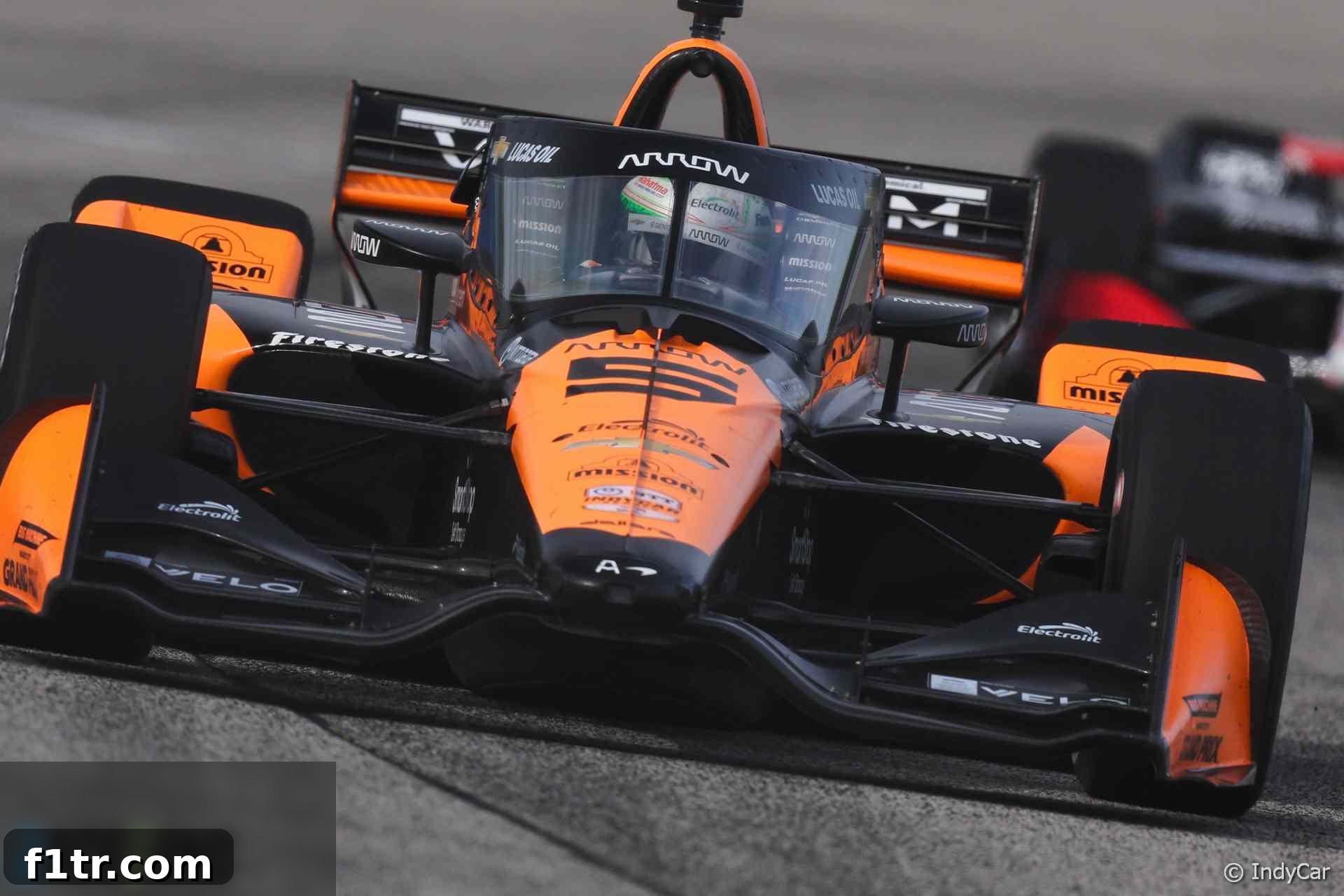
In a spectacular display of resilience and strategic prowess, Pato O’Ward orchestrated a triumphant comeback at the Milwaukee Mile, clinching a crucial victory just a week after voicing strong disapproval over his team’s “unacceptable” performance at Portland. Finishing 15th in the previous race, the McLaren driver transformed frustration into fuel, delivering a masterclass performance that re-energized his championship aspirations and showcased the team’s ability to rebound under pressure.
The Milwaukee Mile: A Historic Return and a Fight for Redemption
The revered Milwaukee Mile, America’s oldest active motor racing oval, set the stage for a thrilling chapter in the IndyCar Series. Its unique, undulating characteristics and demanding nature promised a true test of driver skill and team strategy. For Pato O’Ward, this return to a classic oval circuit wasn’t just another race; it was an opportunity for redemption. Following a challenging outing in Portland where a lack of pace and execution plagued his McLaren team, O’Ward’s frustration was palpable. His sharp critique served as a catalyst, sparking a renewed determination within the team to demonstrate their true capabilities. The pressure was immense, not only to perform but to prove that the Portland result was an anomaly, not a trend. This victory, his third of the season, provided precisely the emphatic statement he and his team sought, reaffirming their status as genuine contenders in a fiercely competitive championship.
Pre-Race Buzz and Qualifying Drama
The lead-up to the Milwaukee IndyCar Classic was charged with anticipation. Championship leader Alex Palou arrived with a comfortable, yet not insurmountable, advantage, aware that any slip could open the door for his rivals. Will Power, a formidable veteran and previous champion, was hot on his heels, consistently seeking opportunities to chip away at Palou’s points lead. Qualifying at the Milwaukee Mile proved to be a nail-biter, with Scott McLaughlin of Team Penske ultimately securing pole position, showcasing the formidable pace of the Chevrolet-powered cars on the historic oval. His front-row start indicated he would be a strong contender, setting the stage for what promised to be an electrifying race day. The qualifying results also highlighted the competitive depth of the field, with several frontrunners poised to challenge for the top step of the podium, including Colton Herta and Linus Lundqvist, who both demonstrated impressive speed.
The Green Flag Drops: Early Race Dynamics
As the green flag waved, signaling the start of the 250-lap race, McLaughlin converted his pole position into an early lead, dictating the pace in the opening laps. The field quickly settled into a rhythm, with drivers meticulously managing their tires and fuel on the challenging oval. However, the lead was not McLaughlin’s to keep for long. Linus Lundqvist, demonstrating remarkable confidence and pace, executed a superb overtake on the pole-sitter during the initial stint, snatching the lead and proving that he was a force to be reckoned with. The early stages were characterized by strategic jostling for track position, as drivers sought to avoid incidents and position themselves advantageously for the crucial pit stops that would define the race. The unique characteristics of the Milwaukee Mile, with its tight turns and varying banking, demanded absolute precision and unwavering focus from every competitor.
Mid-Race Maneuvers and O’Ward’s Ascent
As the race progressed towards its halfway mark, the tactical battle intensified. Pit stop cycles began to play a significant role, with teams employing various strategies to gain an edge. It was during this period that Pato O’Ward truly began to assert his dominance. Executing a series of perfectly timed overtakes, he first dispatched Colton Herta, then swiftly moved past Scott McLaughlin to seize the lead. These moves were not merely about speed; they were a testament to O’Ward’s acute understanding of racecraft and his team’s optimized setup. Once in front, O’Ward demonstrated exceptional control, maintaining a steady pace and expertly navigating the traffic, all while conserving his equipment. His McLaren showed incredible stability and speed, allowing him to build a comfortable margin. This mid-race surge laid the foundation for his eventual victory, transforming him from a frustrated contender into the race leader, firmly in command of his destiny.
Three Cautions, Three Turning Points
The 250-lap race was punctuated by three caution periods, each dramatically reshaping the competitive landscape and adding layers of tension to an already thrilling contest. These yellow flags offered opportunities for some and dashed the hopes of others, forcing teams to make split-second strategic decisions that would ultimately impact the final outcome.
Caution 1: Legge’s Incident and Its Minor Impact
The first caution of the day was triggered by Katherine Legge, who experienced a harmless spin. Fortunately, Legge was able to regain control of her car and continue in the race, albeit losing several positions. While this incident did not result in major damage or retirements, it served to bunch up the field, erasing any significant gaps that had developed and forcing a restart that intensified the racing action. Teams used this brief interlude to assess their strategies and prepare for the next phase of the race, but its overall impact on the front-runners was minimal.
Caution 2: The Newgarden-Ericsson Clash and Championship Repercussions
The second caution period, however, proved to be far more impactful and contentious. It involved a high-profile tangle between Josef Newgarden, a multi-time champion, and Marcus Ericsson. As Ericsson attempted an ambitious pass on the Penske driver, Newgarden squeezed him, leaving Ericsson with little room and forcing him towards the less grippy inside line. The contact sent both cars into the barriers, ending their races prematurely and sparking immediate debate among fans and pundits. For Newgarden, it was a frustrating end to what had been a challenging day, while for Ericsson, it was a lost opportunity to score valuable championship points. This incident highlighted the fine margins and aggressive nature of IndyCar oval racing, where drivers are constantly pushing the limits, sometimes with significant consequences.
Caution 3: Herta’s Pit Stop Nightmare Leads to Grand Finale
The third and final caution period was perhaps the most dramatic, directly influencing the climactic final stages of the race. It was triggered by Colton Herta, who had been a strong contender throughout the event. During his final pit stop, a catastrophic failure occurred: his front-left tire changer failed to properly attach his new wheel. Tragically, the wheel detached from the car shortly after Herta rejoined the track, forcing him to pull off and ending his promising run. This mechanical failure was a brutal blow for Herta and his Andretti team, stripping them of a potential podium finish. The subsequent caution period provided the field with one last opportunity to close up, setting the stage for a thrilling dash to the checkered flag, with O’Ward leading a tightly packed group of hungry competitors.
The Final Sprint: O’Ward Under Pressure
With the third and final caution period concluding on lap 204, the race resumed for a high-stakes sprint to the finish. Pato O’Ward, now firmly in the lead, found himself under immense pressure from Will Power. The Penske driver, known for his relentless pursuit and uncanny ability to perform under duress, was glued to O’Ward’s gearbox. For the remaining laps, the tension was palpable as Power relentlessly probed for an opening, utilizing every inch of the historic oval to try and find a way past. O’Ward, however, remained unwavering. He expertly defended his position, placing his McLaren precisely where it needed to be, absorbing Power’s pressure with a cool head and demonstrating exceptional car control. The final laps were a testament to his mental fortitude and the raw speed of his car, culminating in a well-deserved victory as he crossed the finish line ahead of his persistent rival.
Conor Daly’s Heroic Charge from the Back
While O’Ward celebrated his victory, another remarkable story unfolded further down the field: Conor Daly’s sensational drive. Starting from a lowly 25th position on the grid, Daly embarked on an incredible charge through the field, showcasing exceptional overtaking skills and astute race management. Having taken over from Agustin Canapino just two races prior, Daly delivered a standout performance, steadily picking off competitors and making intelligent strategic moves. His relentless progress saw him climb into contention, and against all odds, he secured a magnificent third-place finish. This podium not only marked a personal triumph for Daly but also represented the Juncos Hollinger Racing team’s best result of the season, a testament to their hard work and Daly’s fighting spirit. It was a true underdog story that resonated deeply with fans and analysts alike, solidifying his performance as one of the highlights of the Milwaukee Classic.
Championship Battle Intensifies
Pato O’Ward’s victory at Milwaukee not only marked a personal redemption but also injected a new wave of excitement into the fiercely contested IndyCar Series championship. While Alex Palou still holds the championship lead, Will Power’s consistent second-place finish allowed him to significantly narrow the points gap, keeping the title fight very much alive. O’Ward’s win also brings him closer to the front, positioning McLaren as a stronger force in the closing stages of the season. The dynamics have shifted; Palou can no longer afford to simply manage his lead, as both Power and O’Ward have demonstrated the speed and consistency required to challenge him directly. With fewer races remaining, every point becomes critical, and the pressure on all frontrunners will intensify, promising a thrilling conclusion to the championship season.
Noteworthy Performances and Unfortunate Exits
Beyond the podium finishers, several other drivers delivered performances worthy of mention, highlighting the incredible depth of talent in the IndyCar paddock. Linus Lundqvist, who had sensationally led during the first stint after passing pole winner Scott McLaughlin, ultimately finished sixth after losing valuable time during his initial pit stop. Despite this setback, his early pace demonstrated his immense potential. Alexander Rossi capitalized on opportunities to secure seventh place, passing Scott McLaughlin on the run to the flag. Christian Lundgaard drove a solid race to finish ninth, while motorsport legend Scott Dixon marked his monumental 400th career start with a top-ten finish in 10th place – a remarkable milestone for an iconic driver. Christian Rasmussen, Kyle Kirkwood, and Felix Rosenqvist were the only other drivers to complete the entire race distance on the lead lap, underscoring the demanding nature of the Milwaukee Mile. Conversely, the race also saw several unfortunate exits. Colton Herta’s dramatic pit stop failure stripped him of a strong finish, and the collision between Josef Newgarden and Marcus Ericsson brought an early end to their respective races, impacting their championship aspirations.
Full Race Results: Milwaukee IndyCar Classic
| P. | No. | Driver | Team | Engine |
|---|---|---|---|---|
| 1 | 5 | Pato O’Ward | McLaren | Chevrolet |
| 2 | 12 | Will Power | Penske | Chevrolet |
| 3 | 20 | Conor Daly | DRR-Cusick | Chevrolet |
| 4 | 13 | Santino Ferrucci | Foyt | Chevrolet |
| 5 | 10 | Alex Palou | Ganassi | Honda |
| 6 | 8 | Linus Lundqvist | Ganassi | Honda |
| 7 | 7 | Alexander Rossi | McLaren | Chevrolet |
| 8 | 3 | Scott McLaughlin | Penske | Chevrolet |
| 9 | 27 | Christian Lundgaard | RLL | Honda |
| 10 | 9 | Scott Dixon | Ganassi | Honda |
| 11 | 25 | Christian Rasmussen | Carpenter | Chevrolet |
| 12 | 22 | Kyle Kirkwood | Andretti | Honda |
| 13 | 29 | Felix Rosenqvist | Meyer Shank | Honda |
| 14 | 18 | Rinus VeeKay | Carpenter | Chevrolet |
| 15 | 30 | David Malukas | Meyer Shank | Honda |
| 16 | 16 | Jack Harvey | Coyne | Honda |
| 17 | 6 | Nolan Siegel | McLaren | Chevrolet |
| 18 | 24 | Pietro Fittipaldi | RLL | Honda |
| 19 | 28 | Katherine Legge | Coyne/WR | Honda |
| 20 | 14 | Graham Rahal | RLL | Honda |
| 21 | 11 | Marcus Armstrong | Ganassi | Honda |
| 22 | 21 | Colton Herta | Andretti/Curb-Agajanian | Honda |
| 23 | 26 | Sting Ray Robb | Foyt | Chevrolet |
| 24 | 32 | Romain Grosjean | Juncos Hollinger | Chevrolet |
| 25 | 4 | Kyffin Simpson | Ganassi | Honda |
| 26 | 23 | Marcus Ericsson | Andretti | Honda |
| 27 | 2 | Josef Newgarden | Penske | Chevrolet |
Looking Ahead: The Road to the Championship Finale
Pato O’Ward’s inspiring victory at the Milwaukee Mile has dramatically shifted the landscape of the IndyCar Series championship. What was once perceived as a comfortable lead for Alex Palou now feels much more precarious, with Will Power and O’Ward themselves demonstrating they have the pace and resilience to challenge for the title in the remaining races. The series now moves into its crucial final events, where every practice session, qualifying lap, and race stint will be scrutinized. The psychological momentum gained by O’Ward and McLaren, coupled with Power’s consistent threat, sets the stage for a spectacular conclusion to the season. Fans can anticipate fierce competition, strategic gambles, and nail-biting finishes as drivers push themselves and their machinery to the absolute limit in pursuit of the coveted IndyCar championship.
More IndyCar Insights
- IndyCar driver McLaughlin cleared of injury after crashing through barrier at Barber
- Schumacher says his IndyCar feels like ‘an F2 car, just with better tyres’
- IndyCar “way faster than Formula 1” in some corners, says Grosjean
- FIA to award more F1 superlicence points to IndyCar drivers from 2026
- Schumacher to race full-time in IndyCar with RLL in 2026
Browse all IndyCar articles