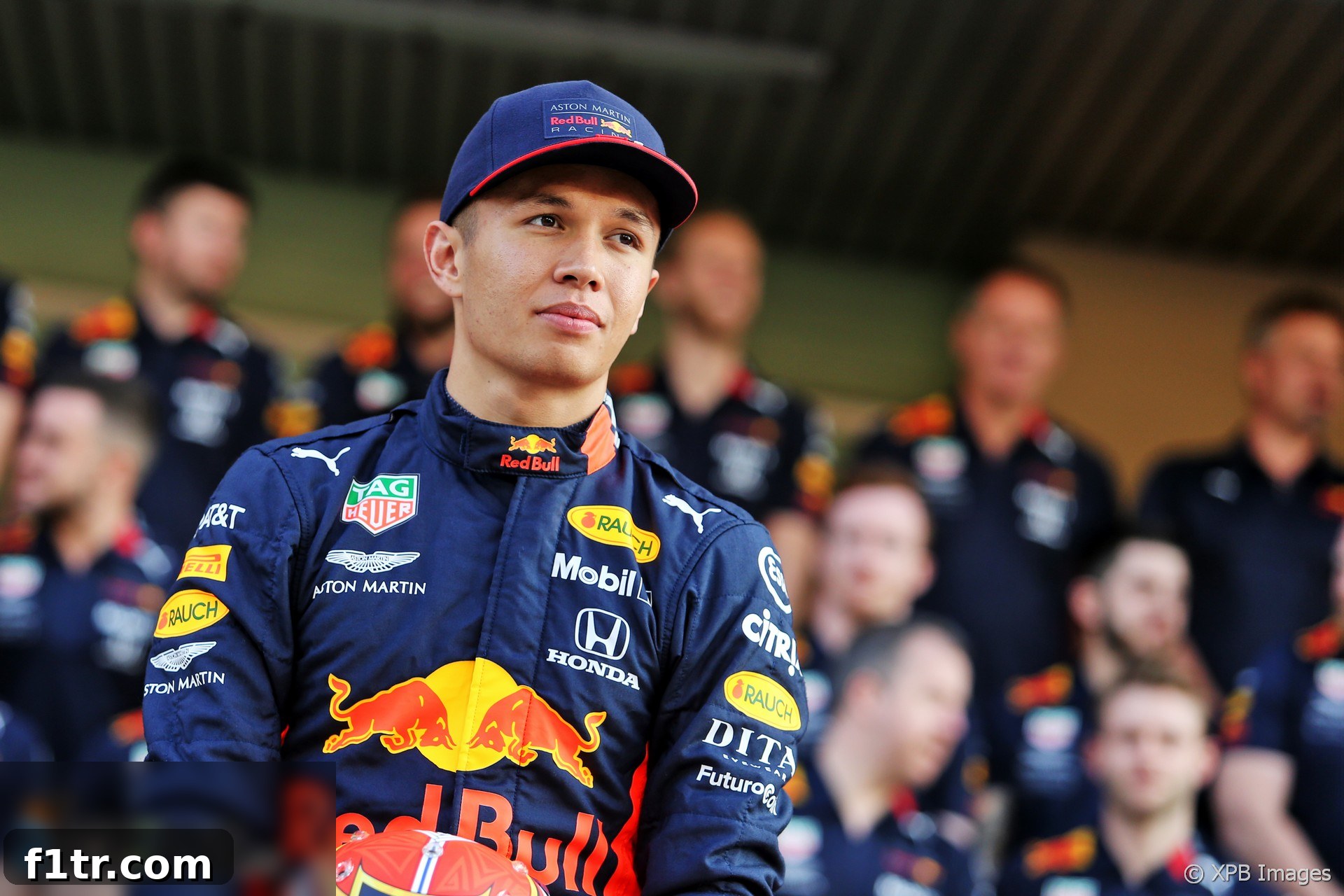
In the highly competitive world of Formula 1, some careers unfold predictably, while others surprise and captivate. Alexander Albon’s 2019 season undoubtedly falls into the latter category, marking an astonishing, meteoric ascent that few could have foreseen. Just 12 months prior, Albon was yet to experience the raw power and intricate demands of a Formula 1 car. By August of his rookie year, he had achieved the remarkable feat of being promoted from Scuderia Toro Rosso to the senior Red Bull Racing team – a trajectory so rapid it left many astonished, highlighting his extraordinary talent and adaptability.
This swift progression, while a testament to Albon’s capabilities, was also influenced by the challenges faced by his predecessor, Pierre Gasly, at Red Bull. Gasly’s difficulties created the critical opening, but it was Albon’s consistently improving performances and undeniable potential demonstrated at Toro Rosso that gave Red Bull the confidence to take a calculated gamble on the young Anglo-Thai driver. This decision underscored the belief in Albon’s inherent speed and his ability to quickly learn and perform under immense pressure.
During his stint with Toro Rosso, Albon delivered several standout performances that etched his name into the minds of team strategists and fans alike. He fondly recalls Silverstone and Hockenheim as two such races, showcasing his burgeoning talent. At Silverstone, he navigated the iconic British circuit with skill, earning valuable points. However, his debut points finish in China stands out as particularly impressive, achieved despite a heavy crash during practice that ruled him out of qualifying. This incident not only highlighted his resilience but also his exceptional racecraft, as he carved his way through the field to secure a points-paying position in an unfamiliar car.
The promotion to Red Bull Racing, however, brought with it an entirely new set of challenges and an inevitable, direct comparison with one of the sport’s most formidable talents: Max Verstappen. Verstappen, already well-versed in the intricate nuances and aggressive handling characteristics of the RB15, had firmly established himself as the team’s spearhead. The immediate result was, perhaps, predictable: Verstappen consistently out-paced his new team mate, often by an average of more than half a second in qualifying. This significant gap highlighted the immense learning curve Albon faced, stepping into a top-tier car mid-season against a driver at the peak of his powers.
Adapting to the Red Bull Challenge: A Focus on Self-Improvement
Despite the daunting comparison with Verstappen, Albon maintained a refreshingly pragmatic approach. He believes the key to narrowing the performance gap lies in a singular focus: “focus on myself” and actively shutting out external distractions and pressures. “It is a team sport but it’s very individual in the way that you have to approach your driving,” he explained, emphasizing the unique demands placed on a Formula 1 driver.
“Putting myself first in terms of questioning where I need to improve and what I need to do to be better, that’s been the main thing for me,” Albon articulated. This introspective approach is crucial in a sport where marginal gains can make a significant difference. He also learned to manage his intensity during practice sessions, noting, “And just take it a bit easier in free practices. Try not to overdrive too quickly.” This indicates a growing maturity and understanding of how to extract maximum performance from the car without overstepping the limit.
Indeed, Albon’s rookie season wasn’t without its share of minor setbacks. His shunt in Shanghai was a clear reminder of the fine margins in F1, and he later experienced another incident when he crashed the Red Bull during qualifying in Sochi. However, mirroring his earlier resilience, he bounced back impressively on both occasions, bringing the car home fifth on race day in Russia. This ability to recover from errors and convert challenging weekends into strong race finishes quickly became a hallmark of his driving style.
Qualifying: The Steep Learning Curve
Upon joining Red Bull in Belgium, a notable performance gap emerged, with Albon consistently lagging behind his new team mate, Verstappen, more significantly than he had against Daniil Kvyat at Toro Rosso. Albon openly acknowledged this disparity, identifying a “combination” of different aspects that required improvement, primarily “Driving and getting the confidence in the car.” He stressed the foundational importance of driver input: “I always put myself first. It’s always the driving first and then work around it.”
Formula 1, as Albon wisely pointed out, is rarely simple. “It doesn’t tend to be one thing, it tends to be a group of things. And of course, experience as well.” This encompasses a multitude of factors, from understanding new tracks and their evolving characteristics to mastering the complex array of in-car tools available to a driver during a lap. “Just coming to tracks, knowing what to do with whatever it will be, [using the] tools during the lap and things like that, it just takes a bit of time,” he elaborated, emphasizing the critical role of track time and accumulated knowledge.
The intricate art of qualifying presented a particularly steep learning curve after his move to Red Bull. At a top team, the pressure to extract every millisecond from the car is immense, especially in the Q3 shootout. “You can build up to it,” he explained regarding preparation. “The sim helps. And by the time you’re in final practice you more or less know what to do.” However, the dynamic nature of qualifying itself introduced new variables.
“It’s always different once you get qualifying with fuel and the track evolving so much. Tracking that progress through qualifying is a bit different,” Albon noted. At Toro Rosso, being a frequent Q3 participant wasn’t always a given, which meant less consistent exposure to the nuances of a rapidly evolving track surface under qualifying conditions. He drew a parallel with other top drivers, stating, “Charles [Leclerc] was saying that sometimes when he first joined Ferrari that kind of understanding how the track tends to grip up, so it’s the same.” This illustrates that even highly talented drivers need time to fully comprehend the subtle shifts in grip and performance during high-stakes qualifying sessions at the pinnacle of motorsport.
By the end of his debut season, while Albon was still striving to match Verstappen’s outright qualifying pace, he remained confident in his ability to progressively narrow the gap. Speaking in Abu Dhabi, he reflected, “It was a bit just trying to understand the sweet spot, more or less, because I think Toro Rosso understood it a bit more.” This suggested a deeper connection and understanding he had developed with his previous car. “With this car I’m understanding it but it’s just a learning process,” he continued. Despite some practice and qualifying incidents throughout the year, he was always “chipping away at it” and feeling “better with the car, always. It is still [about] trying to find the lap time out of it which, of course, Max is showing. I’m getting there.” This determined outlook underscored his resilience and commitment to continuous improvement.
Become a RaceFans supporter andgo ad-free
Race Day Resilience and Unlocking Potential
While Albon’s qualifying performances presented the clearest area for growth and improvement, his race craft and ability to seize opportunities during the Grand Prix weekends were consistently impressive. Throughout his rookie season, particularly after his Red Bull promotion, he demonstrated a strong aptitude for converting challenging starting positions into solid finishes. There were only two notable occasions when he started inside the top 10 but finished outside of it, a testament to his race-day consistency and strategic execution.
One such instance occurred in Britain, where his race was unfortunately compromised by a power unit problem. This issue prevented him from making a crucial pit stop at the optimal time, forcing him to endure an extended stint on heavily worn tires, ultimately ruining his chances for a strong finish. Another high-profile setback came in Brazil, where Albon was on course for a well-deserved maiden Formula 1 podium finish. However, his dreams were dashed when he was hit by the then-reigning world champion, Lewis Hamilton, during a late-race battle, an incident that robbed him of a truly memorable result.
Despite the crushing disappointment in Interlagos, Albon’s ability to find positives even in adversity shone through. Reflecting on the weekend, he remarked, “When I look at the weekend as a whole, it was a good weekend. There were some areas still to improve but there are more positives there.” This constructive mindset, focusing on progress rather than dwelling on misfortune, is a key attribute for a young driver in such a demanding sport.
Become a RaceFans supporter andgo ad-free
Solidifying His Place: A Promising Start and Future Outlook
Following his unexpected mid-season promotion to Red Bull, Alexander Albon consistently brought his car home among the front runners. This was, by all reasonable measures, exactly what could be expected of him given the challenging circumstances of such a late and high-profile transfer. While his 2020 season would undoubtedly demand further consolidation and improvement to secure his long-term future with the team, his debut year provided more than enough reasons for satisfaction and optimism regarding his potential in Formula 1.
“It’s been good,” Albon commented, reflecting on his journey. “I sometimes have to tell myself that I am still a rookie because it does feel like being in Red Bull that kind of feeling goes away just with expectations and things like that.” This candid admission highlights the immense pressure and heightened expectations that come with driving for a top team, which can quickly overshadow one’s rookie status. However, his underlying self-awareness remained intact.
“But on reflection, I am happy with it. Not just the good moments and things like that,” he added. His happiness stemmed not from individual highlights, but from the overall progression and growth he experienced. “I think it’s just human nature and it’s who I am, I am hard on myself and I do want to improve all the time. I feel like I don’t want it to be an excuse that I am a rookie.” This fierce self-criticism and relentless drive for betterment are precisely the qualities that define elite athletes.
“It’s part of me and it’s my drive to just improve as a driver. I know there’s still scope for me to improve,” Albon concluded, encapsulating his determined mindset. His extraordinary journey from F1 newcomer to Red Bull racer in a single season served as a powerful narrative of talent, resilience, and unwavering dedication. While the road ahead in Formula 1 would always present new challenges, Alexander Albon had undeniably laid a strong foundation, signaling his arrival as a serious contender in the world of Grand Prix racing.
Go ad-free for just £1 per month>> Find out more and sign up
Race: Reasons for Retirements
| Race | Retirement |
|---|---|
| Canada | Withdrew to preserve power unit |
Quotes: Dieter Rencken
2019 F1 Season Insights
- Crying in the Melbourne car park at 2019 grand prix was my career low – Ocon
- McLaren Racing reports reduced £71 million loss in 2019
- Kvyat: Hockenheim podium last year was “my biggest achievement” so far
- How the FIA’s new encrypted fuel flow meter targets Ferrari’s suspected ‘aliasing’ trick
- “He smashed my office door”: 23 must-see moments from ‘Drive to Survive’ season two
Browse all 2019 F1 season articles