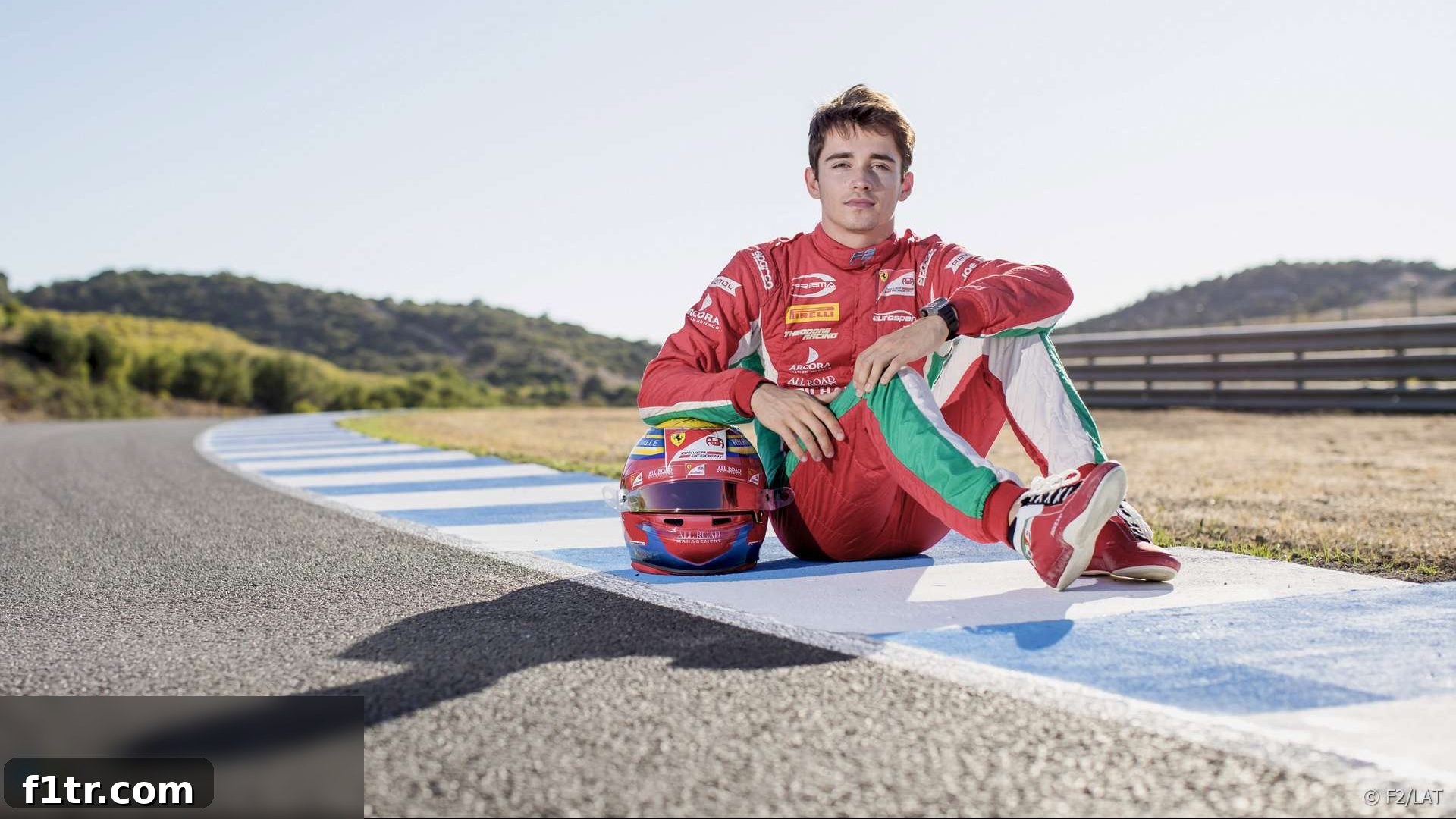
Charles Leclerc arrived in Formula 1 for the 2018 F1 season with Sauber, carrying the impressive distinction of consecutive championships in two of motorsport’s premier junior categories. His meteoric rise through the ranks captivated the racing world, signaling the arrival of a truly special talent. This in-depth look explores the pivotal moments and defining characteristics of his remarkable early career, shedding light on the grit, skill, and sheer determination that propelled him to the pinnacle of motorsport.
Leaving Karting at the Apex: A Rivalry with Max Verstappen
The parallels between Charles Leclerc and Max Verstappen are striking, not least because the two formidable talents are separated by a mere 16 days in age. While Verstappen, a Red Bull phenom, embarked on his fourth full season in Formula 1 by 2018, Leclerc’s journey to the top flight, though equally successful, followed a more traditional and slightly longer trajectory. Their paths, however, famously converged and diverged at a critical juncture in their karting careers.
The year was 2014, and the karting world championship final in the highly competitive KZ1 category served as the stage for their last head-to-head battle. In a thrilling display of nascent skill, Leclerc (wearing number 6) initially led Verstappen (number 1), both fiercely chasing early pacesetter Marco Ardigò. However, Verstappen, showcasing his characteristic audacious overtakes, eventually surged past both competitors to claim victory. Leclerc, demonstrating exceptional racecraft and resilience, secured a commendable second place, crossing the finish line just three seconds behind his rival. This intense showdown offered a tantalizing glimpse into the future of Formula 1, highlighting the immense potential of both drivers.
This early rivalry not only underscored their individual talents but also set the stage for their future competition in Formula 1, demonstrating that even at a young age, both possessed the competitive fire and raw speed destined for greatness. The memories of their karting duels remain a fascinating prelude to their ongoing battles on the Grand Prix circuits.
A Racing Pedigree: The Legacy of Herve Leclerc
Much like his contemporary Max Verstappen, Charles Leclerc hails from a family deeply ingrained in the world of motor racing. His father, Herve Leclerc, while not reaching the same international prominence as Jos Verstappen, was a respected figure in French motorsport. Herve competed in French Formula 3 throughout the 1980s, a period that fostered many future F1 stars, and was a regular and passionate participant in the prestigious Monaco F3 Grand Prix, a highly regarded event on the international racing calendar.
Herve’s profound love for motor racing, particularly his admiration for Ayrton Senna’s legendary qualifying laps around the iconic streets of Monaco, profoundly influenced young Charles. This passion was not just passed down but actively nurtured. It was through Herve’s close friendship with Philippe Bianchi, the father of the late Formula 1 driver Jules Bianchi, that Charles was formally introduced to the world of competitive motor racing, setting him on a path that would ultimately lead to Formula 1. This familial connection and early exposure provided a crucial foundation for Charles’s burgeoning career.
A Bond Forged in Racing: Growing Up with Jules Bianchi
The Bianchi family owned the kart track in Brignoles, France, a hallowed ground where Charles Leclerc first sat behind the wheel of a kart shortly before his fifth birthday. This initial experience quickly blossomed into an all-consuming passion, leading to young Charles occasionally skipping school to dedicate more time to practice and hone his skills on the track. The bond between Charles and Jules Bianchi, who was seven years his senior, was akin to that of brothers, forged through countless hours spent together at the kart circuit.
When Leclerc made his official racing debut, Jules Bianchi, already an accomplished driver on his own ascent, took on the role of his mechanic, offering invaluable guidance and support. Bianchi’s career progressed rapidly, reaching Formula 1 in 2013 and famously scoring his maiden points in Monaco the following year, a significant achievement for a driver in a midfield team. However, tragedy struck the motorsport world in 2014 when Bianchi suffered severe injuries during the Japanese Grand Prix. Leclerc, who was racing in Spain at the time, was deeply affected. Jules Bianchi tragically succumbed to his injuries in July 2015, leaving an immense void in the hearts of his family, friends, and the entire racing community.
Despite the profound loss of his childhood friend and mentor, Leclerc demonstrated astonishing mental fortitude and resolve, choosing to continue his racing career in tribute to Jules. The following year brought yet another devastating personal blow. Just days before the Azerbaijan Grand Prix, where Leclerc was competing in Formula 2, his beloved father, Herve, passed away. The emotional toll of these losses would have been insurmountable for most, but Charles, at just 19 years old, channeled his grief into an extraordinary performance.
Remarkably, a mere three days after his father’s death, Leclerc delivered a qualifying lap of unparalleled brilliance, snatching pole position by a staggering margin of more than half a second. The very next day, he converted that pole into a dominant victory in the feature race, showcasing not only his immense speed but also his exceptional mental strength under unimaginable pressure. He very nearly achieved a double victory on Sunday, crossing the line first in the sprint race, only to be relegated to second place due to a 10-second penalty for failing to slow sufficiently under yellow flags. Nonetheless, the sheer determination, resilience, and breathtaking talent he displayed in Baku earned him widespread admiration and cemented his reputation as a driver with an iron will and championship-winning potential.
A Historic Achievement: The First Back-to-Back GP3 and Formula 2 Champion
Charles Leclerc etched his name into the history books as the first driver to secure consecutive championships in GP3 and its successor, Formula 2 (formerly GP2). This achievement highlights not only his consistent excellence but also his rapid adaptability to different racing machines and competitive environments, a crucial trait for any aspiring Formula 1 driver.
Leclerc’s GP3 championship campaign in 2016 was a testament to his fighting spirit in a fiercely competitive season. He faced stiff opposition, particularly from his talented ART Grand Prix teammate, Alexander Albon. The title was ultimately decided under unusual circumstances in the final round. While Albon’s challenge ended prematurely after a tangle with Jack Aitken, Leclerc also found himself out of the race following a separate incident involving Santino Ferrucci. Despite the dramatic conclusion, Leclerc had accumulated enough points throughout the season to rightfully claim the championship, demonstrating his superiority over a strong grid of future F1 hopefuls.
Dominance in Debuts: Conquering Formula 2 at First Attempt
Leclerc’s transition to Formula 2 in 2017 was nothing short of sensational, marked by an utterly dominant performance that firmly established him as a generational talent. He became the first driver since Nico Hülkenberg in 2009 to win the highly challenging F2 title as a rookie, an incredible feat given the complexity and competitiveness of the series.
His raw speed was evident from the outset. But for a minor technical infringement during qualifying in Hungary, he would have secured pole position for an astounding eight consecutive races to start the season. This exceptional performance was achieved without the benefit of an experienced teammate to benchmark against, as his Prema Racing colleague, Antonio Fuoco, was also in his inaugural year in the category. Leclerc effectively carried the team, demonstrating leadership and an unmatched understanding of the new Pirelli tires and the Dallara F2 chassis.
By the season’s end, Leclerc had amassed a staggering 72-point lead over his closest rival, definitively wrapping up the title with three races still remaining on the calendar. Had it not been for a few unfortunate mechanical issues and racing incidents beyond his control, he could have secured the championship even earlier and by an even more significant margin. His F2 season was a masterclass in controlled aggression, strategic thinking, and sheer pace, leaving no doubt about his readiness for Formula 1.
A Continuing Racing Lineage: The Brother Arthur
The Leclerc family’s passion for motorsport extends beyond Charles. He has a younger brother named Arthur, who is also carving out his own career in racing. This mirrors a fascinating historical coincidence, as the last Charles to race in Formula 1, Charles Pic, also had a brother involved in motorsport. Arthur Leclerc’s presence in the junior categories further underscores the deep-rooted racing heritage and competitive spirit that defines the Leclerc household, hinting at a potential future dynasty in motorsport.
A High-Profile Endorsement: Massa’s World Champion Prophecy
Felipe Massa, a seasoned Formula 1 veteran and former Ferrari driver, publicly declared Charles Leclerc to be “world champion material.” This powerful endorsement carried significant weight within the paddock, and it wasn’t merely due to the fact that both drivers shared the same astute manager, Nicolas Todt. Todt, a prominent figure in driver management and the son of former FIA president Jean Todt, played a crucial role in Leclerc’s career, and Charles himself has often credited Todt’s backing as instrumental in enabling him to even enter the world of competitive racing.
The connection between Leclerc and Todt was initially fostered through Jules Bianchi, highlighting the intricate web of relationships within the F1 community. Massa’s assessment was based on Leclerc’s raw talent, his exceptional mental strength in the face of adversity, and his undeniable results in the junior formulas. Such high praise from an experienced F1 driver like Massa, who has witnessed countless talents, served as a resounding validation of the burgeoning Monegasque’s potential and further fueled expectations for his Formula 1 debut.
A Rare Breed: The Third F1 Driver from Monaco
While Monaco is synonymous with Formula 1, serving as a glamorous home for many F1 drivers and the backdrop for its most iconic race, very few drivers actually hail from the principality itself. Even 2016 world champion Nico Rosberg, though growing up there, represented Germany. Charles Leclerc, therefore, holds the unique distinction of being only the third Formula 1 driver to genuinely come from the home of motorsport’s most famous street circuit, adding another layer of historical significance to his career.
His predecessors are legendary figures in their own right. Louis Chiron, a true pioneer of Monegasque motorsport, achieved an incredible podium finish at his home race in 1950, a moment etched in F1 folklore. Olivier Beretta followed decades later, competing for the uncompetitive Larrousse team in 1994, where he managed to secure three top-10 finishes before his season was prematurely cut short. Leclerc’s arrival on the F1 grid not only revived this proud Monegasque lineage but also brought renewed hope for a homegrown hero to one day conquer the streets of Monte Carlo.
Mastering Modern Engagement: His Strong Social Media Presence
In an era where driver personality and fan engagement are increasingly vital, Charles Leclerc has proven himself adept not just on track but also off it. His social media presence, particularly on platforms like Twitter, is notable for its authenticity and engaging nature. One particular post eloquently encapsulates his charismatic personality and quick wit, often shared with his growing fanbase.
This ability to connect with fans on a personal level, sharing insights into his life and career with a blend of humor and seriousness, is a modern hallmark of top F1 drivers. Leclerc’s “Twitter game” is strong because it allows his supporters to feel a closer connection to him, showcasing a relatable side beyond the intense competitor seen on the circuit.
Discover More About Charles Leclerc
For those eager to delve deeper into the career of this extraordinary talent, here is a detailed history of his journey so far:
- Charles Leclerc biography
Show Your Support for Charles Leclerc
Are you cheering for Charles Leclerc as he embarks on his Formula 1 journey? Here’s how you can proudly display your support for him and all the other incredible drivers on the grid within the RaceFans community:
- If you haven’t already, create an account with RaceFans to join our vibrant community.
- Once logged in, navigate to the ‘Edit My Profile’ section, typically found in the top-right menu.
- Locate the ‘F1 Teams and Drivers’ option within your profile settings.
- Make your selections to indicate your favorite teams and drivers, then click ‘Save Changes’ to update your preferences.
Explore the 2018 F1 Season Archives
Delve into the key events, news, and analysis from the season that marked Charles Leclerc’s Formula 1 debut:
- F1 feared “death knell” for Drive to Survive after Ferrari and Mercedes snub
- McLaren staff told us we were “totally crazy” to take Honda engines in 2018 – Tost
- ‘It doesn’t matter if we start last’: How Red Bull’s junior team aided Honda’s leap forward
- Honda’s jet division helped F1 engineers solve power unit problem
- McLaren Racing losses rise after Honda split
Browse all 2018 F1 season articles