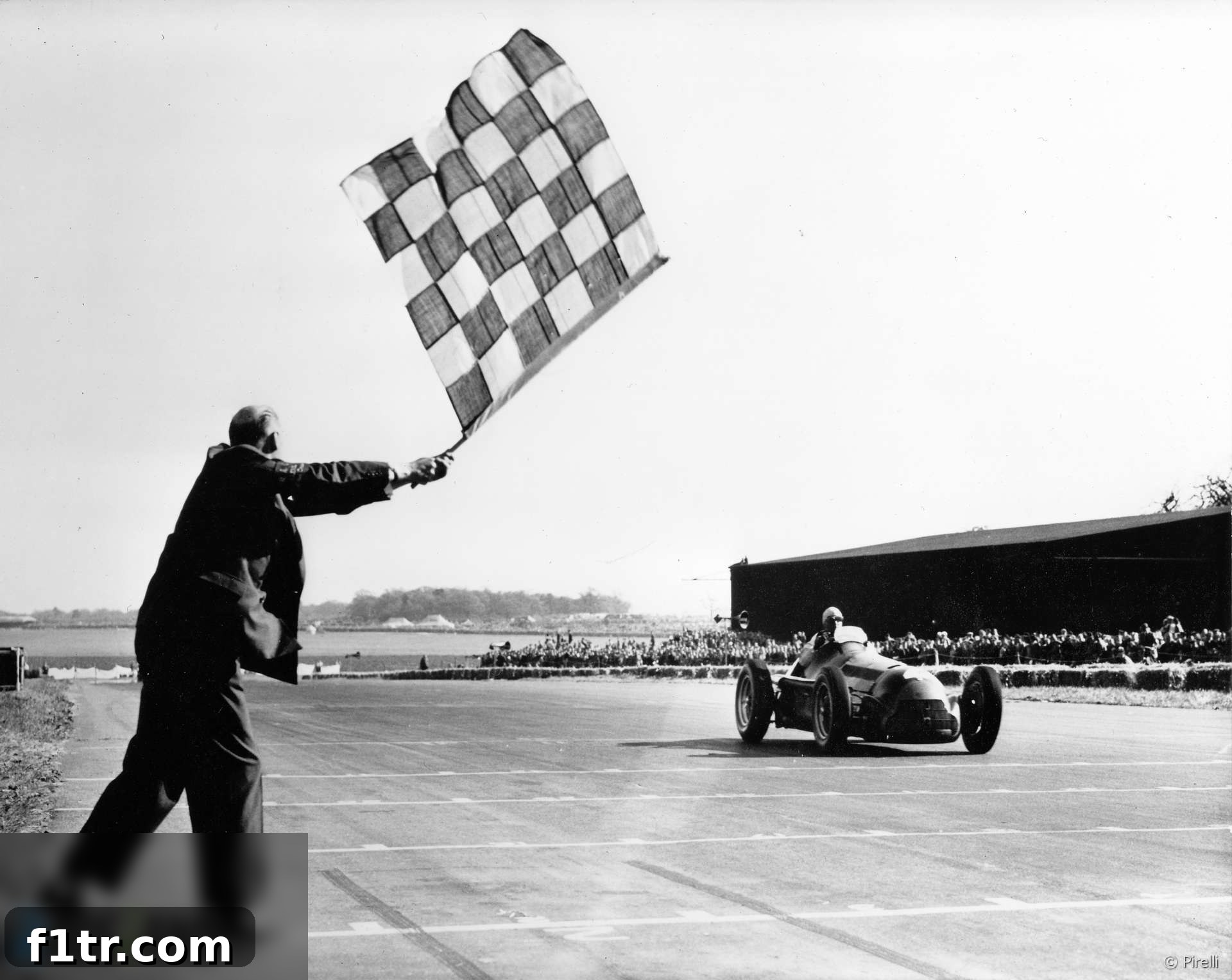
The Genesis of Speed: Unraveling the Birth of the Formula 1 World Championship in 1950
Seventy years ago, on a historic day at Silverstone, the roar of powerful engines heralded the birth of a global phenomenon: the Formula 1 World Championship. This seminal event not only laid the groundwork for modern motorsport but also ignited fierce rivalries between legendary marques like Alfa Romeo and Ferrari. Delve into the fascinating origins of this pinnacle of racing, exploring how the championship was conceived and how these two Italian giants set the unprecedented pace in its inaugural year, as drawn from Peter Higham’s insightful book, ‘Formula 1 Car by Car 1950-59’.
1950: A New Era Dawns – The Foundation of the Formula 1 World Championship
The aftermath of World War II left much of Europe, and indeed the world, in tatters, but it also sparked a profound desire for renewal and a return to normalcy. For the world of motorsport, this meant rebuilding and redefining its future. The pre-war governing body, the Association Internationale des Automobile Clubs Reconnus (AIACR), underwent a crucial transformation in 1947, emerging as the Fédération Internationale de l’Automobile (FIA). Tasked with charting a new course for the sport, a specialized subcommittee, the Commission Sportive Internationale (CSI), was established. This influential body convened in October 1947 and meticulously crafted a new set of Grand Prix regulations for the forthcoming 1948–53 seasons.
These groundbreaking rules, initially dubbed Formula A but swiftly rebranded as Formula 1, outlined strict engine capacity limits: 4.5 litres for normally aspirated engines or 1.5 litres for forced-induction (supercharged or turbocharged) powerplants. This technical framework was designed not only to encourage innovation but also to ensure a competitive yet manageable playing field, setting the stage for exhilarating and equitable competition.
Inspired by the success of a motorcycling world championship that had been successfully launched in 1949, the concept of an F1 World Championship for drivers gained significant traction within the FIA. In the final week of February 1950, a pivotal meeting saw Count Antonio Brivio, Italy’s delegate to the FIA and a respected former pre-war racing driver, passionately propose this very idea. The proposal was enthusiastically accepted, leading to the official announcement of the inaugural F1 World Championship calendar. It comprised six prestigious European Grandes Épreuves: Britain, Monaco, Switzerland, Belgium, France, and Italy, along with the inclusion of the iconic Indianapolis 500 race in the United States. Points were to be meticulously awarded to the top five finishers on a scale of 8–6–4–3–2, with an additional bonus point allocated to whoever set the fastest race lap. While the Indianapolis 500 technically extended the championship’s geographic reach beyond European shores, its distinct rules and highly specialized car specifications meant it held little practical relevance or participation for the European-based teams and drivers during its eleven-year official inclusion.
The Inaugural British Grand Prix: A Historic Day at Silverstone
The dawn of this new, global championship arrived on Saturday, May 13, 1950, at the hallowed grounds of Silverstone Circuit, a former RAF airfield that had quickly become synonymous with British motorsport. The event, bestowed with the honorary title of the Grand Prix of Europe, was conceived as a grand spectacle worthy of its historic significance. Prior to the start of the main race, the participating drivers, including the top competitors from the supporting F3 race, were formally presented to the royal party by Earl Howe, adding a distinctly regal touch to the momentous occasion. Count Brivio himself, the architect of the championship, had the distinct honour of flagging off the very first World Championship race. A massive crowd, estimated at up to 100,000 enthusiastic spectators, flocked to witness history unfold, with ticket prices ranging from an accessible six shillings for general admission purchased in advance to £2 2s for a prime viewing spot in the main pit grandstand. They were treated to a dominant and almost effortless display by the Alfa Romeo team, whose powerful supercharged cars swept the top three positions. While Alfa’s powerful but notably thirsty machines ultimately secured the inaugural title, Ferrari, with astute foresight, cleverly exploited the larger capacity normally aspirated engine alternative, posing an increasingly serious challenge by the season’s close.
British Racing Motors (BRM): A Promising Concept Plagued by Early Woes
For British fans, the most anticipated national contender, British Racing Motors (BRM), faced a profoundly disappointing and inauspicious start to the championship. Their highly ambitious Type 15, equipped with a revolutionary and complex V16 engine, had been unveiled amid considerable fanfare and hype at Folkingham airfield on December 15, 1949. Founder Raymond Mays provided a brief but tantalizing demonstration during the 1950 British GP meeting, igniting fervent hopes for a home-grown champion. However, the complex and groundbreaking machine was unfortunately plagued by persistent developmental issues and crippling reliability problems, preventing it from appearing in any championship race that year. Its competitive debut finally came in Silverstone’s non-championship International Trophy, a precursor event, where Raymond Sommer tragically broke its transmission at the very start of his heat, a disheartening and public setback for the nascent project. Reg Parnell did manage to secure a couple of minor victories in lesser, non-championship races at a rain-soaked Goodwood in September, offering a fleeting glimpse of potential. Yet, in the non-championship season finale in Barcelona, both he and Peter Walker were forced to retire their BRMs. Goodwood aside, it was a truly sorry and inauspicious beginning for Britain’s national team, underscoring the immense technical challenges and financial pressures of building a competitive Formula 1 car from scratch in this pioneering era.
Alfa Corse (Alfa Romeo): The Unchallenged Reign of the Alfettas
Alfa Romeo, with its iconic and much-celebrated Type 158, affectionately known throughout motorsport circles as the ‘Alfetta,’ proved to be the undisputed dominant force in the inaugural year of the World Championship. This formidable racing machine, powered by a sophisticated 1.5-litre, eight-cylinder supercharged engine, boasted a rich and successful heritage dating back to its origins. Designed by the brilliant Gioacchino Colombo for voiturette racing back in 1938, it was a program ironically initiated by Enzo Ferrari himself during his tenure overseeing Alfa Romeo’s racing operations. The Type 158 featured a conventional yet robust tubular chassis, independent front suspension utilizing advanced trailing arms, and a swing axle at the rear. Its four-speed gearbox efficiently managed the immense power from a supercharged 1,479cc straight-eight engine, complete with double-overhead camshafts. This sophisticated engineering made the Alfetta a marvel of its time, combining power with surprising agility.
The car’s official debut in the 1,500cc race supporting the 1938 Coppa Ciano at Livorno saw Emilio Villoresi lead an Alfa Romeo 1–2 finish, providing an early and clear hint of its future prowess. By 1947, the Alfettas were fully compliant with the new Formula 1 regulations and proved virtually unbeatable in that year and the next, sweeping aside all competition. Technical refinements included replacing the original small-diameter twin exhaust arrangement with a more efficient single exhaust pipe and fitting triple choke Weber carburettors, further enhancing both power delivery and reliability. However, the team faced immense tragedy with the untimely deaths of three prominent drivers who had contributed greatly to Alfa Romeo’s racing legacy: Achille Varzi, killed during practice for the 1948 Swiss GP; Jean-Pierre Wimille, who perished in a Simca-Gordini accident in Buenos Aires’ Palermo Park in January 1949; and Count Trossi, who succumbed to cancer later that same year. These profound losses deeply affected the team and cast a sombre shadow over their otherwise stellar record.
Resurrection and Re-entry for the 1950 Championship
Alfa Romeo’s 1949 racing season was completely absent, a direct consequence of the post-war economic climate and the team’s internal restructuring. Consequently, their participation in the nascent 1950 World Championship was initially shrouded in considerable uncertainty. As reported by the respected automotive journal The Autocar in January of that year, the team’s appearance was entirely dependent on the company’s precarious financial health and the prevailing political climate in Italy. Fortunately, after much deliberation and intense lobbying, and amid crucial discussions of a vital government subsidy, a three-car entry was finally confirmed in March, much to the immense relief and excitement of motorsport enthusiasts worldwide. For the 1950 season, the Alfetta’s already potent engine received a significant upgrade, now featuring two-stage supercharging and developing a remarkable 360bhp at 8,500rpm. Such was their initial supremacy that drivers often restricted revs to 8,000rpm, showcasing their comfortable performance margin over the competition. The team partnered strategically with Pirelli for tyres and Shell for oil and fuel, forming a formidable technical alliance that contributed to their consistent success. Giovanni-Battista Guidotti remained at the helm as team manager, while Orazio Satta Puliga, who had joined the design department in 1938, commenced the year as chief engineer, guiding the team’s ongoing technical direction and evolution.
The driver lineup for Alfa Romeo was equally impressive and strategically assembled. Rising star Juan Manuel Fangio, a name destined for greatness, joined the experienced Giuseppe Farina, forming a potent duo. Luigi Fagioli, ending a remarkable twelve-year retirement from top-level racing, replaced Consalvo Sanesi, who was the intended third driver but sustained an unfortunate arm injury during the challenging Mille Miglia endurance race. Fangio quickly demonstrated his prodigious talent, securing a convincing victory in a non-championship race at a wet San Remo on his team debut, beating Luigi Villoresi’s Ferrari by over a minute. This early triumph unequivocally signalled Alfa Romeo’s intentions and formidable capabilities for the championship season ahead.
Silverstone and Early Season Triumphs
Alfa Romeo’s next pivotal event was the British Grand Prix at Silverstone, marking their first official appearance on English soil. The formidable trio, inevitably dubbed the ‘three Fs’ (Farina, Fagioli, Fangio), was augmented by local hero Reg Parnell in a fourth factory Type 158, adding to the home crowd’s excitement and anticipation. Ferrari’s unexpected withdrawal just weeks before the race paved the way for Alfa Romeo to completely dominate qualifying, locking out the entire four-car front row, with Giuseppe Farina securing pole position. In the early stages of the race, Farina, Fagioli, and Fangio engaged in a thrilling display of skill and teamwork, swapping the lead for the opening twenty laps, while Parnell, utilizing slightly higher gear ratios, held a solid fourth place. However, with just eight laps remaining, Fangio, running a close second, was forced to retire due to a fractured oil pipe, a cruel blow. This allowed Farina to lead a commanding 1–2–3 finish for Alfa Romeo, securing a historic victory. Parnell, despite his radiator being deranged after an unfortunate collision with a hare on the track, heroically managed to secure third place. Such was Alfa Romeo’s overwhelming superiority that the entire opposition had been thoroughly outclassed, being lapped at least twice, a clear indication of their unmatched performance advantage.
Just eight days later at the legendary Monaco Grand Prix, Fangio once again made a superb start from pole position. However, Farina was outmaneuvered off the line by José Froilán González’s Maserati. While recovering admirably to second place by the Tabac corner, Farina lost control on a treacherous patch of water that had been swept over the harbour wall by a sudden gust of wind. He crashed heavily, and his bouncing Alfa tragically rebounded back into the narrow road, triggering a massive pile-up that eliminated half the field in the ensuing chaos. Fagioli also retired in the pits after fifteen minutes of frantic hammering failed to straighten his bent steering. Fangio, demonstrating incredible presence of mind and uncanny skill, expertly squeezed through the wreckage of the crashed cars and, by the end of lap two, had built a commanding lead of 51.8 seconds. He maintained this lead throughout the remainder of the race, ultimately lapping the severely depleted field to secure a remarkable and dramatic victory.
The relentless ‘three Fs’ continued their dominance in Switzerland, where Farina and Fagioli secured a commanding 1–2 finish, despite Fangio qualifying on pole position but being forced to retire while running a strong second. A significant hint of future technical trends emerged at Spa-Francorchamps: Raymond Sommer’s 4.5-litre Lago-Talbot, utilizing a normally aspirated engine, remarkably led for five laps while the supercharged Alfas made their initial refueling stops. With the thirsty 158s requiring a second stop and Sommer running non-stop, a potential upset loomed large in the Belgian air. However, the Frenchman’s engine regrettably failed after twenty laps, allowing Fangio to lead Fagioli home. Farina, after prudently pitting to check falling oil pressure, finished fourth at a reduced pace, signaling that while the Alfettas were undeniably fast, their high fuel consumption was a potential vulnerability that competitors might exploit in the future.
Fangio once again secured pole position for the French Grand Prix at Reims, leading yet another Alfa 1–2–3 in qualifying. Farina led the opening sixteen laps before two lengthy pitstops were necessitated to resolve a persistent fuel-feed problem. Despite these significant setbacks, he valiantly climbed back into third position before his car eventually coasted to a halt on the back straight with nine laps remaining. With Farina classified outside the points, Fangio capitalised fully on his consistent performance, taking a maximum score to seize the championship lead with just one crucial round left to race. Both Fangio and Fagioli finished an impressive three laps clear of the rest of the field, even easing their pace in the closing stages, further underscoring Alfa Romeo’s formidable and unparalleled superiority.
Championship Climax and Farina’s Historic Triumph
Before the final championship showdown, Alfa Romeo continued their winning streak in several non-championship events: Farina triumphed at Bari and Silverstone, while Fangio claimed impressive victories at Geneva and Pescara. A notable and controversial incident occurred at Pescara where Fagioli was poised for victory, but his front suspension dramatically broke on the final lap. Fangio, following closely, observed the stricken car limping agonisingly towards the finish. However, seeing Louis Rosier’s fast-closing Lago-Talbot threatening to snatch victory, Fangio decisively sped past Fagioli within sight of the line, a controversial move that nonetheless showcased his fierce competitive spirit and singular focus on victory.
The stage was thus magnificently set for the Italian Grand Prix at Monza, the ultimate championship decider, with only four crucial points separating the regular Alfa Romeo team-mates. To bolster their chances and ensure a strong presence, Alfa Romeo entered additional Type 158s for Consalvo Sanesi and Piero Taruffi. It appeared that company management subtly favored Giuseppe Farina, as he was notably provided with an upgraded engine that delivered an extra 20bhp, effectively transforming his car into what was now dubbed the Type 159. For the first time in the season, Alfa Romeo faced meaningful and direct opposition, as Ferrari finally harnessed the full potential of its 4.5-litre normally aspirated capacity. Fangio qualified on a familiar pole position, but it was Farina who made the best start. Alberto Ascari’s Ferrari bravely led for a couple of laps, thrilling the Tifosi and showcasing Ferrari’s dramatically improved pace, before both he and Fangio were unfortunately forced to retire. Fangio then controversially took over Taruffi’s car, but it too broke down after a few laps. Farina, demonstrating incredible resilience, continued unchallenged to a magnificent victory, which not only secured his win at Monza but also clinched the inaugural Formula 1 World Drivers’ Championship title, cementing his place in history. Fagioli finished a respectable third, while Sanesi, who had qualified brilliantly on the outside of the front row in fourth place, retired early in the race. Less than a month after his historic triumph, Farina was tragically injured in a serious road accident outside Genoa. Meanwhile, Fangio, reportedly frustrated by a string of bad luck and perceived team orders, returned to Argentina to contemplate his future in the sport, leaving an intriguing and dramatic conclusion to the first-ever F1 season.
Scuderia Ferrari: The Challenger Emerges with a New Philosophy
Scuderia Ferrari represented the primary hope for providing substantial and meaningful opposition to the seemingly invincible Alfa Romeo team. Enzo Ferrari, a name that would soon become synonymous with motorsport excellence, originally founded his racing stable, the Scuderia, in 1929. However, it wasn’t until 1940 that he embarked on constructing his own cars under the esteemed Ferrari marque. The very first hint of Ferrari’s Formula 1 aspirations came with Prince Igor Troubetzkoy driving a modified Ferrari 166 sports car in the 1948 Monaco Grand Prix. The marque’s first true Formula 1 car, purpose-built for the new regulations, made its debut at the Italian Grand Prix that same year, marking the tentative but determined beginning of a legendary journey.
In a significant strategic move, former Alfa Romeo engineer Gioacchino Colombo joined Ferrari on January 1, 1948. He promptly designed the short-wheelbase Ferrari 125, featuring a robust tubular chassis and a 1,498cc 60-degree V12 engine, initially equipped with a single Roots type supercharger and a four-speed gearbox. The original 125 incorporated transverse-leaf independent front suspension and a torsion-bar rear axle. However, it was quickly identified as being underpowered and suffered from poor handling characteristics compared to the dominant Alfas. Recognizing these deficiencies, Colombo’s assistant, the brilliant Aurelio Lampredi, undertook a comprehensive redesign for the 1949 Italian Grand Prix. This revised version boasted two-stage supercharging, twin overhead camshafts, a five-speed gearbox, and, crucially, modified rear suspension coupled with a longer chassis to significantly enhance handling and stability. Alberto Ascari triumphantly won that race, showcasing the car’s improved potential and Ferrari’s growing competitiveness. Both Ascari and Luigi Villoresi remained as the works drivers for the 1950 season, forming the core of Ferrari’s ambitious challenge.
Early Season Challenges and Pivotal Strategic Shifts
Ferrari’s entry for the British Grand Prix was unexpectedly withdrawn just two weeks before the inaugural World Championship race. The Autocar, the leading motoring publication of the time, reported that this decision stemmed from “the usual disagreement with regard to the amount of starting money to be paid for their attendance,” highlighting the often-contentious financial negotiations common in early motorsport. Ferrari subsequently arrived late for the challenging Monaco Grand Prix, a critical mistake as qualifying positions for the top five were determined exclusively in the first practice session, effectively sidelining them from prime grid spots. Despite this setback, Ascari and Villoresi, whose practice times would have secured Villoresi second on the grid, managed to skillfully avoid the horrific opening-lap chaos at Tabac. However, Villoresi unfortunately chose the wrong path around the pile-up on the second lap and stalled. He heroically push-started his car but ultimately retired from third place. Ascari, demonstrating remarkable skill and composure amid the carnage, managed to finish an impressive second, securing Ferrari’s very first World Championship points.
For the Swiss Grand Prix at Bremgarten, Villoresi was provided with a lighter, new chassis, featuring a four-speed gearbox, a sophisticated de Dion rear suspension, and a wheelbase restored to its original length, indicating Ferrari’s continuous and rapid efforts to refine their machines. Both regular drivers initially ran competitively among the dominant Alfas before ultimately retiring due to mechanical issues. Raymond Sommer also participated, driving the works V12 Ferrari 166/F2/50, a car he had successfully used to win the supporting F2 race. However, its suspension regrettably failed before the halfway mark in the main Grand Prix, further underscoring the durability issues some of Ferrari’s early supercharged models faced against the robust and proven Alfettas.
Recognizing with clarity that their supercharged cars were simply no match for the overwhelming dominance of the Alfas, technical director Aurelio Lampredi initiated a crucial and visionary strategic shift: he began experimenting with normally aspirated engine designs. The first iteration of this new philosophy courageously appeared at Spa-Francorchamps. Here, Alberto Ascari, driving an old long-wheelbase chassis fitted with an atmospheric 60-degree single-overhead cam 3,322cc V12 sports car engine (renamed the Ferrari 275), managed an impressive fifth-place finish despite an early puncture. While still underpowered and lacking the fuel range of competitors like the Lago-Talbots, this marked a significant and bold turning point in Ferrari’s engineering direction, away from forced induction. For the French Grand Prix, no supercharged works cars were fielded; instead, Ascari and Villoresi shared the experimental Ferrari 275 during practice, but the car was eventually withdrawn from the race, indicating that the development was still in its very early and formative stages.
The Rise of the Naturally Aspirated Ferrari 375: A Glimpse of the Future
Ferrari’s commitment to the normally aspirated concept intensified and rapidly accelerated throughout the season. The engine capacity was strategically stretched to 4,101cc for the non-championship GP des Nations in Geneva, signaling continuous progress and refinement of the new philosophy. The true game-changer, however, arrived dramatically at the Italian Grand Prix at Monza: two brand new 4,494cc Ferrari 375s were introduced, representing a quantum leap in Ferrari’s design. These revolutionary cars featured a completely redesigned tubular chassis, a robust four-speed gearbox, independent front suspension via wishbones and transverse leaf springs, and a sophisticated de Dion rear end. The 375 was a formidable machine, a testament to Lampredi’s vision and Enzo Ferrari’s unwavering determination.
At Monza, Ascari qualified an impressive second and briefly led for a couple of laps, thrilling the ecstatic Tifosi and bravely challenging the seemingly unbeatable Alfas, before his engine unfortunately failed. Luigi Villoresi had sustained an injury at Geneva, so Dorino Serafini drove the second Ferrari 375. He qualified a commendable sixth and, in a display of astute team strategy, handed his car over to Ascari, who then drove it to a magnificent second-place finish, securing crucial points and unequivocally demonstrating the 375’s immense potential. With Alfa Romeo notably absent from the final championship round at Barcelona, Ascari capped off the 1950 season by leading a dominant Ferrari 1–2–3 in the Penya Rhin Grand Prix. This emphatic victory unequivocally confirmed that normally aspirated engines represented Ferrari’s immediate and highly promising future in Formula 1, setting the stage for even fiercer battles and a new era of competition in the years to come.
For enthusiasts keen to delve deeper into the rich tapestry of early Formula 1, ‘Formula 1 Car by Car 1950-59’ by Peter Higham offers an unparalleled and meticulously detailed history of every car that raced in the foundational decade of the world championship. Keep an eye out for an upcoming review on RaceFans to learn more about this essential read.
You can purchase ‘Formula 1 Car by Car 1950-59’ directly from Evro Publishing, an excellent resource for motorsport literature.
Further Insights into F1 History
- When did F1 last have a mid-season break longer than five weeks? 1990
- Did Norris actually win Formula 1’s closest championship fight of all time?
- Hamilton is Ferrari’s first new driver in 44 years to complete season without a podium
- Ferrari are on course to lose an F1 record they’ve held since 2004
- Red Bull in 2010 or Ferrari in 1979? Past title fights illustrate McLaren’s current dilemma
Browse all history articles