Red Bull’s Costly Azerbaijan GP Collision: Verstappen and Ricciardo Reprimanded
The 2018 Formula 1 Azerbaijan Grand Prix delivered an unforgettable spectacle of high-speed drama, but for Red Bull Racing, it concluded in the most disastrous way imaginable. Teammates Max Verstappen and Daniel Ricciardo, locked in a fierce battle for position, collided on the main straight, resulting in a double retirement that sent shockwaves through the paddock. Following an extensive investigation, race stewards issued reprimands to both drivers, attributing fault to both for the pivotal incident.
The Baku Battle Unfolds: A High-Stakes Rivalry
The streets of Baku had already witnessed a race filled with incidents and safety car periods, setting the stage for a tense strategic battle. By lap 40, the two Red Bull drivers, renowned for their aggressive racing styles, found themselves vying for fourth position. Ricciardo had just completed an impressive overtake on Verstappen, but the Dutchman quickly fought back, attempting to reclaim his spot. This intra-team battle had been brewing throughout the race, with both drivers pushing the limits and making daring moves against each other, much to the delight and apprehension of fans and the team alike.
Approaching Turn 1 at blistering speed, Verstappen initially defended his line against Ricciardo’s attack. As they hurtled towards the braking zone, Ricciardo attempted to make a move down the inside. However, Verstappen moved slightly to cover the inside line, a common defensive tactic. Critically, Ricciardo, perhaps anticipating an opening or reacting late, committed to his overtake attempt. The consequence was immediate and devastating: Ricciardo, running close behind Verstappen, misjudged the closing speed and clipped the rear of his teammate’s car, leading to a catastrophic loss of control for both.
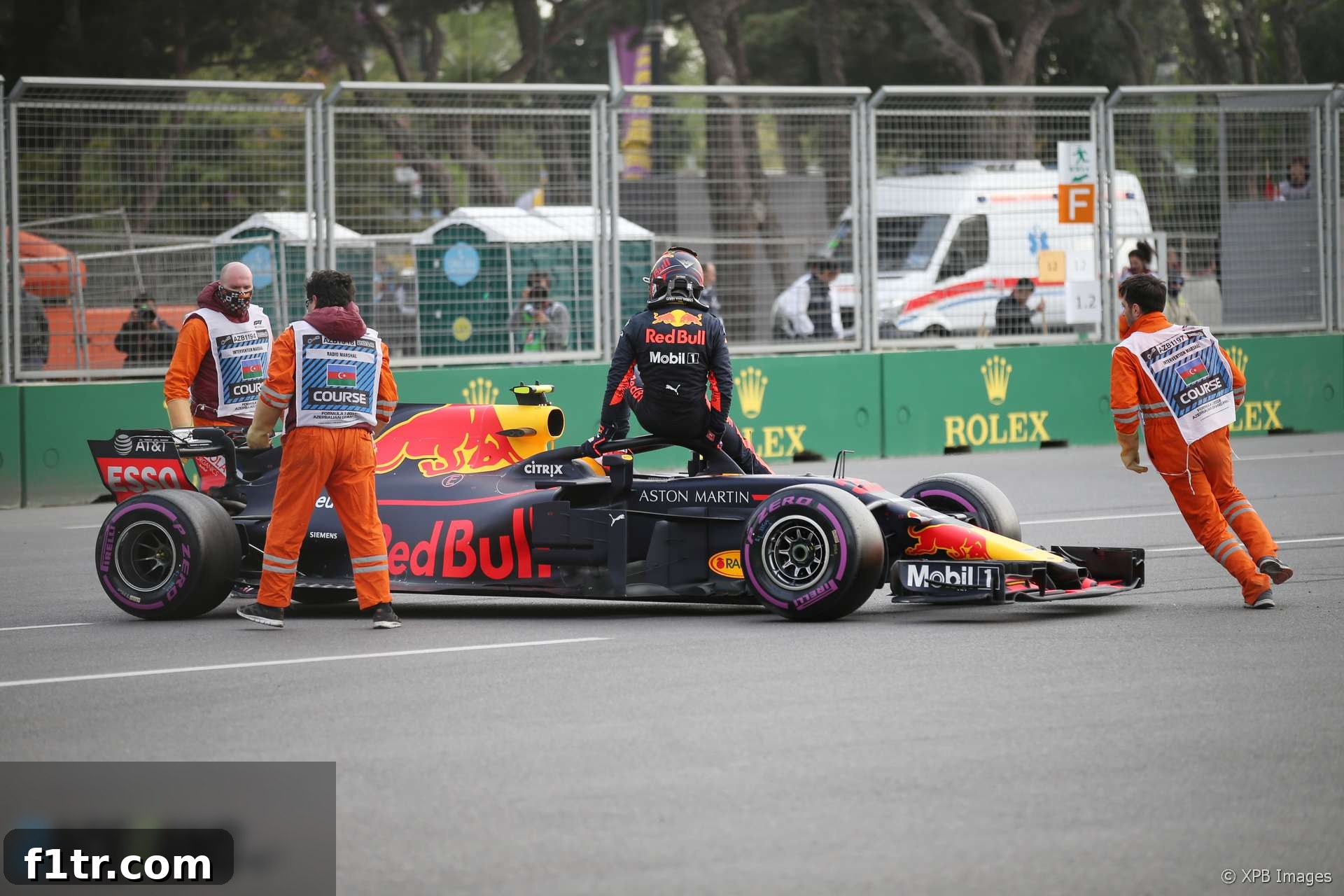
The collision was not just a minor bump; it was a full-speed impact that ripped front wings and punctured tires, sending both RB14s into retirement. The image of two Red Bull cars, mangled and stationary on the track, underscored the severity of the incident and the immense cost to the team’s championship aspirations. It was a stark reminder of the fine line between thrilling racing and devastating consequences, especially when the competitors are teammates.
Stewards’ Verdict: Shared Responsibility and Reprimands
Immediately after the race, the stewards launched an inquiry into the collision, a standard procedure for such significant incidents. Both Max Verstappen, the driver of car 33, and Daniel Ricciardo, the driver of car 3, were summoned to the stewards’ office along with a team representative. The deliberation was thorough, examining telemetry, onboard footage, and driver testimonies to piece together the sequence of events.
The official statement from the stewards revealed a nuanced understanding of the incident, concluding that “both drivers contributed to the collision.” They specifically noted that “the driver of car 33 made two moves, both of which were relatively minor.” This pointed to Verstappen’s defensive maneuvers on the main straight, which, while within the bounds of racing rules, were deemed to have contributed to the escalating tension and narrow margins. On the other hand, “the driver of car three admitted he left his move to overtake on the left, too late.” Ricciardo’s late decision and subsequent commitment to the overtake were identified as a significant factor in the impact.
Ultimately, the stewards clarified that “although the incident had its origins in the moves by car 33, the driver of car three also contributed to the incident.” This balanced assessment highlighted the complex dynamics of racing, where a chain of events and decisions by multiple drivers can lead to a single outcome. The decision to issue reprimands rather than more severe penalties like grid drops or time penalties reflected the belief that it was a racing incident stemming from aggressive competition rather than deliberate foul play. Both drivers, in a display of sportsmanship and responsibility, “expressed regret about their respective contributions to the incident, during the stewards’ hearing,” acknowledging the severity of their actions and the consequences for the team.
Horner’s Reaction: Defending “Let Them Race” While Counting the Cost
For Red Bull team principal Christian Horner, the incident was a bitter pill to swallow. His immediate post-race comments encapsulated the frustration and disappointment of a team that had lost a significant haul of points due to an avoidable internal clash. Horner, a staunch proponent of the “let them race” philosophy, found himself defending the team’s long-standing policy while simultaneously dealing with its most damaging manifestation.
“As a policy we want to let our guys race,” Horner stated, reiterating a principle that has defined Red Bull’s approach to driver management for years, fostering an environment where competitive instincts are encouraged. “We’ve let them race hard against each other. And unfortunately today has resulted in the worst possible scenario where you’ve had both drivers make contact and retire from the grand prix.” This sentiment underscored the fine line the team walks between promoting thrilling, unadulterated racing and maintaining team harmony and championship aspirations.
Crucially, Horner refused to place more blame on one driver than the other. “There’s no blame apportioned more in one position than the other. They’re both equally responsible.” This commitment to equal accountability was vital for maintaining an equitable environment within the team, preventing any perception of favoritism that could further destabilize driver dynamics. However, the emotional and strategic cost was undeniable: “What’s obviously annoying is we’ve given away an awfully large amount of points today so both the drivers will be apologising to all the members of staff who work so hard to put these cars together.” The acknowledgement of apologies highlighted not only the drivers’ regret but also the immense collective effort and investment that goes into preparing two Formula 1 cars for a Grand Prix, only to see it all unravel in a single, costly moment.
The Baku collision brought Red Bull’s “let them race” policy under intense scrutiny. While it often delivers exciting racing, it also carries inherent risks, especially when two highly competitive drivers like Verstappen and Ricciardo are involved. The incident forced the team to re-evaluate the boundaries of their racing philosophy, even if the core principle remained. It was a testament to the team’s belief in empowering their drivers, but also a stark reminder of the potential consequences when that empowerment leads to internal conflict on track.
Long-Term Impact: A Turning Point for Red Bull?
The double retirement in Baku was more than just a loss of points; it was a significant moment in the 2018 Formula 1 season and, arguably, in the career trajectories of both drivers at Red Bull. For the team, it was a missed opportunity to capitalize on a chaotic race where their main rivals, Mercedes and Ferrari, also faced challenges. The loss of points had a tangible impact on Red Bull’s position in the Constructors’ Championship, making their fight for second or third even harder against the might of Mercedes and Ferrari.
For Daniel Ricciardo, the Azerbaijan Grand Prix incident, coupled with other frustrating reliability issues and perceived disadvantages compared to Verstappen, contributed to a growing dissatisfaction within the team. By the end of the 2018 season, Ricciardo made the surprising decision to leave Red Bull for Renault, a move that shocked many in the paddock. While no single event dictates such a major career decision, the Baku collision and its aftermath certainly played a role in the narrative of his waning comfort at Milton Keynes, highlighting the escalating tension in his rivalry with the younger, rapidly ascendant Max Verstappen.
Max Verstappen, on the other hand, continued to solidify his position as Red Bull’s future star. While he shared blame in Baku, his aggressive driving style was often seen as part of his immense talent and potential. The team continued to build around him, fostering a competitive environment where he could thrive. The incident, therefore, served as a painful but perhaps necessary lesson in managing intra-team rivalry, emphasizing the importance of balancing competitive spirit with a collective responsibility to the team’s objectives.
The 2018 season was ultimately a transitional one for Red Bull. While they secured victories, the consistency required to challenge for championships was undermined by moments like Baku. The collision became a reference point for discussions about team orders, driver accountability, and the inherent risks of allowing two top-tier talents to race without constraint. It underscored that in the high-stakes world of Formula 1, even the most thrilling rivalries can have severe and lasting repercussions.
Don’t miss anything new from RaceFans
Follow RaceFans on social media to stay updated with the latest F1 news and analysis:
- Join RaceFans on Facebook
- Follow RaceFans on Twitter
- Get daily email updates from RaceFans
2018 F1 season: Related Articles
Delve deeper into the events and stories from a memorable season:
- F1 feared “death knell” for Drive to Survive after Ferrari and Mercedes snub
- McLaren staff told us we were “totally crazy” to take Honda engines in 2018 – Tost
- ‘It doesn’t matter if we start last’: How Red Bull’s junior team aided Honda’s leap forward
- Honda’s jet division helped F1 engineers solve power unit problem
- McLaren Racing losses rise after Honda split
Browse all 2018 F1 season articles