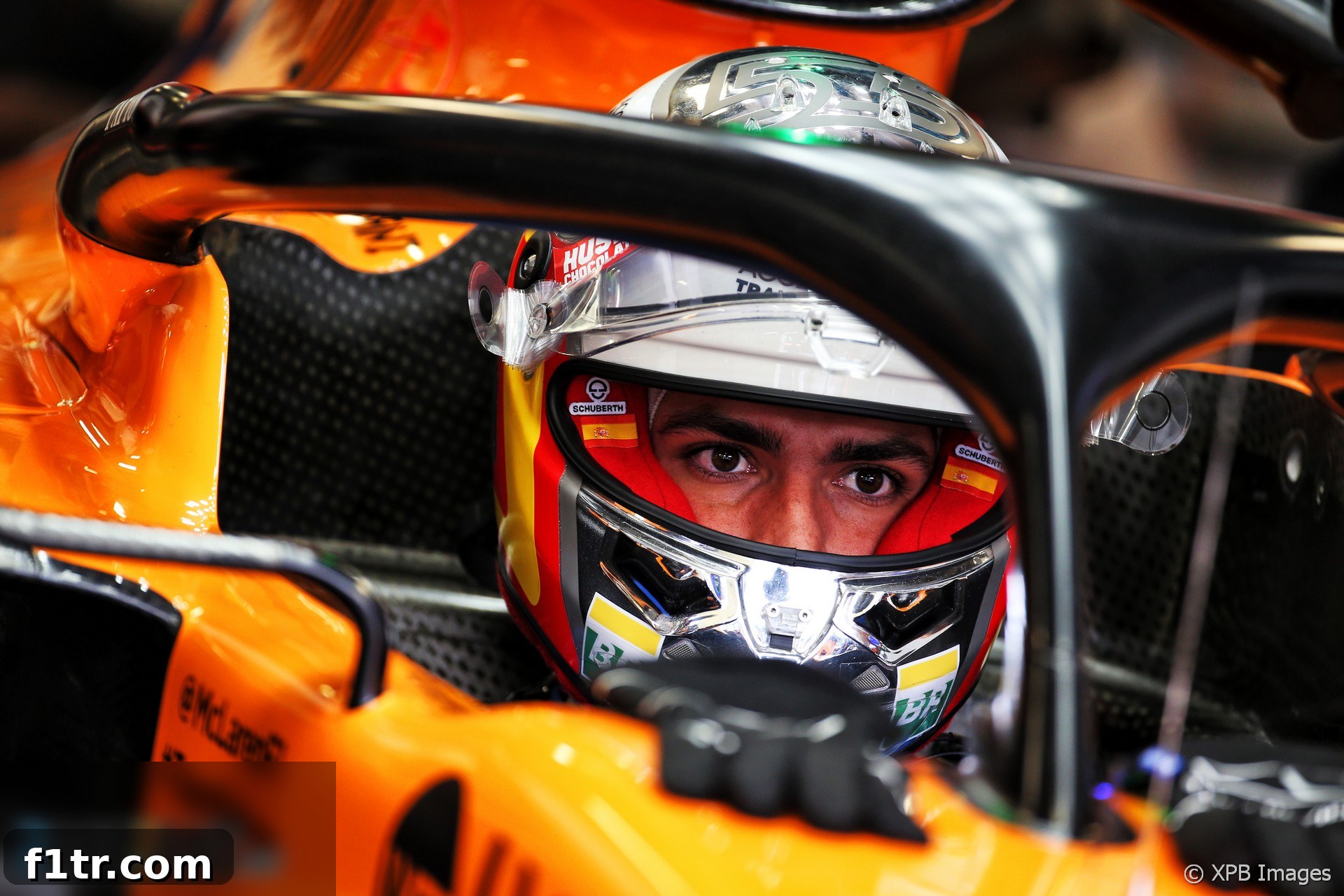
In the thrilling world of Formula 1, drivers constantly push the boundaries of speed and human endurance. Yet, behind the wheel, a different kind of battle unfolds – a psychological one against the inherent dangers of the sport. Recent comments from McLaren’s Carlos Sainz Jnr shed light on how elite athletes like him mentally navigate this high-stakes environment, revealing a fascinating insight into the mindset required to compete at the pinnacle of motorsport.
The Psychology of Speed: Carlos Sainz Jnr on Facing F1’s Dangers
For a Formula 1 driver, the line between courage and caution is razor-thin, and the consequences of misjudgment can be severe. When questioned about how he confronts the ever-present danger in F1 racing, Carlos Sainz Jnr offered a candid perspective that underscores the mental fortitude characteristic of top-tier athletes.
Advert | Become a Supporter & go ad-free
I honestly don’t think about it. I might be right or wrong, but I’ve never truly focused on the concept of danger while inside a Formula 1 car.
Of course, there are moments, perhaps in a rain-soaked race like Hockenheim, where visibility drops to near zero on the main straight, and you’re still hurtling along at 300 kilometres an hour. In those instances, you acknowledge the inherent risk, and you might naturally ease off the throttle just a fraction.
However, you simply cannot dwell on the danger or the potential catastrophic consequences of a major accident. In my experience, if those thoughts permeate your mind, you inevitably become slower. It’s a mental block that compromises performance. Therefore, I make a conscious effort never to entertain such thoughts.
Sainz’s statement highlights a crucial aspect of high-performance sports: the ability to compartmentalize fear and maintain absolute focus. For F1 drivers, thinking about the danger isn’t just a distraction; it’s a direct threat to their speed and precision. The brain’s natural response to perceived threats involves a “fight or flight” mechanism, which, while vital for survival, is detrimental in a sport demanding split-second decisions and unwavering confidence.
This psychological approach isn’t unique to Sainz; many elite drivers across generations have spoken about the need to suppress thoughts of fear to achieve peak performance. From Ayrton Senna’s legendary focus to Michael Schumacher’s unshakeable determination, the mental game is as critical as the physical one. The constant evolution of F1 safety, from stronger chassis and better crash structures to advanced medical support, has undoubtedly helped alleviate some of the existential dread for drivers. Yet, the core challenge remains: to push the limits of human and machine while mentally disengaging from the peril involved.
The Monza circuit, often referred to as the ‘Temple of Speed,’ embodies this very dichotomy. Its long straights and fast corners demand absolute commitment, leaving no room for hesitation. Drivers like Sainz must trust their instincts, their engineering, and their training implicitly, pushing out any conscious acknowledgment of the risks to extract every millisecond of performance. This profound mental discipline is what separates the good from the great in Formula 1.
Quotes courtesy of Dieter Rencken
Advert | Become a RaceFans supporter andgo ad-free
Motorsport Moments & Social Buzz: A Glimpse into the F1 World
Social media serves as a vibrant hub for Formula 1 fans and professionals alike, offering real-time updates, historical throwbacks, and candid insights. Here’s a round-up of notable posts that recently captured the attention of the motorsport community:
40 years ago at Monza, Jody Scheckter became the last driver to win a world championship in a Ferrari until Michael Schumacher, more than two decades later. He took his 312T4 back onto the track today. #F1 #ItalianGP pic.twitter.com/ItUGeump6O
— RaceFans (@racefansdotnet) September 6, 2019
This significant post from RaceFans reminded fans of a momentous occasion at Monza, celebrating Jody Scheckter’s 1979 World Championship win with Ferrari. His triumph marked a pivotal moment in Ferrari’s history, as he was the last driver to secure a drivers’ title for the Scuderia before the legendary Michael Schumacher’s era began over two decades later. The tweet captured the nostalgia and excitement of Scheckter returning to the iconic circuit, driving his championship-winning 312T4, a truly special sight for fans attending the Italian Grand Prix.
Amazing experience here at the #ItalianGP – trying to improve my lap times every day! #F1 pic.twitter.com/hJHe6rcepY
— Jody Scheckter (@JScheckter) September 6, 2019
Following up on the historical narrative, Jody Scheckter himself shared his personal excitement from the Italian Grand Prix. His post highlighted the “amazing experience” of being back at Monza, even playfully mentioning his efforts to “improve lap times.” This personal touch from a former world champion added a layer of charm and direct engagement, connecting the rich history of F1 with the present-day event, and showing that the thrill of the track never truly leaves a racer.
Italian Grand Prix, Monza 1970.
On the Saturday Jochen Rindt was tragically killed.
On the Sunday, Clay Regazzoni scored his first victory, for Ferrari, and the tifosi went wild. pic.twitter.com/hWKaTsMM6m— Paul-Henri Cahier (@F1Photo) September 6, 2019
This poignant tweet from F1Photo, a respected archive of Formula 1 imagery, revisited a bittersweet and tragic chapter in Monza’s history: the 1970 Italian Grand Prix. It recounted the devastating Saturday when Jochen Rindt, then leading the championship, was tragically killed during practice. This stark reminder of F1’s perilous past contrasts sharply with the Sunday’s emotional victory by Clay Regazzoni for Ferrari, a moment that saw the ‘tifosi’ erupt in a mix of grief and jubilation. Such historical reflections underscore the journey of Formula 1, from a sport fraught with extreme danger to its current, much safer, iteration.
- For an extensive list of official F1 accounts and key figures to follow, explore the F1 Twitter Directory.
Essential Motorsport Updates: News from the F1 Paddock and Beyond
Stay informed with the latest happenings across the motorsport landscape. Here’s a curated selection of recent news and insights from Formula 1, Formula 2, Formula 3, and other key areas of the racing world:
De Vries Disqualified from Monza Qualifying (F2)
In a significant development from the Formula 2 paddock at Monza, Nyck de Vries faced disqualification from qualifying. Originally placing fourth, a strong position for the Feature Race, the stewards’ decision meant a setback for the championship contender. This ruling highlights the strict technical regulations in junior formulas and the critical importance of compliance, even for top drivers. De Vries was, however, granted permission to start the Feature Race, albeit from a position yet to be fully determined by race control, leaving his path to points challenging but not impossible.
Lundgaard Secures Second F3 Pole in Chaotic Monza Session (F3)
The Formula 3 qualifying session at Monza proved to be a dramatic affair, with Christian Lundgaard ultimately clinching his second pole position of the season. The session was marked by heavy traffic as drivers vied for slipstreams on the high-speed circuit. This intense jostling for position led to safety concerns, prompting the race director to red-flag the session with less than four minutes remaining on the clock. Due to the proximity to the end and the nature of the interruption, the session was not resumed, underscoring the challenges of managing large fields on a fast track and prioritizing driver safety above all else.
Aldo Costa Departs Mercedes to Join Dallara as CTO from 2020 (Mercedes)
A significant personnel change was announced by Mercedes-AMG F1, with their highly respected Engineering Director, Aldo Costa, set to transition to Dallara Automobili S.p.A as Chief Technical Officer (CTO) starting in 2020. Costa, a pivotal figure in Mercedes’ dominant hybrid era, will pursue a new career chapter closer to his home. This move represents a “fantastic opportunity” for him to broaden his work across various racing and automotive projects and continue his passion for developing Italian engineering talent – a commitment he actively championed during his tenure at Mercedes. His departure marks the end of an era for Mercedes but opens a new, exciting chapter for Dallara and the broader Italian motorsport industry.
Red Bull Racing’s Free Practice Insights from Monza (Red Bull)
Following the free practice sessions at the Italian Grand Prix, Red Bull Racing shared their initial impressions. Driver Max Verstappen provided an optimistic assessment regarding the team’s new engine specification, stating, “I definitely think this new engine is a good step forward and you can feel the extra power which is positive.” This feedback is crucial for Red Bull as they continuously strive to close the performance gap to their rivals, especially on power-sensitive circuits like Monza, where engine output is paramount. The team will be analysing data to maximize the benefits of this upgrade for qualifying and the race.
Toro Rosso Prepares with New Engine Spec at Italian GP (Toro Rosso)
Scuderia Toro Rosso also detailed their preparations for the Italian Grand Prix, particularly regarding their engine strategy. Toyoharu Tanabe confirmed that Honda’s ‘Spec 4’ engine, previously introduced on two cars in Belgium, had now been fitted to the remaining two cars for Monza. “We are planning to have all four cars race with it on Sunday,” Tanabe stated, indicating a unified engine strategy across both Red Bull sister teams. The focus for Toro Rosso, like Red Bull, was on meticulously analysing the day’s data to fine-tune settings for qualifying and the race on Monza’s unique high-speed layout, aiming to leverage the full potential of the upgraded power unit.
Vicky Piria Praises W Series as ‘Completely Revolutionary’ (Fast and Fearless)
W Series driver Vicky Piria offered glowing praise for the all-female racing championship, describing it as “completely revolutionary.” In an interview with Fast and Fearless, Piria elaborated on the significant impact of the W Series in fostering female talent in motorsport. She also shared valuable advice for aspiring individuals looking to enter the sport: “go to races, watch them, try to work in the automotive business… even though it is difficult for budget reasons, try to live and breathe motorsport as much possible.” Her insights underscore the importance of immersion and passion, regardless of the challenges, and highlight the W Series’ role in creating unprecedented opportunities for women in a traditionally male-dominated field.
RaceFans consistently strives to acknowledge and credit all original sources. Should you have a suggestion for a link to be featured in an upcoming RaceFans round-up, please do not hesitate to submit it via our contact form.
Advert | Become a RaceFans supporter andgo ad-free
Community Voices: Debating Race Control & the ‘Unsportsmanlike Driving’ Flag
One of the persistent challenges in Formula 1 is finding the right balance between aggressive racing and fair competition, often leading to debates about stewarding decisions and penalties. A recent discussion centered on the potential reintroduction and effective use of the ‘unsportsmanlike driving’ flag, and whether this change would ultimately improve the sport.
I believe this is an excellent initiative. Such a flag could effectively serve as a cautionary warning to drivers exhibiting overly aggressive behavior, without immediately resorting to disruptive race order changes or contentious time penalties that, in my view, often detract from the true spirit of the sport.
Certainly, for blatantly aggressive maneuvers, a direct time penalty is warranted. However, this flag could significantly reduce the number of minor, often perceived as ‘silly’, penalties handed out for small infractions, allowing the racing to flow more naturally while still maintaining a level of oversight.
— @Mmertens, RaceFans Commenter
The sentiment expressed by commenter @Mmertens resonates with many fans who feel that current penalty systems sometimes over-regulate the racing, stifling overtakes and close wheel-to-wheel action. The ‘unsportsmanlike driving’ flag, if implemented judiciously, could act as a crucial intermediary step between a verbal warning and a severe penalty. It would allow race control to communicate a clear message to a driver – that their conduct is borderline – thereby encouraging self-correction without immediately impacting their race result or the championship standings for a minor incident. This could lead to more robust racing and fewer post-race controversies, fostering a healthier competitive environment while ensuring safety remains paramount.
The debate around race control and driver conduct is a perennial one, highlighting the fine line between allowing drivers to race hard and preventing dangerous or overly aggressive tactics. A warning flag could be a valuable tool in empowering stewards with more nuanced options, reducing the reliance on black-and-white penalty decisions for grey-area incidents, and ultimately enhancing the spectacle of Formula 1 for viewers worldwide.
Join the Conversation: Your Monza Grand Prix Experience
- Planning to attend the iconic Italian Grand Prix at Monza this weekend? We invite you to share your thoughts, photos, and experiences in our dedicated forum thread: Are you going to Monza this weekend for the race? Tell us what you thought of it here. Connect with fellow fans and relive the excitement of the ‘Temple of Speed’!
Wishing a Happy Birthday to Our Community Members!
A very happy birthday to Stephen and F1Sauber! We hope you both have a fantastic day filled with celebration and all things motorsport.
If you’d like to receive a birthday shout-out on RaceFans, please let us know your birth date via our contact form or by adding your details to our community list. We love celebrating with our dedicated readers!
On This Day in F1 History: Hamilton’s Dominance at Monza 2014
-
Five years ago today, Lewis Hamilton secured a memorable victory at Monza, the home of the Italian Grand Prix. The 2014 race was a pivotal moment in his championship battle against then-Mercedes teammate Nico Rosberg. Hamilton, after falling behind Rosberg at the start, exerted relentless pressure throughout the race. This sustained intensity ultimately led to two crucial mistakes from Rosberg, who locked up and ran wide at the first chicane on two separate occasions, allowing Hamilton to seize the lead and claim a significant win.
This race was a classic example of Hamilton’s tactical prowess and his ability to push his rivals into errors under extreme pressure. It underscored the intense rivalry between the two Mercedes drivers during a season where they were often head and shoulders above the rest of the field. Monza’s high-speed nature and minimal grip in certain braking zones always present a unique challenge, making driver errors more likely under duress. Hamilton’s victory not only boosted his championship campaign but also demonstrated the psychological warfare that often plays out between teammates at the highest level of Formula 1.
The 2014 Italian Grand Prix remains a highlight in the rich history of Monza, a circuit that has witnessed countless dramatic races and championship-defining moments. Hamilton’s performance that day was a testament to his skill, determination, and mental strength, solidifying his status as one of the sport’s all-time greats.