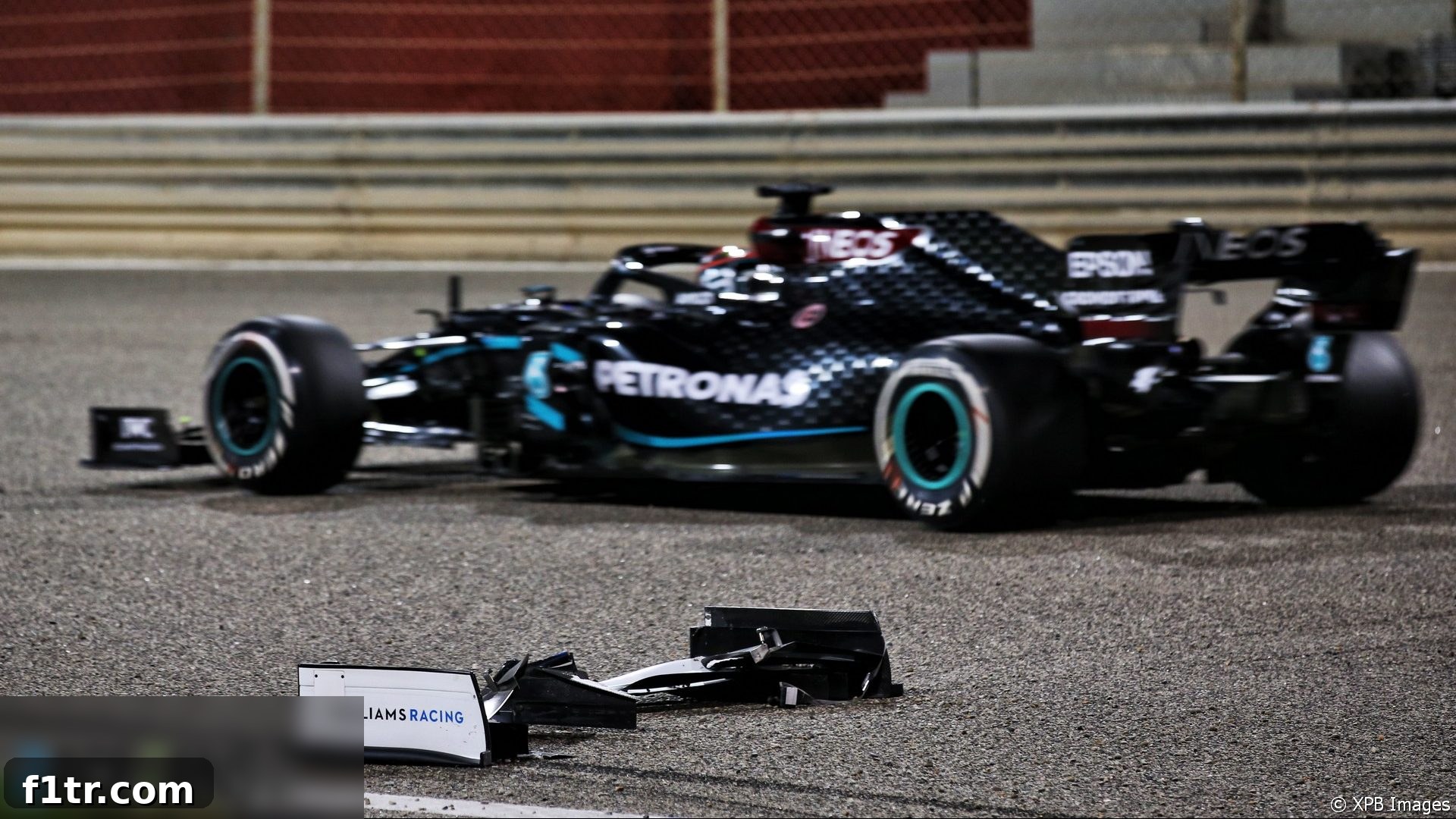
In the high-octane world of Formula 1, moments of triumph and despair often hang by the slimmest of margins. Few instances encapsulate this more acutely than George Russell’s heart-wrenching experience at the Sakhir Grand Prix. Filling in for the reigning world champion Lewis Hamilton, Russell was on the verge of a sensational debut victory with Mercedes, having dominated much of the race. Yet, a pit stop blunder, initiated just two seconds before a potential pass, brutally snatched away his glory, transforming a dream into a nightmare for the young Briton.
Advert | Become a Supporter & go ad-free
George Russell’s Dominant Debut and the Looming Shadow of the Safety Car
The 2020 Sakhir Grand Prix, held on Bahrain’s unique Outer Circuit, presented a rare opportunity for George Russell. Thrust into the formidable Mercedes-AMG Petronas F1 Team car as a stand-in for the unwell Lewis Hamilton, Russell wasted no time in showcasing his immense talent. From the moment the lights went out, he asserted his dominance, leading virtually every lap and demonstrating a pace that belied his rookie status in a front-running car. His command over the W11 chassis was absolute, turning what many expected to be a solid performance into a potential historic victory. He and teammate Valtteri Bottas had established a comfortable one-two, seemingly destined for a Mercedes procession.
However, the unpredictable nature of motorsport often dictates that no lead is truly safe. On lap 62, the race took an unexpected turn with the deployment of the Safety Car. This was triggered by a seemingly innocuous incident involving Jack Aitken, coincidentally Russell’s replacement at Williams, who spun and made contact with the barrier at the final corner. Initially, a Virtual Safety Car (VSC) was declared to allow for the safe retrieval of Aitken’s dislodged front wing. But the tight, 3.5-kilometer Bahrain Outer circuit, combined with the close proximity of the cars, quickly made race control realize that a VSC period would not provide sufficient time for marshals to safely clear the track.
The imperative to prioritize marshal safety, a concern heightened by recent near-misses in other races, led to a swift decision: a full Safety Car deployment. This call came at the most inopportune moment for Mercedes and Russell, just as he was exiting the final corner with the pit lane entrance looming large. Mercedes, renowned for its meticulous strategizing, suddenly faced an incredibly tight window for decision-making.
A Crucial Decision and the “Smoking Gun” Error
In the heat of the moment, with the Safety Car deployment confirmed just five seconds before he reached the pit entry line, Russell’s own presence of mind ironically played a role in the unfolding disaster. He questioned his team, asking “Staying out?”, but was repeatedly instructed to “Box, box.” The decision to pit was confirmed with a mere two seconds to spare. Russell, known for his acute strategic awareness even during his time at Williams – particularly regarding the benefits of pitting under a Safety Car – perceptibly decreased his pace. This quick reaction, which likely saved Mercedes precious milliseconds, ultimately facilitated the pit stop that would unravel his race.
Mercedes’ plan was to double-stack their cars, bringing both Russell and Bottas in for fresh tires. This aggressive strategy, while risky, often pays dividends in F1. However, what followed was a catastrophic breakdown in communication. Russell was sent out of the pits with two of his teammate’s front tires fitted to his car – a clear breach of Formula 1 regulations. The error became horrifyingly apparent when Bottas arrived in his pit box moments later. His crew, reaching for the medium compound front tires destined for his car, discovered they were missing, already having been incorrectly fitted to Russell’s W11.
The team, in a frantic effort to minimize Bottas’s time loss, hastily re-fitted his old hard tires, sending him back out onto the track. But the damage was done. Russell was immediately summoned back into the pits for a second stop, where his correct set of tires was finally fitted. His lead, and hopes of victory, had evaporated.
The Radio System Failure: A Deeper Look
In the aftermath, Mercedes swiftly identified the “smoking gun” – not a faulty wheel gun, but a fundamental flaw in their radio communication system. Andrew Shovlin, Mercedes’ trackside engineering director, explained the technical glitch. The core issue lay in how the system prioritizes messages, especially during high-pressure, simultaneous communications.
The FIA’s investigation corroborated Mercedes’ findings, noting, “Car 63 [Russell] was fitted with front tyres that were allocated to car 77 [Bottas]. This was caused by a radio communications technical issue wherein the pit wall’s communication to the pit crew that car 63 was entering the pits prior to (and not after) car 77, failed to be received by the crew of car 63 because at the same time, the driver of car 63 transmitted over the top of that message.”
Ron Meadows, the team’s sporting director, had given the instruction to prepare Russell’s tires. However, due to a delay in the radio system and Russell’s simultaneous transmission, Meadows’ critical message was not fully received by all members of the pit crew. Shovlin elaborated, “There were a number of broadcasts at that time on the radio system. The system knows to prioritise the messages coming from Ron because the most important thing is the tyres are there, more so than whatever a driver says or whatever someone else in the crew might say. But it looks like there is a period whereby the system is deciding to let the prioritised message through and we missed a key bit of the broadcast such that half of the tyre collectors didn’t get the message and it looks like half of them did.” This partial reception meant chaos: some crew members were ready for Russell, others were still preparing for Bottas, leading to the disastrous mix-up.
The On-Track Drama and Frustration
The immediate consequences of the pit stop error were devastating. Russell, after his second pit stop, found himself relegated down the order. His radio communications revealed his growing disbelief and frustration as he tried to ascertain his position and the status of his competitors:
| To Russell | VSC, VSC, keep the delta positive. |
| To Russell | So we’ll have HPP default 35, three-five, on. |
| To Russell | So you’re doing a good job on the delta. |
| To Russell | Exiting last corner Safety Car, Safety Car. |
| Russell | Staying out? |
| To Russell | Box box, box box. |
| To Russell | He leaves pits So keep the delta positive on exit. |
The confusion was palpable. Russell’s initial inquiry about staying out, followed by the urgent instruction to box, highlighted the razor-thin margins and the frantic decision-making under pressure. His subsequent radio exchanges paint a vivid picture of a driver grappling with the sudden reversal of fortune:
| To Russell | OK George we’re going to have to box, box. We have a mixed tyre set on the car. We should be OK, so let’s just come into the pits again, we’ll change the tyres. |
| Russell | I box yeah? |
| To Russell | So box, box. |
| To Russell | He leaves pits So you are pushing down to the Safety Car line. |
| To Russell | So you are pushing to catch the Safety Car. |
| Russell | Is Valtteri ahead of us? |
| To Russell | Affirm, Valtteri is ahead of us. He is still on the hard tyre, 14-lap-old hard tyre. |
| Russell | Are we in P2 like this? |
| To Russell | Currently P5. All cars ahead are on old tyres. |
| Russell | Laps remaining? |
| To Russell | Laps remaining 24, two-four. |
| To Russell | So let’s have magic on. And we’ve just got a bit on front discs. |
| To Russell | So we should have good pace with the new tyre set, all not lost. |
| Russell | Struggling to cope with this disc. |
| To Russell | It should come back, don’t stress about it too much. |
| Russell | Who are the cars ahead? |
| To Russell | So lapped cars are going to be overtaking so just stay on-line. |
| To Russell | Lapped cars are coming past. The order is Perez P1, Ocon then Stroll, Valtteri and yourself. |
| Russell | How old are their tyres? |
| To Russell | Perez 17-lap-old hard, Ocon 23-lap hard, Stroll 22-lap medium, Valtteri 15-lap medium. |
| To Russell | Correction, Valtteri 15-lap old hard tyre. |
| To Russell | So this should be a big tyre advantage. |
| Russell | I bloody hope so. |
Advert | Become a RaceFans supporter andgo ad-free
Valtteri Bottas, though not suffering a double stop, also expressed his bewilderment and frustration over the sudden change in strategy and the implications for his race:
| To Bottas | After pit entry. VSC, VSC, keep the delta positive. Target plus two. Don’t think it will last very long. Let me know if you ran over any debris. |
| Bottas | I think we’re good. |
| To Bottas | Copy, we’ll keep an eye on the pressures. |
| To Bottas | So keep temperature in the tyres. |
| To Bottas | Yellow in turn 10, 11. |
| To Bottas | Two voices Safety Car, Safety Car. Box box box. Keep delta positive. Gap to George 4.2. Gap to George five seconds. |
| To Bottas | He enters the pit box. We have plenty of time. |
| To Bottas | He leaves the pit box. Careful on the brakes. |
| Bottas | What are these tyres? |
| To Bottas | You are back on the hard tyres, the old tyres back on, so just pushing from exit to Safety Car line. |
| Bottas | Say again which tyre set is this? |
| To Bottas | So Valtteri I think we have hard tyres, the tyres you were on, you have them back on the car. |
| Bottas | Why? |
| To Bottas | We’ll discuss that later on. |
| Bottas | What the fuck was that? |
| To Bottas | So just staying out, staying out. |
| To Bottas | So George is back in, there was a mix-up on the tyres. We lost some positions so we are pushing, push push to the exit. |
| To Bottas | So now follow the delta again… now we don’t need to follow the delta any more, you’re good. |
| To Bottas | So you got the position on George now, they stopped again. He’s on new mediums, we’re on hards. Perez current leader, Ocon P2, both on old hard tyres, 16 laps for Perez, 22 for Ocon, and then Stroll, 21-lap-old medium, then yourself, 14-lap hard. |
Hindsight, Philosophy, and a “Colossal F***-up”
Adding a layer of cruel irony to the already painful outcome, Mercedes later admitted that neither driver actually needed to pit during that Safety Car period. Andrew Shovlin reflected on this with the benefit of hindsight: “We could have gone to the end of the race… if we’d stayed out, if we’d avoided the issue, that would have been brilliant.” However, he stressed that a racing team cannot be paralyzed by fear of making strategic calls under pressure. “As a racing team you can’t be afraid of doing a pit stop… we do hundreds of these in races under pressure, double stacked, all sorts of things. And they go well and the ability to do them under pressure is what often wins you races.” The focus, he reiterated, must be on the root cause of the error, not the outcome.
Shovlin revealed that this radio system fault, the true “root cause,” was not a new issue but one that had potentially lurked within their systems for years. It was, by sheer misfortune, brought to light on Russell’s highly anticipated Mercedes debut, while he was leading the race. “This is something that could have caught us out in any of the past three years. It could have caught us out at the first race next year. So it’s something that’s been there in the system and it was awfully unfortunate for the drivers and desperately unfortunate for George that we found that today.”
Mercedes team principal Toto Wolff, in his characteristic bluntness, minced no words, famously calling the error a “colossal fuck-up.” His frustration was palpable, especially considering he has previously advocated for broadcasting internal pit wall discussions to make F1 coverage more engaging. This particular incident, he might have quietly conceded, was one for which he was grateful such a feature doesn’t exist.
Advert | Become a RaceFans supporter andgo ad-free
The Enduring Impact of a Nearly Perfect Debut
Despite the crushing disappointment, George Russell’s performance at the Sakhir Grand Prix was a resounding statement of his potential. He drove with the maturity and speed of a seasoned champion, demonstrating that he belonged at the very pinnacle of the sport. While the pit stop error denied him a fairytale victory, it arguably solidified his reputation as a future star and a formidable asset to Mercedes. The experience, though bitter, provided invaluable lessons for both Russell and the Mercedes team, highlighting the relentless pursuit of perfection required to stay at the top in Formula 1.
The Sakhir Grand Prix of 2020 will forever be etched in F1 history as the race where George Russell almost achieved the impossible, only for a technical glitch and a strategic misstep to steal his moment. It serves as a stark reminder that in Formula 1, even the most dominant teams can fall prey to the smallest of errors, and that victory, until the final flag, is never truly guaranteed.
Quotes: Dieter Rencken
Join the RaceFans Supporters Drive!
If you’ve enjoyed RaceFans’ motor sport coverage during 2020, please take a moment to find out more about our Supporter Drive.
We’re aiming to welcome 3,000 new Supporters to help fund RaceFans so we can continue to produce quality, original, independent motorsport coverage. Here’s what we’re asking for and why – and how you can sign up:
- Join the RaceFans Supporters Drive!
2020 Sakhir Grand Prix
- Leclerc will choose his fights better to avoid more “silly” first-lap crashes
- 2020 Bahrain and Sakhir Grand Prix Star Performers
- Sakhir performance risked making me look a fool, admits Bottas
- Perez makes his case for 2021 chance with masterful recovery drive for first win
- Perez breaks Webber’s record with 190-race wait for first win
Browse all 2020 Sakhir Grand Prix articles