Charles Leclerc’s astonishing late-race charge saw him snatch the fastest lap and an invaluable bonus point at the 2019 Azerbaijan Grand Prix, a feat accomplished on the soft C4 compound tyres. However, this blistering performance on worn softs was a stark contrast to the experience of most other drivers, who found the C4 rubber to be a challenging companion on the unforgiving Baku City Circuit throughout the race weekend. The strategic complexities of tyre management proved to be a defining factor in this thrilling contest, as teams grappled with rapid degradation and the quest for optimal performance.
Advert | Become a Supporter & go ad-free
The Baku City Circuit, renowned for its unique blend of high-speed straights and incredibly tight, intricate sections, places immense demands on Pirelli’s Formula 1 tyres. Early in the 2019 Azerbaijan Grand Prix, drivers who commenced their race on the softer C4 compound quickly discovered its propensity for rapid degradation. This led to a significant drop-off in performance, forcing many into earlier-than-anticipated pit stops or struggling with a distinct lack of grip. Yet, Leclerc, despite a qualifying crash that necessitated starting on a fresh set of C3 medium tyres, cleverly circumvented this initial challenge. His unique tyre allocation, a direct consequence of damaging his Q2 set, allowed him a different strategic pathway from the outset.
Leclerc’s inherent speed and the strategic advantage of his medium tyres became apparent very early in the race. By lap five, when he momentarily found himself in clear air, his lap times instantly matched those of the race-leading Mercedes cars. More remarkably, he was a staggering 1.3 seconds faster than his Ferrari teammate, Sebastian Vettel, who was then running on the struggling soft tyres. This stark contrast highlighted the precarious nature of the C4 compound in the early stages and Leclerc’s exceptional ability to extract performance from his mediums.
The challenges faced by drivers on the softs were vividly encapsulated by Vettel’s candid post-race admission to his team: “Sorry for the beginning, but I was shitting myself a little bit around here, I had no grip.” This honest reflection underscored the difficulties many experienced, demonstrating how a lack of tyre adhesion could severely compromise a driver’s confidence and pace on such a high-stakes street circuit. As the race progressed, Leclerc continued his impressive ascent, effortlessly moving past Max Verstappen’s Red Bull. From lap seven to lap 12, the Ferrari driver consistently clocked the fastest laps on track, further solidifying his strategic advantage before his teammate finally transitioned to the more durable medium tyres.
Once both Ferrari and Red Bull drivers had settled onto the C3 medium compound, the strategic battle intensified. While the Mercedes drivers initially found a significant pace advantage on their fresh mediums, as the stint wore on, both Vettel and Verstappen demonstrated their capability to match the Silver Arrows’ lap times. This indicated that once the C3 tyres were brought into their optimal operating window, the top three teams could operate at a remarkably similar level, setting the stage for a tense strategic game of cat and mouse for the remainder of the 2019 Azerbaijan Grand Prix. The medium compound emerged as the critical tyre for sustained race performance, offering the durability and consistent pace required to navigate the challenging 51-lap race.
The predominant and most effective strategy employed by the majority of the grid was a single pit stop, transitioning from the soft C4 tyres to the more enduring C3 mediums. This approach aimed to maximize initial grip for a strong start while ensuring sufficient tyre life to reach the checkered flag without excessive degradation. A few adventurous drivers attempted a late switch to fresh softs during a Virtual Safety Car period towards the end of the race, hoping to capitalize on a short burst of speed for a final push. However, this gamble largely failed to yield any significant benefit, underscoring the limited window of effectiveness for the C4 compound, even for a short sprint. The VSC, triggered by Pierre Gasly’s retirement, offered a tempting but ultimately ill-fated opportunity for a few to deviate from the established norm.
One of the most remarkable drives of the day came from Kimi Raikkonen. Following a qualifying penalty that forced him to start from the pit lane, the veteran Finn embarked on an incredible recovery drive. Navigating through the field with characteristic precision and an astute tyre strategy, Raikkonen steadily climbed the order, ultimately securing the final championship point. His impressive performance saw him gain a total of nine positions, an unparalleled achievement among all drivers in the 2019 Azerbaijan Grand Prix, highlighting his enduring skill and the potential for strategic gains even from the very back of the pack.
Advert | Become a RaceFans supporter andgo ad-free
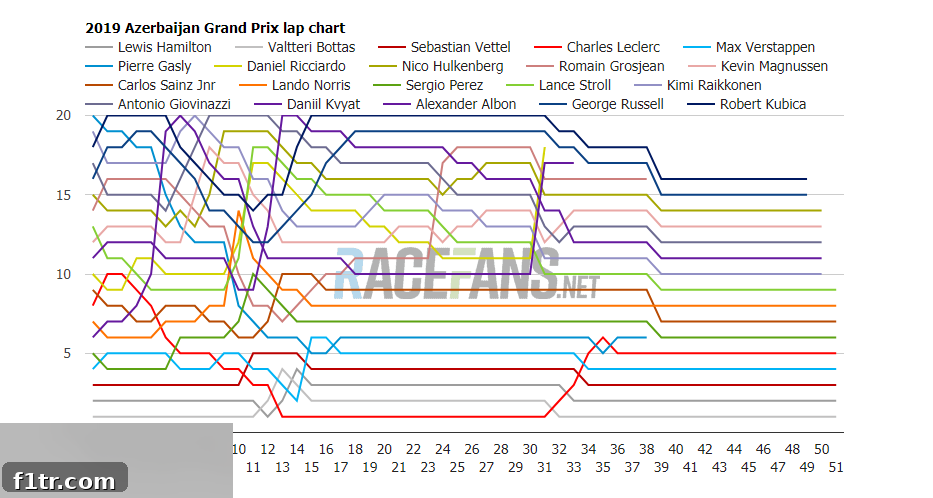
2019 Azerbaijan Grand Prix Lap Chart Analysis
Understanding the ebb and flow of a Formula 1 race is often best visualised through a lap chart, which meticulously plots the position of each driver on every single lap. The 2019 Azerbaijan Grand Prix lap chart, for instance, would vividly illustrate the early struggles of those on soft tyres, Charles Leclerc’s rapid climb through the field, and the consistent dominance of the Mercedes duo. It would also highlight the strategic moments, such as pit stops, and how they reshaped the order. Viewers can click on a driver’s name to isolate their trajectory, gaining insights into their individual race progression and strategic decisions. Right-clicking would reset the view, allowing for further exploration of different battles and overtakes throughout the race.
Go ad-free for just £1 per month>> Find out more and sign up
2019 Azerbaijan Grand Prix Race Chart Insights
Beyond simple position changes, the race chart provides a deeper layer of analysis by illustrating the gaps between each driver relative to the leader’s average lap time. This dynamic visualization is crucial for understanding true race pace, strategic pace management, and how effectively drivers could close or extend gaps. For the 2019 Azerbaijan Grand Prix, such a chart would reveal how Mercedes maintained their lead, the periods when Ferrari and Red Bull were able to match or even surpass their pace, and how tyre degradation impacted overall race rhythm. Large gaps, often indicative of significant incidents, pit stops, or retirements, are typically omitted for clarity, allowing focus on the competitive battles. Users can scroll to zoom in on specific periods, drag to pan across the entire race, and right-click to reset, offering an interactive way to dissect the strategic nuances of the Baku race.
Position Change: A Detailed Look at Overtakes and Strategic Gains
The “Position Change” table offers a fascinating statistical snapshot of how each driver navigated the challenging Baku City Circuit, highlighting their ability to gain or lose ground from their starting grid slot. This data is invaluable for assessing not just individual performance but also the effectiveness of team strategies and the impact of race incidents. For the 2019 Azerbaijan Grand Prix, the table reveals Kimi Raikkonen’s exceptional recovery, having started from 19th and gaining a remarkable nine positions to finish in the points. Other notable movers include Lance Stroll, who advanced four places, and Charles Leclerc, who, despite an initial minor setback on lap one, ultimately improved by three positions from his P8 start. Conversely, some drivers like Max Verstappen, Lewis Hamilton, and Valtteri Bottas maintained their positions, reflecting their strong qualifying and consistent race pace at the front of the field. This table provides a quick, clear overview of who made the most of their opportunities and who struggled to maintain their initial standing.
| Driver | Start position | Lap one position change | Race position change |
|---|---|---|---|
| Lewis Hamilton | 2 | 0 | 0 |
| Valtteri Bottas | 1 | 0 | 0 |
| Sebastian Vettel | 3 | 0 | 0 |
| Charles Leclerc | 8 | -2 | 3 |
| Max Verstappen | 4 | -1 | 0 |
| Pierre Gasly | 20 | 1 | |
| Daniel Ricciardo | 10 | 1 | |
| Nico Hulkenberg | 15 | 1 | 1 |
| Romain Grosjean | 14 | -2 | |
| Kevin Magnussen | 12 | -1 | -1 |
| Carlos Sainz Jnr | 9 | 1 | 2 |
| Lando Norris | 7 | 1 | -1 |
| Sergio Perez | 5 | 1 | -1 |
| Lance Stroll | 13 | 2 | 4 |
| Kimi Raikkonen | 19 | 2 | 9 |
| Antonio Giovinazzi | 17 | 2 | 5 |
| Daniil Kvyat | 6 | -1 | |
| Alexander Albon | 11 | -1 | 0 |
| George Russell | 16 | -2 | 1 |
| Robert Kubica | 18 | -2 | 2 |
2019 Azerbaijan Grand Prix Lap Times: The Pace Battle
A comprehensive overview of all lap times provides granular insight into driver performance and strategic shifts throughout the 2019 Azerbaijan Grand Prix. This detailed data allows enthusiasts and analysts to pinpoint moments of extraordinary speed, periods of tyre degradation, or strategic pace management. By tracking individual lap times, one can observe when drivers pushed hard, when they were conserving tyres, and the effectiveness of their pit stops. The interactive chart, for instance, would allow comparison of drivers side-by-side, revealing how Charles Leclerc managed his mediums for an extended first stint before unleashing his record-breaking fastest lap on fresh softs at the very end. The exclusion of very slow laps ensures that only truly representative racing pace is considered, offering a clear picture of the competitive landscape. This tool is invaluable for dissecting the strategic ballet of a Formula 1 race.
Go ad-free for just £1 per month>> Find out more and sign up
2019 Azerbaijan Grand Prix Fastest Laps: Leclerc’s Dominance
The “Fastest Laps” table is a testament to raw pace and strategic execution, revealing which drivers were able to extract the absolute maximum performance from their machines during the 2019 Azerbaijan Grand Prix. Unsurprisingly, Charles Leclerc stands at the top of this list, clocking an incredible 1’43.009 on lap 50, a performance that not only secured him the bonus point but also underscored his exceptional pace, particularly on fresh soft tyres in the dying moments of the race. This lap was over a second faster than the second-placed Valtteri Bottas, and significantly quicker than his teammate Sebastian Vettel. It highlights Ferrari’s underlying speed at Baku, even if race circumstances prevented them from contending for victory. The table also showcases the competitive efforts of other top drivers, with both Mercedes drivers, Bottas and Hamilton, and Max Verstappen all featuring prominently, demonstrating their ability to push their cars to the limit. The “On lap” column provides crucial context, showing whether these blistering times were set early, mid-race, or as a late strategic push.
| Rank | Driver | Car | Fastest lap | Gap | On lap |
|---|---|---|---|---|---|
| 1 | Charles Leclerc | Ferrari | 1’43.009 | 50 | |
| 2 | Valtteri Bottas | Mercedes | 1’44.024 | 1.015 | 50 |
| 3 | Lewis Hamilton | Mercedes | 1’44.166 | 1.157 | 48 |
| 4 | Sebastian Vettel | Ferrari | 1’44.629 | 1.620 | 46 |
| 5 | Max Verstappen | Red Bull-Honda | 1’44.794 | 1.785 | 39 |
| 6 | Lando Norris | McLaren-Renault | 1’45.394 | 2.385 | 43 |
| 7 | Sergio Perez | Racing Point-Mercedes | 1’45.524 | 2.515 | 49 |
| 8 | Pierre Gasly | Red Bull-Honda | 1’45.712 | 2.703 | 34 |
| 9 | Alexander Albon | Toro Rosso-Honda | 1’45.754 | 2.745 | 49 |
| 10 | Carlos Sainz Jnr | McLaren-Renault | 1’45.807 | 2.798 | 43 |
| 11 | Antonio Giovinazzi | Alfa Romeo-Ferrari | 1’45.969 | 2.960 | Set on 2 laps |
| 12 | Lance Stroll | Racing Point-Mercedes | 1’46.009 | 3.000 | 38 |
| 13 | Kimi Raikkonen | Alfa Romeo-Ferrari | 1’46.479 | 3.470 | 48 |
| 14 | Kevin Magnussen | Haas-Ferrari | 1’46.682 | 3.673 | 42 |
| 15 | Daniel Ricciardo | Renault | 1’46.767 | 3.758 | 29 |
| 16 | George Russell | Williams-Mercedes | 1’47.251 | 4.242 | 42 |
| 17 | Nico Hulkenberg | Renault | 1’47.407 | 4.398 | 43 |
| 18 | Daniil Kvyat | Toro Rosso-Honda | 1’47.681 | 4.672 | 28 |
| 19 | Robert Kubica | Williams-Mercedes | 1’47.709 | 4.700 | 45 |
| 20 | Romain Grosjean | Haas-Ferrari | 1’48.517 | 5.508 | 33 |
Advert | Become a RaceFans supporter andgo ad-free
2019 Azerbaijan Grand Prix Tyre Strategies: A Battle of Compounds
The strategic deployment of tyre compounds is often the cornerstone of Formula 1 success, and the 2019 Azerbaijan Grand Prix was no exception. This detailed table outlines the tyre strategies employed by each driver, providing critical insights into how teams approached the challenging Baku circuit. The most common strategy, as observed, was a C4 (soft) to C3 (medium) one-stopper, a choice made by front-runners like Valtteri Bottas, Lewis Hamilton, and Sebastian Vettel. This underlined the belief that the C3 medium offered the best balance of pace and durability for the majority of the race. However, Charles Leclerc’s strategy stood out: starting on C3 mediums due to his qualifying incident, he ran a remarkably long first stint before switching to softs, and then again to softs for his fastest lap attempt. This unorthodox two-stopper showcased the flexibility of his plan. Other interesting variations included drivers like Lando Norris, Kevin Magnussen, and Nico Hulkenberg opting for three stints, typically involving two sets of mediums and a final stint on softs, indicating perhaps a struggle with degradation or an attempt to maximize fresh rubber late in the race. Even backmarkers like George Russell and Robert Kubica started on mediums, hinting at a more conservative approach given their car’s performance limitations. Analyzing these strategies reveals the diverse tactics employed to conquer Baku.
| Stint 1 | Stint 2 | Stint 3 | |
|---|---|---|---|
| Valtteri Bottas | C4 (12) | C3 (39) | |
| Lewis Hamilton | C4 (13) | C3 (38) | |
| Sebastian Vettel | C4 (11) | C3 (40) | |
| Max Verstappen | C4 (14) | C3 (37) | |
| Charles Leclerc | C3 (34) | C4 (13) | C4 (4) |
| Sergio Perez | C4 (10) | C3 (41) | |
| Carlos Sainz Jnr | C4 (12) | C3 (39) | |
| Lando Norris | C4 (9) | C3 (30) | C4 (12) |
| Lance Stroll | C4 (10) | C3 (41) | |
| Kimi Raikkonen | C4 (6) | C3 (44) | |
| Alexander Albon | C4 (12) | C3 (38) | |
| Antonio Giovinazzi | C4 (7) | C3 (43) | |
| Kevin Magnussen | C4 (7) | C3 (32) | C4 (11) |
| Nico Hulkenberg | C4 (8) | C3 (26) | C4 (16) |
| George Russell | C3 (25) | C3 (13) | C4 (11) |
| Robert Kubica | C3 (23) | C3 (19) | C4 (7) |
| Pierre Gasly | C3 (38) | ||
| Romain Grosjean | C3 (34) | C4 (4) | |
| Daniil Kvyat | C4 (5) | C3 (28) | |
| Daniel Ricciardo | C4 (10) | C3 (21) |
Go ad-free for just £1 per month>> Find out more and sign up
2019 Azerbaijan Grand Prix Pit Stop Times: The Crucial Seconds
In the high-stakes world of Formula 1, every millisecond counts, and nowhere is this more evident than during a pit stop. The “Pit Stop Times” table from the 2019 Azerbaijan Grand Prix meticulously records the duration of each driver’s stop, offering a fascinating glimpse into the efficiency of each team’s pit crew. Carlos Sainz Jnr of McLaren recorded the fastest stop at an impressive 19.755 seconds, closely followed by his teammate Lando Norris. These rapid turnarounds highlight McLaren’s strong operational performance in the pits, which is crucial for gaining track position or minimizing time loss. Ferrari also demonstrated strong pit work, with Charles Leclerc’s fastest stop at 19.857 seconds and Sebastian Vettel’s at 19.981 seconds, placing them within the top five. Mercedes, too, were efficient, with Lewis Hamilton and Valtteri Bottas executing stops just over 20 seconds. Analyzing these times reveals how critical well-drilled pit crews are to overall race strategy and how a few tenths of a second can make a significant difference in a tightly contested race like the 2019 Azerbaijan Grand Prix. Even Leclerc’s second stop, while slightly slower, was still competitive, demonstrating consistent team performance. Conversely, some longer stops, such as Lance Stroll’s 23.099 seconds, can be indicative of issues or more complex tyre changes, costing valuable track time.
| Driver | Team | Pit stop time | Gap | On lap | |
| 1 | Carlos Sainz Jnr | McLaren | 19.755 | 12 | |
| 2 | Lando Norris | McLaren | 19.819 | 0.064 | 9 |
| 3 | Charles Leclerc | Ferrari | 19.857 | 0.102 | 47 |
| 4 | Sebastian Vettel | Ferrari | 19.981 | 0.226 | 11 |
| 5 | Lewis Hamilton | Mercedes | 19.993 | 0.238 | 13 |
| 6 | Valtteri Bottas | Mercedes | 20.006 | 0.251 | 12 |
| 7 | Kevin Magnussen | Haas | 20.118 | 0.363 | 7 |
| 8 | Charles Leclerc | Ferrari | 20.382 | 0.627 | 34 |
| 9 | George Russell | Williams | 20.475 | 0.720 | 25 |
| 10 | Robert Kubica | Williams | 20.703 | 0.948 | 42 |
| 11 | Alexander Albon | Toro Rosso | 20.720 | 0.965 | 12 |
| 12 | George Russell | Williams | 20.751 | 0.996 | 38 |
| 13 | Antonio Giovinazzi | Alfa Romeo | 20.776 | 1.021 | 7 |
| 14 | Kevin Magnussen | Haas | 20.859 | 1.104 | 39 |
| 15 | Nico Hulkenberg | Renault | 20.870 | 1.115 | 34 |
| 16 | Daniel Ricciardo | Renault | 20.884 | 1.129 | 10 |
| 17 | Romain Grosjean | Haas | 20.906 | 1.151 | 34 |
| 18 | Sergio Perez | Racing Point | 20.939 | 1.184 | 10 |
| 19 | Max Verstappen | Red Bull | 20.973 | 1.218 | 14 |
| 20 | Daniil Kvyat | Toro Rosso | 21.013 | 1.258 | 5 |
| 21 | Robert Kubica | Williams | 21.037 | 1.282 | 23 |
| 22 | Nico Hulkenberg | Renault | 21.325 | 1.570 | 8 |
| 23 | Kimi Raikkonen | Alfa Romeo | 21.401 | 1.646 | 6 |
| 24 | Lando Norris | McLaren | 22.080 | 2.325 | 39 |
| 25 | Lance Stroll | Racing Point | 23.099 | 3.344 | 10 |
Further Reading and Insights from the 2019 Azerbaijan Grand Prix
For those eager to delve deeper into the strategic battles, standout performances, and pivotal moments that defined the 2019 Azerbaijan Grand Prix, a wealth of additional content is available. From in-depth analyses of driver performance to captivating photographic galleries and behind-the-scenes paddock diaries, these resources offer a comprehensive understanding of one of Formula 1’s most unpredictable races. Exploring these articles provides further context to the tyre strategies, pit stop timings, and the overall narrative of a Grand Prix where Charles Leclerc showcased incredible speed and Kimi Raikkonen delivered a memorable recovery drive. Discover more about the challenges faced by teams and drivers at the unique Baku City Circuit and how the race ultimately unfolded.
- Leclerc impressed by Binotto’s handling of Baku crash
- Top ten pictures from the 2019 Azerbaijan Grand Prix
- 2019 Azerbaijan Grand Prix Star Performers
- Mercedes start season with record-breaking fourth consecutive one-two
- Paddock Diary: Azerbaijan Grand Prix day four
Browse all 2019 Azerbaijan Grand Prix articles