In the high-stakes arena of Formula 1, where a mere handful of teams have historically dominated the podium, the 2021 Italian Grand Prix at Monza delivered a seismic shift, etching itself into the annals of racing history. For seven-and-a-half seasons under the V6 turbo-hybrid regulations, a staggering 170 Grands Prix had been contested. Of these, an overwhelming 167 victories had been claimed by the formidable trio of Mercedes, Red Bull, and Ferrari. The remaining three wins were anomalies, often requiring significant misfortune for the frontrunners to open a window of opportunity for other teams. Pierre Gasly’s stunning triumph for AlphaTauri at Monza a year prior, Sergio Perez’s career-defining win for Racing Point in Sakhir, and Esteban Ocon’s unexpected success for Alpine in Hungary all fit this narrative.
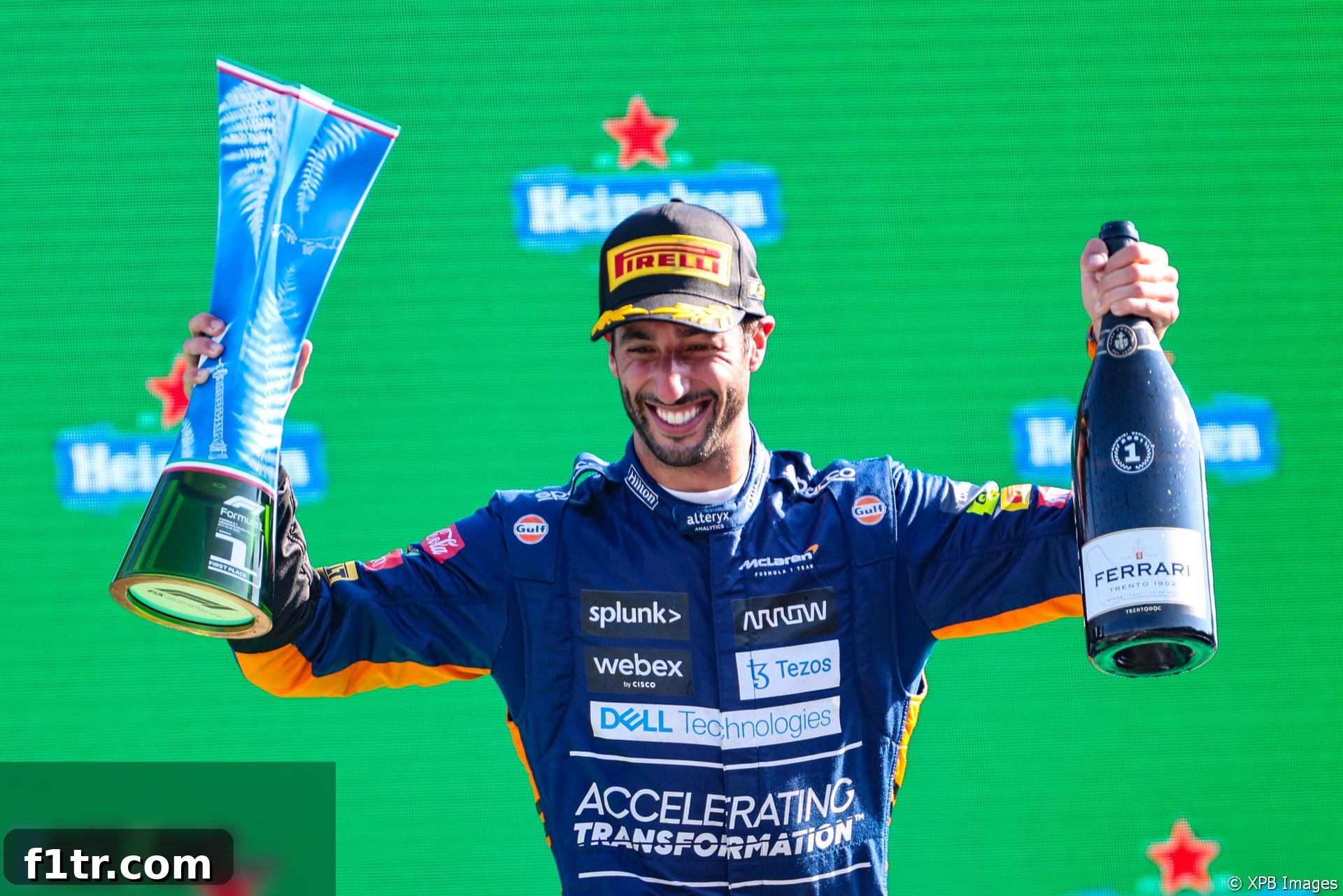
However, what unfolded on that fateful Sunday at the 2021 Italian Grand Prix was different. Daniel Ricciardo, leading a rejuvenated McLaren, crossed the finish line ahead of his teammate Lando Norris, not only ending McLaren’s longest win drought in their illustrious history but arguably becoming the first manufacturer outside the traditional ‘big three’ to achieve victory on pure, unadulterated pace. This was more than just a win; it was a powerful statement of intent and a testament to McLaren’s resurgence.
Advert | Become a Supporter & go ad-free
While the victory was a monumental achievement for McLaren, a touch of good fortune certainly played its part in setting the stage. The fastest driver on the Monza circuit across Friday’s qualifying and Saturday’s sprint race, Valtteri Bottas, found himself condemned to start Sunday’s main event from the very back of the grid. Bottas, fiercely motivated after the announcement of his departure from Mercedes for 2022, had been peerless, topping Friday’s qualifying session and cruising to a dominant victory in Saturday’s sprint. Yet, what should have been a well-deserved pole position was cruelly snatched away by a series of power unit component penalties, relegating him to the rear and opening up the front row.
For the third consecutive Sunday, Max Verstappen lined up at the very front of the grid. However, his mirrors, usually filled with the familiar black silhouettes of Mercedes cars, were instead adorned with two vibrant flashes of orange. Daniel Ricciardo, looking revitalized and refocused after the summer break, had edged out his McLaren teammate Lando Norris in Saturday’s sprint to secure a front-row start – his first since the 2018 Mexican Grand Prix pole. With both his cars sandwiching the championship leader on the grid, and facing one of the longest runs to the first corner on the F1 calendar, McLaren team principal Andrea Seidl recognized the vulnerability of the championship leader at the start.
Advert | Become a RaceFans supporter andgo ad-free
“Of course, we will not try to do anything stupid,” Seidl wisely stated before the race, “but when you start from P2 and P3 here in Monza with the long run to the first corner, there’s always a chance to get a good tow and maybe be first after the first corner.” His prediction would soon prove remarkably accurate. As the lights went out, Ricciardo launched his McLaren with surgical precision. From the moment he dropped the clutch, he looked destined to reach the iconic Rettifilo chicane ahead of his former Red Bull teammate.
Ricciardo’s superior start was so pronounced that he had already established a lead even before the pit lane exit seamlessly merged with the race track. Despite the customary jostling and weaving as the field thundered down to Monza’s notoriously tight first chicane, the drivers navigated the sequence without major incident. Ricciardo emerged in the lead, with Verstappen settling into second. Lando Norris, initially in third, momentarily lost his position to Lewis Hamilton as the Mercedes swept around the outside. Hamilton then benefited from Verstappen’s slipstream through Curva Grande, positioning himself on the outside line as the pair approached the braking zone for the Roggia chicane, literally wheel-to-wheel. Their battle continued into the corner, resulting in Hamilton bouncing over the run-off kerbs – a near carbon copy of a previous incident at Imola. Norris, ever opportunistic, happily capitalized on the skirmish to reclaim his third position.
Further back in the field, more tyre-to-tyre contact unfolded. Antonio Giovinazzi ran wide at the same Roggia chicane and, upon rejoining, made contact with Carlos Sainz Jnr. The awkward tangle sent the Alfa Romeo spinning into the barrier on the left-hand side of the track, shattering its front wing. A Virtual Safety Car (VSC) was promptly deployed to clear the scattered debris. Drivers dramatically slowed along the back straight, attempting to create sufficient buffer to adhere to the mandatory time delta. However, the earlier-than-expected resumption of the race seemed to catch many front-runners off guard, creating significant gaps of over two seconds between Ricciardo, Verstappen, Norris, Hamilton, and Leclerc.
Verstappen, seizing the opportunity, rapidly closed the gap to the leader once the green flag waved, comfortably entering DRS range shortly after the system was enabled. It seemed an immediate return to the established competitive order was imminent. Yet, even with the additional speed boost on Formula 1’s fastest circuit, Verstappen found himself unable to mount a sustained challenge on Ricciardo. The McLaren driver, demonstrating impeccable pace and control, managed to fend off every advance. “It’s always the same garbage,” a frustrated Verstappen radioed to his team. “It’s impossible to get close.”
Advert | Become a RaceFans supporter andgo ad-free
“Verstappen reported overtaking is difficult,” McLaren race engineer Tom Stallard calmly informed his race-leading driver. “Okay. Keep me posted,” Ricciardo replied with characteristic coolness, his confidence unwavering. Meanwhile, Lewis Hamilton in fourth was meticulously biding his time and managing his tyres. A unique quirk of the sprint qualifying regulations had presented Hamilton and Mercedes with the rare option to start the race on hard compound rubber, and they had shrewdly exploited it. They were the only drivers in the top 10 to make this strategic choice.
With the adverse effects of ‘dirty air’ only exacerbated by Monza’s low-downforce configuration, Mercedes was content to play a patient game, aiming to gain a decisive advantage in the latter stages of the race. This was as much a ploy to give Hamilton the best possible chance to overtake Verstappen as it was to contend for the win. When the drivers’ tyre choices were revealed on the dummy grid, Charles Leclerc, positioned behind Hamilton, had remarked that the Mercedes driver’s selection of hard tyres was a “weird” choice. However, as the medium-tyred front-runners began to encounter difficulties, with visible graining forming on their rubber, Mercedes’ audacious strategy started to show its clear merits.
“The rears are sliding,” warned a concerned Verstappen, as he continued to drift in and out of DRS range of the leading McLaren. Despite the constant pressure from the Red Bull in his mirrors, Ricciardo appeared more than comfortable managing the threat. “I think there were definitely laps where I was going too slow, so then I’d pick it up and then just try to find that balance,” Ricciardo explained after the race. “There were some laps where he pushed up closer but I never really had to properly defend. So he was there, but I knew if I didn’t make a mistake, it was going to be hard for him. Unless he kind of sent a little bit of a ‘Hail Mary’, it was going to be tough for him to pass.”
The difficulties faced by Verstappen were starkly demonstrated on lap 21 when he carried too much speed into the Rettifilo chicane, forcing him to take to the escape road on the inside and costing him half a second to the leader. McLaren, anticipating Red Bull’s counter-strategy, knew that whatever they did with their pit stop, Red Bull would likely do the opposite. Thus, it came as little surprise when Verstappen inherited the lead as Ricciardo pitted for hard tyres at the end of lap 22. While it wasn’t McLaren’s quickest tyre change of the season, their prospects of retaining the lead remained strong. Ricciardo immediately proved four-tenths of a second faster on his fresh hard tyres in the middle sector compared to Verstappen on his old, grainy mediums. “My tyres are f***ed,” came Verstappen’s blunt assessment when instructed to push harder.
Any faint hope Verstappen harbored of rejoining ahead of Ricciardo after his own stop quickly vanished with a lengthy delay on his right-front tyre. When he eventually rejoined the track, he was met with a rather unwelcome sight: the rear wing of a McLaren directly ahead of him. However, it belonged not to Ricciardo, but to Lando Norris, who had also completed his pit stop. “I can see that, for f*** sake,” Verstappen retorted, clearly unimpressed. With Norris now out of the way, Hamilton found himself in the lead of the race. However, Mercedes’ immediate focus wasn’t on pushing further into the race to potentially attack Norris and Ricciardo; it was squarely on seizing the golden opportunity to leapfrog Verstappen in the championship standings.
Pitting at the end of lap 25, Hamilton’s stop was neither spectacular nor disastrous. As he rejoined the circuit, Norris skillfully slipped by to retake his position ahead of the Mercedes, with Verstappen mere meters behind. The two championship rivals, Hamilton and Verstappen, entered the braking zone for the Rettifilo chicane side-by-side, both acutely aware that whoever emerged ahead would likely leave Monza in possession of the lead of the world championship. Hamilton stubbornly held the inside line, refusing to yield. Verstappen, equally unyielding, held the outside. Contact was inevitable. The horrifying sight of Verstappen’s Red Bull bouncing into the air before crashing down on top of Hamilton’s Mercedes would instantly become one of the most iconic, albeit ugly, images of the season, if not this era of Formula 1.
As both rivals eventually extricated themselves from their wrecked cars and walked back to their respective garages, neither having scored a single point from the incident, the battle for that year’s championship appeared to have intensified to an almost unbearable degree. Whether Hamilton, Verstappen, or the ridiculously narrow and awkward Rettifilo chicane itself was predominantly to blame for the collision was a debate that would rage for weeks, long after the sport moved on to Sochi. However, for the 16 drivers still actively participating in the race, such discussions mattered little. Of far more pressing relevance to the field was the immediate deployment of the Safety Car – especially for the seven drivers who had yet to make their mandatory pit stops. Suddenly, McLaren realized their hard-earned lead was under very real threat for the first time.
“So, Leclerc is in our Safety Car window, Daniel,” Stallard warned his driver. “You need to minimize the lines and have the delta close to zero.” Leclerc immediately pitted from the lead, but McLaren could finally breathe a deep sigh of relief when he rejoined behind Ricciardo in second place. A crucial five-second difference had been just enough to allow Ricciardo to retain the net lead. Ricciardo and Leclerc were followed in the Safety Car train by Norris, Sergio Perez, Carlos Sainz Jnr, and Valtteri Bottas – the latter three having all made their stops during the safety car period.
With virtually all cars in the top 10, bar Bottas, now on fresh hard tyres, the second half of the race was poised to be a furious sprint to the finish line. Yet, no one felt more confident about their chances of victory than the leader, Daniel Ricciardo. “When we came back out in the lead, I was like ‘all right, we’ve got this today’,” Ricciardo recounted after the race. “‘Unless something unfortunate happens, we can really win this race.'” Once the remains of the championship rivals’ vehicles were safely removed, the race dramatically restarted at the end of the 30th lap. Ricciardo immediately focused on breaking the tow to Leclerc behind, but the Ferrari driver was more preoccupied with the McLaren in his mirrors than the one in front.
Maximizing his straight-line speed by pushing the track limits at the final corner, Norris bravely committed to the inside of the Ferrari into the Rettifilo chicane, but Leclerc defended robustly. However, Norris secured a far better exit and benefited immensely from a strong slipstream, courageously sticking his nose to the inside of the Ferrari as they rounded Curva Grande. Despite putting two wheels onto the grass, Norris miraculously found the space to complete the audacious move, leaping into second place and securing a McLaren one-two for the first time in over a decade. Leclerc now found himself under immense pressure from Sergio Perez in fourth and was again forced into a defensive stance approaching the Roggia chicane. Perez ventured to the outside, only to discover, as so many drivers before him, that there is barely enough room for two Formula 1 cars through that tight sequence. Perez bailed out of the corner, bouncing over the kerbs and emerging in third place. While it seemed certain the Red Bull driver would have to hand the position back to the Ferrari, Perez stubbornly remained ahead, claiming he had been forced into the maneuver.
Any opportunity Perez had to redress his illegally-gained position was complicated when Valtteri Bottas surged past the Ferrari within the very next lap. Bottas had been on an incredible charge through the field from the rear of the grid – already up to 11th place by lap 11 – and had been gifted a timely advantage with the deployment of the safety car. Now, the medium-shod Mercedes was just over three seconds behind race leader Ricciardo and appeared to be a genuine threat to McLaren’s hopes of victory. “With Bottas looking quick,” Stallard calmly explained to Ricciardo, “we think the best thing is to be as quick as you can to the end of the race and just pull a gap on these cars behind if possible.”
However, if Bottas was to challenge the McLarens, he first needed to navigate past Perez, who held third place. The Red Bull driver’s chances of a podium finish appeared all but over after the stewards slapped him with a five-second time penalty for leaving the track and gaining a lasting advantage. Nevertheless, Bottas still needed to physically overtake the Red Bull on track to have any chance of attacking the leading McLarens. As Bottas labored behind Perez, McLaren became increasingly aware that not just a race win, but a historic one-two, was now a very real possibility. The sheer magnitude of the achievement within his team’s grasp did not escape second-placed Lando Norris, even in the face of a potential first career victory.
“Do you think it’s best for us if I stay like this, stay where I am?” Norris inquired of his team, displaying remarkable team spirit. McLaren’s response was swift and decisive: “Lando, best for us, where you are. Hold position, hold position.” Bottas eventually caught up to the back of Perez on lap 43, forcing an error into the first chicane that left him momentarily exposed through Curva Grande. Bottas attempted an outside pass through the Roggia chicane and initially succeeded – but Perez, exploiting a far tighter line, gained significantly greater momentum on exit to retake the position on-track. That was as close as the Mercedes would come to dispatching the Red Bull for the remainder of the race.
As the laps meticulously ticked down, the instructions from the tense McLaren pit wall grew increasingly scarce. It had been so long since McLaren had tasted victory that many of the team’s dedicated members had never before experienced that intoxicating sensation. But perhaps the one person in the team who understood that winning feeling best was also the one currently leading the race. Daniel Ricciardo was not only staring at his eighth career victory but also his first outside of the Red Bull racing stable, and with it, profound personal vindication for daring to seek a new horizon beyond Milton Keynes three years prior.
As he exited the Alboreto corner for the final time and surged across the chequered flag, fists pumping wildly in the cockpit, Ricciardo had unequivocally ended the longest win drought endured by one of the sport’s most decorated teams. And when his teammate Lando Norris crossed the line mere seconds later, he secured McLaren their first glorious one-two finish since the 2010 Canadian Grand Prix. “Thank you, guys and girls,” Ricciardo radioed, savoring the familiar, cherished feeling. “F***ing dominated.” And dominate he had. From seizing the lead at the very start, Ricciardo was never genuinely forced to defend his position on the circuit, dictating his own impeccable pace as required. Underlining his supreme control, he even set the fastest lap on his final tour of the afternoon – a remarkable turnaround for a driver who had, for much of the first half of the season, been consistently out-performed by his younger teammate.
“Everyone’s been aware of some of the struggles that I’ve had this year,” Ricciardo reflected afterwards. “I think to come back from that – not only to win, but as a team to get a one-two – I don’t know, it’s just crazy.” As a home-grown McLaren talent, Norris demonstrated incredible maturity and team spirit, setting aside his personal ambitions for a maiden victory to appreciate the monumental moment for the team that had invested so much belief in him. “To be honest, I don’t know what it means to me,” said Norris, his voice reflecting a mix of awe and satisfaction. “The main thing it means to me is our resolve as a team. Whether I’m second, third, or first, I think the best thing is having that one-two for the team and securing maximum points, and it’s just such a cool feeling to be part of this.”
With Perez’s post-race penalty demoting him behind both Bottas and Leclerc, Valtteri Bottas inherited a well-deserved podium place. This served as a small but significant consolation prize after what had undeniably been his strongest race weekend of the entire season. “Overall, I did everything I could today and this weekend overall. So, for that, I’m happy,” he stated. However, even if he had managed to pass Perez on track, Bottas candidly doubted he would have been able to deny McLaren their historic one-two victory. “Honestly, they’ve been strong all weekend, and they have their strengths, especially on the straight line. Yesterday Lewis was trying everything he could but couldn’t get by, so I honestly think it was the maximum today we could reach.”
Leclerc ultimately secured a commendable fourth place for Ferrari, just ahead of Perez, who was demoted to fifth. Carlos Sainz, fortunate to avoid significant damage in his opening lap clash with Giovinazzi, finished a solid sixth – undoubtedly happy for his former McLaren teammates but also recognizing the difficult implications for his current outfit. Lance Stroll finished in seventh ahead of the evergreen Fernando Alonso, with George Russell securing his third points finish in four races in ninth, and Esteban Ocon taking the final point in tenth. As much as this Italian Grand Prix will forever be remembered for the potentially season-defining collision between the two championship protagonists, Max Verstappen and Lewis Hamilton, Daniel Ricciardo and McLaren’s truly remarkable achievement should not, and will not, be overshadowed by it. This was not just a historic victory; it was a victory secured entirely on merit, a testament to relentless hard work and strategic brilliance.
For Daniel Ricciardo, the profound poignancy of joining the hallowed list of legendary names who have won in a McLaren was certainly not lost on him. “When I think ‘McLaren’, I think of Senna,” he mused. “That’s the early memories. I’ve seen the trophies in the cabinet at the McLaren Technology Centre. And to have a winning trophy now with my name in pretty much the same cabinet is crazy.” Given McLaren’s considerable and consistent improvement over recent seasons, a trajectory that culminated in this emphatic Monza triumph, who’s to say that magnificent trophy cabinet won’t continue to expand significantly in the years to come? The papaya army had truly arrived.
Go ad-free for just £1 per month>> Find out more and sign up
2021 Italian Grand Prix Analysis
- Dissecting the Hamilton-Verstappen Collision: Who Was to Blame at Monza?
- Hamilton-Verstappen Crash Deemed ‘Racing Incident, No Danger’ by Alonso
- Hamilton Commends Stewards for ‘Setting a Precedent,’ Verstappen Expresses Disagreement
- Ricciardo’s Monza Masterclass: A Stunning Win Independent of Title Rivals’ Clash
- Understanding Verstappen’s Grid Penalty vs. Hamilton’s Silverstone Sanction
Explore All 2021 Italian Grand Prix Articles
Latest F1 Race Reviews
- Antonelli Secures Second Victory, Becomes Youngest F1 Championship Leader
- Emotional Antonelli Claims Maiden Formula 1 Victory in Chinese Grand Prix
- Russell Dominates in Melbourne, Leads Mercedes One-Two Finish
- Norris Clinches F1 Title by Two Points as Verstappen Wins Yas Marina Finale
- McLaren Strategy Error in Losail Hands Verstappen Crucial Win and Title Hope
Read All F1 Race Reviews