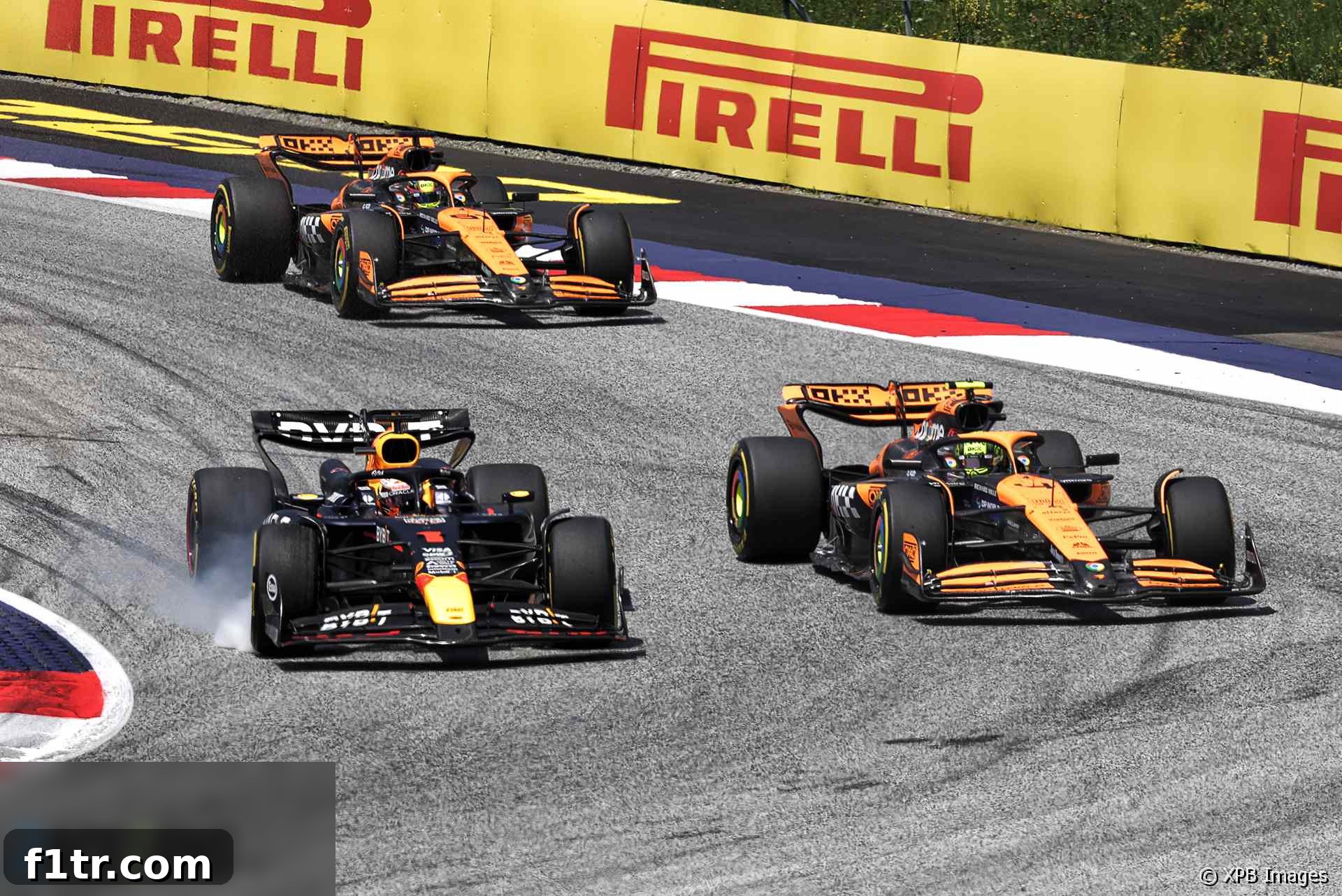
The exhilarating world of Formula 1 consistently delivers high-octane drama, and few rivalries capture the imagination quite like the burgeoning contest between Lando Norris and Max Verstappen. Following their acrimonious collision at the Austrian Grand Prix, all eyes were on their subsequent on-track encounters at Silverstone. While those battles might have lacked the raw fireworks of their Red Bull Ring clash, they underscored a fundamental truth: a captivating and potentially title-defining rivalry is rapidly taking shape between two of the sport’s brightest stars.
Advert | Become a Supporter & go ad-free
The intensity of their fight for the lead in Austria surprised many, especially given Verstappen’s clear championship lead and Norris’s status as his closest challenger. Therefore, the somewhat subdued nature of their Silverstone scraps felt almost anticlimactic. Each time they met on the legendary Hangar Straight, one driver undeniably held a pace advantage over the other. This, combined with the formidable power of the Drag Reduction System (DRS), transformed potential protracted duels into straightforward overtaking maneuvers, resembling slam-dunks rather than nail-biting wheel-to-wheel warfare. Yet, despite the lack of direct contact, the underlying tension and the promise of future confrontations remained palpable.
Indeed, the stage is set for far more dramatic chapters in this rivalry. The performance gap between Red Bull and McLaren has narrowed considerably, leading to a remarkable statistic: Verstappen and Norris have qualified in consecutive grid positions for each of the last four Grands Prix. This striking parity suggests that their battle is not merely a fleeting moment but a sustained engagement that promises to define the foreseeable future of Formula 1. The upcoming Hungarian Grand Prix, notorious for its tight, twisty layout where overtaking is an arduous task, is widely anticipated as the next potential flashpoint, a venue where strategic brilliance and aggressive racing could lead to another memorable confrontation.
The critical question looms: will Norris be better equipped to challenge his formidable rival this time around? To answer this, we turn to a driver uniquely positioned to offer insightful judgment: Daniel Ricciardo. Having spent two seasons as Norris’s teammate at McLaren and nearly three years alongside Verstappen at Red Bull, Ricciardo possesses an unparalleled understanding of both drivers’ mentalities and racing styles. His own notorious run-in with Verstappen six years ago in Baku, an incident that ultimately influenced Ricciardo’s decision to leave Red Bull at the end of that season (though he has since returned to the Red Bull family with its second team last year), lends further weight to his observations. For Ricciardo, the events of Austria provided a valuable, albeit tough, learning experience for the young McLaren driver.
In Ricciardo’s view, Max Verstappen, despite accumulating a wealth of experience and maturity over his eight years in F1, remains fundamentally the same hard-as-nails racer he was when he first burst onto the scene. “When I say he’s unchanged, I think the way he goes racing, obviously he leaves it all out on the track and that’s also what a lot of fans have admired about him,” Ricciardo commented, highlighting Verstappen’s relentless pursuit of victory. However, he quickly qualified this, adding, “But do I think he’s matured since the start of his career? Absolutely.” This maturity, according to Ricciardo, manifests not as a softening of his aggressive edges, but rather as a refinement of his formidable driving skills, allowing him to harness his raw talent with greater precision and strategic awareness.
Advert | Become a RaceFans supporter andgo ad-free
The controversial collision at the Austrian Grand Prix served as a stark reminder of Verstappen’s uncompromising style. After an enthralling multi-lap duel for the lead, the two drivers ultimately made contact. Norris was vocal in his accusations, alleging that his rival had repeatedly altered his line under braking, gained an unfair advantage by exceeding track limits, and ultimately initiated the contact that ended his race. The stewards, after deliberation, largely concurred with Norris’s assessment, imposing a 10-second time penalty on Verstappen. While this penalty ultimately had no bearing on his fifth-place finish, as Norris had already retired, the incident sparked a wider debate about racing conduct and stewarding consistency.
Adding another layer of complexity to the incident, the FIA later confirmed that Verstappen should have received an early warning during his intense skirmish with Norris, indicating that further line changes in braking zones would result in penalties. This admission highlighted the difficulties stewards face in real-time decision-making and the sometimes-conflicting interpretations of racing regulations. In the aftermath of the Austrian GP, several drivers voiced their concerns that Formula 1’s intricate rulebook has grown so convoluted that accurately judging permissible reactions in various racing scenarios has become exceedingly challenging. Ricciardo himself drew a parallel to his own collision with Alexander Albon at Suzuka, offering a candid perspective on the fine margins of on-track judgment.
“We all know when you super-slow-mo everything down and this and that, you’ll always find ‘ah maybe I moved a bit there…’,” Ricciardo explained, underscoring the impossibility of perfection at high speed. He elaborated on his Suzuka incident: “If I put myself in this situation, look at me in Japan: I look back and I gave too much room to the inside and therefore there wasn’t enough room on the outside for Albon and we crashed on lap one. If I slow-mo it all down then I’m like ‘shit, I should have left some more room, probably’.” This introspective reflection reveals the immense pressure and split-second decision-making inherent in F1. “But when it happens so quickly and you’re in the battle and it’s intense and there’s adrenaline and there’s so much going on – yes, we are paid to do this and we should be able to, most of the time, do it at a very high level but it’s so hard to be inch-perfect when there’s all these other factors,” he concluded. Ricciardo’s comments resonate with many in the paddock, emphasizing that despite their elite skills, human error and the chaotic nature of racing are unavoidable elements.
Advert | Become a RaceFans supporter andgo ad-free
Given these inherent complexities, Ricciardo suggests that such calculations become even more formidable when racing against Max Verstappen. Verstappen, he notes, consistently grants his rivals less margin than other drivers on the grid. “Max, in this situation, we know he’s a tougher racer, it’s not that we don’t trust going side-by-side with him, not at all. It’s just you know that extra inch maybe someone will give you, you probably just won’t get that. You might get the centimetre, not the inch.” This powerful metaphor perfectly encapsulates Verstappen’s uncompromising approach: he will defend his position fiercely, pushing boundaries to the absolute limit, forcing rivals to execute truly impeccable overtakes. This style, while thrilling for spectators, demands absolute precision and mental fortitude from any driver challenging him for position.
Ricciardo also drew a direct link between Norris’s experience in the Austrian Grand Prix sprint race and the main event the following day. In the sprint, Norris made a slight error, allowing Verstappen to re-pass him for the lead. Ricciardo viewed the subsequent collision in the main race as a consequence, in part, of that earlier interaction. He articulated the psychological warfare inherent in Formula 1: “No one in this sport wants to be the one that gets bullied. You want to stand your ground against everyone.” This speaks volumes about the reputations drivers build on track. “Obviously it’s your reputation as well: When people come up to you on-track, you don’t want them to think ‘oh, this guy’s going to be an easy one for me’. So you always want to have your elbows out to an extent,” he added, illustrating the aggressive mindset required to compete at the pinnacle of motorsport.
Advert | Become a RaceFans supporter andgo ad-free
Verstappen, Ricciardo asserts, has embodied this “elbows out” philosophy since his very first day in F1. “We know Max from day one has always had his out. I think just naturally, his DNA, he just is a tough racer. It’s not something he has to really dig deep for, that’s just how he races.” This innate aggression is a core component of Verstappen’s identity as a driver, making his battles predictably intense. “You know it’s kind of unconditional with him that you’re going to get a tough battle but it doesn’t necessarily change the way you do race him. You just know that you’re going to have to pull off a really good move and make sure you make it stick.” This insight highlights that while Verstappen’s aggression is a known quantity, it still requires opponents to elevate their game and execute perfectly. Ricciardo believes Norris experienced this firsthand: “I think Lando learned that on Saturday. I think he thought he probably had it done and Max said ‘no, not today’. So it’s like, you live and you learn. Obviously then Lando made some bold moves on Sunday and had his elbows out too and as I said, it’s unfortunate but I think the outcome was what it was.” The sprint race was a precursor, the main race a direct lesson in the unyielding nature of a championship contender.
For Lando Norris, with a solitary Grand Prix victory to his name compared to Verstappen’s impressive tally of 61, this journey is not just about competing, but profoundly about learning how to clinch victories and, crucially, how to overcome a reigning world champion. While Norris unequivocally maintained his belief that some of Verstappen’s defensive maneuvers crossed acceptable boundaries, he largely validated Ricciardo’s perspective that the Austrian Grand Prix had been an invaluable, albeit harsh, educational experience. “We’ve gone over things a few times,” Norris reflected. “I learned many things.” He acknowledged that while many aspects were anticipated, the reality of the battle was different: “I think a lot of stuff I was anticipating, I knew about, but it’s still different. You’re fighting against different people, you’re fighting in different ways at the top, compared to when you’re a bit further back, like we have done the last year or so.” This articulates the significant shift in mindset and strategy required when transitioning from midfield battles to championship contention. Norris concluded, “But at the same time, Max has a very different way of racing compared to a lot of others and that’s one of the reasons of why he’s a champion.” This statement is a profound acknowledgment from Norris, recognizing that Verstappen’s unique, often aggressive, approach is not a flaw but a defining characteristic of his championship-winning prowess. This experience will undoubtedly forge a stronger, more resilient Norris, ready to apply these lessons in future confrontations.
As the Formula 1 season progresses, the anticipation for the next meeting between these two exceptional drivers on track is soaring. Whether it’s the tight confines of the Hungaroring or a high-speed circuit later in the calendar, every encounter promises to be a thrilling spectacle. This rivalry, fueled by raw talent, contrasting styles, and an unyielding will to win, is quickly becoming the narrative centerpiece of the championship, promising fans unforgettable moments and potentially a new era of F1 legends duking it out for supremacy. The lessons learned in Austria will undoubtedly play a crucial role as Norris continues his quest to challenge Verstappen’s dominance, making their future battles utterly fascinating, perhaps just days away.
Advert | Become a RaceFans supporter andgo ad-free
Miss nothing from RaceFans
Get a daily email with all our latest stories – and nothing else. No marketing, no ads. Sign up here:
Formula 1
- “Overtaking is overtaking”: Domenicali denies F1’s yo-yo racing is “artificial”
- The crashes F1 is trying to prevent may be rare – but the danger is obvious
- F1 returning to India soon after 2027 sounds like wishful thinking
- Verstappen loathes F1’s new generation of cars – but what do his rivals reckon?
- The ‘throwback weekend’ is back in fashion. But it’s a flawed concept – especially for F1
Browse all Formula 1 articles