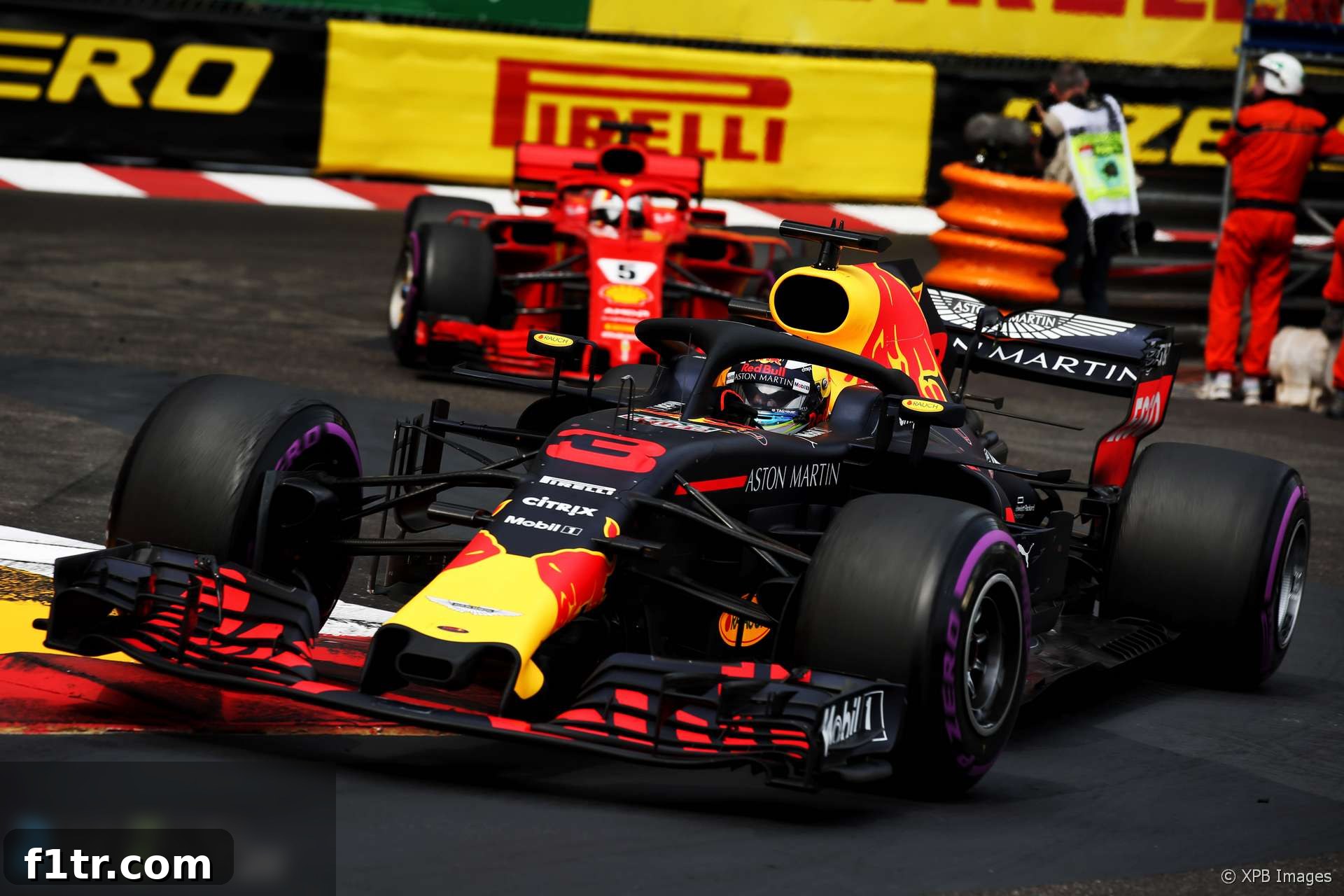
In a masterful display of skill, grit, and strategic acumen, Daniel Ricciardo conquered the iconic streets of Monte Carlo to win the 2018 Monaco Grand Prix. The Red Bull Racing driver, starting from a well-deserved pole position, navigated the legendary circuit with precision, fending off fierce challenges from Sebastian Vettel of Ferrari, despite facing a critical power unit issue for the majority of the race. This triumph marked Ricciardo’s first victory on the demanding Monaco street circuit and his second win of the enthralling 2018 Formula 1 season, etching his name into the annals of one of motorsport’s most prestigious events.
The Australian’s remarkable performance was highlighted by his ability to manage a debilitating MGU-K (Motor Generator Unit – Kinetic) failure, which significantly reduced his car’s power output. Christian Horner, Red Bull Team Principal, later confirmed the extent of the technical handicap. Yet, Ricciardo held firm, demonstrating exceptional defensive driving and tyre management to keep the charging Ferrari of Vettel at bay. Lewis Hamilton secured a respectable third place for Mercedes, followed by Kimi Räikkönen in the other Ferrari and Valtteri Bottas completing the top five for Mercedes, underlining the established hierarchy of the sport’s leading teams.
The build-up to the Monaco Grand Prix is always charged with anticipation, and 2018 was no exception. While a brief pre-race shower created a momentary flutter of excitement and speculation about a wet race, the track quickly dried, ensuring a conventional dry-weather start. However, drama unfolded even before the formation lap for Sergey Sirotkin. The Williams driver reported a critical wheelnut problem, leading to an investigation by the stewards. The team was under scrutiny for not having all wheels securely fitted to his car three minutes prior to the formation lap, an infraction that later resulted in a ten-second stop-and-go penalty, significantly hampering his race before it truly began.
As the lights went out, the start was characteristically clean for Monaco, a circuit where even the slightest misjudgment can lead to race-ending consequences. Ricciardo executed a flawless getaway from pole, maintaining his lead into Sainte Devote. Behind him, Sebastian Vettel slotted into second, followed by Lewis Hamilton and Kimi Räikkönen, all holding their grid positions. The tightly packed field snaked through the opening corners, each driver keenly aware of the narrow margins for error on the unforgiving street circuit.
Further down the field, the early laps were not without incident. Brendon Hartley of Toro Rosso reported contact with Charles Leclerc, who was racing in his home Grand Prix for Sauber. The collision resulted in minor front wing damage for Hartley, but he was able to continue without needing an immediate pit stop, a testament to the resilience of modern F1 cars and the drivers’ ability to adapt. Williams’ day continued to worsen when Lance Stroll suffered a left front puncture on his car, forcing him into an early and unscheduled pit stop. This double blow further compounded the struggling team’s challenges on one of the most demanding circuits on the calendar.
The strategic chess game began early amongst the front-runners. Lewis Hamilton was the first of the top three to blink, pitting his Mercedes on Lap 12 to switch to the ultra-soft compound tyres. He rejoined the race in sixth place, behind Esteban Ocon’s Force India, signaling Mercedes’ aggressive strategy to potentially undercut their rivals. Sebastian Vettel responded four laps later, pitting his Ferrari from second place on Lap 16. A swift stop allowed him to resume the race without losing position, successfully covering Hamilton’s move. Red Bull, known for their sharp strategic calls, immediately reacted to Vettel’s stop. Ricciardo was called into the pits on the very next lap, Lap 17. The precision of the Red Bull pit crew and Ricciardo’s perfectly timed in-lap ensured he retained the lead of the race, emerging ahead of Vettel and cementing his track position.
With Ricciardo seemingly in control out front, the race took a dramatic turn on Lap 28. The Australian suddenly reported a critical loss of power from his Red Bull. The team quickly identified the issue as an MGU-K failure, a crucial component of the hybrid power unit that recovers kinetic energy during braking and provides additional power. This sudden reduction in performance allowed Sebastian Vettel to significantly close the gap, transforming what was a comfortable lead into a nail-biting, wheel-to-wheel battle. Ricciardo’s car was now operating with approximately 25% less power, making it incredibly challenging to manage the pace and defend against the full-strength Ferrari behind him, particularly on a circuit like Monaco where engine power, though less critical than other tracks, is still vital for acceleration out of the slow corners and up the steep inclines.
Despite the immense technical handicap, Ricciardo demonstrated extraordinary composure and driving prowess. He adapted his driving style, meticulously managing his throttle application and brake balance to mitigate the power loss. The question for all the front-runners now became whether the ultra-soft compound tyres, chosen for their grip and speed, would endure the full race distance. Monaco is notoriously hard on tyres due to its continuous cornering and abrasive surface. Ricciardo, even with his power deficit, had to expertly balance preserving his tyres while simultaneously fending off Vettel, who was pushing relentlessly in pursuit of the lead. His ability to maintain his advantage and dictate a pace that, while slower, was still just enough to hold off Vettel, became the defining narrative of the Grand Prix.
The race continued to unfold with further incidents. Fernando Alonso became the first retirement on Lap 53, pulling his McLaren off at Sainte Devote. The two-time world champion reported a gearbox problem, a disappointing end to his race and a blow for McLaren’s hopes of scoring valuable points. Later, late-race drama erupted when Charles Leclerc suffered an apparent braking issue into the notorious harbour chicane. Unable to slow his Sauber sufficiently, he crashed into the back of Brendon Hartley’s Toro Rosso, bringing both cars’ races to an abrupt end. The debris and damaged cars necessitated the deployment of the Virtual Safety Car (VSC), neutralizing the race and temporarily freezing the gaps between drivers. This incident, while unfortunate for both drivers, added another layer of strategic complexity and tension to the closing stages.
When the Virtual Safety Car period ended and the race resumed, the dynamics shifted once more. Sebastian Vettel, having been running closely behind Ricciardo, appeared unable to bring his tyres back into their optimal operating window. This loss of tyre temperature and grip caused him to lose significant ground to the leading Red Bull. Ricciardo, demonstrating unwavering focus and control, comfortably held on to his position. He expertly navigated the final laps, soaking in the impending victory, as he crossed the finish line to take his inaugural Monaco Grand Prix victory to the wild delight of the Red Bull team and fans worldwide. It was a triumph against the odds, a testament to his talent and the team’s ability to manage a critical situation under immense pressure.
The final standings saw Sebastian Vettel claim a solid second place for Ferrari, a strong result despite the frustration of not converting Ricciardo’s issues into a win. Lewis Hamilton secured third for Mercedes, maintaining his championship challenge. Kimi Räikkönen and Valtteri Bottas followed, showcasing the consistent performance of Ferrari and Mercedes. Esteban Ocon delivered an impressive drive to finish sixth for Force India, ahead of Pierre Gasly in seventh for Toro Rosso, both young drivers demonstrating their potential. Nico Hülkenberg brought his Renault home in eighth, while Max Verstappen, after starting from the very back of the grid due to a practice crash and subsequent gearbox change penalty, staged a phenomenal comeback drive to finish ninth, showcasing blistering pace and exceptional overtaking skills. Carlos Sainz rounded out the top ten for Renault, ensuring both their cars finished in the points.
2018 Monaco Grand Prix: A Race of Unforgettable Drama and Heroism
The 2018 Monaco Grand Prix will forever be remembered as a race where Daniel Ricciardo truly earned the title of “King of the Streets.” His victory wasn’t merely a testament to raw speed but a showcase of supreme mental fortitude, surgical precision, and tactical genius. Overcoming a significant MGU-K failure for 50 grueling laps on the most demanding street circuit in Formula 1 is a feat that elevates this win beyond a mere statistic. It was a demonstration of a driver pushing the limits of both man and machine, extracting performance from a compromised car that few others could have achieved. The Red Bull team’s quick diagnosis and communication, combined with Ricciardo’s masterful execution, created a narrative of triumph against adversity that captivated millions globally.
This race underscored the unpredictable nature of Formula 1, especially at Monaco, where strategy, driver skill, and a touch of luck often intertwine to produce iconic moments. For Sebastian Vettel, it was a frustrating second place, a missed opportunity to capitalize on a rival’s misfortune. However, securing vital championship points in Monaco is always a valuable outcome. Lewis Hamilton’s pragmatic approach to third place also highlighted the strategic maturity of a championship contender, knowing when to push and when to consolidate. The diverse challenges of the Monaco Grand Prix, from the intense qualifying battles to the relentless physical and mental demands of the race itself, continue to make it the crown jewel of the Formula 1 calendar. Ricciardo’s victory in 2018 is a vivid reminder of why this race remains so special, celebrating not just speed, but the artistry of driving under extreme pressure.